The Editor's Mailbag
pp. 21-22 · Read in the full issue
The Robber Crab Again
Sir, —I was interested to read Solomona Kalauni’s reply ( PIM, Dec., 1968, p. 13) to Mr. Lever’s letter regarding the robber crab (Birgus latro ) which appeared in the August, 1968, PIM.
It would appear that Solomona’s contention that an uga (as we call the robber crab here) can indeed tear the husk off a nut and attain the meat inside by way of one of the “eyes” is true.
I have managed to find a reference to this in the book Wild Life in Southern Seas, by Louis Becke.
Becke states: “The oft-repeated statement that the robber crab ascends the coconut tree and there husks the nut is only a traveller’s story although, if it cannot find a fallen nut and other food be unobtainable, it will, if it can discover a short coconut tree bearing fruit, ascend it, and, nipping the stalk, let it fall. It will then descend to the ground, and proceed, not to tear off the husk, but to make a hole in the soft fleshy part of the top, and thus reach the interior.
“At the same time a full-grown robber crab, if it cannot find a young nut makes no difficulty of tearing off the husk of an old, fully matured one. Bit by bit it strips off the tough, wiry covering until the “monkey’s face” is revealed. Into the “eye” of this it inserts the tip of one of its sharp claws, and works out a space sufficiently large to at last permit it to begin operations on the hard shell with its nippers. Then
it snaps away piece after piece till the orifice is large enough to allow it to clean out the entire nut, which is left scraped of every remnant of pulp.”
Although 1 have not seen an uga dealing with a matured nut, I have seen what I believe to be evidence of this. A short distance from Solomona’s home village of Hakupu on Niue is a locality named Togo.
This is a deep extensive cleft or valley with almost perpendicular sides of jagged coral. Growing in the sandy floor of this almost inaccessible depression is a grove of coconuts.
On a visit there some time ago I noticed many small heaps of shredded coconut husk fibre and broken coco nut shells. At the time I was at a loss to account for their presence, but after reading Becke’s chapter on “Birgus the Robber” from Wild Life in Southern Seas, I now believe that what I saw was the result of the coconut crab’s attacks on matured nuts.
Solomona also mentions that he saw the crab “wrap itself completely on the nut”. By doing this I believe that the very strong claws of the crab would gain enough leverage to indeed effect an entry through the tough shell to the meat inside.
One is prompted to ask this question; Is this ability to open nuts an inate one —or does each genera tion of crabs “learn” by watching other older crabs get into the nut?
R. G. Harding.
Alofi, Niue Island
(Over)
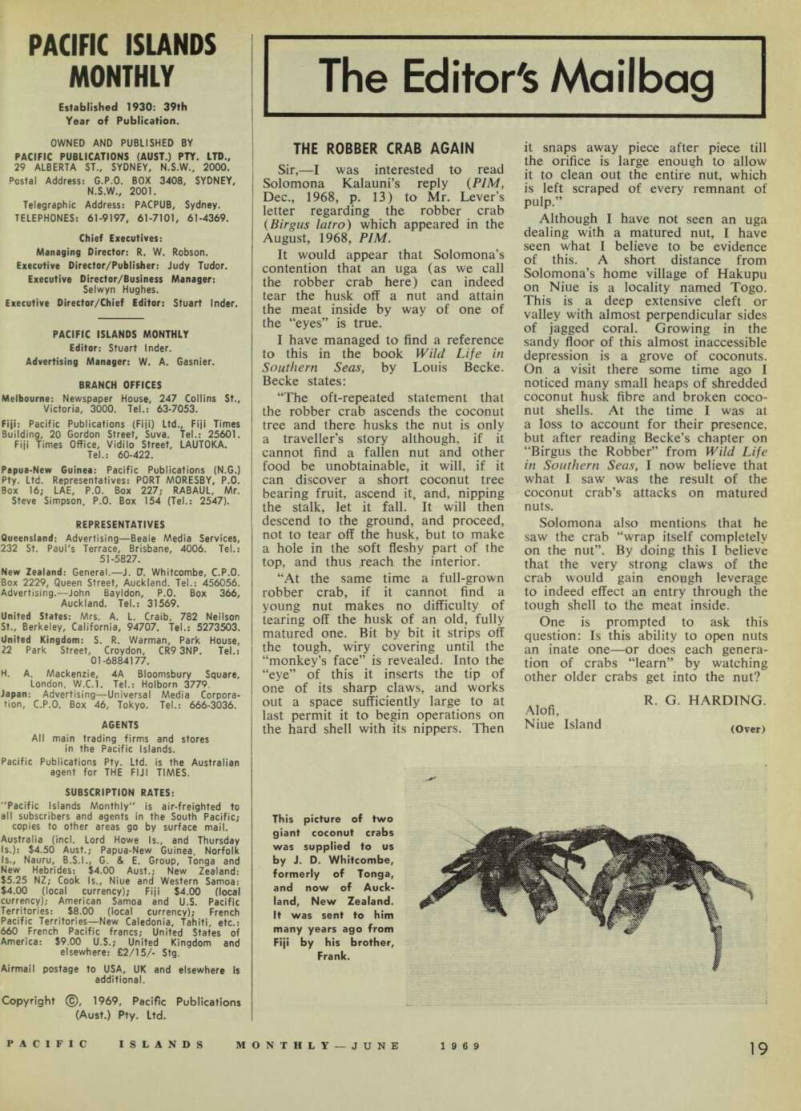
This picture of two giant coconut crabs was supplied to us by J. D. Whitcombe, formerly of Tonga, and now of Auck land, New Zealand.
It was sent to him many years ago from Fiji by his brother, Frank.
Nz Fruit Prices
Sir, —In your April issue (p. 120) you note the general manager of New Zealand Fruit Distributors considers New Zealanders aren’t keen on buy ing South Pacific bananas at 15 cents a pound. Mr. Walker says many New Zealanders now prefer to buy cheaper New Zealand pears and apples at nine-11 cents a pound.
South Pacific producers shouldn’t be misled by Mr. Walker. Firstly, pear and apple prices aren’t all that low, in major cities anyway. Prices for pears and apples rarely go below 10 cents and usually average 10-16 cents. Bananas at 15 cents are quite competitive.
Secondly, Mr. Walker failed to mention why South Pacific bananas aren’t being bought—they’re simply not available. Because New Zealand Fruit Distributors Ltd. are only in terested in the maximisation of their profits, and not the interests of the Island producers, South American bananas are now being imported.
When will South Pacific producers start seeking independent advice and marketing arrangements, and not follow meekly behind the biggest profit-seekers?
Alister Taylor.
News Communication Ltd., Wellington, New Zealand.
More About Mola
Sir, —In March PIM (p. 55) it was stated in the editorial that Glen L.
Mola is an Australian Melbourne university student who has closely identified himself with the Buka people.
Well, apart from his arithmetical inaccuracy, he is not just closely identifying himself with the Buka people. Buka Island is going to be his home as soon as he is a fully qualified medical practitioner. Glen and myself are going to have a partnership up at Buka one day— a very unusual arrangement. Such an arrangement only comes about when there is a feeling of brotherhood among people of goodwill.
Please be assured that Glen is a Buka boy true. He is no longer an Australian or a Melbournite but a Buka true. As soon as he finishes his medical course he comes home to Buka where we shall start a private practice.
Thomas L. Sawa.
Resident Medical Officer, Taurama Hospital, Port Moresby, e For more letters, turn to p. 41.