Milne Bay will soon be a place
pp. 39-44 · Read in the full issue
—not just a war relic
“The last time I was here, in 1943, it didn’t stop raining,” said the Australian Minister for Territories, Mr. Charles Barnes. And he looked with some surprise at Milne Bay’s blue skies and sunshine.
It’s unlikely that the change in the weather the Minister noted in April was anything but temporary, but in other respects he certainly visited a different Milne Bay from the one he remembered as a wartime flying officer with the RAAF 26 years ago.
The most significant change is that Milne Bay is now fast assuming an identity as a place, rather than merely the name of a district. This is due to the transfer last August of Milne Bay District headquarters from the island of Samarai to a new site called Alotau on the northern shore of Milne Bay itself.
It was to Alotau that Mr. Barnes went, 12 to 14 miles along a good dirt road (though lacking a bridge or two) from Gurney Airfield, on this eastern arm of Papua with so many wartime memories. This site of Alotau was once called Cameron’s Plateau and there was a wartime hospital nearby.
Samarai, “Jewel of the Pacific” as they once called it, lost its place as headquarters because it has long been bursting at the sides, and because it has no airstrip. Alotau has the airstrip, but it has no over seas wharf yet, and thus it is no better as headquarters than Samarai —at the moment. But it will have to get a wharf as soon as the money can be found.
Frontier town
Meanwhile, Alotau’s 2,000 citizens, a big proportion of them youngsters in the two schools, primary and high, find the cost of living is high because $8 a ton plus $5 handling charges are added to all cargo transhipped from Samarai by trawler.
One Administration officer left his car in Australia after his last leave when he found it would cost him $l6O to ship it from Melbourne to Samarai, and another $9O for the few miles from Samarai to Alotau.
In this early stage of its existence, Alotau still has something of the frontier town. Its wide “main street”
has only three general stores, owned by Dennis Young, Wesley Leo and Amdrew Chan, although Jimmy Seeto is building another. Burns Philp have applied for a block, but Steamships don’t appear to be interested. There are three bank agencies, and the Bank of NSW says it will open a branch when and if the Copra Marketing Board depot moves from Samarai.
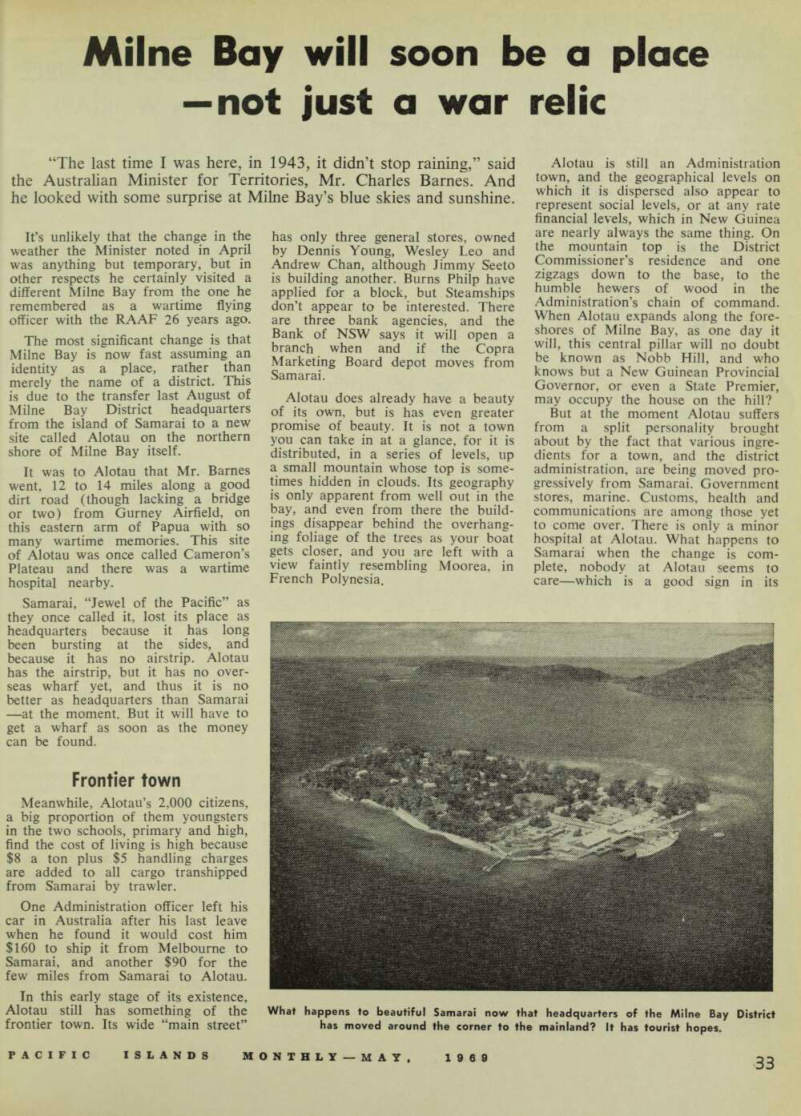
Alotau does already have a beauty of its own, but is has even greater promise of beauty. It is not a town you can take in at a glance, for it is distributed, in a series of levels, up a small mountain whose top is sometimes hidden in clouds. Its geography is only apparent from well out in the bay, and even from there the buildings disappear behind the overhanging foliage of the trees as your boat gets closer, and you are left with a view faintly resembling Moorea, in French Polynesia,
Alotau is still an Administration town, and the geographical levels on which it is dispersed also appear to represent social levels, or at any rate financial levels, which in New Guinea are nearly always the same thing. On the mountain top is the District Commissioner’s residence and one zigzags down to the base, to the humble hewers of wood in the Administration’s chain of command.
When Alotau expands along the fore shores of Milne Bay, as one day it will, this central pillar will no doubt be known as Nobb Hill, and who knows but a New Guinean Provincial Governor, or even a State Premier, may occupy the house on the hill?
But at the moment Alotau suffers from a split personality brought about by the fact that various ingre dients for a town, and the district administration, are being moved pro gressively from Samarai. Government stores, marine. Customs, health and communications are among those yet to come over. There is only a minor hospital at Alotau. What happens to Samarai when the change is com plete, nobody at Alotau seems to care—which is a good sign in its
What happens to beautiful Samara! now that headquarters of the Milne Bay District has moved around the corner to the mainland? It has tourist hopes.
Samarai may become a tourist centre
way, because it means Alotau is beginning to feel its own identity.
The chances are that Samarai will become a tourist centre, and that travellers will be sent there after first seeing Alotau. This makes sense, because the area immediately sur hounding Alotau is a better draw card than Samarai for the thousands of Australian and American ex servicemen who fought in the Milne Bay campaign. These are the men now reaching the age and the financial position that will enable them to come back along memory’s trail.
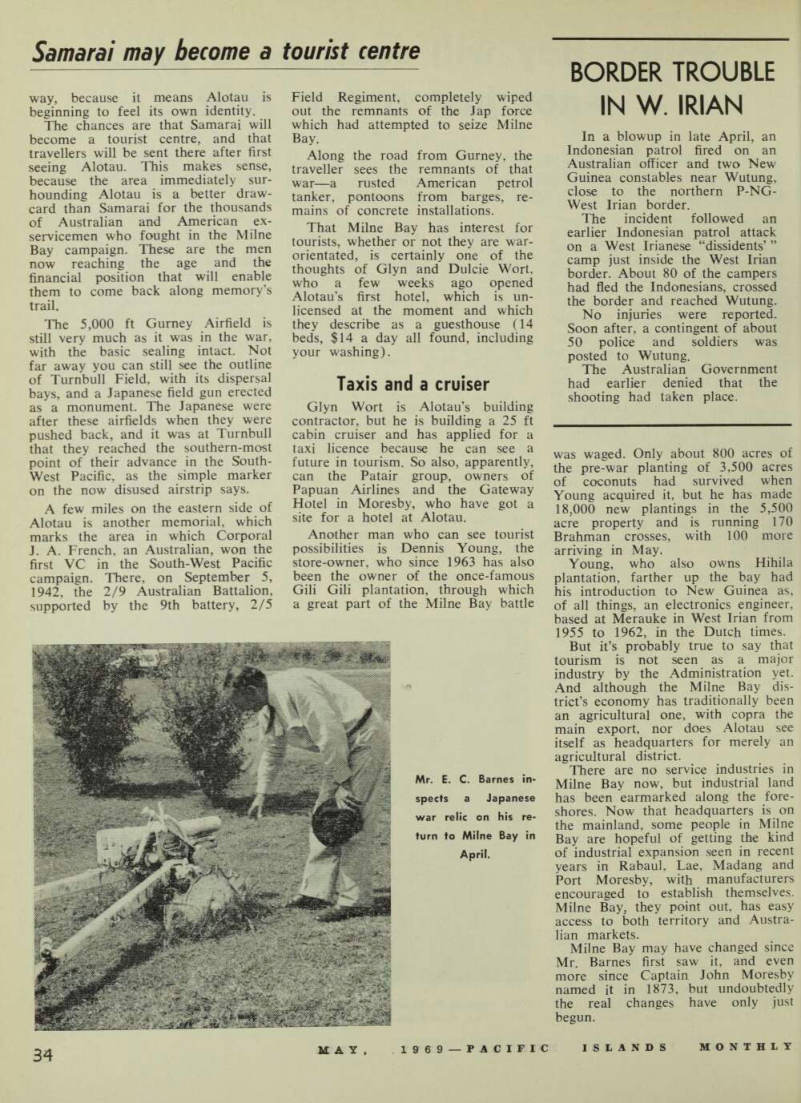
The 5,000 ft Gurney Airfield is still very much as it was in the war, with the basic sealing intact. Not far away you can still see the outline of Turnbull Field, with its dispersal bays, and a Japanese field gun erected as a monument. The Japanese were after these airfields when they were pushed back, and it was at Turnbull that they reached the southern-most point of their advance in the South- West Pacific, as the simple marker on the now disused airstrip says.
A few miles on the eastern side of Alotau is another memorial, which marks the area in which Corporal J. A. French, an Australian, won the first VC in the South-West Pacific campaign. There, on September 5, 1942, the 2/9 Australian Battalion, supported by the 9th battery, 2/5
Field Regiment, completely wiped out the remnants of the Jap force which had attempted to seize Milne Bay.
Along the road from Gurney, the traveller sees the remnants of that war—a rusted American petrol tanker, pontoons from barges, re mains of concrete installations.
That Milne Bay has interest for tourists, whether or not they are war orientated, is certainly one of the thoughts of Glyn and Dulcie Wort, who a few weeks ago opened Alotau’s first hotel, which is un licensed at the moment and which they describe as a guesthouse (14 beds, $l4 a day all found, including your washing).
Taxis and a cruiser
Glyn Wort is Alotau’s building contractor, but he is building a 25 ft cabin cruiser and has applied for a taxi licence because he can see a future in tourism. So also, apparently, can the Patair group, owners of Papuan Airlines and the Gateway Hotel in Moresby, who have got a site for a hotel at Alotau.
Another man who can see tourist possibilities is Dennis Young, the store-owner, who since 1963 has also been the owner of the once-famous Gili Gili plantation, through which a great part of the Milne Bay battle
was waged. Only about 800 acres of the pre-war planting of 3,500 acres of coconuts had survived when Young acquired it, but he has made 18,000 new plantings in the 5,500 acre property and is running 170 Brahman crosses, with 100 more arriving in May.
Young, who also owns Hihila plantation, farther up the bay had his introduction to New Guinea as, of all things, an electronics engineer, based at Merauke in West Irian from 1955 to 1962, in the Dutch times.
But it’s probably true to say that tourism is not seen as a major industry by the Administration yet.
And although the Milne Bay dis trict’s economy has traditionally been an agricultural one, with copra the main export, nor does Alotau see itself as headquarters for merely an agricultural district.
There are no service industries in Milne Bay now, but industrial land has been earmarked along the fore shores. Now that headquarters is on the mainland, some people in Milne Bay are hopeful of getting the kind of industrial expansion seen in recent years in Rabaul, Lae, Madang and Port Moresby, with manufacturers encouraged to establish themselves.
Milne Bay, they point out, has easy access to both territory and Austra lian markets.
Milne Bay may have changed since Mr. Barnes first saw it, and even more since Captain John Moresby named it in 1873. but undoubtedly the real changes have only just begun.
Mr. E. C. Barnes in spects a Japanese war relic on his re turn to Milne Bay in
April.
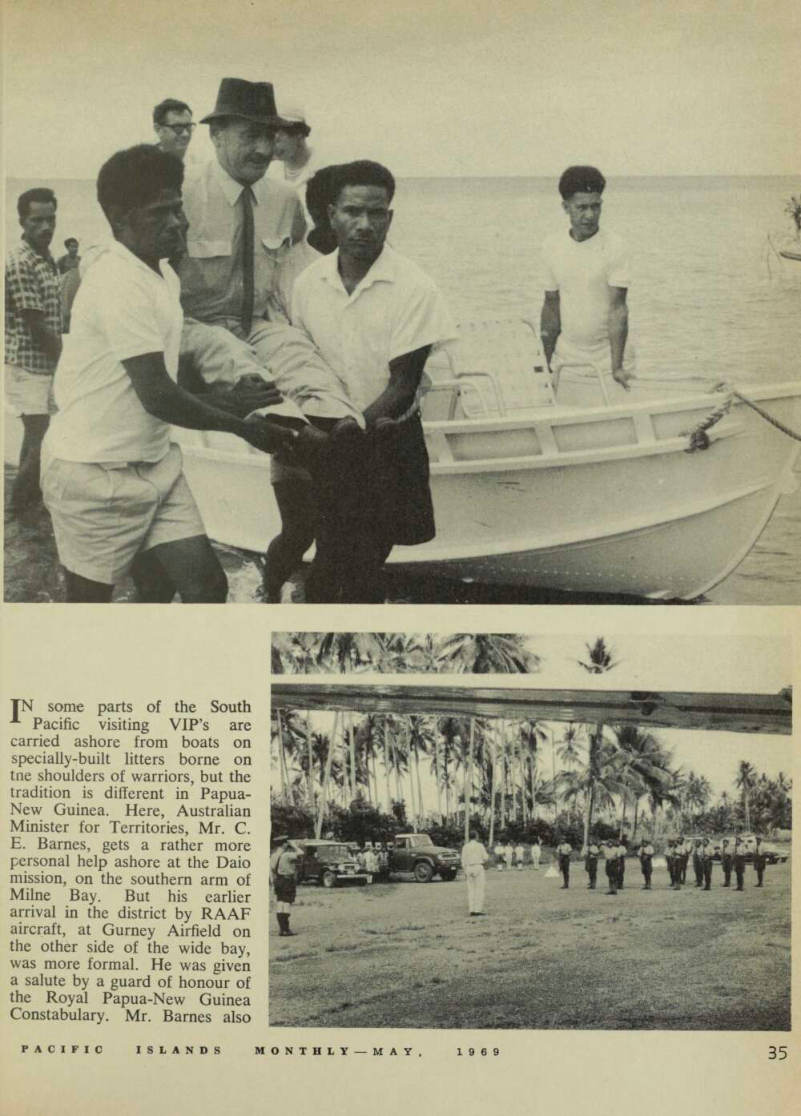
TN some parts of the South A Pacific visiting VlP’s are carried ashore from boats on specially-built litters borne on tne shoulders of warriors, but the tradition is different in Papua- New Guinea. Here, Australian Minister for Territories, Mr. C.
E. Barnes, gets a rather more personal help ashore at the Daio mission, on the southern arm of Milne Bay. But his earlier arrival in the district by RAAF aircraft, at Gurney Airfield on the other side of the wide bay, was more formal. He was given a salute by a guard of honour of the Royal Papua-New Guinea Constabulary. Mr. Barnes also
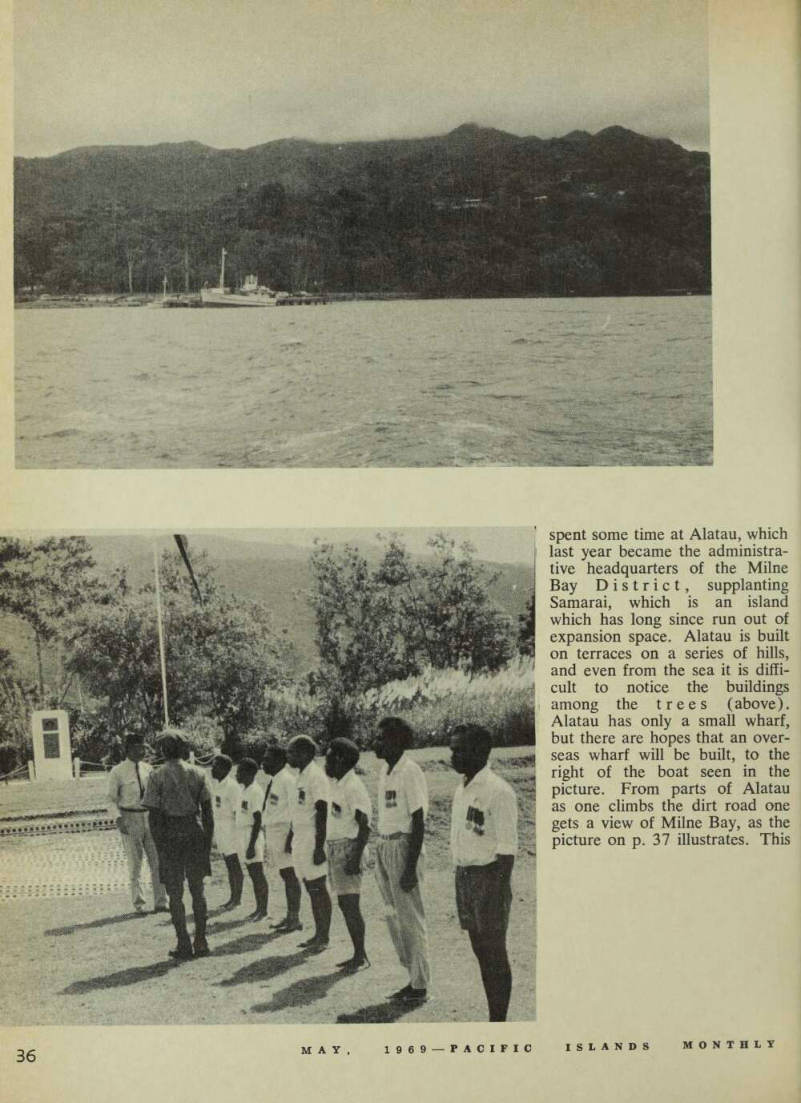
spent some time at Alatau, which last year became the administra tive headquarters of the Milne Bay District, supplanting Samarai, which is an island which has long since run out of expansion space. Alatau is built on terraces on a series of hills, and even from the sea it is diffi cult to notice the buildings among the trees (above).
Alatau has only a small wharf, but there are hopes that an over seas wharf will be built, to the right of the boat seen in the picture. From parts of Alatau as one climbs the dirt road one gets a view of Milne Bay, as the picture on p. 37 illustrates. This
one was taken on one of the higher levels of the town, with children of the integrated primary school seen playing in the dis tance. Alatau’s shopping area is, like the rest of the town, still being built and there are wide open spaces on the “main street”.
There are three general stores, one of them operated by Andrew Chan (below) formerly of Rabaul, but more are on the way. Milne Bay still very much remembers the Pacific War. On p. 36 Mr. Barnes is seen talking with native ex-servicemen who fought in New Guinea and have campaign ribbons to prove it.
They are standing on Turnbull Field, where, in the background
can be seen a monument which marks “the western-most point in Milne Bay of the Jap advance in Aug.-Sept. 1942, and also the southern-most point of the Jap advance in the S.W. Pacific”.
The inscription adds, “83 un known Jap marines lay buried here”. Later in his visit Mr.
Barnes also laid a wreath on the monument to Cpl, J. A. French,
who nearby won posthumously
the first Victoria Cross in the S.W. Pacific campaign. It’s a quiet spot, little visited now. The bridge in the picture is a wartime one, still doing sterling service at
Milne Bay.