Tropicalities
pp. 36-38 · Read in the full issue
“It’s good to be back in civilisation,” was the relieved comment from American anthropologist, Mr. Ivan Brady, when he arrived at Nausori Airport, outside Suva, with his six year-old son, Todd.
The inter-island ship Ninikoria “rescued” the pair from the tiny island of Nanumanga in the Gilbert and Ellice Islands Colony in April, after they had run out of supplies and two other ships expected to pick them up had failed to call.
Mr. Brady, 28, was studying land settlement on the island, as part of his work for a University of Oregon ■J-. , T • ♦ • His blonde wife, Janie, staying in Suva with their other son, two yearold Tye, first called the .alert after receiving the anthropologists cable saying the two ships hadn t turned U P. ...
She arranged for Fiji ship Ai Sokula to pick the pair up on its way to Tarawa, then received a cable from the Tarawa Marine Department with the news that the Ninikoria was closer and would do the job.
There was an emotional family
Great To
Be Back!
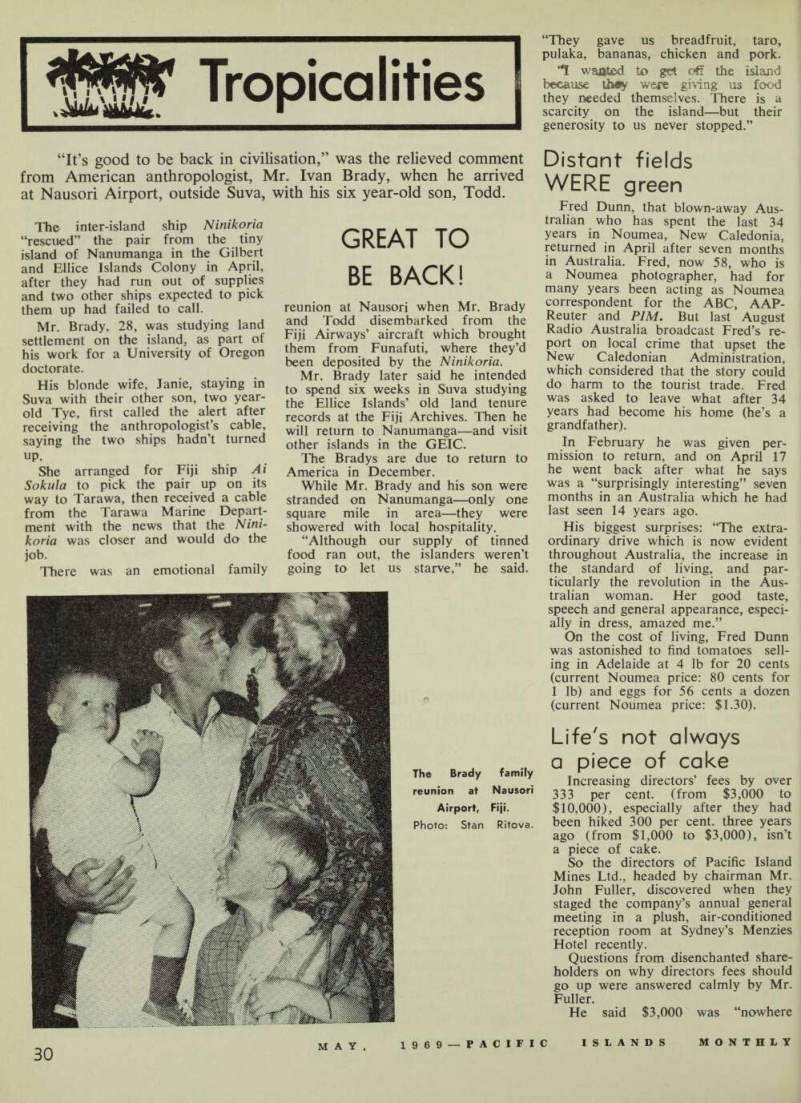
reunion at Nausori when Mr. Brady and Todd disembarked from the Fiji Airways’ aircraft which brought them from Funafuti, where they’d been deposited by the Ninikoria.
Mr. Brady later said he intended to spend six weeks in Suva studying the Ellice Islands’ old land tenure records at the Fiji Archives. Then he will return to Nanumanga—and visit other islands in the GEIC.
The Bradys are due to return to America in December.
While Mr. Brady and his son were stranded on Nanumanga—only one square mile in area—they were showered with local hospitality.
“Although our supply of tinned food ran out, the islanders weren’t going to let us starve,” he said.
“They gave us breadfruit, taro, pulaka, bananas, chicken and pork. ‘T wanted to get off the island because were giving us food they needed themselves. There is a scarcity on the island—but their generosity to us never stopped,”
Distant fields
WERE green
Fred Dunn, that blown-away Aus tralian who has spent the last 34 years in Noumea, New Caledonia, returned in April after seven months in Australia. Fred, now 58, who is a Noumea photographer, had for many years been acting as Noumea correspondent for the ABC, AAP- Reuter and PIM. But last August Radio Australia broadcast Fred’s re port on local crime that upset the New Caledonian Administration, which considered that the story could do harm to the tourist trade. Fred was asked to leave what after 34 years had become his home (he’s a grandfather).
In February he was given per mission to return, and on April 17 he went back after what he says was a “surprisingly interesting” seven months in an Australia which he had last seen 14 years ago.
His biggest surprises: “The extra ordinary drive which is now evident throughout Australia, the increase in the standard of living, and par ticularly the revolution in the Aus tralian woman. Her good taste, speech and general appearance, especi ally in dress, amazed me.”
On the cost of living, Fred Dunn was astonished to find tomatoes sell ing in Adelaide at 4 lb for 20 cents (current Noumea price: 80 cents for 1 lb) and eggs for 56 cents a dozen (current Noumea price: $1.30).
Life's not always
a piece of cake
Increasing directors’ fees by over 333 per cent, (from $3,000 to $10,000), especially after they had been hiked 300 per cent, three years ago (from $l,OOO to $3,000), isn’t a piece of cake.
So the directors of Pacific Island Mines Ltd., headed by chairman Mr.
John Fuller, discovered when they staged the company’s annual general meeting in a plush, air-conditioned reception room at Sydney’s Menzies Hotel recently.
Questions from disenchanted share holders on why directors fees should go up were answered calmly by Mr.
Fuller.
He said $3,000 was “nowhere
The Brady family reunion at Nausori Airport, Fiji.
Photo: Stan Ritova.
sufficient remuneration for the type of people” on PI Mines’ board (other directors—Messrs. L. W. Bergstrand, J. S. Bishop, F. R. Wood and J.
P. Rawson).
“We propose to appoint other directors to the board and we need to pay them properly,” Mr. Fuller said.
But how was the figure of $lO,OOO arrived at? Mr. Fuller answered this one indirectly by saying that the directors’ responsibilities were “far greater than those of a few years ago”. PI Mines’ directors were tak ing “tremendous interest” in the company.
They were all “workers” and had a “very pleasant association”, said Mr. Fuller. He added that another exploration company had recently upped directors’ fees to $29,000. He thought that was “a bit much”.
When Mr. Fuller finally put the fees proposal vote to the 50-odd shareholders present he received subdued “Yeses”.
Anyone not in favour, asked Mr.
Fuller?
From a small, elderly and red faced gentleman, wearing a well-cut suit, came the very loud cry: “Yes.
Damn robbers”.
Mr. Fuller gaped. Three of his dozing boardmen started. Everyone turned around to where the dissenter was standing, near the rear door of the room.
His protest made, a copy of PI Mines’ report and Mr. Fuller’s speech in one hand, the dissenter glared at everyone for a second and then dived out the door.
Grass roots
art of New Guinea
Pastor E. F. Hannemann left South Dakota, USA. in 1923 to be a missionary in New Guinea. In the following 33 years, as well as being a pioneer, a teacher and a translator, he also became a collector of native art.
But he wasn’t a collector in the
ordinary sense. He didn’t ship a load of native carvings back to the United States when he retired; he took a collection of designs which he had taken from spears, masks, shields, bows, bowls, canoes, headbands, necklaces, lime containers, drums and all the other decorated objects used in everyday native village life.
The best of these designs has now been published in a 56-page folio called Grass Roots Art of New Guinea. Along with the designs, Mr.
Hannemann gives a description of each, its place of origin and, usually, some indication of what the artist had in mind when he executed it.
Judy Tudor, publisher for Pacific Publications (Aust.) Pty. Ltd., which publishes the book at 5A1.35, admits she isn’t sure just quite who the book will appeal to—artists, collectors, souvenir hunters—but she says, “We liked it when we saw it, so we’ve published it”.
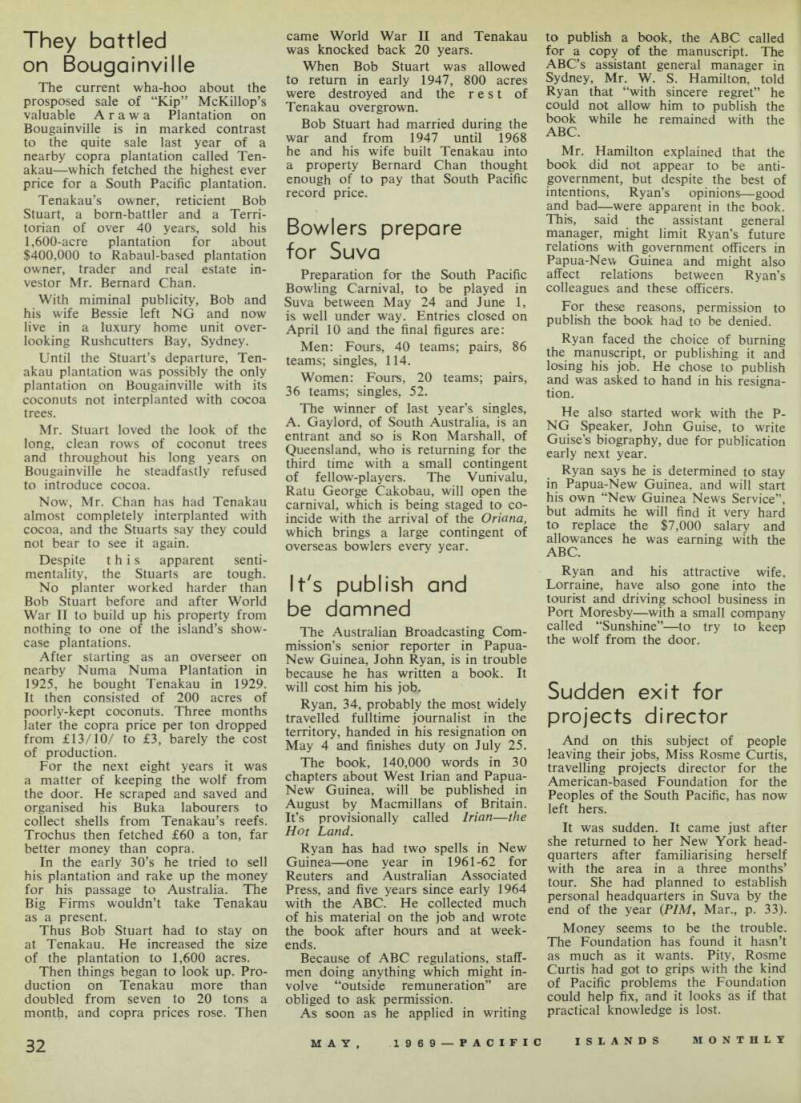
As a sample of the contents of Grass Roots Art, observe the design here. What is it? Its Sepik River creator explained to Pastor Hanne mann many years ago that the idea came from observing a fly in the second stage of development.
Gizo swings for
the "Royal Navee"
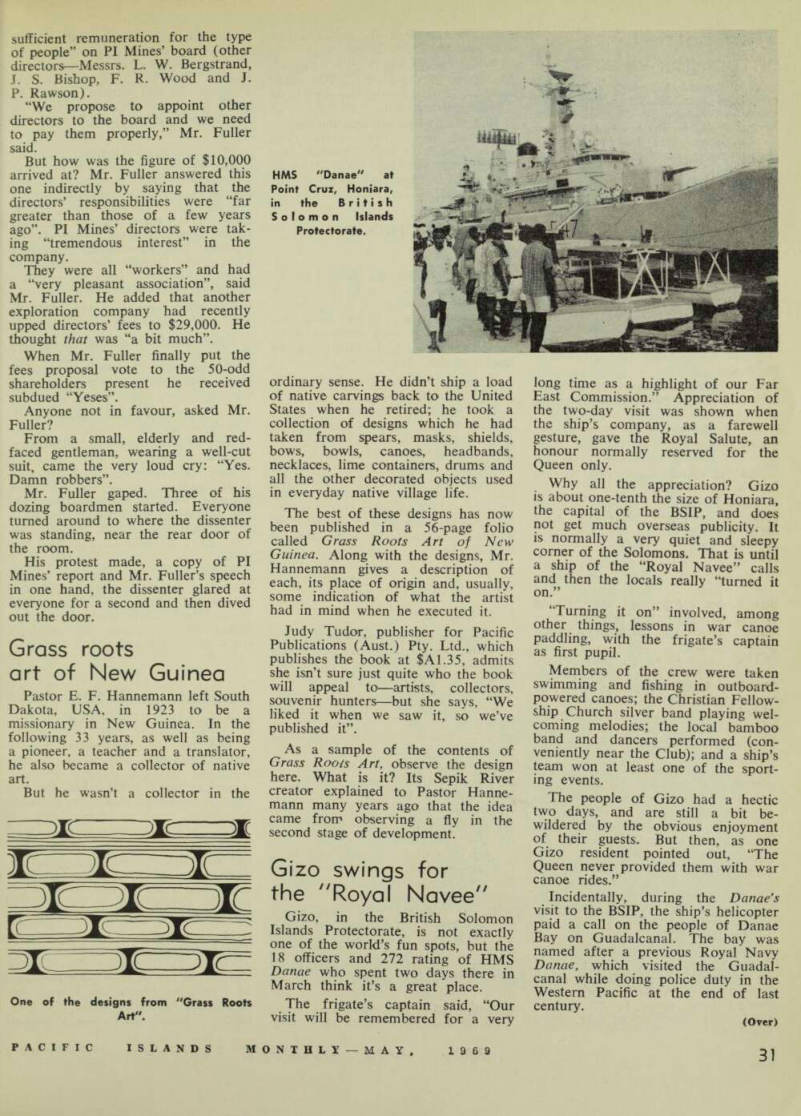
Gizo, in the British Solomon Islands Protectorate, is not exactly one of the world’s fun spots, but the 18 officers and 272 rating of HMS Danae who spent two days there in March think it’s a great place.
The frigate’s captain said, “Our visit will be remembered for a very
long time as a highlight of our Far East Commission.” Appreciation of the two-day visit was shown when the ship’s company, as a farewell gesture, gave the Royal Salute, an honour normally reserved for the Queen only.
Why all the appreciation? Gizo is about one-tenth the size of Honiara, the capital of the BSIP, and does not get much overseas publicity. It is normally a very quiet and sleepy corner of the Solomons. That is until a ship of the “Royal Navee” calls and then the locals really “turned it on.”
“Turning it on” involved, among other things, lessons in war canoe paddling, with the frigate’s captain as first pupil.
Members of the crew were taken swimming and fishing in outboard powered canoes; the Christian Fellow ship Church silver band playing wel coming melodies; the local bamboo band and dancers performed (con veniently near the Club); and a ship’s team won at least one of the sport ing events.
The people of Gizo had a hectic two days, and are still a bit be wildered by the obvious enjoyment of their guests. But then, as one Gizo resident pointed out, “The Queen never provided them with war canoe rides.”
Incidentally, during the Danae’s visit to the BSIP, the ship’s helicopter paid a call on the people of Danae Bay on Guadalcanal. The bay was named after a previous Royal Navy Danae, which visited the Guadal canal while doing police duty in the Western Pacific at the end of last century. (Over)
One of the designs from "Grass Roots Art".
HMS "Danae" at Point Cruz, Honiara, in the British Solomon Islands Protectorate.
They battled
on Bougainville
The current wha-hoo about the prosposed sale of “Kip” McKillop’s valuable Ara w a Plantation on Bougainville is in marked contrast to the quite sale last year of a nearby copra plantation called Ten akau—which fetched the highest ever price for a South Pacific plantation.
Tenakau’s owner, reticient Bob Stuart, a born-battler and a Terri torian of over 40 years, sold his 1,600-acre plantation for about $400,000 to Rabaul-based plantation owner, trader and real estate in vestor Mr. Bernard Chan.
With miminal publicity, Bob and his wife Bessie left NG and now live in a luxury home unit over looking Rushcutters Bay, Sydney.
Until the Stuart’s departure, Ten akau plantation was possibly the only plantation on Bougainville with its coconuts not interplanted with cocoa trees.
Mr. Stuart loved the look of the long, clean rows of coconut trees and throughout his long years on Bougainville he steadfastly refused to introduce cocoa.
Now, Mr. Chan has had Tenakau almost completely interplanted with cocoa, and the Stuarts say they could not bear to see it again.
Despite this apparent senti mentality, the Stuarts are tough.
No planter worked harder than Bob Stuart before and after World War II to build up his property from nothing to one of the island’s show case plantations.
After starting as an overseer on nearby Numa Numa Plantation in 1925, he bought Tenakau in 1929.
It then consisted of 200 acres of poorly-kept coconuts. Three months later the copra price per ton dropped from £l3/10/ to £3, barely the cost of production.
For the next eight years it was a matter of keeping the wolf from the door. He scraped and saved and organised his Buka labourers to collect shells from Tenakau’s reefs.
Trochus then fetched £6O a ton, far better money than copra.
In the early 30’s he tried to sell his plantation and rake up the money for his passage to Australia. The Big Firms wouldn’t take Tenakau as a present.
Thus Bob Stuart had to stay on at Tenakau. He increased the size of the plantation to 1,600 acres.
Then things began to look up. Pro duction on Tenakau more than doubled from seven to 20 tons a month, and copra prices rose. Then
came World War II and Tenakau was knocked back 20 years.
When Bob Stuart was allowed to return in early 1947, 800 acres were destroyed and the rest of Tenakau overgrown.
Bob Stuart had married during the war and from 1947 until 1968 he and his wife built Tenakau into a property Bernard Chan thought enough of to pay that South Pacific record price.
Bowlers prepare
for Suva
Preparation for the South Pacific Bowling Carnival, to be played in Suva between May 24 and June 1, is well under way. Entries closed on April 10 and the final figures are: Men: Fours, 40 teams; pairs, 86 teams; singles, 114.
Women: Fours, 20 teams; pairs, 36 teams; singles, 52.
The winner of last year’s singles, A. Gaylord, of South Australia, is an entrant and so is Ron Marshall, of Queensland, who is returning for the third time with a small contingent of fellow-players. The Vunivalu, Ratu George Cakobau, will open the carnival, which is being staged to co incide with the arrival of the Oriana, which brings a large contingent of overseas bowlers every year.
It's publish and
be damned
The Australian Broadcasting Com mission’s senior reporter in Papua- New Guinea, John Ryan, is in trouble because he has written a book. It will cost him his job.
Ryan, 34, probably the most widely travelled fulltime journalist in the territory, handed in his resignation on May 4 and finishes duty on July 25.
The book, 140,000 words in 30 chapters about West Irian and Papua- New Guinea, will be published in August by Macmillans of Britain.
It’s provisionally called Irian —the Hot Land.
Ryan has had two spells in New Guinea—one year in 1961-62 for Reuters and Australian Associated Press, and five years since early 1964 with the ABC. He collected much of his material on the job and wrote the book after hours and at week ends.
Because of ABC regulations, staff men doing anything which might in volve “outside remuneration” are obliged to ask permission.
As soon as he applied in writing
to publish a book, the ABC called for a copy of the manuscript. The ABC’s assistant general manager in Sydney, Mr. W. S. Hamilton, told Ryan that “with sincere regret” he could not allow him to publish the book while he remained with the
Abc.
Mr. Hamilton explained that the book did not appear to be anti government, but despite the best of intentions, Ryan’s opinions—good and bad—were apparent in the book.
This, said the assistant general manager, might limit Ryan’s future relations with government officers in Papua-New Guinea and might also affect relations between Ryan’s colleagues and these officers.
For these reasons, permission to publish the book had to be denied.
Ryan faced the choice of burning the manuscript, or publishing it and losing his job. He chose to publish and was asked to hand in his resigna tion.
He also started work with the P NG Speaker, John Guise, to write Guise’s biography, due for publication early next year.
Ryan says he is determined to stay in Papua-New Guinea, and will start his own “New Guinea News Service”, but admits he will find it very hard to replace the $7,000 salary and allowances he was earning with the
Abc.
Ryan and his attractive wife, Lorraine, have also gone into the tourist and driving school business in Port Moresby—with a small company called “Sunshine”—to try to keep the wolf from the door.
Sudden exit for
projects director
And on this subject of people leaving their jobs, Miss Rosme Curtis, travelling projects director for the American-based Foundation for the Peoples of the South Pacific, has now left hers.
It was sudden. It came just after she returned to her New York head quarters after familiarising herself with the area in a three months’ tour. She had planned to establish personal headquarters in Suva by the end of the year ( PIM , Mar., p. 33).
Money seems to be the trouble.
The Foundation has found it hasn’t as much as it v/ants. Pity, Rosme Curtis had got to grips with the kind of Pacific problems the Foundation could help fix, and it looks as if that practical knowledge is lost.