The Fireworks
pp. 29-30 · Read in the full issue
After Sir Robert Came
The first address by the Governor of Fiji, Sir Robert Foster, to the Fiji Legislative Council on April 14 was not an occasion for significant announcements of major policy changes or projections.
In the main. Sir Robert contented himself with outlining the country’s economic growth and the progress of various development projects.
In a speech which lasted three quarters of an hour, the Governor touched briefly on subjects ranging from the sugar industry (“Provided harvesting and milling of cane proceeds without interruption, the prospects for the coming season are bright”), copra production and rural development to education, family planning, the filiariasis campaign and road construction.
He said the government continued to recognise the importance of forestry in present and future development. The total acreage established since 1966 was now 13,040 acres—26 per cent, higher than the target of 10,325 acres laid down in the Fiji Development Plan.
Record production
Sir Robert said copra production had improved slightly again last year to a total of 27,970 tons, some 80 per cent, of which was classified as Fiji 1 Grade. Early indications were that yields would improve still further this year.
“The quality of our copra must be maintained in the future if the best advantage is to be gained when the 66,000 acres of new coconuts which have been planted and the 5,500 acres which have so far been re planted come into production,” he said.
The government would continue its efforts to assist and develop prospect ing and mining, said Sir Robert.
“Present indications are that the manganese industry is on the thres hold of major expansion; and off shore prospecting by an American company in various parts of Fiji continues. Negotiations have been completed for a mining lease to a Japanese consortium for bauxite mining in the Wainunu area of Vanua Levu; and shipments to Japan should begin about 1971.
“Intensive prospecting is being undertaken by three organisations in
South East Viti Levu, and another company is to make an aerial pro specting survey of Viti Levu and Vanua Levu this year.”
The Governor added that, un fortunately, known copper ore re serves at Udu Point were very much less than was previously thought.
Commenting on education, Sir Robert said it was encouraging that just over 86 per cent, of all 6-11 year-olds were already at school last year, compared with just over 80 per cent, five years ago.
The long-term aim was to start the secondary course two years earlier and to provide a curriculum more relevant to the world in which they lived for those children who leave school after eight or 10 years.
On housing, the Governor said vigorous efforts were being made to improve housing in Fijian villages that were in the immediate vicinity of towns and township boundaries, “There is deep concern among Fijian leaders and urban local govern ment authorities about the condition of urban Fijian villages,” he said.
The Great Debate
Although Sir Robert Foster’s Legis lative Council speech contained no fireworks in itself—Liberal Party leader, Dr. Lindsay Verrier, wryly commented: “I thank him for not bursting into tears through boredom and frustration at having to read such stuff”—there were sparks enough in the nine-day debate which followed.
As the Speaker, Mr. R. G. Ker mode, pointed out, few members stuck strictly to the issues contained in Sir Robert’s speech and the debate ranged far. Touchy issues like the sugar cane contract and the burning of cane, alleged racial imbalance in government departments, the need for price control, the trade union move ment, the Fijian land-owning system, co-operatives, the Emperor Gold Mining Company subsidy and the degree of Australian aid to Fiji, all received attention from both sides.
There were lighter moments. Dr.
Verrier brought a cheer or two when he offered to take members on a con ducted tour of hotel lounges, after he’d given an account of the “horrors” he’d witnessed in these places.
And there was amusement over Opposition member Mr. K. C. Ram rakha’s indignation at the Suva Travelodge having a dish called cannibal steak on its menu. He found jokes about cannibals offensive, which seemed over sensitive in view of some of the funny jokes which several Fijian leaders like to tell on the subject.
At another stage, Mr. Ramrakha was on the receiving end of a bitter attack from Mr. Charles Stinson, the Minister for Communications, Works and Tourism, who accused the Opposition member of indulging in dangerous propaganda, which was harmful to Fiji.
Referring to Mr. Ramrakha’s con stant criticism of “British propa ganda” in Fiji, Mr. Stinson said Mr.
Ramrakha was a past master at digging down to the bottom of the barrel and reminding people of past incidents, many of them untrue.
Opposition attacks on the Govern ment side were equally strong.
National Federation Party leader, Mr.
A. D. Patel, accused the Government of sheer presumption and audacity over its economic planning for the next development plan; called the Fijian member for Tailevu, Ratu William Toganivalu, a “Don Quixote fighting windmills for the hand of a fictitious lady . . .” and challenged the competency of the Minister for Com merce, Industry and Co-Operatives, Mr. Vijay R. Singh, to handle those portfolios. (Over)
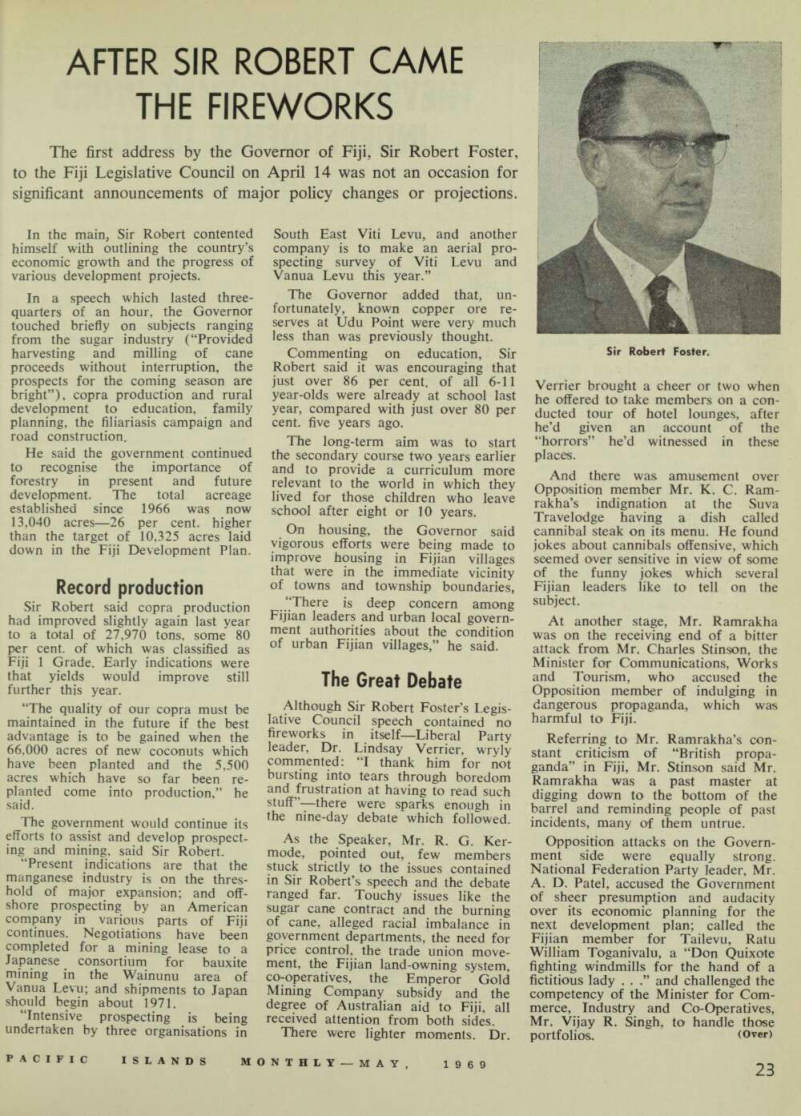
Sir Robert Foster.
On the matter of aid from over seas, Mr. Patel said that in view of what Australia gained and received from Fiji, the Australian Govern ment’s recent gift of wheat was “pea nuts”. Australia and its businesses had been allowed to make Fiji their own economic reserve.
Mr. Stinson was quick to defend Australian aid and quoted a figure of $828,000 —consisting of the gift of wheat and another of vehicles. This, he said, could not be considered crumbs from under the Australian table.
“This is not the only aid we are getting. This is just the start of the assistance that is beginning to come to us,” he added. He gave as an example the fact that Australia shared the annual losses on Nadi Air port and put up capital every time it was needed there.
Mr. Stinson referred to the occasion three years ago when Fiji’s request for a loan from Australia was refused.
“I think we had a right to be bitter,” he said. But a change had taken place, he added, and Australia had permitted Fiji to raise money on their market. It had created a pre cedent when it did this.
Price control
In his speech to the council, the Chief Minister, Ratu Sir Kamisese Mara, hinted that some form of price control may be established in Fiji if prices did not remain at a reasonable level.
The Government had been con sidering the question of price control, he said—and price inflation during the changeover to decimal currency was one of the reasons.
“Let this be a warning, if people wish to take it as that, that we have studied the price control system in other places,” the Chief Minister said.
In his speech, the Chief Minister stressed that the sugar contract should not be made a political football.
Unfortunately, it seems rather too late for that. The NFP makes no bones about its intention of making the “grower’s struggle” political— and it could be the one big issue which might prevent the constitu tional conference being held this year.
Ratu Sir Kamisese verified that the Government still stood by its state ment, made during the last Legco session, that a constitutional con ference would be held towards the end of the year—“at a date yet to be mentioned”. But there would have to be a favourable political atmosphere in Fiji, he warned.