(with times or conditions)
pp. 27-162 · Read in the full issue
Fiji swimmers aren't happy (with times or conditions)
By mid-April, only three Fiji swimmers—two boys and one girl—had equalled the local times set to qualify them as members of Fiji’s Games training squad. But coach Bob Kennedy is confident that about a dozen youngsters—probably six or seven of them boys —will be good enough to go to Port Moresby in August.
Some 22 swimmers—disappoint ingly, only five of them girls—are training seriously for entry into the Games squad. Before qualifying, they must equal or better the times set by the Amateur Swimming Asso ciation of Fiji, based on place times at the Noumea games.
The only girl to do it by mid- April was 15-year-old Lyndal Probert, who equalled the ASAF qualifying time of 1 m. 12 s. for the 100 metres freestyle.
Broad-shouldered Phil Wilkins, who at 21 is the second oldest of Fiji’s potential Games swimmers, qualified for the squad when he swam the 200 metres freestyle in 2 m. 15.7 s. The qualifying time set by the ASAF is 2 m. 20,5 s.
The third member to qualify was David Lane, 15, who did it with a time of 1 m. 16 s. in the 100 metres backstroke. According to coach Kennedy, Lane should do far better at future time trials.
"Baths a disgrace"
“We’re still four months from our best,” Bob Kennedy told PIM in April, “but we’d be making much better progress if the Suva Sea Baths weren’t so appallingly filthy. The saths —the only place we can train —are a disgrace to the city.
“Considering the conditions, the rialists are doing a damn good job.”
Mr. Kennedy said that between bur and six days are lost a month hrough closure of the pool for clean ng.
“The kids get very disheartened.
Fhe health authorities reckon the >ool is so dirty that even fish can’t lurvive,” he declared.
Judging by their present per brmances the swimmers are at least to or better than Fiji’s 1963 james team and they are nearing he standard of its swimmers in Noumea.
However, Mr. Kennedy feels that
with the toughest competition at Port Moresby coming from Papua-New Guinea and New Caledonia, Fiji’s competitors will find it hard to gain even second places.
Encouraging
Some of the recent times are en couraging though, and swimmers like Phil Wilkins—who returned the fastest time for the 100 metres free style yet swum in Fiji—are getting somewhere.
Wilkins’ achievement—s9.s s. in early April—wasn’t as good as his best time ever, which was 59.1 s. in a heat at Noumea. But it was done in the Suva Sea Baths. And it was 9/10ths of a second faster than his previous best time in Fiji, 60.4 s.
In the qualifying trials at the beginning of April, 21 of 30 boy and girl swimmers beat their own best times, some by significant margins, in the 100 and 400 metres freestyle and the 200 metres breastroke events.
With two time trials a month, the
Fiji trainees should be pretty close to breaking Fiji records by the middle of May.
The Dolphin Swimming Club, to which all the trialist swimmers be long, will hold its championships late in May, with the national champion ships scheduled for July. The team for the Games will be announced shortly after.
Glamour boy
On April 19, Fiji’s Usaia Sotutu, who continues to be the glamour boy of Fiji’s pre-Games athletics scene, made the finest long-distance showing ever seen in the South Pacific.
This, at least, was the opinion of Fiji Amateur Athletic Association officials who viewed his performance in the 20-mile marathon training run, in which he was the only finisher.
The 21-year-old student farmer
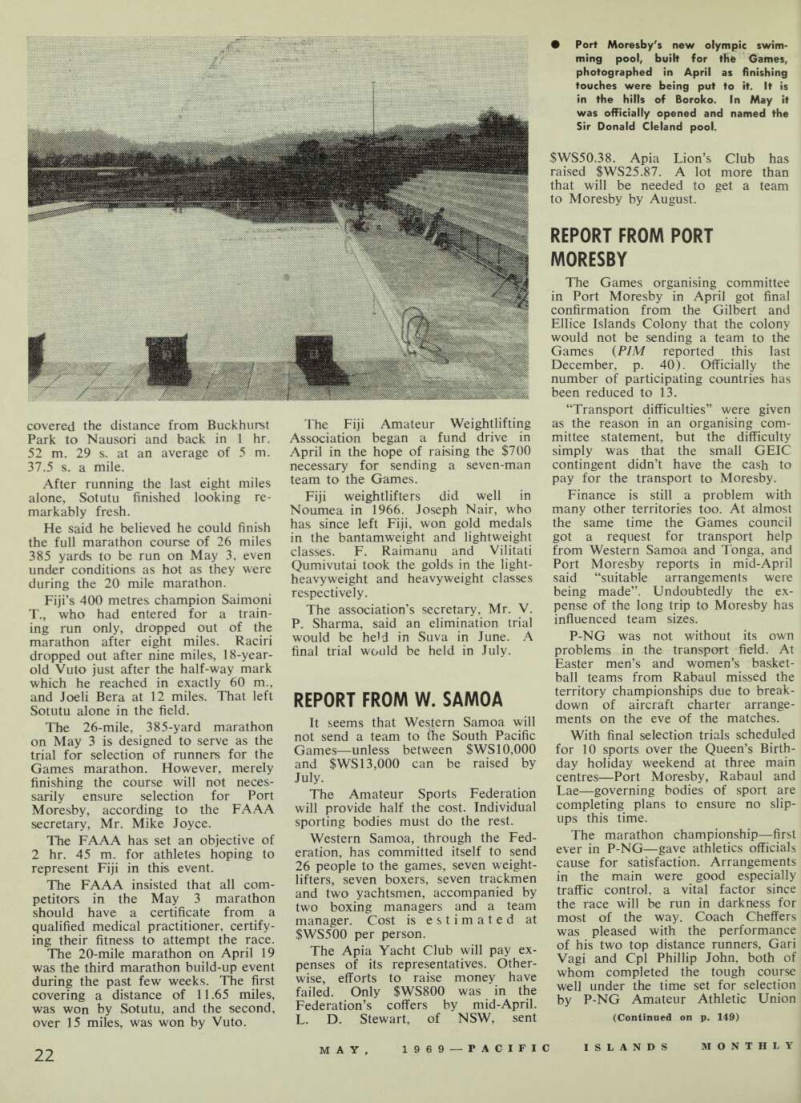
Fiji's outstanding
sporting personalities
of 1968 were pre sented with Sports man and Sports woman of the Year awards by the Governor, Sir Robert
Foster, in April. They
are Senilola Tora,
basketball player,
and Nat Uluiviti, cricketer.
covered the distance from Buckhurst Park to Nausori and back in 1 hr. 52 m. 29 s. at an average of 5 m. 37.5 s. a mile.
After running the last eight miles alone, Sotutu finished looking re markably fresh.
He said he believed he could finish the full marathon course of 26 miles 385 yards to be run on May 3, even under conditions as hot as they were during the 20 mile marathon.
Fiji’s 400 metres champion Saimoni T., who had entered for a train ing run only, dropped out of the marathon after eight miles. Raciri dropped out after nine miles, 18-year old Vuto just after the half-way mark which he reached in exactly 60 m., and Joeli Bera at 12 miles. That left Sotutu alone in the field.
The 26-mile, 385-yard marathon on May 3 is designed to serve as the trial for selection of runners for the Games marathon. However, merely finishing the course will not neces sarily ensure selection for Port Moresby, according to the FAAA secretary, Mr. Mike Joyce.
The FAAA has set an objective of 2 hr. 45 m. for athletes hoping to represent Fiji in this event.
The FAAA insisted that all com petitors in the May 3 marathon should have a certificate from a qualified medical practitioner, certify ing their fitness to attempt the race.
The 20-mile marathon on April 19 was the third marathon build-up event during the past few weeks. The first covering a distance of 11.65 miles, was won by Sotutu, and the second, over 15 miles, was won by Vuto.
The Fiji Amateur Weightlifting Association began a fund drive in April in the hope of raising the $7OO necessary for sending a seven-man team to the Games.
Fiji weightlifters did well in Noumea in 1966. Joseph Nair, who has since left Fiji, won gold medals in the bantamweight and lightweight classes. F. Raimanu and Vilitati Qumivutai took the golds in the light heavyweight and heavyweight classes respectively.
The association’s secretary, Mr. V.
P. Sharma, said an elimination trial would be held in Suva in June. A final trial would be held in July.
Report From W. Samoa
It seems that Western Samoa will not send a team to fhe South Pacific Games—unless between SWS 10,000 and SWS 13,000 can be raised by July.
The Amateur Sports Federation will provide half the cost. Individual sporting bodies must do the rest.
Western Samoa, through the Fed eration, has committed itself to send 26 people to the games, seven weight lifters, seven boxers, seven trackmen and two yachtsmen, accompanied by two boxing managers and a team manager. Cost is estimated at SWSSOO per person.
The Apia Yacht Club will pay ex penses of its representatives. Other wise, efforts to raise money have failed. Only IWSBOO was in the Federation’s coffers by mid-April.
L. D. Stewart, of NSW, sent
5W550.38. Apia Lion’s Club has raised 5W525.87. A lot more than that will be needed to get a team to Moresby by August.
Report From Port
Moresby
The Games organising committee in Port Moresby in April got final confirmation from the Gilbert and Ellice Islands Colony that the colony would not be sending a team to the Games (P/M reported this last December, p. 40). Officially the number of participating countries has been reduced to 13.
“Transport difficulties” were given as the reason in an organising com mittee statement, but the difficulty simply was that the small GEIC contingent didn’t have the cash to pay for the transport to Moresby.
Finance is still a problem with many other territories too. At almost the same time the Games council got a request for transport help from Western Samoa and Tonga, and Port Moresby reports in mid-April said “suitable arrangements were being made”. Undoubtedly the ex pense of the long trip to Moresby has influenced team sizes.
P-NG was not without its own problems in the transport field. At Easter men’s and women’s basket ball teams from Rabaul missed the territory championships due to break down of aircraft charter arrange ments on the eve of the matches.
With final selection trials scheduled for 10 sports over the Queen’s Birth day holiday weekend at three main centres—Port Moresby, Rabaul and Lae—governing bodies of sport are completing plans to ensure no slip ups this time.
The marathon championship—first ever in P-NG—gave athletics officials cause for satisfaction. Arrangements in the main were good especially traffic control, a vital factor since the race will be run in darkness for most of the way. Coach Cheffers was pleased with the performance of his two top distance runners, Gari Vagi and Cpl Phillip John, both of whom completed the tough course well under the time set for selection by P-NG Amateur Athletic Union
(Continued on p. 149)
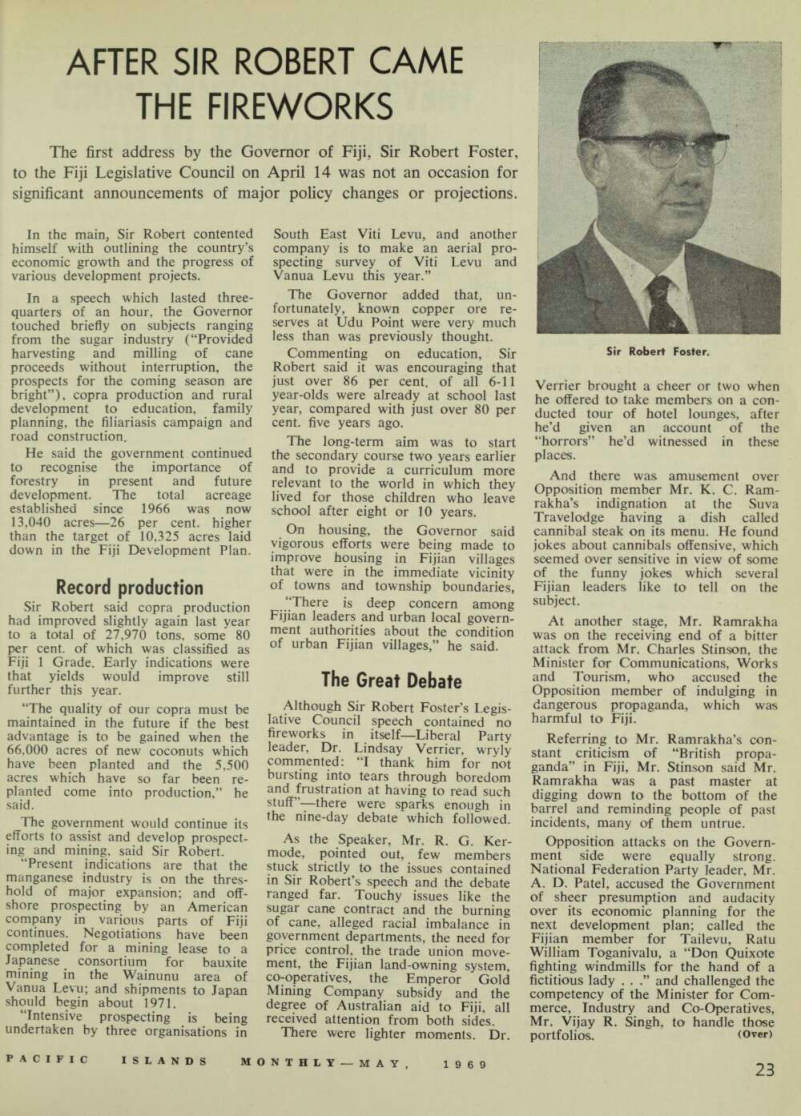
Port Moresby's new Olympic swim ming pool, built for the Games, photographed in April as finishing touches were being put to it. It is in the hills of Boroko. In May it was officially opened and named the Sir Donald Cleland pool.
the long dry spells which Port oresby experiences.
And timing is important. The grass ast be brought along with judicious itering and fertilising to allow of 2 optimum use of mowers and Hers, to guarantee the right surface.
The run-up for the javelin event s been changed to make room for ; French national champion javelin rower, Wakalina, of New Cale mia!
The Director of Organisation, Mr. □n Murty, revealed in April that e organising committee had plan d for javelin throws of about 240 “However the other day we ceived word that Wakalina had :en throwing the javelin 260 feet id more,” he said.
“This meant we had the choice of langing the run-up or running the dc of Wakalina throwing the javelin to the crowd!
Hundreds of students in Port [oresby have responded to appeals i assist at the Games. Ushers and ewards are available in large jmbers, and others will assist the aff of the Chief Electoral Officer, hich will man the tally room.
Visitor accommodation at Games me is being met by a highly srsonalised campaign titled, “Have guest for the Games”.
Advertisements and stickers in Port loresby say: “Make new friends.
Apart from bed and breakfast all that is required of you is your warm spirit of hospitality. Phone Judi Howse, 5311”. Mrs. Judi Howse is the executive officer of this tourist
accommodation campaign a one woman band of energy.
She also has an accommodation questionnaire which should be filled in by everybody planning to be in Port Moresby for the Games, whether wanting to live privately or in a hotel.
She will make the bookings, and since hotel accommodation is, at this late stage, very short, her free service should be popular. Her address is, South Pacific Games Organising Committee, Tourist Accommodation, Free Mailbag Service, Boroko Port Moresby.
O Legislative Council member for North Guadalcanal, Mr. Baddeley Devesi, was married in Honiara, British Solomon Islands Protectorate, recently to Miss June Barley, daughter of Mr. William Barley of Buma, Malaita, and the late Mrs.
Barley. The wedding was conducted by the Rev. Donald Ferguson at the new Anglican Cathedral, and the best man was Mr. Bill Ramsay, LegCo member for Honiara. Among the 150 guests were the Chief Justice, Sir Jocelyn Bodilly and Lady Bodilly, senior civil servants, and the pre sident of the Guadalcanal Council.
the House of Assembly amended the Public Service Ordinance to transfer much of the Public Service control from Canberra to Port Moresby. The Governor - General disallowed the amendments, but Minister for Ex ternal Territories, Mr. Barnes, ap pointed a special committee (headed by the then Member for Eastern Papua, John Stuntz) to look for ways of more rapid localisation of the Public Service.
One of the outcomes was a strong recommendation for a Public Service Board with native membership.
And it was this board that was sworn in last month.
Mr. Unkles: “It’s absolutely essen tial for this country to have a good, efficient and hopefully economic Public Service, and my board will pinpoint native officers throughout this country for higher responsibility and turn on special training for them . . . we’ve got to accelerate this localising of the service.”
Mr. Unkles agreed with G. D. S.
Somers that a lot had already been done—“the number of local officers in the Second Division has increased from 22 at the time of the recon struction in 1964, to 780 at this moment . . . and there will be many more”.
Total native membership of the service has increased from 1,400 to more than 14,000, and European membership from just under 5,000 to nearly 6,500—a total Public Service of about 20,500 with an operational and wages bill of about $47,000,000 this financial year.
Newsman: “In view of the size of the service now and the salaries bill, has the service reached its economic ceiling?”
Mr. Unkles, pausing: “I think we are at the ceiling ... let me qualify that just a bit. Our job is to aim to avoid over-organisation of this ser vice.”
Mr. Unkles said his board would look for short-cuts, and would eventually begin setting target-dates for the localisation on selected gov ernment sections. “We can’t do this overnight, but we’re certainly looking for it.”
The 6,500 Europeans in the Papua- New Guinea Public Service will be taking a very close interest in the localising activities of Mr. Gerald Unkles’ Public Service Board.
Europeans losing their jobs to New Guineans ruled equally competent, will have the government’s special legislation to fall back on—the
ordinance they euphemistically de scribe as the “Golden Handshake”— which provides for lump-sum com pensation for loss of career, or a comparable job in the Commonwealth or State Public Service.
This ordinance hasn’t been tested yet, and a good many European public servants distrust it.
Mr. Unkles: “Oh, there’ll be a place here for Europeans for a long time to come . . . the highly technical fields—we can’t find local people for these jobs overnight.”
• Bob Packham, a Service Organisation worker o Malaita, Solomons, was to retiu home to Britain in late April whe the court house he has been helpin to build on Small Malaita had bee completed. Another VSO, Pete Col lecott, was expected to leave Malait about the same time and travel the protectorate’s northerly atol Ontong Java, and supervise coi struction of a council clinic.