Book Reviews
pp. 95-97 · Read in the full issue

Factual Side Of The
Old Labour Trade
The results of the Pacific Islands labour trade that lasted for little more than half a century, have not yet been fully documented although, in the end, doubtless the busy beavers in the School of Pacific Studies at the Australian National Uni versity will sift it down to its last footnote.
In the meantime, the ANU Press has published as No. 1 in its Pacific History Series, A Cruize in a Queensland Labour Vessel —a journal compiled by W. E. Giles during a recruiting voyage from Queensland to the New Hebrides in 1877.
Although a couple of dozen other journals, kept by men who were engaged in the labour trade, are known to exist, Giles’ account has been chosen for publication as it is judged the fullest and least-biased.
Anyone who has had anything even remotely to do with the recruiting of native labour, even at a much later date, will probably agree that it sounds authentic.
In a way, this small book also seems to cut the whole business of so-called blackbirding down to size.
Measured against the whole canvas of history and what man has habitually done to man, it appears as a pretty small sin, although the one most frequently cast in the teeth of those who had early business in the South Pacific.
The demand for labour in Queens land went on longest and lasted for less than half a century; in Fiji, “free” Pacific Islands labour came in subsequently, but Cession in 1874 put an end to the organised labour trade. Recruiting for Samoa and New Caledonia was always on a small scale.
Although the trade of necessity started as outright kidnapping or something close to it, it probably never was as widespread or con tinued as long as the trade’s severest critics have tried to make out. Like any other business, men who wanted to stay in it had soon to devise some sort of ground rules.
The fact that there are now only
very small groups of Solomon Islanders and Hebrideans in Fiji and none at all in Australia is proof enough that repatriation was fairly systematically carried out, even before the mass exodus from Australia in the early years of this century.
The worst effects of the Pacific Island labour trade were probably much more subtle, and observed well enough through the eyes of W. E. Giles himself.
Giles was not a labour recruiter by profession; he made his 18 weeks voyage on the brigantine Bobtail Nag in 1877 by way of taking a holiday after four years in the back country.
This was the vessel’s sixth voyage in the labour trade and it took place 14 years after Robert Towns had started the ball rolling by recruiting
labourers for his cotton plantations on the Logan River.
The Queensland trade had been lln der supervision of some sort from about 1868> when , he p olynesian Labourers Act of that year provided that all ships be licensed and that masters enter a £5OO bond against kidnapping.
From the end of 1870, vessels were required to carry a government
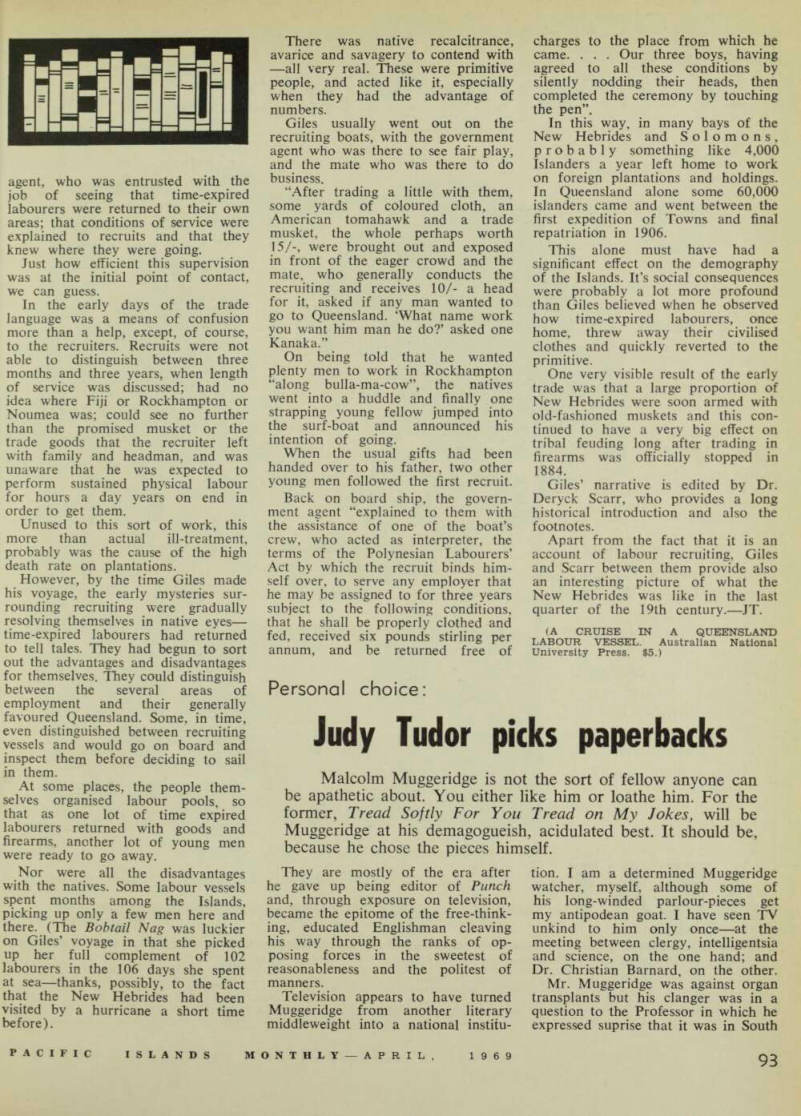
HMS "Rosario" overhauling the blackbirder "Carl" in the New Hebrides in 1871 (from a sketch by an artist on the warship). Just how bad was blackbirding?
agent, who was entrusted with the job of seeing that time-expired labourers were returned to their own areas; that conditions of service were explained to recruits and that they knew where they were going.
Just how efficient this supervision was at the initial point of contact, we can guess.
In the early days of the trade language was a means of confusion more than a help, except, of course, to the recruiters. Recruits were not able to distinguish between three months and three years, when length of service was discussed; had no idea where Fiji or Rockhampton or Noumea was; could see no further than the promised musket or the trade goods that the recruiter left with family and headman, and was unaware that he was expected to perform sustained physical labour for hours a day years on end in order to get them.
Unused to this sort of work, this more than actual ill-treatment, probably was the cause of the high death rate on plantations.
However, by the time Giles made his voyage, the early mysteries sur rounding recruiting were gradually resolving themselves in native eyes— time-expired labourers had returned to tell tales. They had begun to sort out the advantages and disadvantages for themselves. They could distinguish between the several areas of employment and their generally favoured Queensland. Some, in time, even distinguished between recruiting vessels and would go on board and inspect them before deciding to sail in them.
At some places, the people them selves organised labour pools, so that as one lot of time expired labourers returned with goods and firearms, another lot of young men were ready to go away.
Nor were all the disadvantages with the natives. Some labour vessels spent months among the Islands, picking up only a few men here and there. (The Bobtail Nag was luckier on Giles’ voyage in that she picked up her full complement of 102 labourers in the 106 days she spent at sea—thanks, possibly, to the fact that the New Hebrides had been visited by a hurricane a short time before).
There was native recalcitrance, avarice and savagery to contend with —all very real. These were primitive people, and acted like it, especially when they had the advantage of numbers.
Giles usually went out on the recruiting boats, with the government agent who was there to see fair play, and the mate who was there to do business.
“After trading a little with them, some yards of coloured cloth, an American tomahawk and a trade musket, the whole perhaps worth 15/-, were brought out and exposed m front of the eager crowd and the mate, who generally conducts the recruiting and receives 10/- a head for it, asked if any man wanted to go to Queensland. ‘What name work you want him man he do?’ asked one Kanaka.”
On being told that he wanted plenty men to work in Rockhampton “along bulla-ma-cow”, the natives went into a huddle and finally one strapping young fellow jumped into the surf-boat and announced his intention of going.
When the usual gifts had been handed over to his father, two other young men followed the first recruit.
Back on board ship, the government agent “explained to them with the assistance of one of the boat’s crew, who acted as interpreter, the terms of the Polynesian Labourers’
Act by which the recruit binds himself over, to serve any employer that he may be assigned to for three years subject to the following conditions, that he shall be properly clothed and fed received six nounds Stirling r>pr icu, icceiveu six pounds surimg per annum, and be returned free of
charges to the place from which he came. . . . Our three boys, having agreed to all these conditions by silently nodding their heads, then completed the ceremony by touching the pen”.
In this way, in many bays of the New Hebrides and Solomons, probably something like 4,000 Islanders a year left home to work on foreign plantations and holdings.
In Queensland alone some 60,000 islanders came and went between the first expedition of Towns and final repatriation in 1906.
This alone must have had a significant effect on the demography Q f the Islands. It’s social consequences were probably a lot more profound t h an Giles believed when he observed how time-expired labourers, once home, threw away their civilised clothes and quickly reverted to the primitive, One very visible result of the early trade was that a large proportion of New Hebrides were soon armed with old-fashioned muskets and this con tinued to have a very big effect on tribal feuding long after trading in firearms was officially stopped in 1884.
Giles’ narrative is edited by Dr.
Deryck Scarr, who provides a long historical introduction and also the footnotes.
Apart from the fact that it is an account of labour recruiting, Giles and Scarr between them provide also an interesting picture of what the New Hebrides was like in the last
quarter of the 19th century.-
JT.
Cruise In A Queensland
LABOUR VESSEL. Australian National University Press. $5.)