Yesterday
p. 93 · Read in the full issue
The difficulties under which some of the small gold-mining companies in New Guinea were labouring 20 years ago were in dicated in the chairman’s report to shareholders of Sandy Creek Gold Sluicing Ltd. in Sydney in early 1949. In the chairman’s opinion, the future of gold-mining in the territory was “not bright” unless there was relief from royalty (at that time a flat 5 per cent., irrespective of costs) and an increase in the price of gold (then £lO/15/- per ounce). It was pointed out that production of gold in 1948 was a fraction of that in 1939, but costs had increased “alarmingly”.
Among other items in PIM for April, 1949: The first screening of films (16 mm.) in the Western Division of Papua was made in February to a large audience of Europeans and locals. Films were supplied by the Education Department, and regular screenings were to be held in the future. This was at Dam.
Suva had three town bus services— one established and two on trial.
Result was the advent of the trial services brought a wail from the taxi proprietors, who claimed that their two most profitable trips— to the hospital and to Rewa Street— had virtually come to an end. One taxi driver said: “I believe that taxi owners will just have to cut their fares (then 2/6 was minimum) or park their £l,OOO cars.”
In March, almost 11 months after the event, the official report on the air accident in Lae on April 18, 1948, was tabled in the Australian Parlia ment, The Minister for Civil Aviation, Mr. Drakeford, said that no legal action would be taken against the operators. The accident occurred when a plane operated by Guinea Air Traders Ltd., and owned by Mr. Van Praag, of Sydney, crashed on an island in the Markham River shortly after taking off from Lae.
The crew of four and 33 native passengers were killed.
Sydney newspaper reports that three “Fijians” had been charged with murder in Adelaide in December caused anger in Fiji. For none of the “Fijians” was a Fijian. One was Gilbertese, one was part-Gilbertese and one was a Solomon Islander.
The Guam Parliament in the US Trust Territory was in revolt against US Navy rule in early April. The revolt was bloodless. Locals did not want to sever any of their ties with the US, but they did want new status
—under civil authority. Leading Guamanians demanded that the US Congress pass an act which would give Guamanians US citizenship and more self-government. Such an act has, of course, since been passed.
The 400-ton London Missionary Society ship, John Williams VI, received an enthusiastic welcome in Australian capital cities in March and April when she was on a good will tour. Skippered by Captain Stanton Page and manned by a Gilbertese crew, the ship was taking Polynesian missionaries home on leave after service in Papua.
Captain Alexander Donaldson, commodore of the BP Line, collapsed and died suddenly in Sydney in March, 1949. Captain Donaldson— who was over 70—had been at sea for 57 years, during which time he had sailed more than three million miles. He was best known as master of BP’s Marella which he commanded for 13 years on the Sydney-Singapore run. During his colourful career, Captain Donaldson made six trips round the Horn in windjammers; was for a time mate on a Yangtze paddle steamer; served in African waters; and knew the Gilberts, the Solomons and New Guinea.
The prop set would have heaved a small sigh of relief. British Com monwealth Airlines had reduced its Sydney to London (via North America) fare from £350/8/6 to £377/10/-. PIM reported that the CPA’s new DC6 planes made it possible to get to London in less than four days.
Western Samoa’s cocoa boom seemed to be over. It was feared
that prosperity based on cocoa ex ports could easily turn into depression.
Over 1,000 tons of cocoa had been accumulated in Apia sheds and over seas buyers were reluctant to buy— even though it was being offered for £lOO to £l2O per ton f.o.b. less than half the amount asked a few months previously.
According to a European cost of living index, issued in Fiji by Mr.
C. H. Came, living in the colony in 1949 cost 74 per cent, more than in 1939. PIM reported that Mr.
Came felt that the cost of living was shortly to rise even more. Then, as now, a safe bet.
Dr. A. N. K. Laubach a special counsellor of the World Literacy and Christian Literature movement in New York, was to leave for New Guinea in late April to conduct a literacy campaign. He was to con duct this campaign by reducing a local language to a phonetic alphabet and then teaching it.
The Most Reverend Leo Arkfeld, SVD, was installed as Vicar Apostolic of the Vicariate of Central New Guinea at Wewak in March. Thirty two priests and lay brothers of the Divine Word Missionaries, and Franciscans of the Order of Friars Minor, as well as a large gathering of locals, welcomed his Lordship and conducted him to the temporary church which then served as his pro cathedral. His Lordship was wel comed by the Very Reverend A.
Gerstner, SVD.
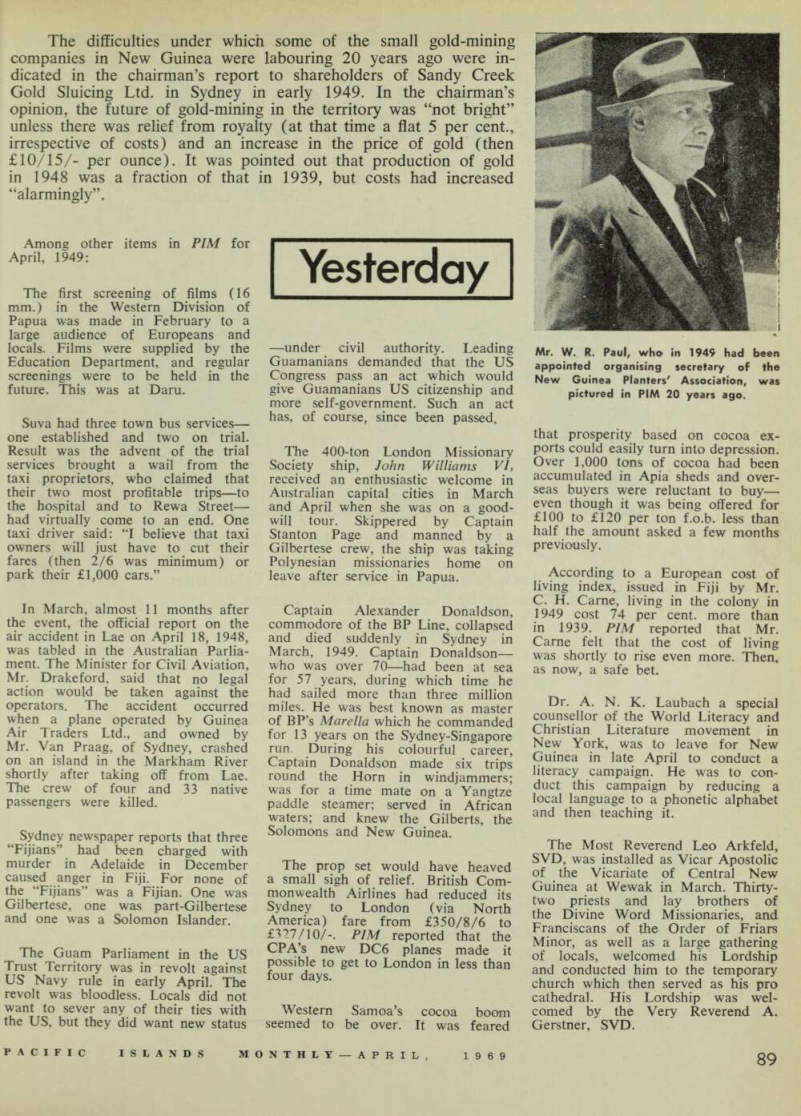
Mr. W. R. Paul, who in 1949 had been appointed organising secretary of the New Guinea Planters' Association, was pictured in PIM 20 years ago.