The papers in "Squeaker"
pp. 87-89 · Read in the full issue

Hamilton's trunk
When Captain William Hamilton, an old hand in the Western Pacific, died in Sydney in November, 1937, at the age of 85, Pacific Islands Monthly recorded that he had left behind him a trunkful of diaries and other papers concerning his Pacific career, which, “in the hands of a competent writer might make a bestseller”.
Captain Hamilton, PIM recalled, had been a trader, pearl-sheller and planter at Thursday Island, New Guinea and the Solomons, and had been known thoughout the Islands as “Squeaker” because of a defect in his voice.
Having taken part in many historic happenings in the Islands, his life had been “full of colourful adventure and incident”.
Born in Scotland in 1852, he had come to Australia with his parents at the age of 10. As a young man he had begun a small shipping service on the Queensland coast, carrying miners and stores to the newly-dis
covered Palmer goldfield on Cape York Peninsula.
PIM went on to recall other details of Captain Hamilton’s career. But beyond a vague hint that his trunk of papers was probably in the posses sion of his daughter, Mrs. E. M.
Stevenson, of Sydney, it gave no clue as to what—if anything—was to be done with it.
Gathering dust
As things turned out, no bestselling novelist or historian ever got to its contents and no antiquarian book
seller ever haggled for its possession.
It simply remained a part of Mrs.
Stevenson’s household, gathering dust and a silverfish or two, until finally, in the last couple of years, Mrs.
Stevenson presented it, with its papers still intact, to the Oxley Memorial Library, Brisbane.
The papers were still unsorted and uncatalogued when the Pacific Manu scripts Bureau, Canberra, chanced to discover the trunk during a visit to the Oxley Library last year.
Haying received permission to examine its contents and obtain microfilm copies of any documents of historical value, the bureau (which collects and copies MSS for posterity), settled down to a diet of Hamiltonian prose for three or four days.
It soon became apparent that Captain Hamilton had been a man of considerable substance in his day.
For a dozen or so years from the late 1890’s, he had run a pearl-shelling business called the Hamilton Pearl ing Co., which had had a number of luggers operating from Komuli in the Admiralty Islands and from Gizo in the Solomons. This company also traded in copra, tortoise shell, black lip and green snail shell, and carried on an extensive correspondence with firms and private individuals in such places as Samarai, Cooktown, Towns ville, Cape Melville, Herbertshohe (now Kokopo), Bundaberg and Brisbane.
By 1910, Captain Hamilton had acquired considerable wealth; and with 7,000 acres of land in the Solomons, mainly on Choiseul, he was the fourth-largest landholder in that group, with big planting interests.
Early history
Although the papers in Captain Hamilton’s trunk record his activities in meticulous detail, they are scarcely of the kind to make a bestselling author’s heart leap with joy.
Like the prosaic Captain Handy in the memorable South Seas yarn by James Norman Hall, Captain Hamilton had a remarkable facility for recording only the business details of his career and ignoring the colourful life and personalities that must have surrounded him.
Yet among the mass of papers in his trunk there is a handful of documents that will be of great value to scholars interested in piecing together the early history of European penetration in the New Hebrides, Solomons and New Guinea, Two of the most interesting documents are diaries which Hamilton kept on two labour recruiting voyages
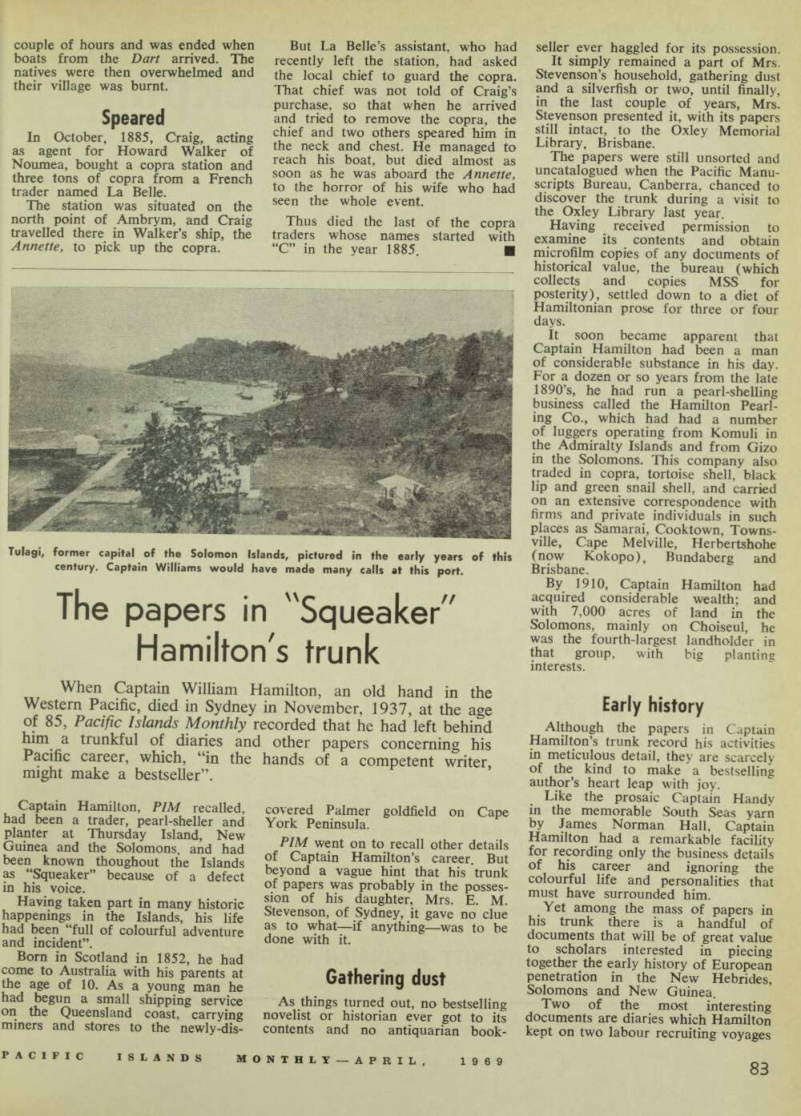
Tulagi, former capital of the Solomon Islands, pictured in the early years of this century. Captain Williams would have made many calls at this port.
to the Islands in the early 1880’s.
This was at the outset of his career when the people he met and the things he saw still had the charm of novelty. Hamilton seems to have been the mate of the ships on both voyages.
The first diary, covering the period September 20, 1882, to December 29, 1882, concerns a voyage in the schooner Lochiel from Brisbane to the New Hebrides in which most of the islands from Tanna northwards to Gaua were visited.
The second diary concerns a voyage in the Jessie Kelly from March to September, 1883. On this voyage, Hamilton visited New Britain and New Ireland in addition to the New Hebrides. An extract from his diary for May 7, 1883, when the Jessie Kelly was in Blanche Bay, gives an idea of the kind of useful information that the diary as a whole contains: “In the afternoon, Captain Farrell and his wife (this was the famous ‘Queen’ Emma) came alongside in their boat. He is manager and partner with Mason Bros., of Sydney, in the copra trade at present, but has resigned and intends starting a copra and cotton plantation on New Britain close to Blanche Bay, on land he has already bought and is having prepared.
“He was short of tobacco and we gave him what we could spare, 191 lb, and in return he gave us what information he could that would be useful in recruiting, and also pro mised to give us the plan of a place where he thought we could get men, lately surveyed by the Germans.
“The vessel we passed at anchor was the Halley Baylley and the vessel we saw under weigh as we
came in was the Fanny from Queens land. They had over 100 recruits on board. The Hopeful had also been here and left a few days ago with over 100 on board.
Skirmish
“There are two other vessels re cruiting further north, the Stanley and Meg Merriles. Captain Farril (sic.) said there was no chance of getting filled up about here and advised us to try fresh ground . . .
“We heard from Capt. Hernsheime, manager from Godfrey’s (i.e.
Godeffroy’s) firm, that the Stanley had a skirmish with one of his traders on the Laughlans and they burned his house and copra. He said he had reported it to the man-of-war, which had gone on to Queensland with the news.”
Other papers in Captain Hamilton’s trunk which contain a good deal of information of interest to a historian are: • Two reports on voyages in search of pearl shell in New Guinea and the Solomons in 1899-1900. • Log of the pearling lugger Nippon from April 20, 1901, to September 24, 1901, kept by Aubrey Griffith and later F. E. J. Schmidt, manager of the Hamilton Pearling Com pany’s station at Komuli, Admiralty Islands. • Log of the Hamilton Pearling Company’s station at Komuli, Admiralty Islands, from Sep tember 27, 1902 to March 10, 1903. • Logs and diaries kept by William Hamilton in the vessels
Canomie, Ysabel, Gazelle and Kambin from January 1, 1903 to November 14, 1905. These concern the operations of the Hamilton Pearling Company in New Guinea and the Solomons.
All of the foregoing documents and the two diaries of the recruiting voyages have now been copied on microfilm for the Pacific Manuscripts Bureau as PMB Manuscript No, 15.
The remaining documents in Captain Hamilton’s trunk were not deemed to be worth the expense of copying on microfilm, but many of them could contain some items of interest to an economic historian.
The main uncopied documents are Hamilton Pearling Co. letterbooks covering the period from January, 1898, to October, 1907; receipts, bills of lading, etc. from March, 1900, to February, 1903; and numerous logbooks of pearling luggers. There are also diaries of Captain Hamilton for the years 1907, 1909-16, 1919-21, 1926, 1928 and 1935, and a ledger for 1909-17, all of which mainly concern his planting interests in the Solomons.
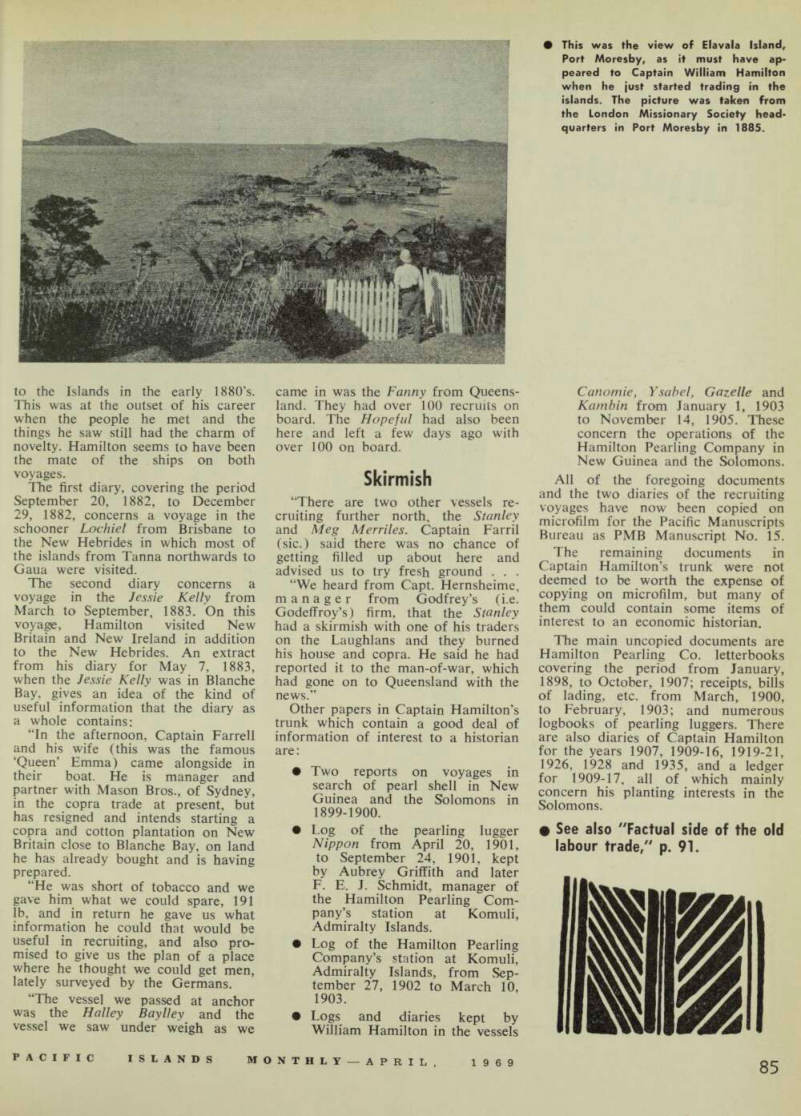
• This was the view of Elavala Island, Port Moresby, as it must have ap peared to Captain William Hamilton when he just started trading in the islands. The picture was taken from the London Missionary Society head quarters in Port Moresby in 1885.
• See also "Tactual side of the old labour trade," p. 91.