Magazine Section
pp. 85-87 · Read in the full issue
Wild Traders
Of The
New Hebrides
By Roger Thompson
If you look at a reasonably large map of the New Hebrides you will see a small bay marked Craig Cove near the western point of the island of Ambrym. This was named after a copra trader, George Craig, who was killed in 1885.
By coincidence two other British settlers who died in the New Hebrides that year were also copra traders whose names started with C-Peter Coyle and Peter Cullen.
A copra trader’s life in the New Hebrides in those days was hard and dangerous. Normally he received permission from a native tribe to settle in their district. This was usually readily granted as the natives liked to have a trader nearby to supply them with European goods.
Anent
» Such a trader built himself a hut that often differed little from native huts except that it might contain a rough table and a chair or two. He also built a storehouse for his copra and put up a few platforms on poles two or three feet above the ground on which to dry the coconut flesh, And he hired three or four natives as labourers.
The trader was usually the agent early firms we** “ based In Noumea in Ne J ralSont 5 ' New Caledoma.
From the firm he received a snnnlv of goods with which to buy coconuts from the local Lfives Matches pipes and tobacco were nonular c , loDacco were P°P ular - „„a , ? , were ... gun !’ ammunition v !’ A althou s h , tbe Fntlsb authonties had banned their sale.
T^. e pr * ce var ied according to the locality and the time of the year, but a fypi ca l exchange was a pipe, ? small fragment of tobacco, or a box of matc hes for a dozen nuts.
Seven to eight thousand nuts were necessary to make a ton of copra which the trader might sell for about £7.
Althoueh the natives a trader around o i k of developed becauseof i n g S or because of the wavth! behaved towards them members of other 7 to plunder his tmrtf * L hieh deatb ite .he .l J S and ®, ronsf,m neeT?" g ,1 ‘ on the alert. r em o e 1116I 116 tr ? de - r also had to contend u," h mala " a \" d t ot ? er tro P !cal illnesses, and with the loneliness of
living many miles from his nearest white neighbour.
The stories of the three copra traders whose names started with “C” are typical of the New Hebrides in the early 1880’s. They are based on records of the Australian Station of the Royal Navy and accounts written by contemporaries who saw the traders in the New Hebrides.
Dancing saloon affray
Peter Coyle was a Scot who had been an officer on a French merchant ship, and had been sent as a convict to New Caledonia. Captain Cyprian Bridge, RN, said that his crime was involvement in a row in a dancing saloon in a French port.
Douglas Rannie in his book My Adventures Among South Sea Can nibals said that Coyle was convicted for shooting his captain.
Perhaps the shooting took place in the dancing saloon.
However the French authorities released Coyle after a term in New Caledonia, whereupon he went to the island of Aoba, New Hebrides, in 1881 or 1882. There he took over the station of a trader named
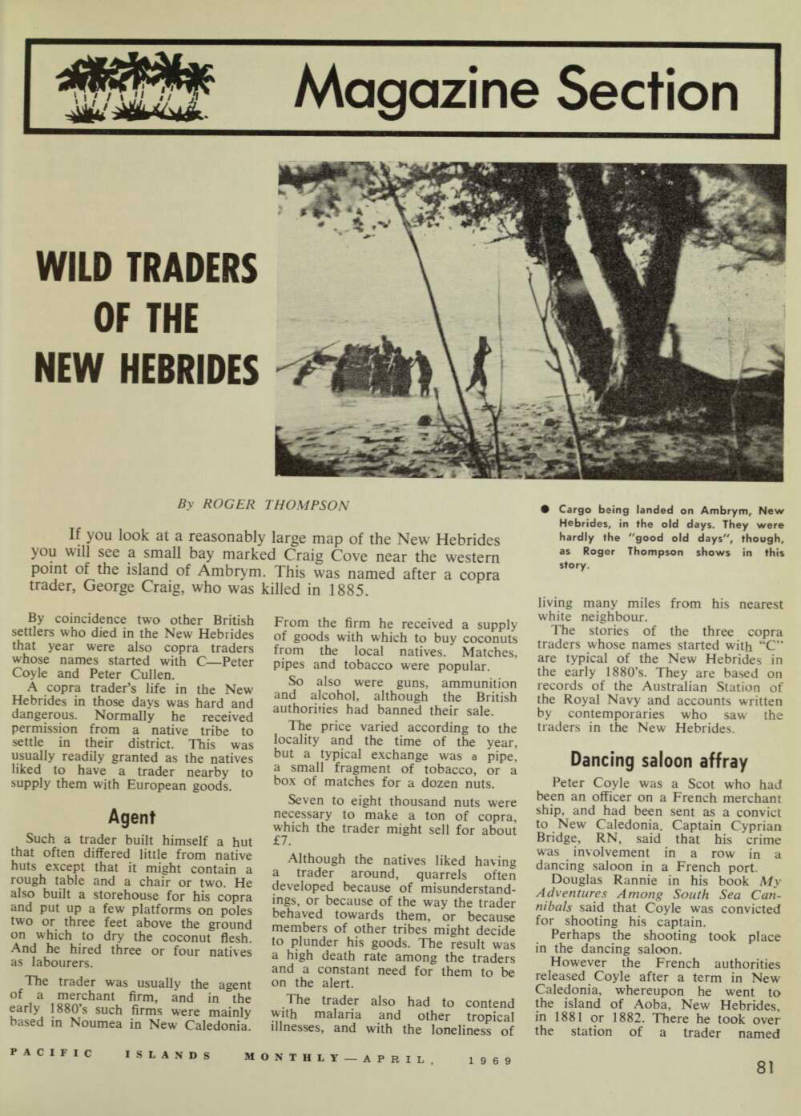
• Cargo being landed on Ambrym, New Hebrides, in the old days. They were hardly the "good old days", though, as Roger Thompson shows in this story.
Notorious blackbirder was his friend
Chaffinch (note the “C” again) who had been killed by the natives.
The people of Aoba at that time had a particularly fierce reputation.
Coyle, however, got on well with them.
Rannie visited Coyle in 1884 and wrote that “he was a man of much intelligence, and was very fond of books, of which he had a good col lection”. Rannie added that he had “a good supply of newspapers, and a number of them from Glasgow” which he gave to Coyle and which “quite gladdened the poor lonely fellow’s heart”.
Tbe following year the natives found Coyle lying dead on his bed, and they buried him, saying that he had committed suicide. But when the naval authorities exhumed his body they found that he been shot in the stomach, and Lieutenant Cross announced that he had accidentally shot himself while loading his revolver.
Less respectable
Peter Cullen was a far less respect able trader than Peter Coyle. He had been a recruiting agent on a Fiji labour vessel and was a friend of the notorious blackbirder James Proctor.
He first established himself on the island of Epi in 1877, but he shifted his residence a number of times in the ensuing years, and he built up an unsavoury reputation for kidnapping and ill-treating his labourers.
The captain of the Hawaiian labour ship Hazard said that he “was a regular nuisance coming and getting drunk on board”. In 1884 Lieutenant Acland put him on £5O bond for mistreating his labourers. Acland said that the natives of Epi com plained of murders committed by him.
It was surprising that he escaped native vengeance for as long as he did, but in 1885 his past caught up with him. Some years before, pro bably in 1881 or 1882, he was living on Lenur Island off the south coast of Malekula and had sailed to nearby Toman Island to get himself a native woman.
When none would come willingly he killed four of the Toman Islanders and kidnapped a number of their women. The Toman islanders fled to the mainland of Malekula, but Cullen prudently left Lenur to enjoy the company of his captives in peace.
In 1885, however, he returned to Lenur with a German partner and set up a copra station, which was financed by a German firm in Samoa.
The Toman Islanders were still living on Malekula and, as if he had forgotten all about his previous brush with these people, Cullen accepted an invitation they sent him to visit the mainland where they had some land to sell. As soon as he set foot on shore, the Toman Islanders des cended on him and achieved their revenge with their tomahawks. Then, for good measure, they went to Lenur, shot Cullen’s partner and plundered his station. The bodies, in good Malekulan fashion, they ate.
£5O bond
It was George Craig who guaran teed the £5O bond that was imposed upon Cullen in 1884. He was an Australian who had started a copra station with his Australian wife on Ambrym in about 1880 at the place which is now Craig Cove.
All who met him said that he was a quiet and respectable man who was well liked by the natives. Rannie, who met him in 1884, said that his wife was one of the few white women at that time in the New Hebrides.
In 1882 he guided Lieutenant Beresford and a small naval party
to the top of the Ambrym volcano.
They were probably the first men, native or white, to ascend that volcano.
The local people tried to warn them against this. One of them explained, “You no can go there.
Suppose you go more far, you finish, you no come back; Devil he stop along big fellow fire”. However they came back without mishap.
The following year Craig accom panied a landing party from HMS Dart to punish natives for murdering Captain Belbin of the labour vessel Borough Belle near his station.
The expedition, 23 men strong, landed some distance from the village of those responsible for the murder shortly before midnight.
Thomas Nineham, the boatswain of the Dart, said afterwards, “I never had such a hard tramp in my life.
It was a real forced march, up and down hill, through soft ground in which we sank up to our knees, over the roots of trees and creepers. You were hardly able to see your hand before you”.
The expedition reached the village as daylight broke and prevented any of the villagers escaping as the sea was at their back. But the natives put up a fight.
“They beat tomtoms and yelled and peppered away at us,” said Nineham, “and we peppered back at them.”
This shooting match lasted for a
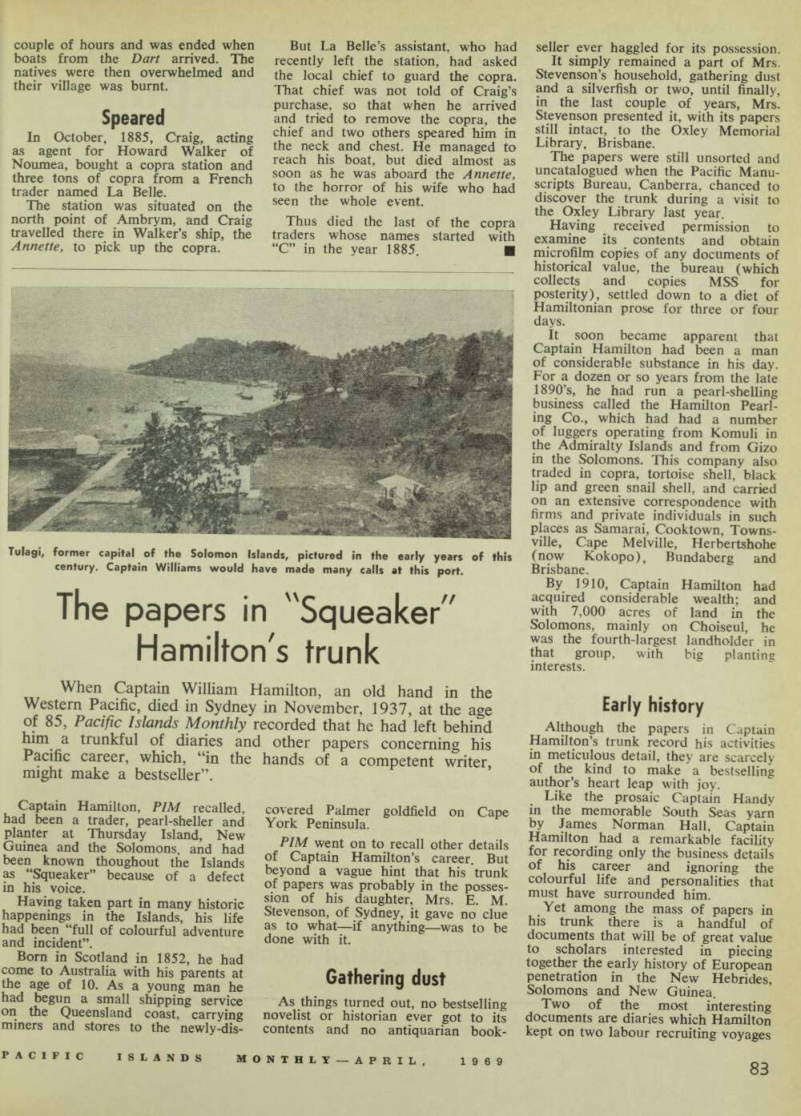
The New Hebrides is a violent place as the story of the "Three C's" demonstrates.
Things happen unexpectedly. This launch is anchored where Ambrym Hospital once stood —on top of an active volcano. The volcano exploded in 1913.
couple of hours and was ended when boats from the Dart arrived. The natives were then overwhelmed and their village was burnt. ,
Speared
In October, 1885, Craig, acting as agent for Howard Walker of Noumea, bought a copra station and three tons of copra from a French trader named La Belle.
The station was situated on the north point of Ambrym, and Craig travelled there in Walker’s ship, the Annette, to pick up the copra.
But La Belle’s assistant, who had recently left the station, had asked the local chief to guard the copra, That chief was not told of Craig’s purchase, so that when he arrived and tried to remove the copra, the chief and two others speared him in the a ° d . c^ st> managed to reacb his boat, but died almost as ooa as he was aboard the Annette, me horror of his wife who had seen tbe w hote event, Thus died the last of the copra traders whose names started with “C” in the year 1885 ■