When Are They Going To Get The
pp. 61-63 · Read in the full issue
Gilberts' Show On The Road?
By staff writer KEN MCGREGOR
Lack of unity, and a general absence of “doers”—practical men to get things done—are the two major problems of the tiny mid-Pacific Gilbert and Ellice Islands Colony.
That’s the way I see it after a month in the GEIC, a period which included two weeks in the capital, Tarawa, and two weeks seeing the Central and Southern Gilberts and Ocean Island.
My general criticisms: The capital has been developed at the expense of everywhere else; administrative set-ups on Tarawa are too far away from one another; too little atten tion is given to agriculture and education; there is a massive gulf in communication between English speaking civil servants and the bulk of Islanders who can’t speak English; and too few locals have important jobs.
My bouuets: shipping connections with most atolls are good; airstrip construction is proceeding well; the House of Representatives is on its feet; causeways are appearing in outer atolls and plans are underway for the biggest of all, to fill the Bairiki-Betio gap; most of the posts in the Secretariat (government ad ministration) and District Offices are filled by competent and experienced men; and traditional Islands life re mains (with the exception, to a great extent, of South Tarawa).
But my big impression was that the different groups in the colony don’t get on with one another, and a small territory can’t afford this. I said something about this in a re port published in PIM in February, which has brought a reply (see p, 60). But now I want to enlarge on it, constructively I hope.
A bit much!
The GEIC’s inhabitants are divided into three groups: the Islanders, the part-Europeans and the Europeans Of these, the Ellice and the Gilbertese distrust one another; the part-Euro peans don’t get on with the Islanders or the Europeans; and the Europeans are split into three camps—New Zealand, British and Australian. This may sound a flat-footed summing up. If the locals don’t believe it, then they should re-examine them selves.
If you toss in other rivalries, be tween District Officers and young VSO’s, between Tarawa administra tion and the Ocean Island BPC set up, between Protestant and Catholic churches and between the residents of Betio and Bairiki, it’s almost too much!
It’s the distrust between the Ellice Islanders and the Gilbertese that is by far the most significant division.
Unless the GEIC people do some thing about it, it could pose a bigger problem than the vexed matter of economic development.
As I pointed out in February, this distrust exists mostly because Ellice Islanders have taken more jobs in government departments on Tarawa than the Gilbertese—and Gilbertese outnumber the Ellice Islanders eight to one.
Gilbertese are easy-going, super stitious and mainly interested in everyday events. Ellice Islanders take life more seriously, they’re politically
aware and ambitious. There are ex ceptions, of course! But this, I be lieve, to be the general picture.
Then there is the conflict between the part-Europeans and the Islanders and Europeans.
Today many part-European de scendants of the colony’s early Ger man, British and American traders hold a significant number of govern ment posts.
Resentment
Betio’s Schutz, Murdoch, Reiher and Redfern families all have local influence and are increasingly appre hensive of their positions in an Islander-run territory.
They live European fashion but claim they are not accepted by Betio’s European community, which is mostly attached to the Wholesale Society, Marine Department and District Office.
And the Gilbertese, they say, won’t
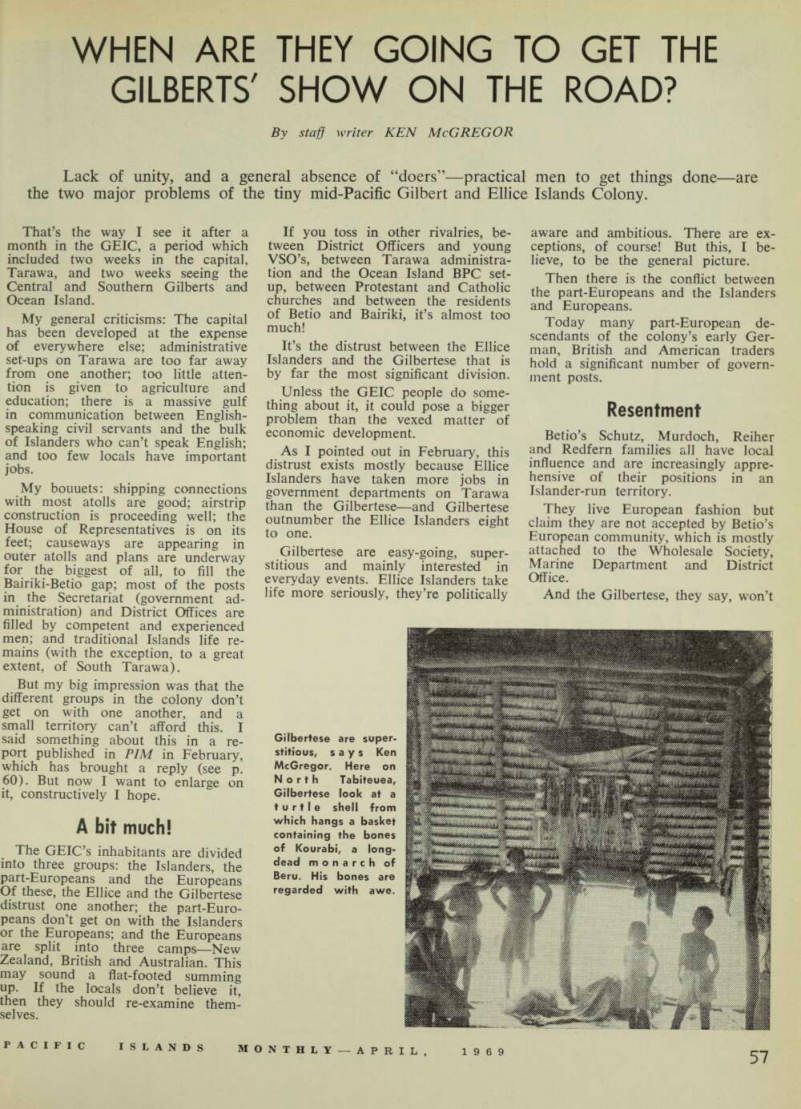
Gilbertese are super stitious, says Ken McGregor. Here on North Tabiteuea, Gilbertese look at a turtle shell from which hangs a basket containing the bones of Kourabi, a long dead monarch of Beru. His bones are regarded with awe.
'We are nobodies"
accept them either and resent the way they have prospered, before 1939 as traders and mariners, and since then as government employees.
Willie Schutz, for example, at his own expense qualified as a Master Mariner overseas. His pay now, he claims, is less than half that of a European with similar qualifications.
“We are nobodies,” he told me.
Many of the colony’s part-Euro peans would leave, if they could.
Several have tried Australia but most see Fiji as their only hope.
Marked divisions have appeared in Tarawa’s European community re cently as recruiting of overseas con tract workers has expanded, and ex tended to Australia and NZ.
The government has taken on a lot of expatriate staff in recent years, particularly in its Wholesale Society, Marine and Public Work Depart ments. Australians have generally been associated with the WS, New Zealanders with the PWD and Secretariat and Englishmen with the Marine, Secretariat and Education departments.
Add to this soup Britain’s colonials who, as Empire has disappeared in Africa, Asia and the Caribbean, have found the GEIC a beautifully-quiet outpost to live out the years until their pension is due.
In the civil service, little gets done.
Ideas are available by the score, but there are too few people with the initiative to put them into practice.
There are people with competence, as I have said, but there are just not enough of them.
As for development, it’s pitifully absent. American and British offers have been received to build resorts, the feelers were out for the football pools’ scheme Nauru landed, the Jap anese have offered to buy clam shell, agriculturists say new foods can be grown and animals raised.
But the only signs I saw of current development were Major Bruce Bown’s two $30,000 white lagoon mud airstrips on North Tabiteuea and Abemama and, in various stages, voluntary causeway construction on outer atolls.
The outer atolls of the Gilberts are among the least-developed areas of the Pacific. Subtract 150-ft high flagpoles supported by massive con crete bases and there’s nothing on the atolls but hundreds of smiling Islanders and coconut trees. With out the aged Union Jacks, Russia or the US could own these atolls for all an uninitiated visitor would know.
There are no plans to build new rest-houses on outer atolls—even though internal air services are scheduled to begin this year. No facil ities have been planned for the tourists the GEIC hopes to attract.
Presumably, the colony’s recently
approved Development Corporation is going to tackle tourist development when it gets going. Whether it “de velops” anything depends on whether the right men are chosen to operate it.
Then there’s lack of decision over which airline will run the vital Tarawa-Majuro (Marshall Islands) air link. Fiji Airways wants to go north and Air Micronesia wants to go south. Stalemate—and the GEIC (or the British Government) can’t make up its mind.
If Britain really wants the GEIC developed economically and paying its way when phosphate royalties finish (presumably she wouldn’t com mission a costly survey such as the Mooring Report if she didn’t) enough of the right men haven’t yet dis embarked at Tarawa’s Bonriki air port.
There are competent men enough in the colony already to keep it run ning (with heavy deficits after 1975), but not expanding. And expand it must.
The GEIC has always been an economic problem, but solutions can be found if Britain takes the problem seriously and gets it out of its back water complex.
Some real activity might help the people who live and work there transcend the petty divisions which at present help restrict progress.
"Some of their best friends are Ellice Islanders/' p. 60.
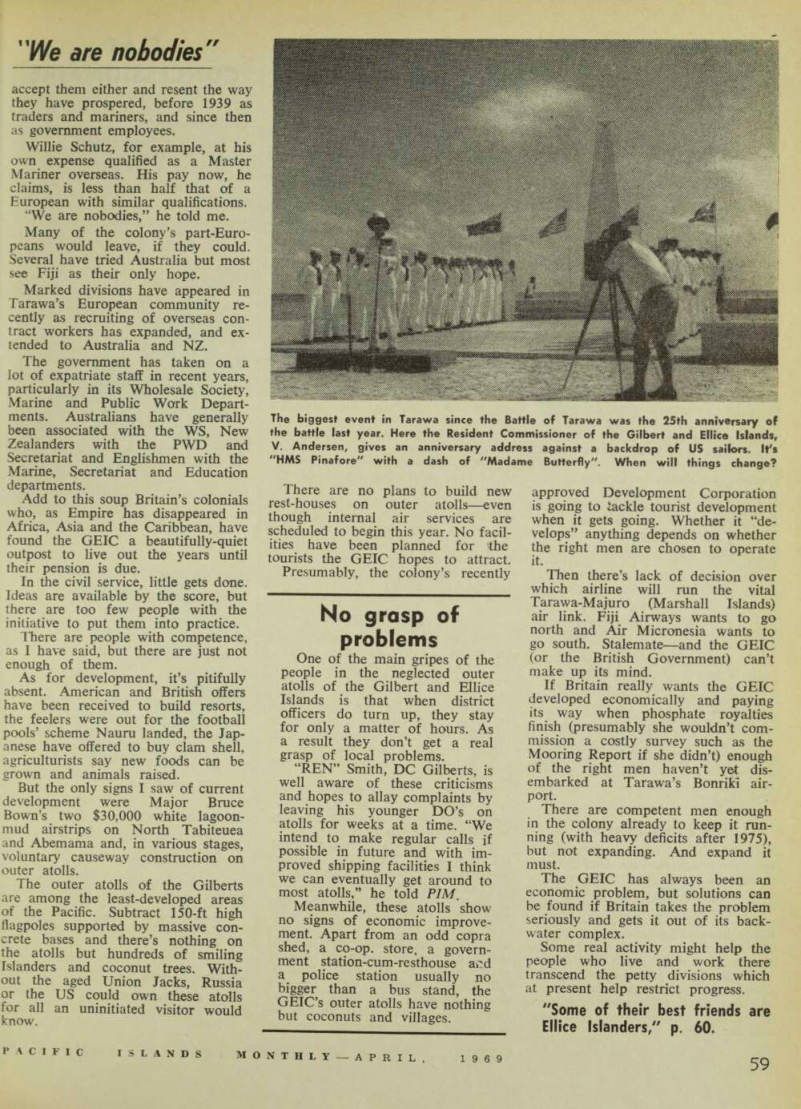
The biggest event in Tarawa since the Battle of Tarawa was the 25th anniversary of the battle last year. Here the Resident Commissioner of the Gilbert and Ellice Islands, V. Andersen, gives an anniversary address against a backdrop of US sailors. It's "HMS Pinafore" with a dash of "Madame Butterfly". When will things change?