To the Point
pp. 56-58 · Read in the full issue
They won't solve the nurses' problems by using that word 'Dohore'
There is a story told of a group of Niuginian students who decided on a protest “march” to express their disapproval of an Administration decision, and asked for Administration transport.
The trainee-nurses from the Papuan Medical College who recently marched on Administration headquarters at Konedobu were of sterner stuff. They rose, I am told, at 4 a.m., made their way along Taurama Road, through Hohola and up the slopes of Burns Peak till they topped the rise above Konedobu. and then waited for daylight and the 8 o’clock eruption before descending on “Happy Valley”.
Their protest was two-fold. First, they claimed that their pay was in sufficient for their needs. Second, they questioned whether their training had too great an element of “learn by doing” in it, and was dictated by the need for keeping the Walter Strong Wing of Port Moresby’s General Hospital staffed, rather than by educational considerations.
Their protest made, they declined an offer of transport back to the college. Tough stuff!
Next day, they were back on the job again, explanations of the new training programme and promise of a review of pay rates having, for the time being, at any rate, placated them.
This trouble had been brewing for some time, and a dilatory Department of Public Health has no one to blame but itself for it having boiled over.
As long ago as the middle of last year, the department was having trouble in recruiting nurse trainees, which was not surprising when other departments were offering better pay prospects for shorter and less arduous training courses.
Questioned on the matter in the House of Assembly, the department’s representative replied blandly that attractive brochures on nursing were shortly to be issued to appropriate school-leaving groups. Everything was under control.
"Under review"
Apparently the brochures were more attractive than the reality. The pay prospects of indigenous nurses are certainly not attractive. Last June, in the House of Assembly, we were told that salary scales were to be reviewed.
In September they were being re viewed. In November thev were still under review. And in March this
To the Point with Percy Chatterton
year, more than a month after the trainee-nurses’ strike, the Ministerial Member for Public Health was un able to say when the review would be completed. As a popular song says, “When will they ever learn?”
The Papuan Medical College is, in many ways, an attractive place. But “attractive” is not an adjective which anyone could truthfully apply to the Walter Strong Wing. Even the late Dr. Walter Strong, who was Chief Medical Officer when pre-war Papua’s total Commonwealth grant was less than £50,000 a year and was con sequently innured to austerity, would not, I think, have called it attractive.
The current in-word for this type of institution is, I believe, “functional”.
Courage ... and cash
Port Moresby General Hospital comprises the Macgregor Wing and the Walter Strong Wing. Not many years ago we were referring to them as the European Hospital and the Native Hospital without batting an eyelid. How crude and colonial we were! Then, not without occasional slips of the tongue, we started to call them the Paying Wing and the Non-paying Wing.
A few Niuginians, possessed of both courage and cash, broke with
tradition and began to avail them selves of the facilities offered by the Paying Wing, while one eccentric European insisted on being admitted to the Non-paying Wing. Most of his co-nationals took the view that he should have been put in the Psychiatric Ward.
Then came the decision to charge patients in the “non-paying” wing.
True, the charges were not large: 20 cents for out-patients, and for in patients $2 however long their stay.
But the term “non-paying” being no longer applicable, we are forced back on “MacGregor” and “Walter Strong”.
As I have said, the Walter Strong Wing is strictly functional. It con sists of a series of pairs of shed-like concrete floored wards, the wards of each pair being linked together by a service block made up of office and treatment rooms. On the grassy spaces between the wards camp the friends and relatives of the patients, surrounded by mats, blankets, dilly bags, primus stoves, saucepans and other impedimenta in picturesque and often quite unhygienic con fusion.
The shock to the systems of Aus tralian-trained nursing sisters on first surveying this scene must be con siderable, and it is not surprising
Constructive suggestions
that the relationship between the sisters and the patients’ “guardians” is one of strain and sometimes hostility.
The doctors are generally more tolerant, but then they make their rounds and go home. They don’t have to live with it. The sisters complain that the “guardians” not only render the place insanitary but eat the patients’ food and souvenir the hospital equipment.
To the sisters the “guardians” are, understandably enough, an intolerable nuisance. But to Niuginians they are part of the cure, every bit as important as the pills, the injections and the blood transfusions.
The best expression of the Niuginian viewpoint that I have read is to be found in an article by Dr.
Alec Price in the Journal of the Papua and New Guinea Society. Dr.
Price is a retired medical officer who has made an extensive study of the customs and beliefs of the Motu and Koitabu people of Papua’s Central District.
This is how he puts it: “If the sick person is scientifically treated by Europeans, he and his Papuan friends appreciate and welcome the scientific help, as a holding procedure and as expediting healing and the reversal of pathology, while he him self attends to the matter of fundamental cause and restoration of wholeness that the Europeans do not understand.
Design for a hospital
“There is no reason why the two systems should not work side by side, provided there is a respect for the other’s point of view, and a mini mum of interference and thwarting of what each believes is right and essential.
“The Papuan believes that the physical presence of numerous friends and relatives, and acts of kindness and help to the distressed family, are essential to the protection and healing of a sick person. This imposes a measure of inconvenience on the European, but should be capable of being met.”
This is an enlightened doctor’s viewpoint. But one can sympathise a bit with the European sister, ac customed to regard the day’s visiting lour as a nuisance to be endured.
Perhaps one of these days someone
will get round to designing a hospital based on the validity of Dr. Price’s analysis. As I envisage it, it would consist of clusters of small huts, each cluster being grouped round a central service block, with office and treat ment rooms.
Each patient would be allotted a hut, in which he could have as many friends and relatives as it would hold. Rations would be issued un cooked, and the “guardians” would be responsible for cooking and supplementing them. Cooking could be done barbecue fashion outside each hut, with perhaps a communal cooking area under cover for wet weather.
Communal toilet and ablution blocks would also be needed, and perhaps one or two conventional wards for the patients who had no “guardians”.
A set-up like this should be much easier to keep clean than the present one, since the “guardians” of each patient could be held responsible for
the cleanliness of the hut and its surroundings. At present anybody’s job is nobody’s job, and it is often impossible to pin down responsibility for mess to any particular person or group.
Perhaps a hospital designed like this would be too costly. But if it were practicable it would be worth trying out.
In the meantime we are stuck with the dear old Walter Strong Wing. Nobody loves it. Nearly everybody grumbles about it. Which is a pity, because much dedicated professional effort goes into its daily round. The administrative and sec retarial staff, I suspect, are too busy coping with the paper war inseparable from a modern public service to notice what is going on around them.
What to do? I suggest that we need three additional people on the staff—a manager, an almoner and a fixer.
Additional staff
The manager should be respon sible for tying up the organisational loose ends, for making sure that the many and varied jobs needed to keep the place ticking are actually being done, are being done properly, and dovetail into one another. He should acquire a reputation for being liable to pop up in any part of the hospital at any moment. It would perhaps be better not to give him an office
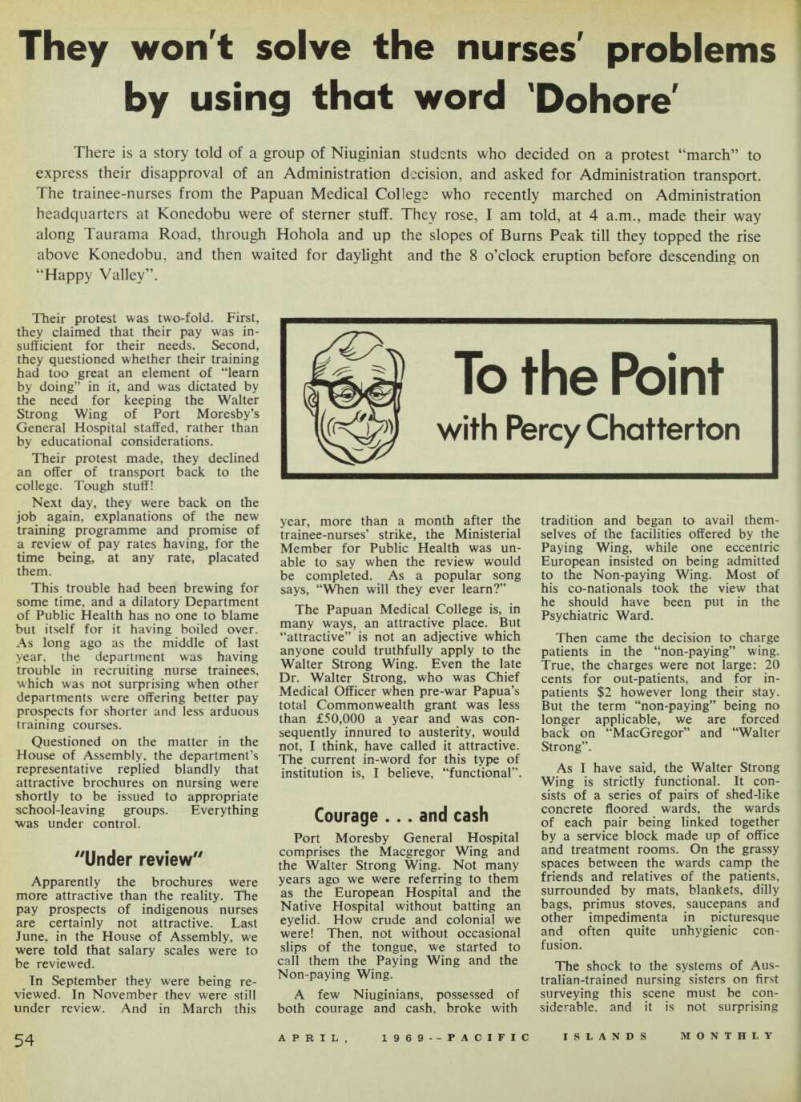
Some of Port Moresby's nurses have held a protest march, complaining against low pay and, more particularly, that they get too much lackey work around the hospital rather than the kind of higher instruction on nursing and medical care being demonstrated in this picture, taken at the hospital. The trouble has been brewing for some time, says Percy Chatterton, and the P-NG Health Department has only itself to blame.
Many have long years of service
at all; then he wouldn’t be tempted to sit in it dictating directives.
We are fortunate at the moment in having two Australian Volunteers Abroad members —a husband and wife team, both of them trained welfare workers working as almoners in the Walter Strong Wing.
They are doing as good a job as their limited facilities and lack of status will allow. But this should be a public service position, and it is difficult to understand why the Public Health Department has, apparently, set its face against the creation of such a position.
Its occupant, if it were created, should be a qualified sociologist who would have the status to meet the professional medical staff on terms of equality, and to have his views respected by them.
Finally there should be a fixer.
He should be a man of earthy mind.
When the toilets are being fouled overnight, it should occur to him that this may be due, not to original sin, but to the fact that the light globes have blown. It should occur to him that it is a waste of money to buy native garden produce and leave it lying around in heaps on the concrete floor to go rotten, when it could be kept fresh by being stored in ventilated racks. And so on.
There would be plenty for him to do.
I am not sure which of these three should have the job of persuading the cooks that food should not only be good but should look good and taste good too, but I am sure that one of them should do so.
I have never known wholesome food made to look so repulsive as that on the trolleys trundled round the wards of this hospital.
The Walter Strong Wing does, however, deserve a hearty pat on the back for one recent development, namely the intensive care ward, in which seriously-ill patients get every care and comfort that modern medical science can provide.
I rmn momnnoc LUny memune* There is one small group on the hospital staff whose memories go back to pre-war Papua. These are the now elderly men who were among the dozen or so young trainee medical assistants sent to Australia in 1933 to do a six-months’ course of training at Sydney University’s School of Tropical Medicine.
Incidentally, Sir Hubert Murray’s latest biographer is wrong in saying that this experiment was not repeated; in fact, at least three groups of about a dozen trainees each did this course between 1933 and 1937.
Some of these men have amply repaid the cost of their training by long years of faithful service with never a strike, and four of that first 1933 group hold down responsible jobs in the Walter Strong Wmg.
Their memories go back to those earlier, simpler days when the “Native Hospital” was on Ela Beach.
Like its successor, it was strictly “functional”. Its wards, though constructed of imported materials, were built on piles over the sea after the fashion of a Papuan beach village.
Crude, and in its later years dilapidated, as it was, it was in many ways a pleasant place; and I have often felt that when needed expansion could not be carried out there for lack of space, more effort might have been made to find another shore-side site instead of the present drab location on Taurama Road.
One of the most extensively opera-
five words in Papua has always been the Motu word Dohore, which means “bye-and bye”. So there is a delightful appropriateness in the f ac t that when, in 1967, it was decided to establish a Hospital Advisory Board for the Port Moresby General Hospital, it was found possible to do so under an ordinance 0 f 1911. r n , , u . Du , n "S “ s first dr . pf work the
! J* C? J ° B
f h em it has also been successful n {£ £ es f of a° number of local government councils in a project for providing accommodation for “guardians”.
The plan involves an expenditure G f $7,000 on sleeping, cooking, toilet and ablution facilities for 100 friends and relatives of patients, and nearly half of this has already been given 0 r promised bv councils, Unfortuna tely, the 1911 ordinance mits the memb ership of the board fi which makes P it too small t 0 rea „ representative and there is amending ordinance to ide for a more representative board perhaps this situation> like the nurses’ salary scale, is “being re viewed”. Dohore!
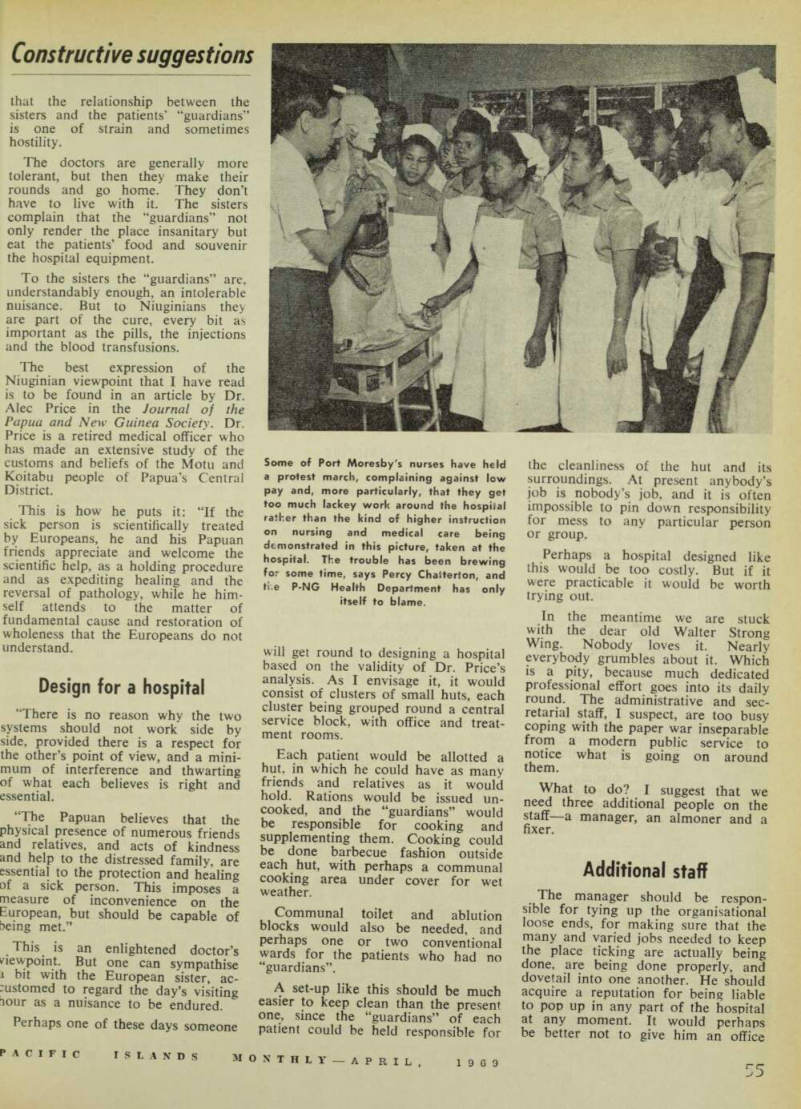
There's no question of the standard of medical care for patients at the Port Moresby hospital, but some other aspects of the hospital are in dispute. What are needed, says Percy Chatterton, are a "manager, an almoner and a fixer".