New Caledonia Today
pp. 44-51 · Read in the full issue
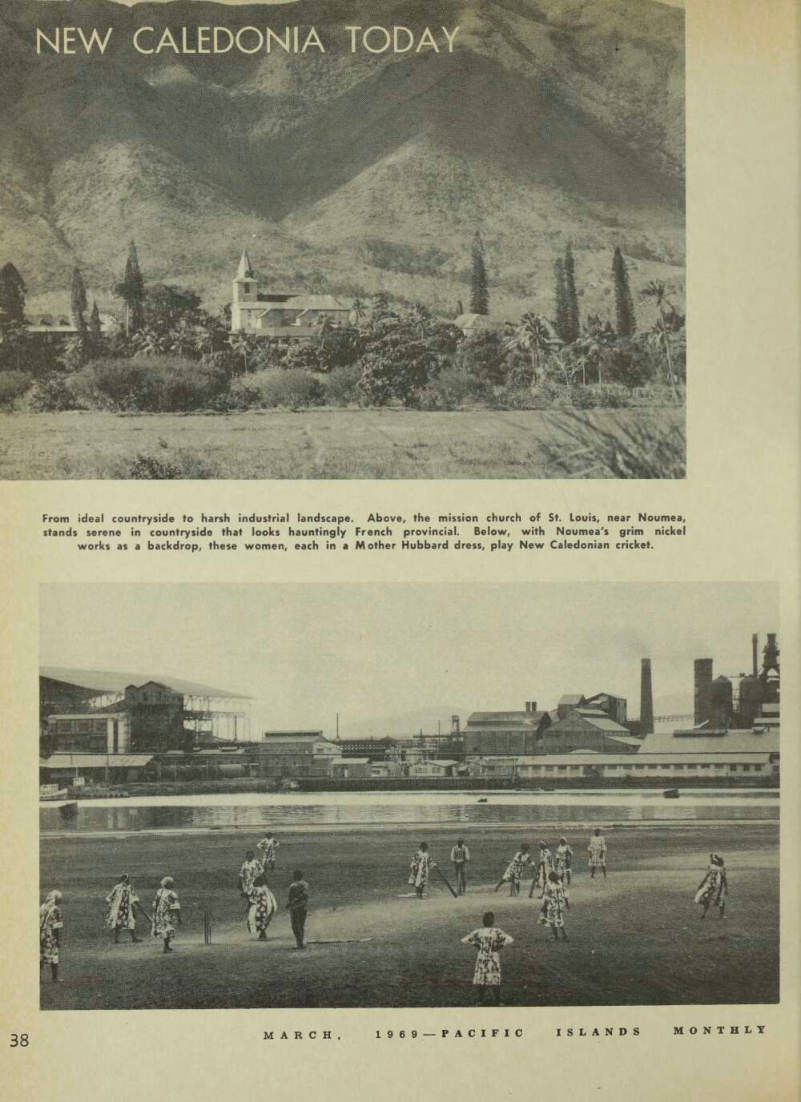
From ideal countryside to harsh industrial landscape. Above, the mission church of St. Louis, near Noumea, stands serene in countryside that looks hauntingly French provincial. Below, with Noumea's grim nickel works as a backdrop, these women, each in a Mother Hubbard dress, play New Caledonian cricket.
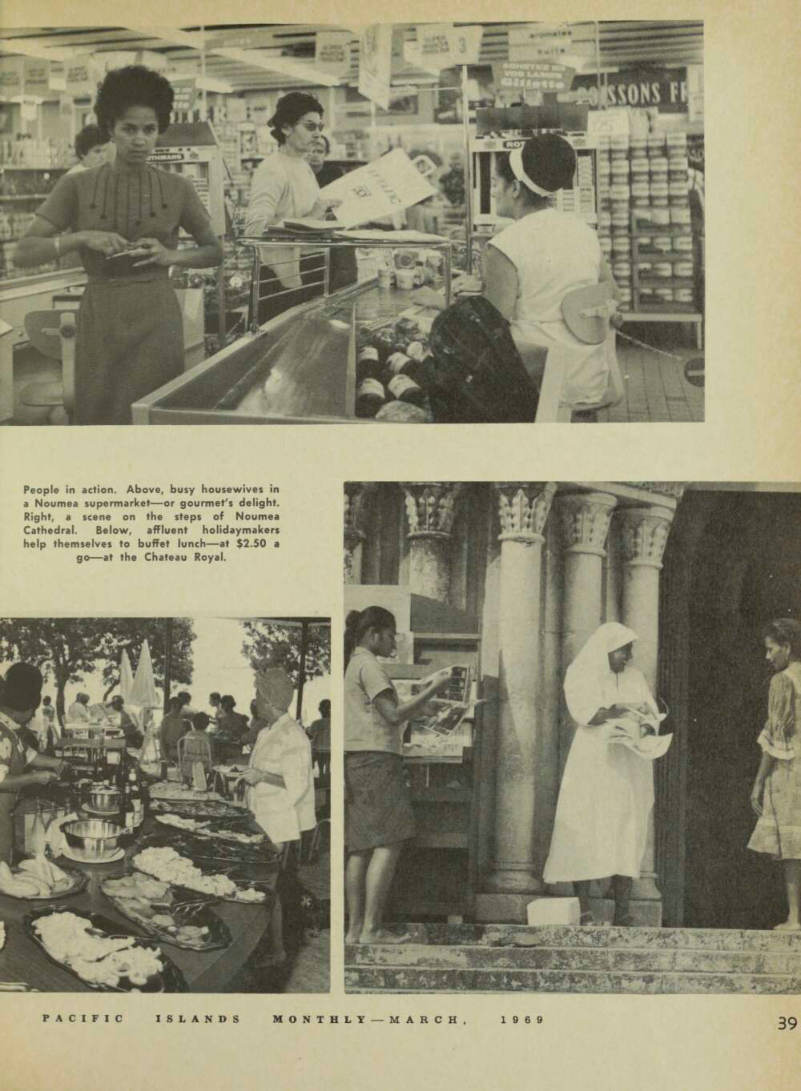
People in action. Above, busy housewives in a Noumea supermarket—or gourmet's delight.
Right, a scene on the steps of Noumea Cathedral. Below, affluent holidaymakers help themselves to buffet lunch—at $2.50 a go—at the Chateau Royal.
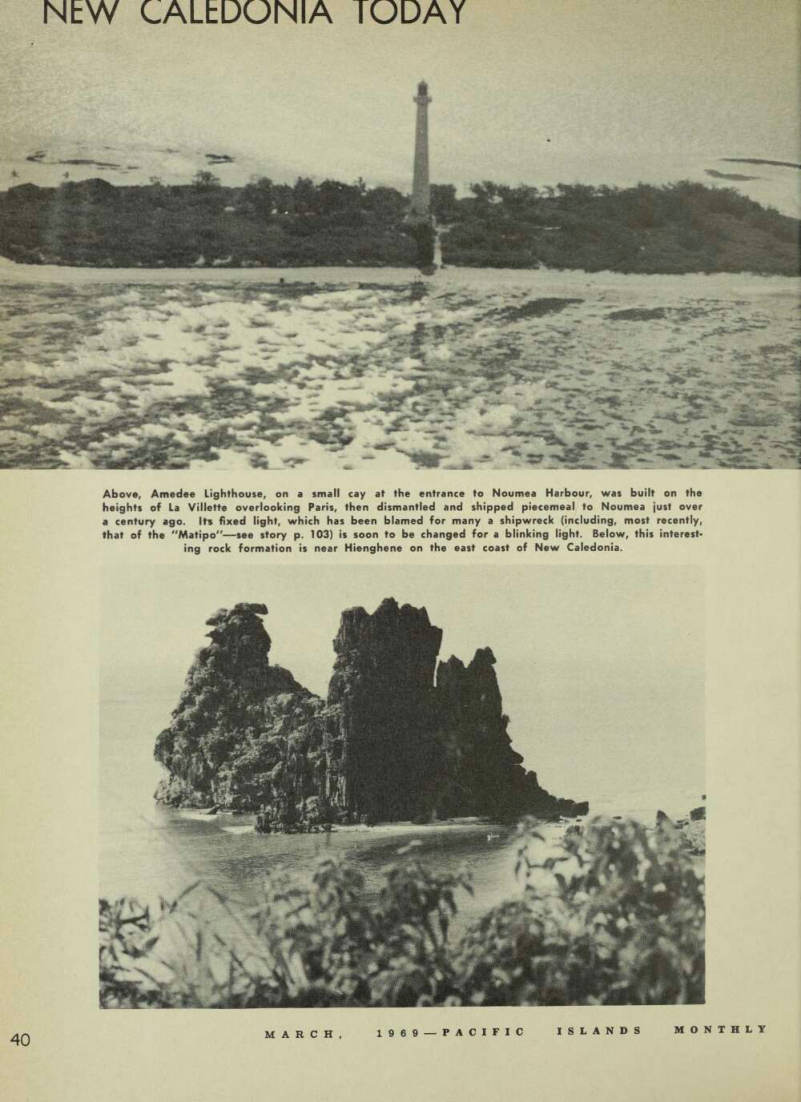
Above, Amedee Lighthouse, on a small cay at the entrance to Noumea Harbour, was built on the heights of La Villette overlooking Paris, then dismantled and shipped piecemeal to Noumea just over a century ago. Its fixed light, which has been blamed for many a shipwreck (including, most recently, that of the "Matipo"—see story p. 103) is soon to be changed for a blinking light. Below, this interest* ing rock formation is near Hienghene on the east coast of New Caledonia.
New Caledonia Today
New Caledonia Is A Beauty, Mate
(But The People Speak French!)
By Judy Tudor
A New Zealander whom I met several years ago in New Caledonia said that it was only New Zealanders who appreciated what the French colony had to offer—good food and wine. Austra lians, he said, were interested only in meat pies, beer and places like Surfers Paradise.
It was news to me that the people of the land of my birth were so sold on the haute cuisine. I’d just spent three weeks in NZ, in hotels, and if I’d been asked to guess I’d have said that they lived on a steady diet of roast hoggett, two veg., steamed pudding with custard and dark coloured beer.
But be all this as it may, it now seems to be Australians who are do ing most for the tourist industry of New Caledonia and few of the shocks that are in store for them come through the food or the wine or the unavailability of Mr. Sargent’s meat pies.
They will be shocked, however, by the fact that there is a big slice of de Gaulle in every Frenchman.
If they can break through this in visible barrier of what seems like remoteness, can ignore it, or meet only colonial or New Caledonian born Frenchmen, then New Caledonia is very worthwhile indeed.
They get peeved
The atmosphere of New Caledonia is French Mediterranean and not Pacific Island and for this alone it should have much merit in the eyes of adventuring Australians. Unfor tunately, adventuring Australians are getting to be a bit like travelling Americans: they like going foreign; they just get peeved when they find that things are not exactly as they are at home.
Frenchmen who feel that everyone else is an uncultured savage are, for their part, just as firmly resolved that they will not depart from their own traditions. And good luck to them.
My own pet nightmare about the Pacific is that it will soon be im possible to distinguish any hotel in Fiji from its exact counterpart in Hawaii; and that duty-free shops and three-piece guitar combos will stretch all the way from Hayman Island to Mururoa atoll.
If our Aussie has gone to the Islands before, then shock number
one in New Caledonia could well be his reception at his hotel. Instead of someone like a genial Fijian, with a grin from ear to ear, he will be received either by an off-hand female or a formally polite male and will share her or his attention with seven other butters-in, half of them using voluble French.
It is seemingly impossible for anyone behind a desk or counter in New Caledonia to deal with one customer at a time. Either through desire to demonstrate bi-lingual dexterity or through French habit, it is necessary for everyone to juggle at least four conversations in the air at the same tin i®-. , , ~. 4 This can be frustrating to the customer but works both ways. It can also become a form of indoor sport.
After you have got the hang of it, there is no need to hang back in the wings, in Anglo-Saxon reticence, When you see that tourist from Texas has at last got the clerk’s eye and
is asking which way to the aquarium, hop straight in at the middle and demand to know why the water has gone off. You will get the clerk’s immediate attention and at least half the explanation before someone else, in a torrent of French, is wanting to know what happened to the air freighted flowers for the Admiral’s suite, Another peeve is that Frenchmen speak French. Most Australians, even uneducated ones, vaguely realise this. Nonetheless, when they see it taking place before their horrified eyes, they are sometimes shocked,
Communication problem
r In tourist hotels, language is no problem. Elsewhere it can be. Most local inhabitants bear up nobly while the foreigner mangles his language or has recourse to a dictionary, or even writes things on scraps of paper.
Some even find it entertaining or are anxious to try out their English
—and, on a population basis, there are far more Frenchmen in New Caledonia who speak idiomatic Eng lish than there are Australians who speak even passable French.
But for downright non-compre hension in English, French, the written word or even sign language, the teenage waitresses and snack bar attendants in Noumea are in a class on their own. The Australian waitress was once world famous for her take it-or-leave-it attitude and the fragility of her sensibilities, Her crown has now passed to the New Caledonian girl Melanesian, Poly nesian, Wallisian or of mixed race —who cultivates the temperament of a diva and habitually looks as though she wishes her customers would drop dead.
This is extraordinary when you consider that, in the rest of the Pacific, a local girl can be depended upon to be amiable, smiling and anxious to please, even if she cannot be de pended upon for much else.
Headaches
New Caledonia has a perennial labour problem which has been partly solved in some industries but which continues to provide headaches for those who want to see an expansion of tourism.
But for a week in January, three weeks before that hurricane, I en joyed New Caledonia as never be fore. The sky was blue, the sea bluer and a cool south-east trade wind kept temperatures pleasant. I was with my family and the Chateau Royal was much improved since my previous visit 14 months before.
The food was better. The Chinese restaurant staff had been replaced by waiters from France, or at any rate, Europe, on contract, and as a result the Chateau can now boast
the best waiters in the South Seas.
Good looking, too.
After a hard day’s lazing, it’s ex ceedingly pleasant to sit in the dim ness of the hotel’s cocktail bar and watch the artist behind it whip up, with dead-pan face and dexterity, poems of liquid refreshment. The drinks and the way they are pro duced almost compensate for the excruciating pain of the cost of the things.
But even the Chateau has its South Seas problems. On the first night the electricity went off, taking with it the air-conditioning—something was wrong with Noumea’s power supply.
On the second day, the water was off from 8 a.m. till 5 p.m.—New Caledonia, at the time, was having a drought. On the third day the air conditioning blew hot instead of cold.
The reception staff by this time had erected an icy barrier of anguish around itself and we felt that we were unloved and unwanted.
We took ourselves to the other side of town to the motor show, full
of lush Continental cars, thousands of dollars cheaper than in Australia.
Later, sighing for membership of the Common Market, waiting at the bus stop in the boiling sun, a large French man, in a small car, insisted on accommodating five of us (“petite derrieres in the front if you please”) and told us the story of his life on the way to the city square where we parted with expressions of mutual regard, vive de Gaulle and all the rest of it. Frenchman can be fun.
Back at the hotel, the pool was out of commission but with the warm sea reaching to the edge of the lawn it was of small consequence. Next door is the magnificent pool that was built for the second South Pacific Games. There is nothing like it in any of the other Pacific Islands and nothing better in Australia and New Zealand.
Prefer the sea
Yet my 14-year-old nephew and I, one sunny Saturday morning, shared the whole Olympic size of it, and its palatial dressing-rooms, with three other tourists and six New Cale donians. Most of the local teenagers seem to prefer to swim in the sea off the Chateau Royal, to lie on its green lawns or to patronise the pool at Nouvata Hotel.
Although New Caledonia is tops in climate, and new things to see and new people to meet, has restau rants galore and interesting shops, there is no way of blinking the fact that at the present rate of exchange it is exceedingly expensive for Aus tralians and New Zealanders.
New Caledonia’s high wage structure in comparison with other Pacific Islands, the fact that it de pends on import and export duties for four-fifths of its local revenue and that most foods have to be im
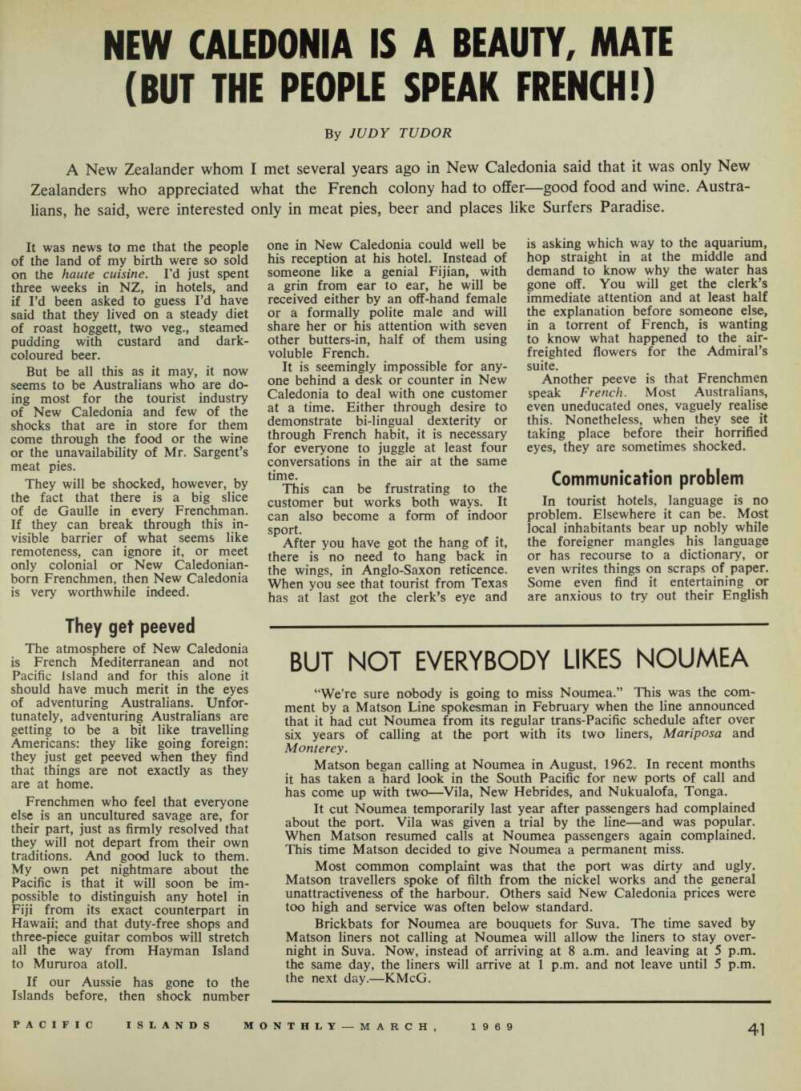
Noumea's mini-buses are fast, frequent and, as things go in Noumea, cheap. You can go anywhere you like in Noumea in them for 20 francs. The bus pictured is in Coconut Square in the city centre.
Guests relaxing on the beach at the Chateau Royal.
ported, all add to a problem that begins with an over-valued franc.
There are, of course, plenty of hotels in New Caledonia cheaper than the Chateau; and, for the matter of that, there is a pleasant camping ground right opposite the Olympic pool. Nevertheless, New Caledonia comes out badly on a cost-for-cost comparison with Fiji—and with Fiji it must inevitably compete if it is to get its share of the promised 1970’s tourist bonanza from affluent Australia.
A twin-bedded room at the newest, most expensive hotel in Suva costs the equivalent of SAI6 a night; the same grade of accommodation in Noumea (although Suva, quite frankly, has the edge on Noumea for appointments) is $25. Eating and drinking in restaurants is also pro portionately higher in New Caledonia, although on the whole the food is better.
One possible solution for New Caledonia is the Mediterranean-type villa that has revolutionised tourism in Spain and Italy. Families and parties can rent these for a few weeks at a time, do for themselves and, incidentally, become far closer to the local people and conditions than they ever would in a tourist hotel.
There are already in Noumea a block of apartments and a motel where something of the sort is pos sible but both are off the beach.
In the meantime, the Chateau and other top hotels might take a page out of the books of Travelodge in Suva and the Hotel Tahiti in Papeete and provide small refrigerators and tea and coffee making facilities in their best rooms.
These could chill the occasional bottle of wine or can of beer bought in that gourmet’s delight, a Noumea supermarket, at a price that is un believably low in comparison with imbibing same in a restaurant.
A refrigerator could also have other uses. Family parties occasion ally jack up on $2.50 buffet lunches, excellent though they are, and prefer something simpler. Armed with a yard of beautiful bread, some French cheese, a pat of Australia butter, a quart of rough red and a few tomatoes (scarcer than rubies in Noumea in January and almost as expensive), they picnic on the terrace outside that $25 room.
Although such practices are naturally abhorred by any self-re specting French hotelier, and refrig erators don’t go with Louis XIV decor, it would be a small concession to Australian barbarians who are likely to make up an increasing pro portion of New Caledonia’s tourists in the years just ahead.