To the Point
pp. 40-42 · Read in the full issue
THE P.I.R. COSTS A LOT TO RUN,
And What Exactly Is It For?
Albert Maori Kiki, in his recently published autobiography, recalls how he and his wife, then his fiancee, became involved in an incident which touched off the Pacific Islands Regiment riot of the late 1950’5. Those of us who remember that occasion—and as the house in which I was then living overlooked Koki Market I had a ringside view—know what a shocking affair it really was.
As Albert Maori Kiki himself shows, the blame for it was not all on one side, but the public had a right to expect that the men of the PIR would have more self-control than their shanty-dweller opponents, and there were some incidents which no provocation could excuse. Voices were raised demanding the regiment’s disbandment.
The PIR blotted its copy-book badly on that occasion. But it was not disbanded, and in the decade which has passed since it has worked hard to erase the blots and to re establish itself in the confidence of the public. And it has succeeded.
It is not for an outsider to appor tion the credit, but those who have had the privilege of knowing Briga dier lan Hunter, who had just relin quished the post of commander of the P-NG Army Command, can hardly avoid feeling that he has had a lot to do with it.
To the Point with Percy Chatterton
Be that as it may, the PIR is now a well-trained and well-disciplined body of men and those responsible for making it so have every right to be proud of it. We do not need to doubt their sincerity when they say that, while the PIR is at present an integral part of the Australian Army and outside the control of both the P-NG Administration and the House of Assembly, it is their aim to mould it into a body which
in due course can become a national army controlled by and loyal to the government of the day.
Nor do we need to doubt their sincerity when they claim that their educational branch, and it is an ex cellent one, is geared to inculcate an understanding and acceptance of the proper relationship between the civil and military arms in a democracy.
Let us accept that those in charge of the PIR have done the job they were given to do and have done it well. It is no criticism of them or their troops if John Citizen wonders what it is all for and where it will all lead.
First, what is it for?
Where's the threat?
To maintain national security? If so, against what sort of threat internal or external? Normally in ternal threats to security can be handled by the police. True, there was the case of Malaya. But I find it hard to believe that our Chinese storekeepers and businessmen, work ing like beavers to pay for their children’s education in Australia, are ever likely to take to the jungle and become Communist guerrillas.
Again, there is the case of Nigeria.
But if ever we have to face the prob lem of a break-away region in Niu gini, I hope that we will be able to find a better solution to it then a Biafra-type blood bath. The fairly remote contingency of an internal threat to security requiring armed
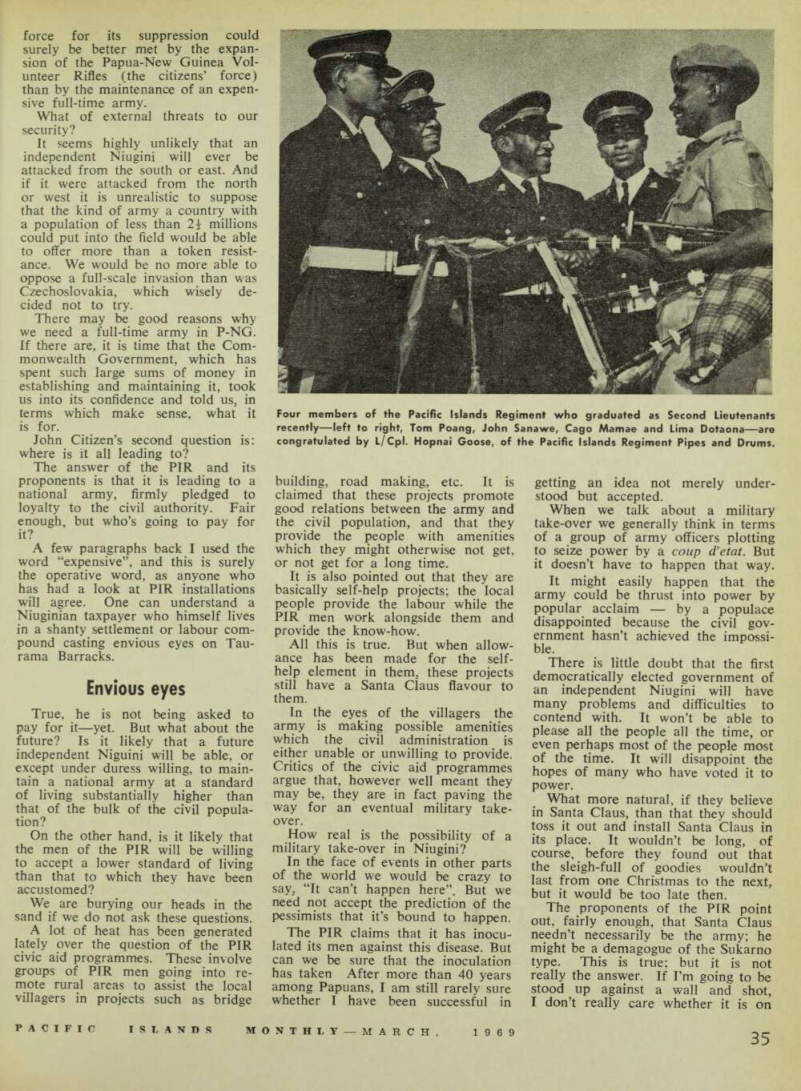
Commander of the Army's P-NG command, Brigadier lan Hunter, has a final review of his troops in February before leaving for Canberra where he is now Quartermaster- General at Army headquarters.
force for its suppression could surely be better met by the expan sion of the Papua-New Guinea Vol unteer Rifles (the citizens’ force) than by the maintenance of an expen sive full-time army.
What of external threats to our security?
It seems highly unlikely that an independent Niugini will ever be attacked from the south or east. And if it were attacked from the north or west it is unrealistic to suppose that the kind of army a country with a population of less than 2± millions could put into the field would be able to offer more than a token resist ance. We would be no more able to oppose a full-scale invasion than was Czechoslovakia, which wisely de cided not to try.
There may be good reasons why we need a full-time army in P-NG.
If there are, it is time that the Com monwealth Government, which has spent such large sums of money in establishing and maintaining it, took us into its confidence and told us, in terms which make sense, what it is for.
John Citizen’s second question is: where is it all leading to?
The answer of the PIR and its proponents is that it is leading to a national army, firmly pledged to loyalty to the civil authority. Fair enough, but who’s going to pay for it?
A few paragraphs back I used the word “expensive”, and this is surely the operative word, as anyone who has had a look at PIR installations will agree. One can understand a Niuginian taxpayer who himself lives in a shanty settlement or labour com pound casting envious eyes on Tau rama Barracks.
Envious eyes
True, he is not being asked to pay for it—yet. But what about the future? Is it likely that a future independent Niguini will be able, or except under duress willing, to main tain a national army at a standard of living substantially higher than that of the bulk of the civil popula tion?
On the other hand, is it likely that the men of the PIR will be willing to accept a lower standard of living than that to which they have been accustomed?
We are burying our heads in the sand if we do not ask these questions.
A lot of heat has been generated lately over the question of the PIR civic aid programmes. These involve groups of PIR men going into re mote rural areas to assist the local villagers in projects such as bridge
building, road making, etc. It is claimed that these projects promote good relations between the army and the civil population, and that they provide the people with amenities which they might otherwise not get, or not get for a long time. !t is also pointed out that they are basically self-help projects; the local people provide the labour while the PIR W ,° rk a [ ongslde them and provide the know-how All this is true. But when allowance has been made for the selfhelp element in them, these projects still have a Santa Claus flavour to them.
In the eyes of the villagers the ai ? y u 15 ™ akl . n B possible amenities which the civil administration is either unable or unwilling to provide.
Critics of the civic aid programmes argue that, however well meant they may be, they are in fact paving the way for an eventual military takeov L r - . . .
How real is the possibility of a mi itary take-over m Niugini?
In the face of events in other parts of the world we would be crazy to say It cant happen here . But we need not accept the prediction of the pessimists that it s bound to happen.
The PIR claims that it has inoculated its men against this disease. But can we be sure that the inoculation has taken After more than 40 years among Papuans, I am still rarely sure whether I have been successful in
getting an idea not merely under stood but accepted, When we talk about a military take-over we generally think in terms of a group of army officers plotting to seize power by a coup d’etat. But it doesn’t have to happen that way.
It might easily happen that the army could be thrust into power by popular acclaim by a populace disappointed because the civil gov ernment hasn’t achieved the impossi ble There is little doubt that the first democratically elected government of an independent Niugini will have many problems and difficulties to contend with. It won’t be able to plea se all the people all the time, or even perhaps most of the people most of the time . It will disapp^ int the hopes of many who have voted it to power what more natura |, if they beHeve in Santa Claus, than that they should toss it out and install Santa Claus in its place . It wou ldn’t be long, of course, before they found out t hat , he s i e i g h-full of goodies wouldn’t as t from one Christmas to the next, but it wou i d be tOO late then The proponents of the PIR point out, f a i r iy enough, that Santa Claus needn’t necessarily be the army; he might be a demagogue of the Sukarno type. This is true; but it is not really the answer. If I’m going to be stood up against a wall and shot, I don’t really care whether it is on
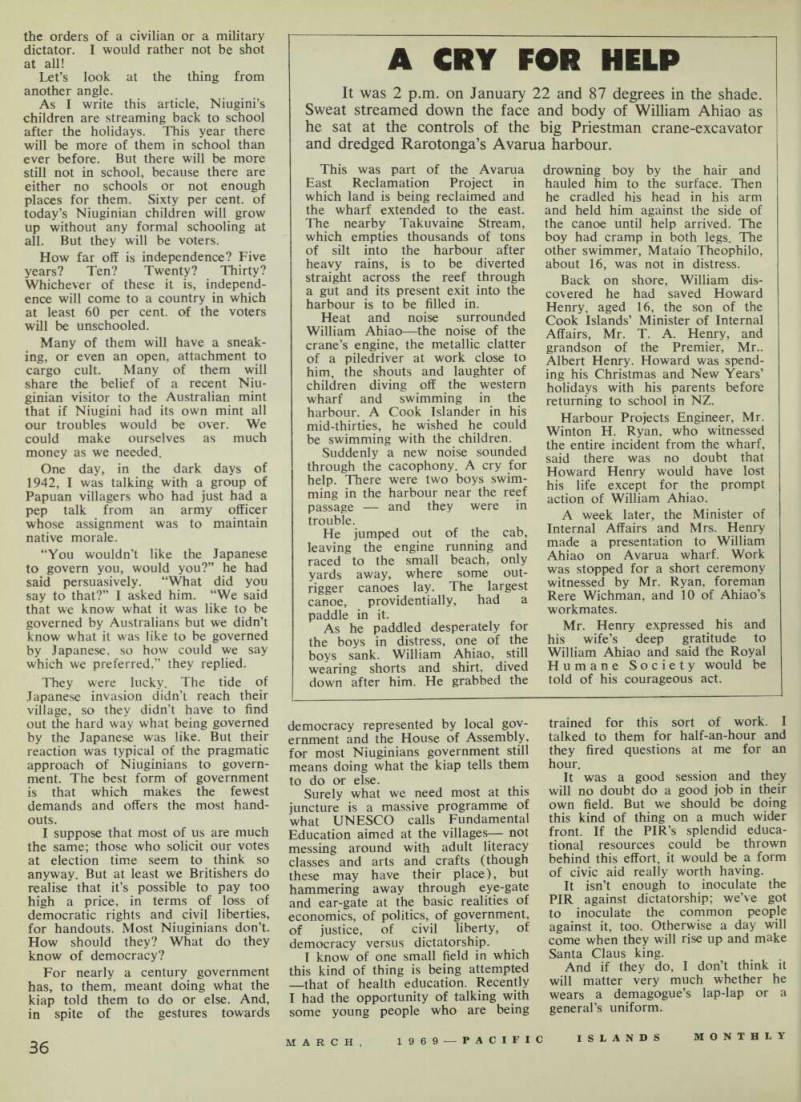
Four members of the Pacific Islands Regiment who graduated as Second Lieutenants recently—left to right, Tom Poang, John Sanawe, Cago Mamae and Lima Dotaona—are congratulated by L/Cpl. Hopnai Goose, of the Pacific Islands Regiment Pipes and Drums.
the orders of a civilian or a military dictator, I would rather not be shot at all!
Let’s look at the thing from another angle.
As I write this article, Niugini’s children are streaming back to school after the holidays. This year there will be more of them in school than ever before. But there will be more still not in school, because there are either no schools or not enough places for them. Sixty per cent, of today’s Niuginian children will grow up without any formal schooling at all. But they will be voters.
How far off is independence? Five years? Ten? Twenty? Thirty?
Whichever of these it is, independ ence will come to a country in which at least 60 per cent, of the voters will be unschooled.
Many of them will have a sneak ing, or even an open, attachment to cargo cult. Many of them will share the belief of a recent Niu ginian visitor to the Australian mint that if Niugini had its own mint all our troubles would be over. We could make ourselves as much money as we needed.
One day, in the dark days of 1942, I was talking with a group of Papuan villagers who had just had a pep talk from an army officer whose assignment was to maintain native morale.
“You wouldn’t like the Japanese to govern you, would you?” he had said persuasively. “What did you say to that?” I asked him. “We said that we know what it was like to be governed by Australians but we didn’t know what it was like to be governed by Japanese, so how could we say which we preferred,” they replied.
They were lucky. The tide of Japanese invasion didn’t reach their village, so they didn’t have to find out the hard way what being governed by the Japanese was like. But their reaction was typical of the pragmatic approach of Niuginians to govern ment. The best form of government is that which makes the fewest demands and offers the most hand outs.
I suppose that most of us are much the same; those who solicit our votes at election time seem to think so anyway. But at least we Britishers do realise that it’s possible to pay too high a price, in terms of loss of democratic rights and civil liberties, for handouts. Most Niuginians don’t.
How should they? What do they know of democracy?
For nearly a century government has, to them, meant doing what the kiap told them to do or else. And, in spite of the gestures towards
democracy represented by local gov ernment and the House of Assembly, for most Niuginians government still means doing what the kiap tells them to do or else.
Surely what we need most at this juncture is a massive programme of what UNESCO calls Fundamental Education aimed at the villages- not messing around with adult literacy classes and arts and crafts (though these may have their place), but hammering away through eye-gate and ear-gate at the basic realities of economics, of politics, of government, of justice, of civil liberty, of democracy versus dictatorship.
I know of one small field in which this kind of thing is being attempted —that of health education. Recently I had the opportunity of talking with some young people who are being
trained for this sort of work. I talked to them for half-an-hour and they fired questions at me for an hour.
It was a good session and they will no doubt do a good job in their own field. But we should be doing this kind of thing on a much wider front. If the PlR’s splendid educa tional resources could be thrown behind this effort, it would be a form of civic aid really worth having.
It isn’t enough to inoculate the PIR against dictatorship; we’ve got to inoculate the common people against it, too. Otherwise a day will come when they will rise up and make Santa Claus king.
And if they do, I don’t think it will matter very much whether he wears a demagogue’s lap-lap or a general’s uniform.