Tropicalities
pp. 38-39 · Read in the full issue
Mr. Apisai Tora, key figure in Fiji’s burgeoning trade union movement, hasn’t forgotten the 159 days he spent in prison, before being acquitted of charges connected with the Korolevu Beach Hotel bure fire in August, 1965 . . .
In January, in the first petition received in the House of the Fiji Legislative Council in 20 years, the militant unionist - turned - politician sought the appointment of a Select Committee to consider the payment of compensation.
The motion that a Select Commit tee be appointed moved by Oppo sition member, Suva lawyer Mr. K.
C. Ramrakha—was rejected on a division by 28 votes to eight.
Although acquitted in the Supreme Court, after the judge had overruled the opinion of the majority of the assessors and accepted the minority opinion, Mr. Tora said in his petition that he had spent 159 days in prison before and during the trial be cause he had been refused bail.
The two major issues in the peti tion were: • Whether the police carried out a fair and just investigation. • Whether the Fiji Government should pay reasonable compensation on the damage sustained by Apisai Tora as a result of the state’s in quiry and trial, during which re peated attempts were made to free him.
Opposing the motion, the Attorney- General, Mr. Justin Lewis, said the constitution enshrined the principle of non-interference with the judiciary and magistracy by the executive.
If the petition was referred to a Select Committee, it followed that a number of decisions of the Chief Justice in the trial would have to be questioned or investigated.
Supposing the Select Committee came to the conclusion, for example, that Mr. Tora had been wrongly acquitted?
A week after presenting his petition in the Legislative Council, Apisai Tora again made headlines in Sydney as well as Fiji.
Issue of an Australian visa so that he could attend a national school on industrial relations in Canberra had been delayed, he said— probably because “of what the Fiji Government told the Australian authorities about me. They probably said Tora was a controversial figure.”
A Question Of
Compensation
Whatever the reason, Mr, Tora received his visa the day after the school began on January 31, and he departed for Canberra two days later.
The day before he received his visa, his Australian sponsor, Vic torian Labor M.P., Dr. J. F. Cairns, was quoted in the Sydney Morning Herald as having raised the matter with the Secretary of the Australian Department of Immigration, Mr. P.
Heydon, He said he’d known Apisai Tora for five or six years and considered him a responsible and effective trade union leader.
Dr. Cairns observed that the delay was most likely caused by the fact that Mr. Tora had applied for a visa later than three other Fijian leaders attending the school.
They all live in a
yellow submarine
Are gangs to be added to the blessings of civilisation already intro duced into Papua-New Guinea?
Some time ago we heard about a gang of Hanuabadan (Port Moresby) teenagers which called itself “the Rascals”. Recently, members of a rival gang, “the Ghosts” found them selves in court for having smeared buses, cars and buildings with tar.
They explained that their rivals, the Rascals, had previously painted cars and houses yellow, and the Ghosts had in honour bound to even up the score.
The Ghosts were put on good behaviour bonds, and ordered to pay compensation to the bus company and clean up the mess they had made on cars and buildings.
The Rascals and the Ghosts are symptoms of a malady of urbanisa tion. Hanuabada, once a rural village, is now almost completely urbanised, and Primary School dropouts can no longer slip back into village life, going out hunting and fishing with their dads as they used to.
Some of the lads who find them selves in court are too old for school and too young for employment.
Others are old enough for employ ment, but, with no useful skills, either can’t get jobs or can’t keep them. Their fathers and grandfathers could fall back on their traditional skills if their acquired ones failed to earn them a living. These young un fortunates are skill-less.
The problem, difficult enough of solution anyway, is made all the more difficult by the fact that it lies in a sort of no-man’s-land between several different departments. And the buck passing that goes on between depart ments in the P-NG Administration has to be seen to be believed.
Fiji, where id
can be worth $2O
Where are they, those 23 million missing Fiji coins? They’re the old £.s.d. variety—and Fiji’s Decimal Currency Board is beginning to wonder about them.
In February, a month after Fiji’s change-over to decimal currency, only a little over 2i million of the 26,000,000 £.s.d. coins issued over the years had been returned to the Currency Office in Suva.
The figure for the returned coins doesn’t include the 1/- and 2/- coins issued between 1934 and 1943.
These contained silver and have been
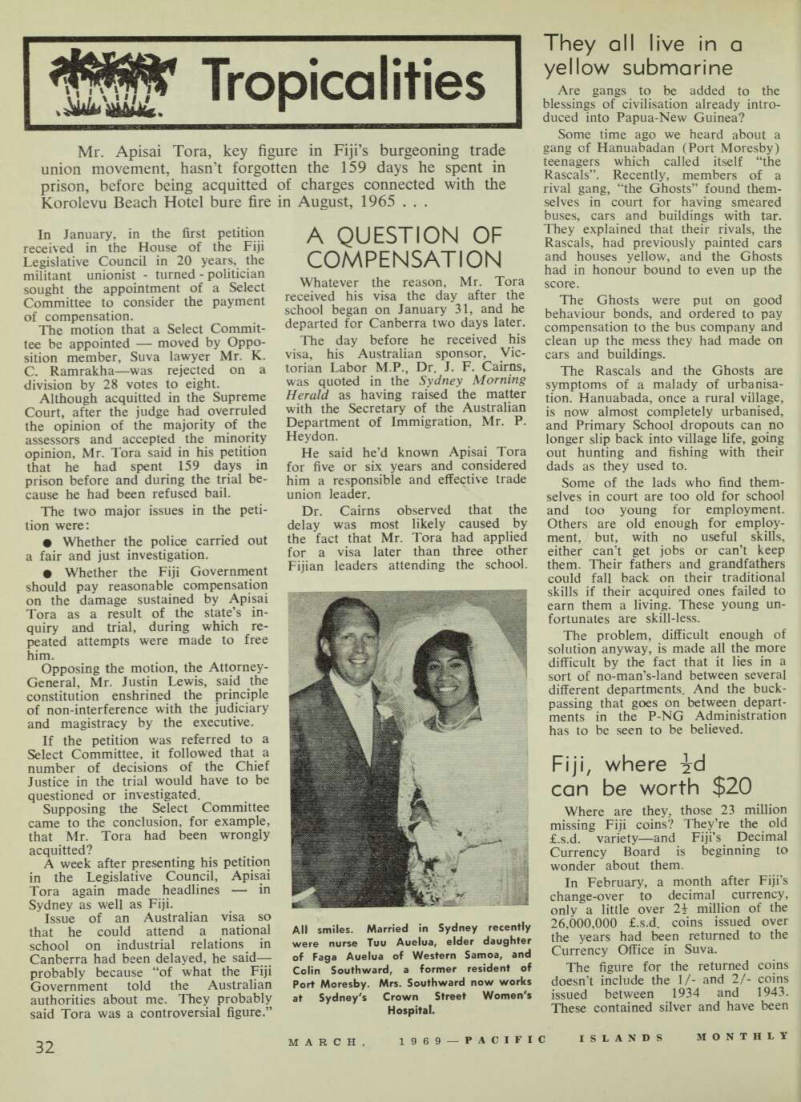
All smiles. Married in Sydney recently were nurse Tuu Auelua, elder daughter of Faga Auelua of Western Samoa, and Colin Southward, a former resident of Port Moresby. Mrs. Southward now works at Sydney's Crown Street Women's
Hospital.
returned by the banks over the years.
Going by returns recorded by other countries which have gone decimal, the board doesn’t expect more than 50 per cent of the old coins back. But that still leaves a lot to come before £.s.d. coins cease to be legal tender—about the middle of the year.
Hoarders are hanging on to the outgoing currency in the hope of cashing in on numismatic demands for old coins. Even now, collectors will pay around $2O for a 1940 Fiji halfpenny—and $lOO for the com plete collection of 89 Fiji coins, dating back to the first issue in 1934.
It’s almost impossible to find a 1967 sixpence in your loose change these days. Although hundreds of thousands were minted, it’s believed that only about 20,000 went into circulation. Speculators tip this one as a likely profit-earner.
Good value if you can find them are the silver-content 2/- coins of 1938 and 1941. Only 20,000 of each were minted. After the war, all silver-content coins were withdrawn and melted down to pay for the cost of the cupro-nickel “silver” coins which replaced them.
As a result, the ’3B and ’4l 27pieces are particularly scarce—and worth between $5 and $6 each.
The 1940 halfpenny is so rare that a few years ago forgers began turn ing out their own version—and selling them at the going market rate of $2O for a mint condition coin.
Right man for a
long, hard look
Teachers throughout Papua-New Guinea have welcomed the news that Dr. C. E. Beeby, CMG, of New Zealand, will be a member of the three man committee appointed by the Minister for External Territories to take a long, hard look at territory education, and particularly at the thorny problems involved in relations between Administration, Missions and Local Government Councils in the educational field.
A few years ago Dr. Beeby delivered the Camilla Wedgwood Memorial Lecture in Port Moresby, and all those who heard the lecture, and especially those who took part in the subsequent seminar, were deeply impressed by his wide range of knowledge and experience and the freshness and independence of his outlook.
A Committee of which Dr. Beeby is a member may be expected to come up with some worthwhile ideas and recommendations.
My chaplain is
newer than thine
Papua-New Guinea seems to be ex periencing a “Day of the Chaplains”.
The Army, of course, has always had them, and under Brigadier lan Hunter’s leadership great importance has been attached to effective army chaplaincy.
Some years ago, the LMS-spon sored “Papua Ekalesia” now absorbed into the United Church of Papua- New Guinea and the Solomon Islands, appointed a full-time chaplain, Rev. Ray Perry, to the Sogeri High School.
Just recently, the Papua and New Guinea Constabulary recruited Father Brian Barnes as its full-time chaplain.
And now the University of Papua and New Guinea, which already has a Roman Catholic chaplain, is to have a Protestant one, too, Rev. Colville Crowe.
There was no Ulster-type Protestant reaction when a Roman Catholic priest was appointed as the police force’s first chaplain. And all the non-Roman denominations com prised in the Melanesian Council of Churches and the Evangelical Alliance—a very wide spectrum indeed—are behind the appointment of a Presbyterian minister as Univ ersity Chaplain.
There is probably no part of the world where inter-church co-operation has proceeded further than in Papua- New Guinea.
Suva will be her
home—from—home
Miss Rosme Curtis, the attractive and lively projects director for the Foundation for the Peoples of the South Pacific, has been wandering in the South Seas for the last three months, familiarising herself with her big new area. She told us in February she had definitely decided to establish personal headquarters in Suva by the end of the year, and use Fiji as a base for the foundation's South Pacific activities.
What has she learned in her three months’ touring? That in most terri tories “everything is constituted to take away all incentives to work” for instance the matai.
She found some initiative in Tonga among 17 farmers in two villages on Tongatapu who wanted to work in co-operation, and who asked the local noble for help with land. He did, and they will now farm 101 acres.
The foundation expects to help them with tractors, fertiliser, etc.
She adds, apropos our paragraph in February, p. 36, that there are no doubts in her mind that the GEIC’s Tarawa causeway project is more im portant than reclamation projects in the colony, and that she is satisfied Tarawa will have to have the cause way before reclamation projects are started. The fundation has committed at least $lOO,OOO to help build the causeway.
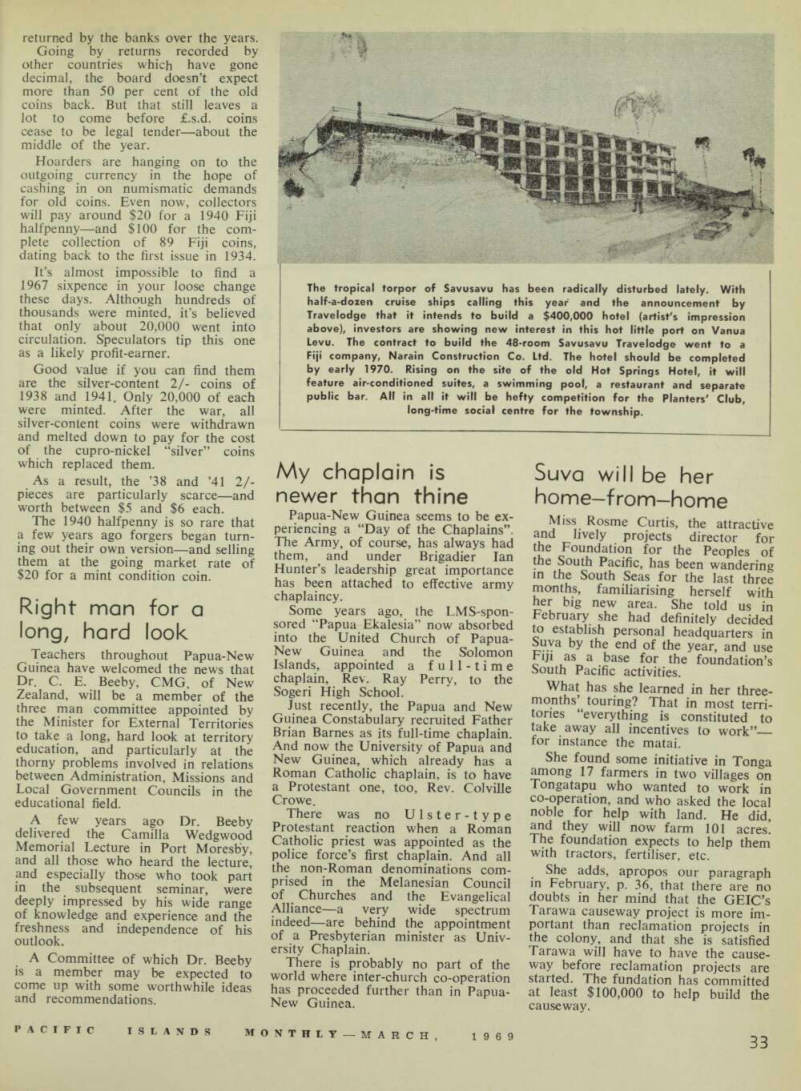
The tropical torpor of Savusavu has been radically disturbed lately. With half-a-dozen cruise ships calling this year and the announcement by Travelodge that it intends to build a $400,000 hotel (artist's impression above), investors are showing new interest in this hot little port on Vanua Levu. The contract to build the 48-room Savusavu Travelodge went to a Fiji company, Narain Construction Co. Ltd. The hotel should be completed by early 1970. Rising on the site of the old Hot Springs Hotel, it will feature air-conditioned suites, a swimming pool, a restaurant and separate public bar. All in all it will be hefty competition for the Planters' Club, long-time social centre for the township.