Pacific Shipping
pp. 107-116 · Read in the full issue
Merchant
Scheme "Too
Expensive"
The GEIC's popular merchant training scheme, the colony’s only major labour venture in recent years, is “too expensive’' and the whole scheme should be “reviewed” as soon as possible to decide whether or not to continue with it.
So said the colony’s Mooring Socio-Economic Survey, released late last year. However, the recom mendation hardly caused a stir at the GEIC’s House of Representatives December session.
The House resolved to take a look at the economics of the scheme about early 1971, “in the light of experience.”
Has cost $426,200
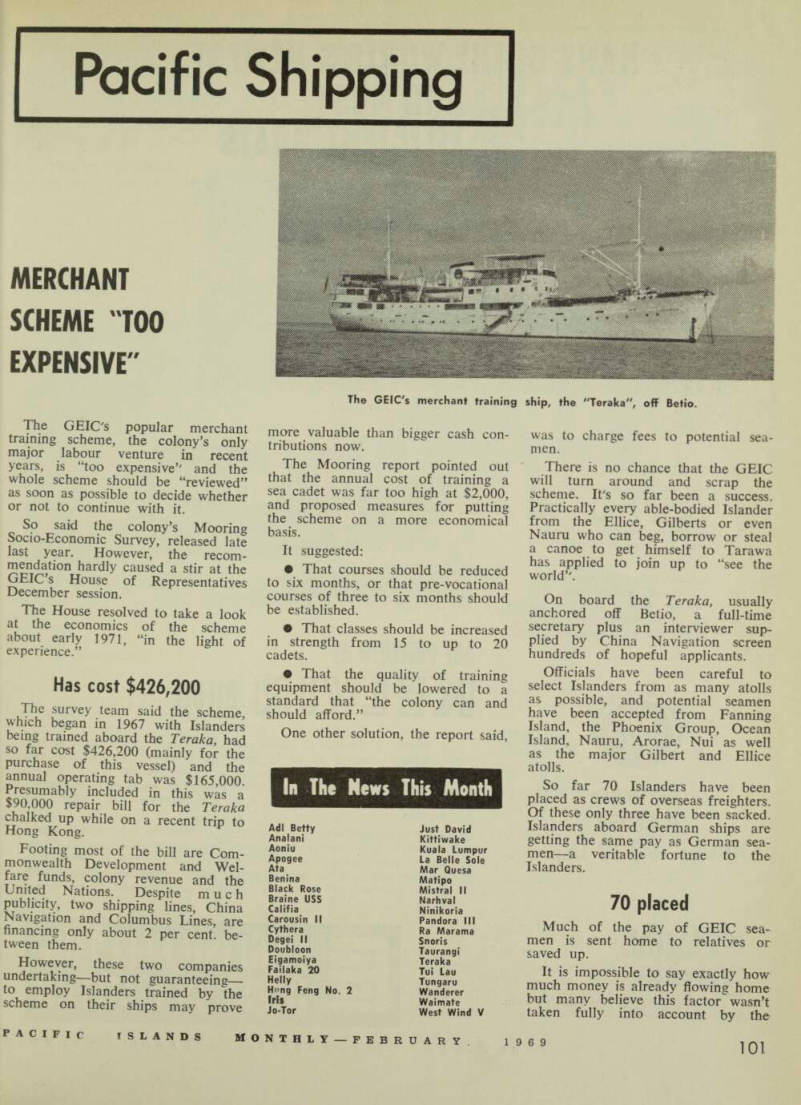
The survey team said the scheme which began in 1967 with Islanders being trained aboard the Teraka, had so far cost $426,200 (mainly for the purchase of this vessel) and the annual operating tab was $165,000.
Presumably included in this was a 59°,000 repair bill for the Teraka chalked up while on a recent trip to Hong Kong.
Footing most of the bill are Com monwealth Development and Wel fare funds, colony revenue and the United Nations. Despite much publicity, two shipping lines, China Navigation and Columbus Lines, are financing only about 2 per cent, be tween them.
However, these two companies undertaking—but not guaranteeing to employ Islanders trained by the scheme on their ships may prove
more valuable than bigger cash con tributions now.
The Mooring report pointed out that the annual cost of training a sea cadet was far too high at $2,000, and proposed measures for putting the scheme on a more economical basis.
It suggested: • That courses should be reduced to six months, or that pre-vocational courses of three to six months should be established. • That classes should be increased in strength from 15 to up to 20 cadets. • That the quality of training equipment should be lowered to a standard that “the colony can and should afford.”
One other solution, the report said,
was to charge fees to potential sea men.
There is no chance that the GEIC will turn around and scrap the scheme. It's so far been a success.
Practically every able-bodied Islander from the Ellice, Gilberts or even Nauru who can beg, borrow or steal a canoe to get himself to Tarawa has applied to join up to “see the world’'.
On board the Teraka, usually anchored off Betio, a full-time secretary plus an interviewer sup plied by China Navigation screen hundreds of hopeful applicants.
Officials have been careful to select Islanders from as many atolls as possible, and potential seamen have been accepted from Fanning Island, the Phoenix Group, Ocean Island, Nauru, Arorae, Nui as well as the major Gilbert and Ellice atolls.
So far 70 Islanders have been placed as crews of overseas freighters.
Of these only three have been sacked.
Islanders aboard German ships are getting the same pay as German sea men—a veritable fortune to the Islanders.
70 placed
Much of the pay of GEIC sea men is sent home to relatives or saved up.
It is impossible to say exactly how much money is already flowing home but many believe this factor wasn’t taken fully into account by the
The GEIC's merchant training ship, the "Teraka", off Betio.
Mooring team when it said the scheme was too dear.
Islanders of the GEIC make ex cellent seamen a PIM staff writer was told on Tarawa. Their only two pitfalls—many as yet drink too much at times and others don’t give enough thought for personal safety while working aboard ships.
"Tui Lau's" Ex-Master
Off To Us Trust Territory
Fiji skipper, Captain Don Wendt, who has had his Certificate of Competency cancelled by a Fiji marine court of inquiry into the stranding of the Tui Lau last October, flew to Nauru in January to take command of the 208-ton Carolines trader Tungaru.
Owned by Ponape’s old-time trader, Carlos Etscheit, 68, Tungaru is these days associated with MILI, the US Trust Territory’s new shipper.
Tungaru, with many calls in Rabaul and Fiji behind her, will operate a service out of the Trust Territory with Captain Wendt to the Solomons, Nauru and Fiji.
Her new route is significant, be cause it will be MILI’s first run south of the Marshalls. The company’s aim is to set up its own shipping links with the South Pacific southwards to Sydney. Tungaru is pointed in that direction.
Master Troubles Hold
Up "Aoniu"
Tempers were rising in Fiji and Tonga in January over the month long impounding by Fiji Marine Department officials of the Tongan Government vessel Aoniu in Suva.
In mid-January Captain Hill Willis, Tonga’s only holder of a Board of Trade Master’s Certificate, flew to Suva to master the Aoniu, when she was finally released by Fiji. Mean time, government-level negotiations between the two territories went on.
Trouble started when Fiji’s marine officials didn’t give Aoniu a clearance to sail from Suva for a trip to Rotuma on December 7. They said her master, Captain P. Taulupe, “did not have the qualifications” to take her to Rotuma.
Suva master mariner Captain J.
E. Hills was then signed on Aoniu to comply with regulations. How ever, just before he was to take Aoniu away, a cable was received from the Tongan Government in structing Aoniu to stay put and Captain Hills to be “signed off”.
Captain Taulupe has sailed under Captain Willis 12 times as chief
officer from Tonga to Fiji and Rotuma and once as master-in-train ing. Captain Hills said the Tongan has passed examinations to a standard set by the British Ministry of Trans port for a master’s certificate issued by the Tongan Government.
Crayfishing Extends
To Fiji
Sydney businessman Peter Warner’s efforts to get a crayfishing industry going are expanding in Tonga and extending to Fiji’s Lau Group. His operations are also diversifying into exporting clams, fish and shark.
His 90 ft crayfisher Ata has been joined in Fiji by another ship, the 45 ft launch Just David, and he will set up in Tonga four 10-ton capacity freezing holding plants (Nukualofa, Haapai (2) and Vavau).
His Fiji company, Fathom Fisheries, has joined Continental Meats Ltd. of Suva to can crayfish and clams as lobster soup and clam chowder. Fathom Fisheries have also recently sent consignments of snapper to Sydney, Suva and Japan, and shark to Melbourne.
Mr. Warner recently described crayfish yields from Tonga as “not rich, but reasonable and steady”. If Lau yields were similar, three freez ing plants would be built there, he said.
Ata will remain his “mother ship” and Just David is expected to be joined by two Tongan ships, Vaomapa and Taufale, early this year.
"Hung Feng" Freed From Suva
Reef After 14 Weeks
The 220-ton Nationalist Chinese fishing boat Hung Feng No. 2 was freed from Namuka Reef, seven miles west of Suva, on January 16.
She had been on the reef for 14 weeks.
Hung Feng No. 2, a Pago Pago based 100-ft ship owned by the Taiwan Fishing Company, was driven onto the reef in heavy seas in early October after her engine failed.
Her salvagers, Bish Ltd., of Suva, had the choice of pulling her a few yards back into the ocean or of dragging her hundreds of yards forward over the reef into Namuka Harbour.
Three attempts by local ships failed to pull her off the reef because of continual heavy seas.
Bish then decided to drag her 2,000 ft across the reef on steel
rollers welded to her hull. A pulling system with a power of 100 tons was arranged. Hung Feng's fuel was pumped out and she was moved slowly—sometimes no more than 12 ft a day—in one or two feet of water.
After the first 400 ft, buoyancy tanks were welded onto the ship’s hull to give her flotation. Her final 500 ft was a virtual rush—it took only three hours.
Hung Feng was towed to Suva where she was found in good con dition. Hopes were she would be back at sea by March.
New Schedule For
Tonga's "Niuvakai"
The Tongan Copra Board, in an attempt to operate the Niuvakai profitably, has rearranged the ship’s schedule to take in two more trips a year between Tonga and Australia, via Fiji and Western Samoa.
On her new route she will leave Sydney direct for Nukualofa, thence Vavau, Apia, Suva and Lautoka.
After Lautoka the Niuvakai will sail for Malau (Labasa) to pick up timber for Australia.
The new route eliminates Pago
Pago from the Niuvakai schedule, except for the voyage which left Sydney on January 11.
In the past, the Niuvakai, after leaving Sydney, called at Suva and Lautoka, then Apia and Pago Pago, before going on to Tonga. She then called at Fiji again before going on to Australia.
Under the old schedule a voyage from Nukualofa to Australia and back took seven and a half weeks.
Under the new one the voyage will take about six weeks.
Meanwhile, the USS Co. plans to increase its services from Australia to Islands ports with the Waimate.
Starting with the January voyage out of Sydney, two ports, Pago Pago and Malau (for timber) were added to the existing schedule of Apia, Nukualofa, Suva and Lautoka.
New Deal For Geic
Phosphate Workers
The GEIC’s $469,000 passenger vessel, the Ninikoria, which travels between Fiji and the New Hebrides and the colony, will call at many of the colony’s atolls several times a year, instead of at Tarawa once a year as did her predecessors.
This means that there is an equal opportunity for all Gilbert and Ellice Islanders to get work on the phos phate deposits on Ocean and Nauru.
Another factor which is making fairer the recruitment of labour for the phosphate deposits is the establish ment of Tarawa-trained executive officers to handle applications to work on Ocean and Nauru. (Previously, elected Islands councillors were responsible for granting such applica tions—and they sometimes showed favouritism).
Now people in the GEIC wishing to work for the British Phosphate
Commission fill in forms and send them to the managers of the BPC.
Islands labourers are paid about $100 a month for working the phosphate deposits.
Another Attempt To
Free The "Matip0"
After an unscheduled stopover on a New Caledonian reef of about eight months, Captain Athol Rusden’s 397-ton trader Matipo was expected to be made mobile again in late January when efforts to free her were renewed.
The New Hebrides-based ship
Tonga will operate the "Niuvakai" on a revamped schedule out of Nukualofa to Sydney in an effort to make her pay. In future calls at Pago Pago will be skipped.
owner’s latest acquisition, a 75 ft coastal vessel Onewa, was to try to free her with salvage gear—and the aid of abnormally high tides.
The Matipo was grounded on the reef, 30 miles off Noumea, on May 7. 1968 ( PIM, June, 1968, p. 97) shortly after Captain Rusden had set up a NZ-New Caledonia-New Hebrides shipping service with her.
Efforts at the time failed to free her, though much equipment and cargo were salvaged.
The NZ - New Caledonia - New Hebrides service is now being run by a NZ subsidiary of Columbus Lines which beat the Holm Shipping Company of NZ for the run in a bitter fight ( PIM, July, 1968, p. 97).
Nauru's New "Eigamoiya"
To Arrive In April
Although described as a bulk phosphate carrier, Nauru’s first ship, the MV Eigamoiya, has a lot more glamour than the description indicates.
Eigamoiya, 5,700 tons dw, was launched at Leith, on December 19 —the first ship to go into the water from Robb Caledon Shipbuilders Ltd., since this new group was formed in October. The vessel will sail on its delivery voyage towards the end of March and is expected to arrive in Nauru at the end of April, carry ing general cargo from the UK.
President Deßoburt, who attended the launching by his wife, was return ing home in January via the Marshalls,, where he was to supervise recruitment of an additional seven crew members for the vessel. Two Nauruan youths are already in Leith, training as navigation officers.
Eigamoiya is, Nauru hopes, the first tonnage of a regular Nauruan mercantile fleet. Her details: Length overall, 368 ft 6 in.; breadth moulded, 55 ft; draft, 24 ft 6 in.; bale capacity, 235,000 cu. ft; insulated cargo, 11,000 cu ft; service speed 15 knots; powered by two Mirrlees National KDMR6 engines geared to a single screw, 2,520 bhp each, and direct reversing.
Decks over the accommodation and cargo holds are sheathed with 2i in. Oregon pine and careful at tention has been paid to sound insulation around the engine casings.
The ship can lift, overhaul and lay her own moorings, using a special electrically-driven mooring winch/ windlass on the forecastle.
She is fitted to a high standard to carry prosphate, general cargo, some refrigerated cargo, and passengers in deluxe accommodation. The ship has two decks with a short forecastle and a raked stem soft-nosed bow, cruiser stern, four cargo holds and
tween decks. No. 1 hold can carry cased petroleum and part of No. 4 is for refrigerated cargo. She is clas sed 100A1 with Lloyds. Three holds are forward of the engine and one aft.
Fresh water is carried in part of the double bottom, tunnel side tanks and tanks over the aft peak. Cargo handling equipment consists of two 10-ton ASEA cranes for Nos. 2 and 3 holds and two five-ton derricks for holds 1 and 4. Portable steel hopper sides are arranged in wings of the holds for handling phosphate.
The complement of 34 is comfort ably accommodated in single cabins.
There are seven well-fitted cabins for passengers, two of them being deluxe
suites. All but two of the passenger cabins have toilet and bath, and shower facilites. All accommodation is air conditioned and television is installed.
Public rooms include a dining saloon to seat 26 at five tables, and a lounge and bar. Suites, cabins and passageways are carpeted.
The master’s and deluxe passenger suites are lined with Eucalyptus veneer and have furniture in Sycamore. There are two fully-equip ped laundries and drying rooms.
There are twelve individual refri gerated cabinets in cabins and public rooms, plus an ice-making machine and a beer cooler.
Kuwait Fishing Scheme
For Papuan Gulf
A $3 million 20-vessel trawling and fish processing operation financed by the tiny Arabian oil-rich state of Kuwait got underway in the Gulf of Papua in January.
Twelve of the 62 ft to 102 ft trawlers and a 225 ft “mother ship”
Failaka 20 arrived at Port Moresby in late December to take on 150 New Guinean crew and to change over to Papuan registry.
Soon after, Failaka 20 sailed out of Moresby to begin fishing and surveying for fish and prawns. She was equipped with underwater elec tronic search gear.
The trawlers were to follow soon after. Each can trace and catch both fish and prawns. Catches are cleaned, headed and snap frozen on Failaka 20, and then transhipped to cargo vessels at sea for export.
In charge of operations locally is Gulf Fisheries (NG) Pty. Ltd., a subsidiary of Gulf Fisheries Co., of Kuwait, a world-wide tropical fishing complex specialising in investing in underdeveloped countries to get fish ing industries going.
Holm Charter W.
German Vessel
Holm and Co. Ltd. has chartered the West German vessel, Pagensand, to run its monthly service between New Zealand and Tahiti. The Pagensand will also call at the Cook Islands and Tonga as required.
Holm says the charter of the ship is an interim measure until it can use a NZ ship manned by New Zealanders. Pagensand was due to arrive in NZ in late December.
Shipping Roundup
• Burns Philp has assumed the agency for the Norwegian-owned Jo- Tor, which services New Guinea ports from Sydney.
The Jo-Tor, which is under charter to Queensland Papua Line, operates a four-weekly service from Sydney and Brisbane to Wewak, Lombrum, Lorengau and Kavieng. About 1,100 tons gross, she has large refrigerated holds able to take up to 400 tons of cargo. • China Navigation’s passenger cargo vessel Kuala Lumpur is to carry a “trade fair” of NZ goods to Tonga, both Samoas, Fiji and New Caledonia in June. An Auckland firm, Export Business Afloat Ltd., hopes to use two decks of the Kuala Lumpur to display goods from up to 50 NZ firms.