Islands history by an Islander who was there
p. 103 · Read in the full issue
Islander who was there
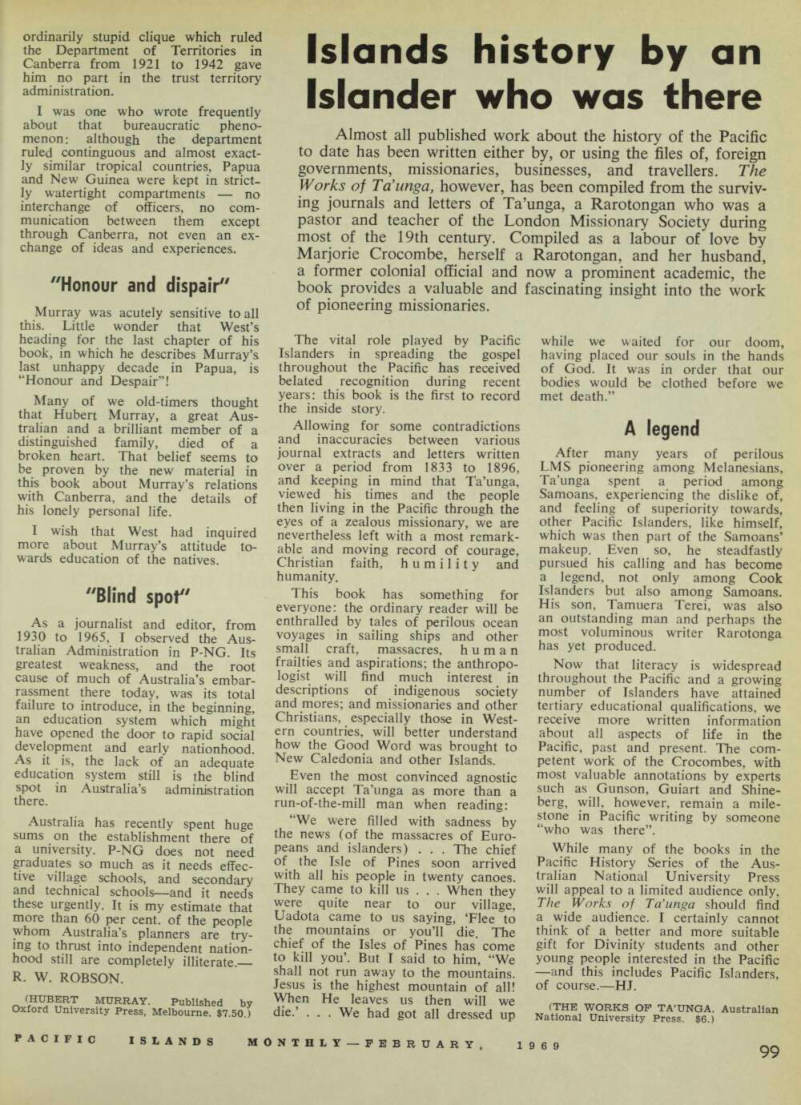
Almost all published work about the history of the Pacific to date has been written either by, or using the files of, foreign governments, missionaries, businesses, and travellers. The Works of Ta’unga, however, has been compiled from the surviv ing journals and letters of Ta’unga, a Rarotongan who was a pastor and teacher of the London Missionary Society during most of the 19th century. Compiled as a labour of love by Marjorie Crocombe, herself a Rarotongan, and her husband, a former colonial official and now a prominent academic, the book provides a valuable and fascinating insight into the work of pioneering missionaries.
The vital role played by Pacific Islanders in spreading the gospel throughout the Pacific has received belated recognition during recent years: this book is the first to record the inside story.
Allowing for some contradictions and inaccuracies between various journal extracts and letters written over a period from 1833 to 1896, and keeping in mind that Ta’unga, viewed his times and the people then living in the Pacific through the eyes of a zealous missionary, we are nevertheless left with a most remark able and moving record of courage, Christian faith, humility and humanity.
This book has something for everyone: the ordinary reader will be enthralled by tales of perilous ocean voyages in sailing ships and other small craft, massacres, human frailties and aspirations; the anthropo logist will find much interest in descriptions of indigenous society and mores; and missionaries and other Christians, especially those in West ern countries, will better understand how the Good Word was brought to New Caledonia and other Islands.
Even the most convinced agnostic will accept Ta’unga as more than a run-of-the-mill man when reading: “We were filled with sadness by the news (of the massacres of Euro peans and islanders) . . . The chief of the Isle of Pines soon arrived with all his people in twenty canoes.
They came to kill us . . . When they were quite near to our village, Uadota came to us saying, ‘Flee to the mountains or you’ll die. The chief of the Isles of Pines has come to kill you’. But I said to him, “We shall not run away to the mountains.
Jesus is the highest mountain of all!
When He leaves us then will we die.’ . . . We had got all dressed up
while we waited for our doom, having placed our souls in the hands of God. It was in order that our bodies would be clothed before we met death.”
A legend
After many years of perilous LMS pioneering among Melanesians, Ta’unga spent a period among Samoans, experiencing the dislike of, and feeling of superiority towards, other Pacific Islanders, like himself, which was then part of the Samoans’ makeup. Even so, he steadfastly pursued his calling and has become a legend, not only among Cook Islanders but also among Samoans.
His son, Tamuera Terei, was also an outstanding man and perhaps the most voluminous writer Rarotonga has yet produced.
Now that literacy is widespread throughout the Pacific and a growing number of Islanders have attained tertiary educational qualifications, we receive more written information about all aspects of life in the Pacific, past and present. The com petent work of the Crocombes, with most valuable annotations by experts such as Gunson, Guiart and Shine berg, will, however, remain a mile stone in Pacific writing by someone “who was there”.
While many of the books in the Pacific History Series of the Aus tralian National University Press will appeal to a limited audience only, The Works of Ta’unga should find a wide audience. I certainly cannot think of a better and more suitable gift for Divinity students and other young people interested in the Pacific —and this includes Pacific Islanders, of course.—Hl. (THE WORKS OP TA’UNGA. Australian National University Press. $6.)