The Bell Of
pp. 92-93 · Read in the full issue
The "Salamis"
Starts A Hunt
Into History
By W. H. WATSON, in Rarotonga.
The world is a small place, they say. And “they” know what they are talking about, as I discovered on a trip with my wife from Cairns to Hong Kong on the Francis Drake. The world was reduced considerably in size on that voyage—almost, you might say, to the size of a captain’s table. For my wife and I were seated at the captain’s table and this small fact triggered off a series of coincidences and opened some doors on Islands shipping history.
The captain turned out to be G. O.
Gatehouse and it didn’t take me very long to recognise him. I’d met him 38 years previously in the Cook Islands when he was a cadet on the Union Company’s Waipahi, and I was a passenger.
During an evening of Islands re miniscences he told me of how many years earlier he had gone ashore on Atiu, in the Cook Islands, and had noticed that one of the churches used an old ship’s bell. To his surprise—and delight—the inscription on the bell read: “ Salamis, 1875, Aberdeen. Walter Hood and Co., Aberdeen”. The wool clipper Salamis was the ship that his grandfather had served on as an apprentice, and over the years he had often wished that he owned the bell. He told me that he was prepared to exchange it for a larger and better bell. I said that I would help him..
I wrote to Mr. O. A. Dare, then Resident Commissioner of the Cook Islands (1961-1965), and told him the story. He wrote to me and said that although some of the older Atiu residents remembered the bell, it had been missing for many years.
A month after writing to me, Mr.
Dare visited Atiu with the Cook Islands’ Executive Committee. On the island, the committee was billeted in the Sunday School, but one member, who had his fingers crushed coming ashore, was allocated a small unused room to himself.
Mr. Dare called to see the injured man, and, while talking to him, noticed some silver cups and other bits and pieces lying in the corner.
“Having a natural curiosity,” Mr.
Dare later wrote to me, “I wandered over to see what the cups were for.
I picked up a very nice bell . . . and lo and behold there was the name — ‘Salamis , 1875, Aberdeen’.”
Interest roused
Mr. Dare consulted church leaders and they agreed to exchange their Salamis bell for the one offered by Captain Gatehouse. The exchange has since taken place.
This happy ending might have been the finish of the story but for the fact that my interest in the Salamis had been roused. I was determined to learn more about the old ship.
So I wrote to friends in Scotland
to make inquiries about her early history and they came up with some interesting news. Firstly, the builders of the Salamis, Walter Hood and Company, had been incorporated in the Hall Russells shipbuilding firm.
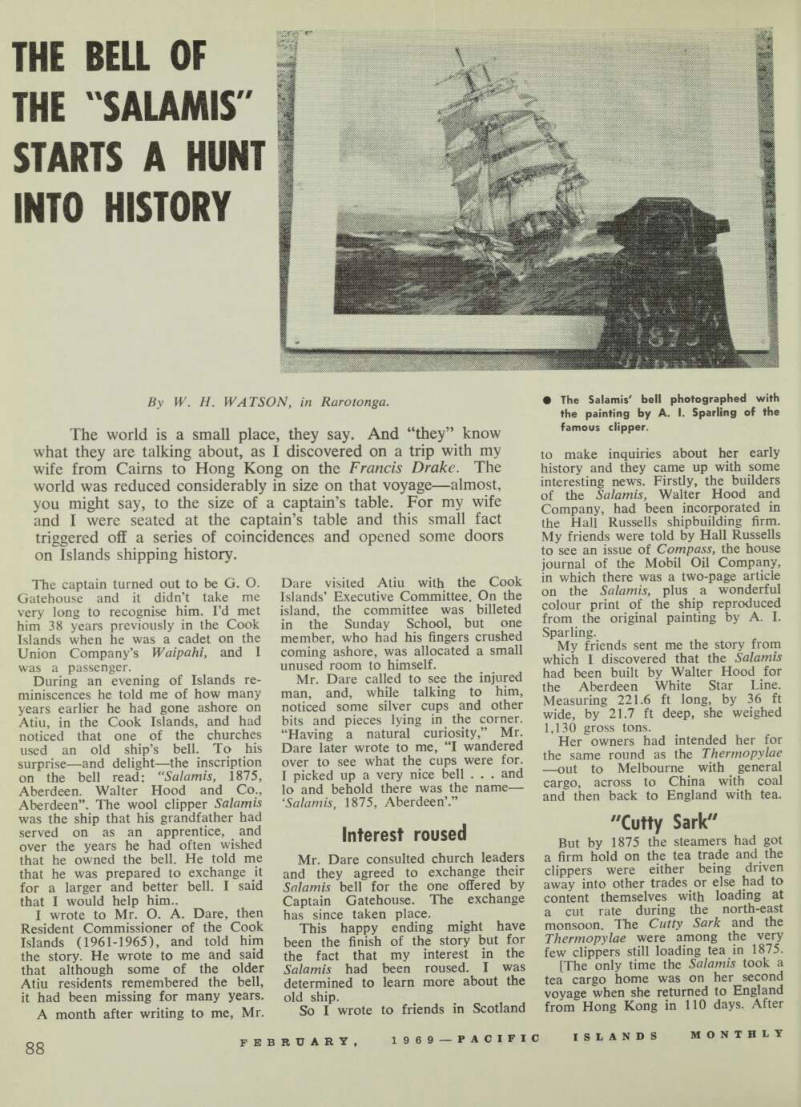
My friends were told by Hall Russells to see an issue of Compass, the house journal of the Mobil Oil Company, in which there was a two-page article on the Salamis, plus a wonderful colour print of the ship reproduced from the original painting by A. I.
Sparling.
My friends sent me the story from which I discovered that the Salamis had been built by Walter Hood for the Aberdeen White Star Line.
Measuring 221.6 ft long, by 36 ft wide, by 21.7 ft deep, she weighed 1,130 gross tons.
Her owners had intended her for the same round as the Thermopylae —out to Melbourne with general cargo, across to China with coal and then back to England with tea.
"Cutty Sark"
But by 1875 the steamers had got a firm hold on the tea trade and the clippers were either being driven away into other trades or else had to content themselves with loading at a cut rate during the north-east monsoon. The Cutty Sark and the Thermopylae were among the very few clippers still loading tea in 1875. [The only time the Salamis took a tea cargo home was on her second voyage when she returned to England from Hong Kong in 110 days. After
• The Salamis' bell photographed with the painting by A. I. Sparling of the famous clipper.
that she was kept steadily in the Melbourne to London wool trade].
On her maiden voyage, Salamis left London on July 6, 1875. She had strong winds to the Equator which she crossed on August 2. The best speed she made on this journey was 304 knots, and she entered Port Philip Heads, Melbourne, on Sep tember 16—just 72 days out of London.
As a wool clipper, Salamis set up a wonderful record. Her average for 13 consecutive runs to Melbourne was 75 days, pilot to pilot, and from 1875 to 1895 her average was 77 days for the London to Melbourne run.
Homeward with wool—generally about 5,500 bales of it—she oc casionally got held up (like all iron ships) and in these cases the run could take her more than 100 days.
Nevertheless on the homeward run she had the best average for an iron ship—of 87 days for 18 consecutive wool passages from Melbourne to London.
Her best run from London to the Equator was 181 days. Twice she ran from the Equator to Cape Meridian in 21 days; twice she ran her east ing down from the Cape Meridian to Cape Otway in 22i days.
From 1875 to 1894, the Salamis had only two masters. They were Captains Phillips—senior and junior.
The clipper was a regular home for the Phillips’ family: at one time, when Captain Phillips, senior, was com mander, one son was chief mate and another was third made.
Captain Phillips, senior, gave up command of the Harlaw to take the Salamis from the stocks. After com manding the ship for 13 years, he was asked, on arrival in Port Philip, to hand the Salamis over to his son. the first mate, and take command of the Pericles.
Wrecked
In 1894, Captain Phillips, junior, handed the Salamis over to Captain R. B. B. McKilliam.
When the Aberdeen White Star Line sold its sailing ships in 1899, the Salamis was bought by L.
Gunderson, of Porsgrund, Norway, who stripped the yards off her mizen mast and turned her into a barque to ply the guano trade in the South Pacific.
After several weary years at this work, the once-handsome clipper was wrecked on Malden Island, 400 miles north of Penrhyn Island in the Line Islands, on May 20, 1905.
Cook Islanders were at that time working on the guano deposits on Malden, and, on their return to Atiu, one of them brought with him the Salamis ’ bell and presented it to the church.