The Japanese Are Returning To P-Ng
pp. 89-91 · Read in the full issue

To Pay Homage To Their Dead
The Japanese who visit Bougainville Island, P-NG, do so to pay homage to the 18,300* Japanese who died there during World War 11, and to collect some of their remains for re interment in Japan.
What diverse memories must accompany those visitors, particularly those who fought on Bougainville during the War. Like all old soldiers re-visiting past battlefields, they must remember the glory they had once proclaimed. The Japanese must also remember it being smashed in Bougainville’s dank, tropical jungles.
In the critical days of the Pacific War, the fate of the Japanese home land was linked with that of distant Bougainville. “Japan will topple if Bougainville falls,” Rear-Admiral Matsuji Ijuin predicted in 1943.
Started schools
The war came to Bougainville in March, 1942, when Japanese troops landed at Buka Passage. Soon they had established themselves in many parts of the island and it seemed that Bougainville would become part of the “Greater South-East Asia Co- Prosperity Sphere.”
For the first year, the Japanese had a fairly easy time in Bougainville.
Much of it was spent consolidating their positions along the coast and patrolling the hinterland in search of the Coastwatchers who incessantly spied on their air and sea move ments.
They found time to start schools for native children. These institu tions, ex-pupils have told me,
specialised in the teaching of cal listhenics, the art of bowing, and the rudiments of the Japanese language.
The soldiers, and the non-com batant coolies who accompanied them as labourers, formed roads and neatly cobbled them with river stones. They dug gun emplacements, made aero dromes and built Shinto Shrines.
They re-named the countryside with names meaningful only to them
selves. In their leisure time they swam > fished with hand-grenades, and sang the lilting f°lk-songs of Japan, But all this was to change. By August, 1942, the Americans had
commlnced
“oodytrek akJna the ‘Wle loJi
* “ General Eichelberger so aptly de scribed it.
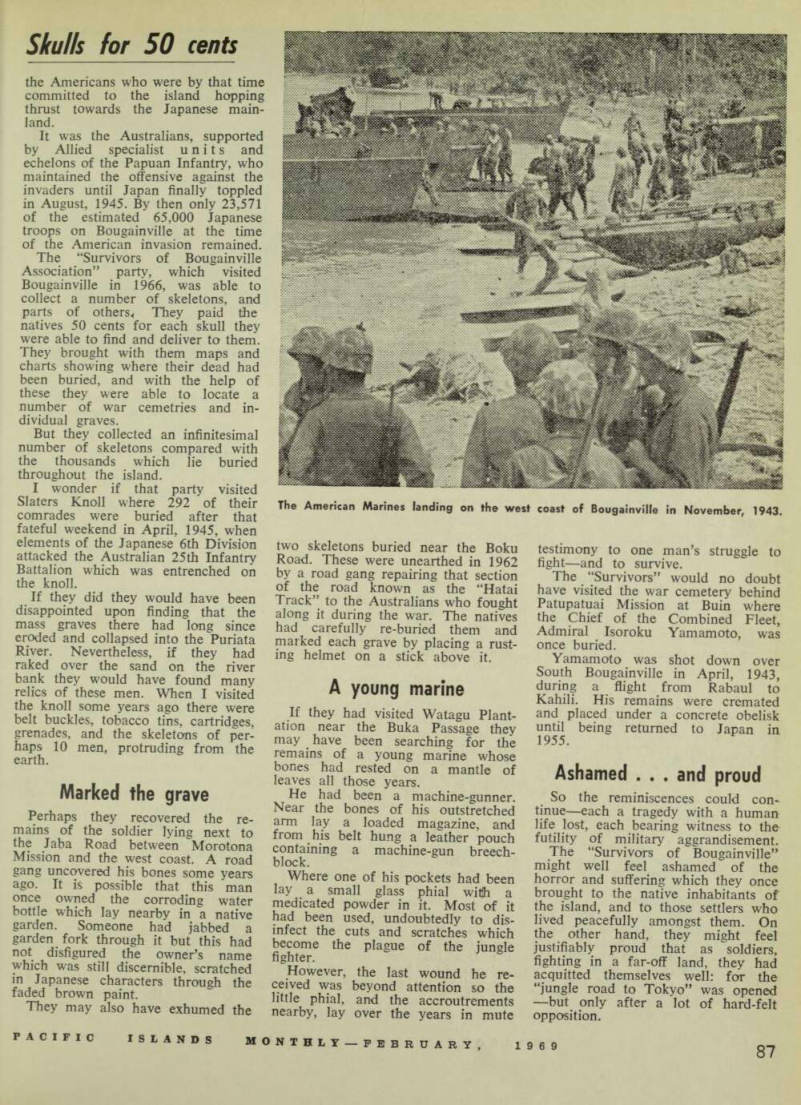
Along that road lay Bougainville and it was there, at Empress Augusta Bay, that the Americans landed on November 1, 1943.
A year later, in November, 1944 the Australian 11th Brigade relieved
The official Australian estimation some sources put Japanese losses on Bougainville as high as 30,000 dead
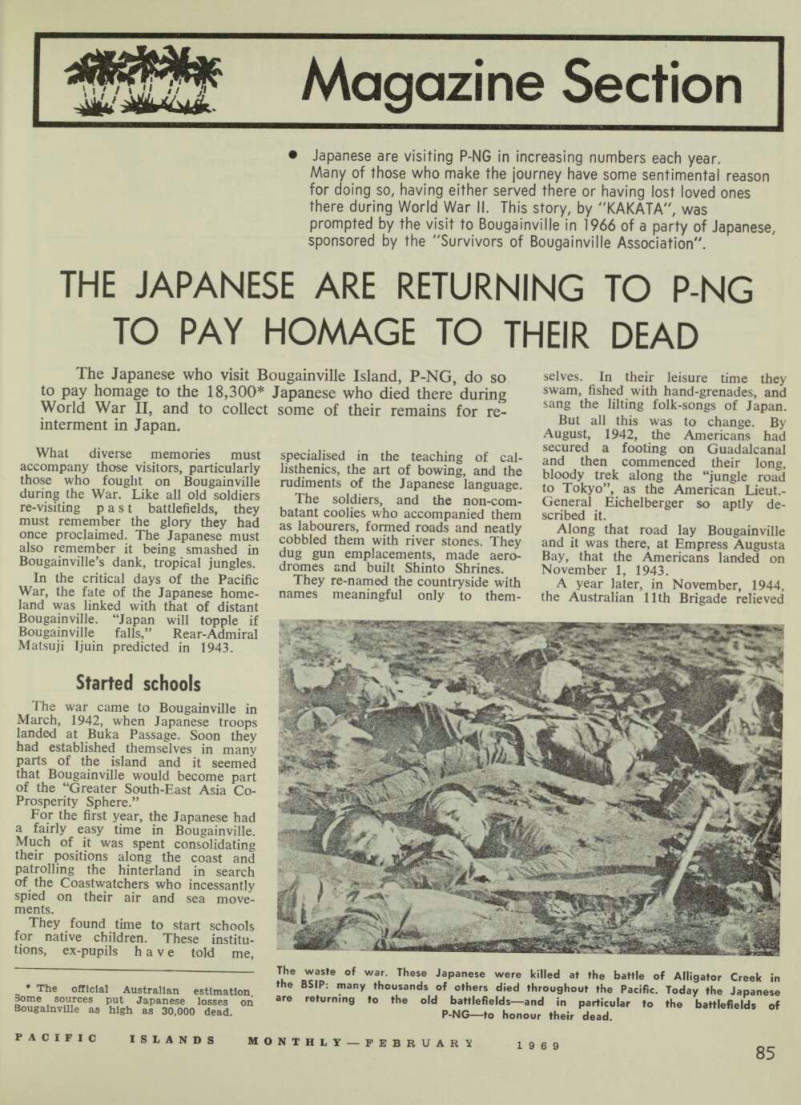
The waste of war . These Japanese were killed at the battle of Alligator Creek in the BSIP: many thousands of others died throughout the Pacific. Today the Japanese are returning to the old battlefields—and in particular to the battlefields of P-NG —to honour their dead.
Skulls for 50 cents
the Americans who were by that time committed to the island hopping thrust towards the Japanese main land.
It was the Australians, supported by Allied specialist units and echelons of the Papuan Infantry, who maintained the offensive against the invaders until Japan finally toppled in August, 1945. By then only 23,571 of the estimated 65,000 Japanese troops on Bougainville at the time of die American invasion remained.
The “Survivors of Bougainville Association” party, which visited Bougainville in 1966, was able to collect a number of skeletons, and parts of others* They paid the natives 50 cents for each skull they were able to find and deliver to them.
They brought with them maps and charts showing where their dead had been buried, and with the help of these they were able to locate a number of war cemetries and in dividual graves.
But they collected an infinitesimal number of skeletons compared with the thousands which lie buried throughout the island.
I wonder if that party visited Slaters Knoll where 292 of their comrades were buried after that fateful weekend in April, 1945, when elements of the Japanese 6th Division attacked the Australian 25th Infantry Battalion which was entrenched on the knoll.
If they did they would have been disappointed upon finding that the mass graves there had long since eroded and collapsed into the Puriata River. Nevertheless, if they had raked over the sand on the river bank they would have found many relics of these men. When I visited the knoll some years ago there were belt buckles, tobacco tins, cartridges, grenades, and the skeletons of per haps 10 men, protruding from the earth.
Marked the grave
Perhaps they recovered the re mains of the soldier lying next to the Jaba Road between Morotona Mission and the west coast. A road gang uncovered his bones some years ago. It is possible that this man once owned the corroding water bottle which lay nearby in a native garden. Someone had jabbed a garden fork through it but this had not disfigured the owner’s name which was still discernible, scratched in Japanese characters through the faded brown paint.
They may also have exhumed the
two skeletons buried near the Boku Road. These were unearthed in 1962 by a road gang repairing that section of the road known as the “Hatai Track” to the Australians who fought along it during the war. The natives had carefully re-buried them and marked each grave by placing a rust ing helmet on a stick above it.
A young marine
If they had visited Watagu Plant ation near the Buka Passage they may have been searching for the remains of a young marine whose bones had rested on a mantle of leaves all those years.
He had been a machine-gunner.
Near the bones of his outstretched arm lay a loaded magazine, and from his belt hung a leather pouch containing a machine-gun breech block.
Where one of his pockets had been lay a small glass phial witjh a medicated powder in it. Most of it had been used, undoubtedly to dis infect the cuts and scratches which become the plague of the jungle fighter.
However, the last wound he re ceived was beyond attention so the little phial, and the accroutrements nearby, lay over the years in mute
testimony to one man’s struggle to fight—and to survive.
The “Survivors” would no doubt have visited the war cemetery behind Patupatuai Mission at Buin where the Chief of the Combined Fleet, Admiral Isoroku Yamamoto, was once buried.
Yamamoto was shot down over South Bougainville in April, 1943, during a flight from Rabaul to Kahili. His remains were cremated and placed under a concrete obelisk until being returned to Japan in 1955.
Ashamed . . . and proud
So the reminiscences could con tinue—each a tragedy with a human life lost, each bearing witness to the futility of military aggrandisement.
The “Survivors of Bougainville” might well feel ashamed of the horror and suffering which they once brought to the native inhabitants of the island, and to those settlers who lived peacefully amongst them. On the other hand, they might feel justifiably proud that as soldiers, fighting in a far-off land, they had acquitted themselves well: for the “jungle road to Tokyo” was opened —but only after a lot of hard-felt opposition.
The American Marines landing on the west coast of Bougainville in November, 1943.