To the Point
pp. 40-42 · Read in the full issue
Lessons From A New Guinea
High School Play
The end of the year generally brings me a crop of invitations to attend school prize-givings.
I enjoy these occasions, but honesty compels me to admit that as one goes from one to another one notices a certain sameness about them—action song by Standard 1, dance by the girls of 38, and so on. So one gets quite a kick from theprize-giving which is different.
The most interesting one I attended as 1968 drew to a close was that held at the Badihagwa High School, which provides secondary schooling for the young people of Hanuabada and some other near-by villages. It is one of the very few high schools in Niugini which are day schools; most are boarding schools.
The name Badihagwa is an evocative one for Motu people. It refers to a hollow, almost an amphi theatre, in the hills about half-a-mile inland from the present beach village of Hanuabada, on the shores of Port Moresby harbour, and it was here that the forebears of the present day Hanuabada people, as well as those of some of the other Motu villages, lived, probably until not so very long before Captain John Moresby’s Basilisk sailed into the harbour in 1873.
From an earlier home
To this sheltered spot they had come from an earlier home in the vicinity of Taurama Head. On the hill slopes, and embedded in the banks of a little creek which, when it is not dry—as it generally is—runs down from the hills to an outlet in the nearby harbour, can be found potsherds and other relics of their stay.
Why, early in the nineteenth century, they moved out on to the beach we don’t know, but it may be guessed that what began as a fisher men’s camp gradually developed into a full-scale village. Anyway, move they did, and when the white man came among them and began to hedge their lives about with incom prehensible rules, it was not surprising that, forbidden the practice of burying their dead in the village, they chose as a burial ground the spot on which their forebears had lived.
The burial ground is on flat land at the foot of the hills. On the lower
To the Point with Percy Chatterton
slopes above the high school has been built; so the busy present and the eager hopes for the future look down over the silent reminder of the past.
Badihagwa High School was established two years ago after long delays due to the reluctance of the owners of the land to part with it. And at first pupils and parents gave it a somewhat reluctant welcome, feeling that the more familiar pattern of a boarding high school had more to offer than one to which the students went day by day from their village homes.
However, the first doubts and reluctances were overcome, and the school is now well established in adequate, though rather austerely functional, buildings. When I looked in there the other day, a team of builders was at work putting up additional buildings in readiness for the new school ?ear. It will probably be several years before the building programme is complete and the school adequately housed. But that’s the way things go in Niugini.
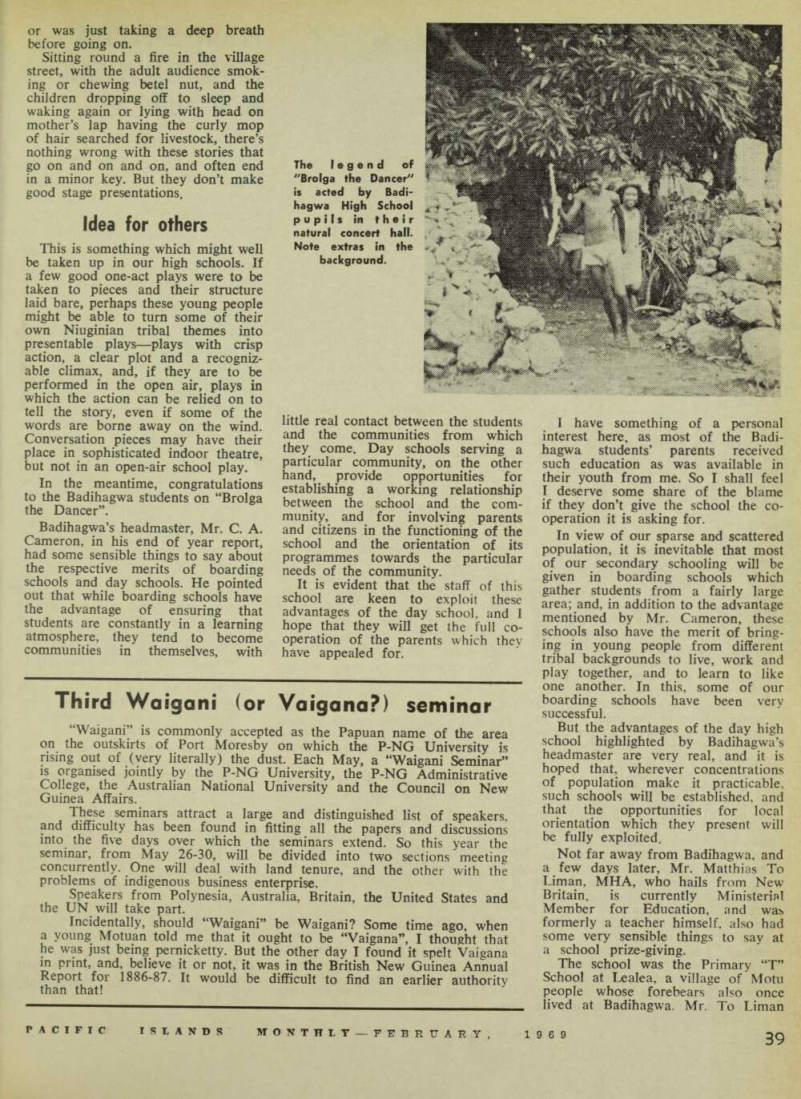
J & & Within the amphitheatre that is Badihagwa, the students have constructed a small amphitheatre of their own, with an ingeniously contrived “set” of stone walls supplementing the rocks and trees already there to make an attractive outdoor stage, From the front of this stage the ground rises in a gentle slope, just fight tor the seating of an audience.
On the occasion of the prize-giving,
the highlight of the programme was a one-act play with an Australian aboriginal theme, acted with verve and obvious enjoyment. Watching it, I fell to wondering why it was so much more successful than some attempts I have seen to dramatise Niuginian legendary themes, I think that there were perhaps two reasons. One may be that young Niuginians feel some measure of diffidence or embarrassment about enacting scenes from their own tribal past, especially in front of potentially critical parents and grandparents— a diffidence which they don’t feel in using themes from a comparable though different culture. I am not sure that this is so, but I think that it may be. , ,
Legends meander
The reason undoubtedly was £at Brolga the Dancer was a soundly constructed play with pace, P |ot a " d Punch, and a crisp climax, 'f s author calls it a quasi-legendary drama , by which I presume he means that he has taken liberties with the legend in the cause of good theatre. And quite right too. ~, . .
Tribal j e g en ds tend to meander, Th ey remind me of some sermons I have heard, of which it might be sa id the preacher passed several B°° d stoppmg places. Listening to
Bering wheThefThf
teller had reached the end of his story
or was just taking a deep breath before going on.
Sitting round a fire in the village street, with the adult audience smok ing or chewing betel nut, and the children dropping off to sleep and waking again or lying with head on mother’s lap having the curly mop of hair searched for livestock, there’s nothing wrong with these stories that go on and on and on, and often end in a minor key. But they don’t make good stage presentations.
Idea for others
This is something which might well be taken up in our high schools. If a few good one-act plays were to be taken to pieces and their structure laid bare, perhaps these young people might be able to turn some of their own Niuginian tribal themes into presentable plays—plays with crisp action, a clear plot and a recogniz able climax, and, if they are to be performed in the open air, plays in which the action can be relied on to tell the story, even if some of the words are borne away on the wind.
Conversation pieces may have their place in sophisticated indoor theatre, but not in an open-air school play.
In the meantime, congratulations to the Badihagwa students on “Brolga the Dancer”.
Badihagwa’s headmaster, Mr. C. A.
Cameron, in his end of year report, had some sensible things to say about the respective merits of boarding schools and day schools. He pointed out that while boarding schools have the advantage of ensuring that students are constantly in a learning atmosphere, they tend to become communities in themselves, with
little real contact between the students and the communities from which they come. Day schools serving a particular community, on the other provide opportunities for establishing a working relationship between the school and the com munity, and for involving parents and citizens in the functioning of the school and the orientation of its programmes towards the particular needs of the community.
It is evident that the staff of this school are keen to exploit these advantages of the day school, and I hope that they will get the full co operation of the parents which they have appealed for.
I have something of a personal interest here, as most of the Badi hagwa students’ parents received such education as was available in their youth from me. So I shall feel I deserve some share of the blame if they don’t give the school the co operation it is asking for.
In view of our sparse and scattered population, it is inevitable that most of our secondary schooling will be given in boarding schools which gather students from a fairly large area; and, in addition to the advantage mentioned by Mr. Cameron, these schools also have the merit of bring ing in young people from different tribal backgrounds to live, work and play together, and to learn to like one another. In this, some of our boarding schools have been very successful.
But the advantages of the day high school highlighted by Badihagwa’s headmaster are very real, and it is hoped that, wherever concentrations of population make it practicable, such schools will be established, and that the opportunities for local orientation which they present will be fully exploited.
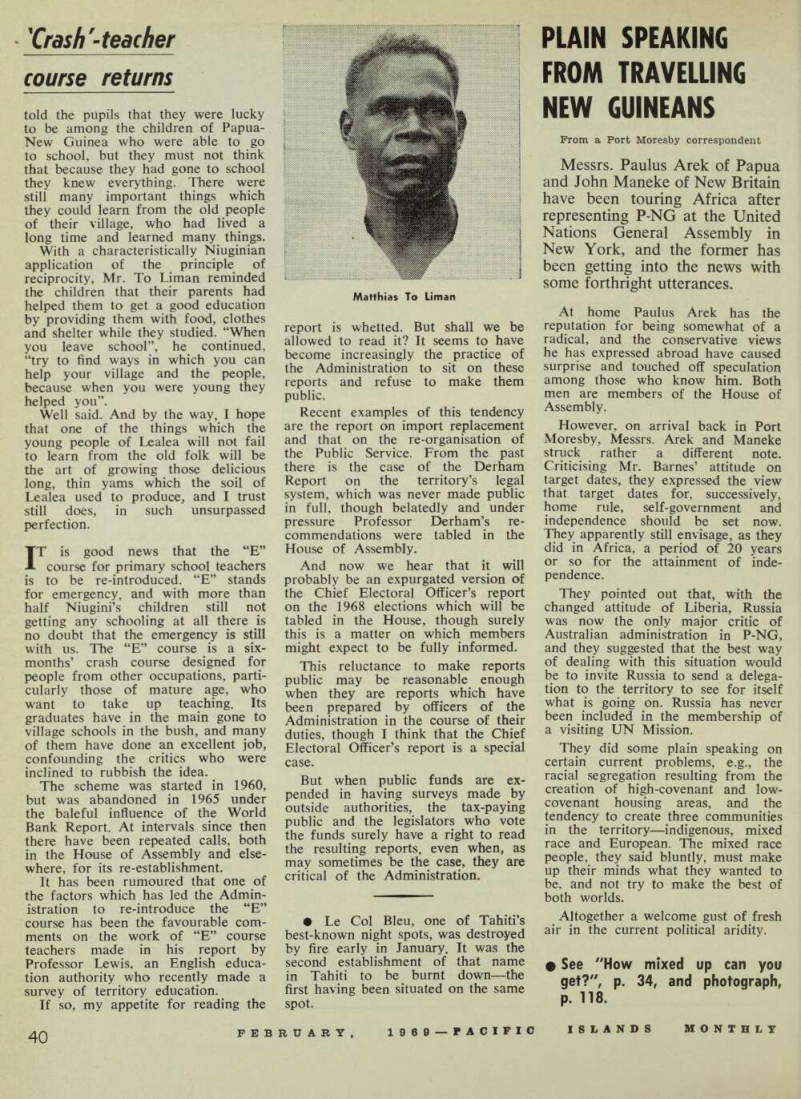
Not far away from Badihagwa, and a few days later, Mr. Matthias To Liman, MHA, who hails from New Britain, is currently Ministerial Member for Education, and was formerly a teacher himself, also had some very sensible things to say at a school prize-giving.
The school was the Primary “T”
School at Lealea, a village of Motu people whose forebears also once lived at Badihagwa. Mr. To Liman
The legend of "Brolga the Dancer" is acted by Badi hagwa High School pupils in their natural concert hall.
Note extras in the background.
'Crash '-teacher course returns
told the pupils that they were lucky to be among the children of Papua- New Guinea who were able to go to school, but they must not think that because they had gone to school they knew everything. There were still many important things which they could learn from the old people of their village, who had lived a long time and learned many things.
With a characteristically Niuginian application of the principle of reciprocity, Mr. To Liman reminded the children that their parents had helped them to get a good education by providing them with food, clothes and shelter while they studied. “When you leave school”, he continued, “try to find ways in which you can help your village and the people, because when you were young they helped you”.
Well said. And by the way, I hope that one of the things which the young people of Lealea will not fail to learn from the old folk will be the art of growing those delicious long, thin yams which the soil of Lealea used to produce, and I trust still does, in such unsurpassed perfection.
IT is good news that the “E” course for primary school teachers is to be re-introduced. “E” stands for emergency, and with more than half Niugini’s children still not getting any schooling at all there is no doubt that the emergency is still with us. The “E” course is a six months’ crash course designed for people from other occupations, parti cularly those of mature age, who want to take up teaching. Its graduates have in the main gone to village schools in the bush, and many of them have done an excellent job, confounding the critics who were inclined to rubbish the idea.
The scheme was started in 1960, but was abandoned in 1965 under the baleful influence of the World Bank Report. At intervals since then there have been repeated calls, both in the House of Assembly and else where, for its re-establishment.
It has been rumoured that one of the factors which has led the Admin istration to re-introduce the “E” course has been the favourable com ments on the work of “E” course teachers made in his report by Professor Lewis, an English educa tion authority who recently made a survey of territory education.
If so, my appetite for reading the
report is whetted. But shall we be allowed to read it? It seems to have become increasingly the practice of the Administration to sit on these reports and refuse to make them public.
Recent examples of this tendency are the report on import replacement and that on the re-organisation of the Public Service. From the past there is the case of the Derham Report on the territory’s legal system, which was never made public in full, though belatedly and under pressure Professor Derham’s re commendations were tabled in the House of Assembly.
And now we hear that it will probably be an expurgated version of the Chief Electoral Officer’s report on the 1968 elections which will be tabled in the House, though surely this is a matter on which members might expect to be fully informed.
This reluctance to make reports public may be reasonable enough when they are reports which have been prepared by officers of the Administration in the course of their duties, though I think that the Chief Electoral Officer’s report is a special case.
But when public funds are ex pended in having surveys made by outside authorities, the tax-paying public and the legislators who vote the funds surely have a right to read the resulting reports, even when, as may sometimes be the case, they are critical of the Administration. • Le Col Bleu, one of Tahiti’s best-known night spots, was destroyed by fire early in January. It was the second establishment of that name in Tahiti to be burnt down—the first having been situated on the same spot.
Matthias To Liman