Tropicalities
pp. 38-39 · Read in the full issue
For the Gilbert and Ellice Islands Colony, the 1960’s will go down as the Decade of Causeways. To link the big and small islets within the colony’s widespread atolls, men, women and children have built rock bridges which vary in width from a couple of feet to a length of almost 300 yards. And the men, women and children have worked without pay.
Many causeways have been com pleted, others have stood half done for months and look as though they will never be finished; still others have sparked heated disputes between neighbouring villages.
None, however, has started as much controversy as the proposed two-mile causeway on Tarawa atoll between the islands of Betio, the colony’s commercial heart, and Bairiki, centre of government.
No one knows if this causeway will have one or two car lanes, or if it will include a couple of bridges to allow tides to move in and out of Tarawa’s lagoon.
The Foundation for the Peoples of the South Pacific, an American based fund-raising organisation, has pledged $lOO,OOO to help build the causeway.
This money will be used to buy a dredge and to pay the wages of the Gilbertese working on the cause way. The foundation has also said it will provide an engineer for the project.
So far no one else has committed a bean, and the residents of Tarawa are sharply divided on the merits of the causeway.
Arguments for: Troublesome ferries can be scrapped; freight can be moved to Bairiki more easily and bus services on the causeway would make profits (at present the ferries are working at a loss).
Arguments against: If no allowance is made for water to flow underneath the causeway, Tarawa’s already over fished lagoon will become fishless; the causeway’s size will disrupt tides and wash away a lot of Betio’s tiny land area and the whole project will be too costly—at a time when the outer atolls are not getting any money at all from the government.
However, arguments such as these overlook one important factor: the animosity that exists between Betio and Bairiki. Fact of the matter is that the people of Betio and the
Geic's Decade
Of Causeways
people of Bairiki don’t really want to be linked.
Miss Rosme Curtis, the lively South Seas wanderer for the Founda tion of the Peoples of the South Pacific, is well aware of this animosity. She has just spent two weeks in the GEIC.
At the end of her stay, Miss Curtis wondered if it might not have been better if the foundation had com mitted itself to reclamation projects on Tarawa and Maiana rather than to have pledged a dredge. Reclama tion would have benefited everybody —without the foundation taking sides.
Moral: Giving money away is not as easy as it sounds.
Further technical investigations are now being made in Tarawa lagoon to see if the contra-arguments can be answered. But whatever happens, that causeway is going to cost at least twice as much as the generous foundation’s handout.
They protested
with kava
Tongans, like people in many parts of the world, take advantage of their democratic right to protest.
But in Tonga the protestors don’t as a rule throw sticks and stones, and they seldom hurl abuse. Instead, they pre sent themselves to the government representative (or to whomsoever has moved them to protest), they offer him a large kava root and then they stand quietly aside while he delivers a wordy explanation about the pre sent unfortunate state of affairs.
Anyway, that’s how it was in December when several hundred banana growers, led by a Tongatapu member of parliament, Vili Ahio, protested against what they took to be the meanness of the 2 cent bonus per case of bananas then being offered by the Tongan Produce Board (the bonus was 32 cents last year).
They marched on the Palace where the Prince Regent, Tuipelehake, was installed in the absence of King Taufa’ahau, and presented him with kava and a petition signed by 3,000 growers.
The petition read, in part: “We understand that the bonuses were made in recognition of the hard work we have put into the soil. Under the circumstances, we feel that we have been wrongly penalised. Can money be made available from other sources of the board to pay more equitable bonuses for the growers? Why should we have to suffer through negligence by the board?”
And as humble and loyal subjects they appealed to His Royal Highness to make an adjustment to the bonus.
Prince Tuipelehake told them that the meagre bonus was due mainly to the fact that Tongan sawmillers
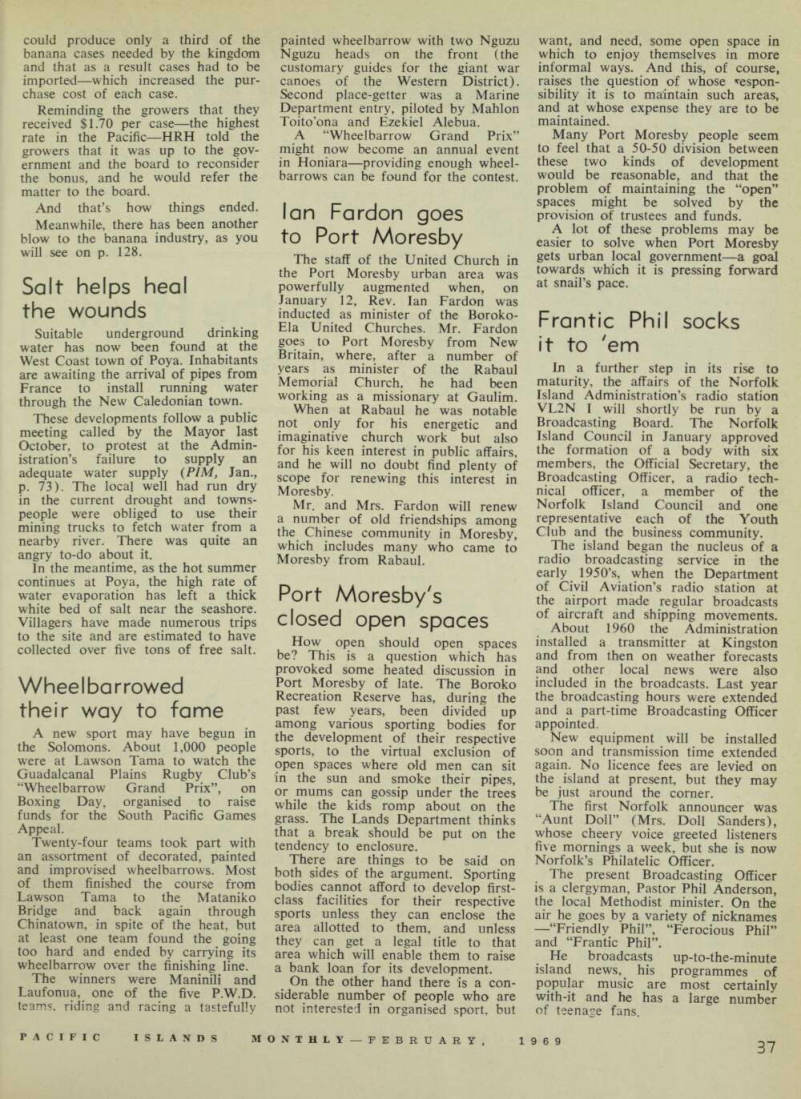
Miss Rosme Curtis, travelling represen tative for the Founda tion for the Peoples of the South Pacific, with Mr. R. M. Birch (left), Australian Com missioner in Fiji, and Mr. Peter Maher, US Vice-Consul in Suva, on Betio, Tarawa, for the 25th anniversary of the Battle of Tarawa. (PIM, Dec., 1968, p. 33). See story above.
could produce only a third of the banana cases needed by the kingdom and that as a result cases had to be imported—which increased the pur chase cost of each case.
Reminding the growers that they received $1.70 per case—the highest rate in the Pacific—HßH told the growers that it was up to the gov ernment and the board to reconsider the bonus, and he would refer the matter to the board.
And that’s how things ended.
Meanwhile, there has been another blow to the banana industry, as you will see on p. 128.
Salt helps heal
the wounds
Suitable underground drinking water has now been found at the West Coast town of Poya. Inhabitants are awaiting the arrival of pipes from France to install running water through the New Caledonian town.
These developments follow a public meeting called by the Mayor last October, to protest at the Admin istration’s failure to supply an adequate water supply ( PIM, Jan., p. 73). The local well had run dry in the current drought and towns people were obliged to use their mining trucks to fetch water from a nearby river. There was quite an angry to-do about it.
In the meantime, as the hot summer continues at Poya, the high rate of water evaporation has left a thick white bed of salt near the seashore.
Villagers have made numerous trips to the site and are estimated to have collected over five tons of free salt.
Wheelbarrowed
their way to fame
A new sport may have begun in the Solomons. About 1,000 people were at Lawson Tama to watch the Guadalcanal Plains Rugby Club’s “Wheelbarrow Grand Prix”, on Boxing Day, organised to raise funds for the South Pacific Games Appeal.
Twenty-four teams took part with an assortment of decorated, painted and improvised wheelbarrows. Most of them finished the course from Lawson Tama to the Mataniko Bridge and back again through Chinatown, in spite of the heat, but at least one team found the going too hard and ended by carrying its wheelbarrow over the finishing line.
The winners were Maninili and Laufonua, one of the five P.W.D. teams, riding and racing a tastefully
painted wheelbarrow with two Nguzu Nguzu heads on the front (the customary guides for the giant war canoes of the Western District).
Second place-getter was a Marine Department entry, piloted by Mahlon Toito’ona and Ezekiel Alebua.
A “Wheelbarrow Grand Prix” might now become an annual event in Honiara—providing enough wheel barrows can be found for the contest.
lan Pardon goes
to Port Moresby
The staff of the United Church in the Port Moresby urban area was powerfully augmented when, on January 12, Rev. lan Fardon was inducted as minister of the Boroko- Ela United Churches. Mr. Fardon goes to Port Moresby from New Britain, where, after a number of years as minister of the Rabaul Memorial Church, he had been working as a missionary at Gaulim.
When at Rabaul he was notable not only for his energetic and imaginative church work but also for his keen interest in public affairs, and he will no doubt find plenty of scope for renewing this interest in Moresby.
Mr. and Mrs. Fardon will renew a number of old friendships among the Chinese community in Moresby, which includes many who came to Moresby from Rabaul.
Port Moresby's
closed open spaces
How open should open spaces be? This is a question which has provoked some heated discussion in Port Moresby of late. The Boroko Recreation Reserve has, during the past few years, been divided up among various sporting bodies for the development of their respective sports, to the virtual exclusion of open spaces where old men can sit in the sun and smoke their pipes, or mums can gossip under the trees while the kids romp about on the grass. The Lands Department thinks that a break should be put on the tendency to enclosure.
There are things to be said on both sides of the argument. Sporting bodies cannot afford to develop first class facilities for their respective sports unless they can enclose the area allotted to them, and unless they can get a legal title to that area which will enable them to raise a bank loan for its development.
On the other hand there is a con siderable number of people who are not interested in organised sport, but
want, and need, some open space in which to enjoy themselves in more informal ways. And this, of course, raises the question of whose respon sibility it is to maintain such areas, and at whose expense they are to be maintained.
Many Port Moresby people seem to feel that a 50-50 division between these two kinds of development would be reasonable, and that the problem of maintaining the “open” spaces might be solved by the provision of trustees and funds.
A lot of these problems may be easier to solve when Port Moresby gets urban local government—a goal towards which it is pressing forward at snail’s pace.
Frantic Phil socks
it to 'em
In a further step in its rise to maturity, the affairs of the Norfolk Island Administration’s radio station VL2N I will shortly be run by a Broadcasting Board. The Norfolk Island Council in January approved the formation of a body with six members, the Official Secretary, the Broadcasting Officer, a radio tech nical officer, a member of the Norfolk Island Council and one representative each of the Youth Club and the business community.
The island began the nucleus of a radio broadcasting service in the early 1950’5, when the Department of Civil Aviation’s radio station at the airport made regular broadcasts of aircraft and shipping movements.
About 1960 the Administration installed a transmitter at Kingston and from then on weather forecasts and other local news were also included in the broadcasts. Last year the broadcasting hours were extended and a part-time Broadcasting Officer appointed.
New equipment will be installed soon and transmission time extended again. No licence fees are levied on the island at present, but they may be just around the corner.
The first Norfolk announcer was “Aunt Doll” (Mrs. Doll Sanders), whose cheery voice greeted listeners five mornings a week, but she is now Norfolk’s Philatelic Officer.
The present Broadcasting Officer is a clergyman, Pastor Phil Anderson, the local Methodist minister. On the air he goes by a variety of nicknames —“Friendly Phil”, “Ferocious Phil” and “Frantic Phil”.
He broadcasts up-to-the-minute island news, his programmes of popular music are most certainly with-it and he has a large number of teenage fans.