Book Reviews
pp. 95-97 · Read in the full issue

Islands History And The
Men Who Made It
The first modem migration experiment in the Pacific was the transfer of an initial 700 people from the overcrowded Gilbert and Ellice Islands to three of the uninhabited atolls of the Phoenix Group in 1939. The scheme was called the Phoenix Islands Settlement Scheme and, for obvious reasons, was one of the few enterprises of recent times not known by its initials.
It was, however, an interesting ex periment and although it ultimately failed (for meterological reasons and not until the 1960’5) it provided a great deal of basic information about transplanting islanders from one part of the Pacific to another.
The story of the scheme and how it was put into effect is the only modern, first-person account in a book of Pacific studies entitled Of Islands and Men, by H. E. Maude.
Maude, then a District Officer in the GEIC, was the architect of the scheme and he physically saw it through until the people had estab lished themselves and had increased in numbers.
Probably no person was better qualified for the job. In a foreword he tells how, as a youngster, he slept with a copy of Stewart’s Handbook of the Pacific under his pillow and had cut his teeth on The Swiss Family Robinson and other romantic tales of the South Seas.
When he joined the Overseas Civil Service (or whatever it was called then) he asked specifically to be sent to the Gilbert and Ellice Islands Colony.
Got his wish
HMOCS was happy to oblige. All the African colonies were in full working order, at that time. There were also the West Indies and, possibly as a last resort, Fiji. Appli cations to go to the Gilberts were few and Maude got his wish.
Apparently he was pleased with what he saw and, reading between the lines, we may presume that the
GEIC has remained his first Pacific love to this day.
After the Pacific War, H. E. Maude became Executive Officer for Social Development in the South Pacific Commission. He is now Professorial Fellow in the Research School of Pacific Studies of the Australian National University, Canberra.
His book is a rare old mixture of Islands history and the men who made it. If, on the first glance, the people and events that he writes about seem completely unrelated incidents in 300 years of history, the view is superficial. Taken together they present something basic in the pattern of development in the Pacific area, binding Australia and the Islands together in a way that can’t be undone by politicians newly be lieving that Australia is now just a part of Asia.
Invaluable material
The whole book is excellent; it is also academic and because it is academic it contains invaluable source material for not-quite-so-academic writers who may come afterwards.
For anyone with an eye for a Pacific story, there is the germ of at least 20 novels and a dozen other books in its 370-odd pages.
Several books could come out of the long chapter on “Beachcombers and Castaways”, upon whom the author seems to look with an in dulgent and non-academic eye; and several more out of the sections on traders—both the pork-traders who, for some 30 years after the founding of the New South Wales colony, supplied it with salt pork from Tahiti;
and the coconut oil traders who paved the way for the copra industry.
“The particular position of the beachcomber,” says the author, “in and out of the indigenous society made him an excellent mediator . . . and in performing this function he probably made his major contribution to the ultimate welfare of the people among whom he lived, cushioning by explanation the inevitable onset of culture change.”
Beachcombers, when they had attached themselves to some chief or community (and there was no other way in which they could exist), were expected to expound on the white man’s country, his habits and the way he thought. They were also the first European artisans in the islands and as such were the first in structors in Western techniques.
Beachcomber literature
The majority of the early beach combers were seamen, but pretty versatile seamen, who could build anything from boxes to houses, and who could use firearms and maintain them. As far as the islanders were concerned these were all valuable accomplishments.
But possibly their most valuable
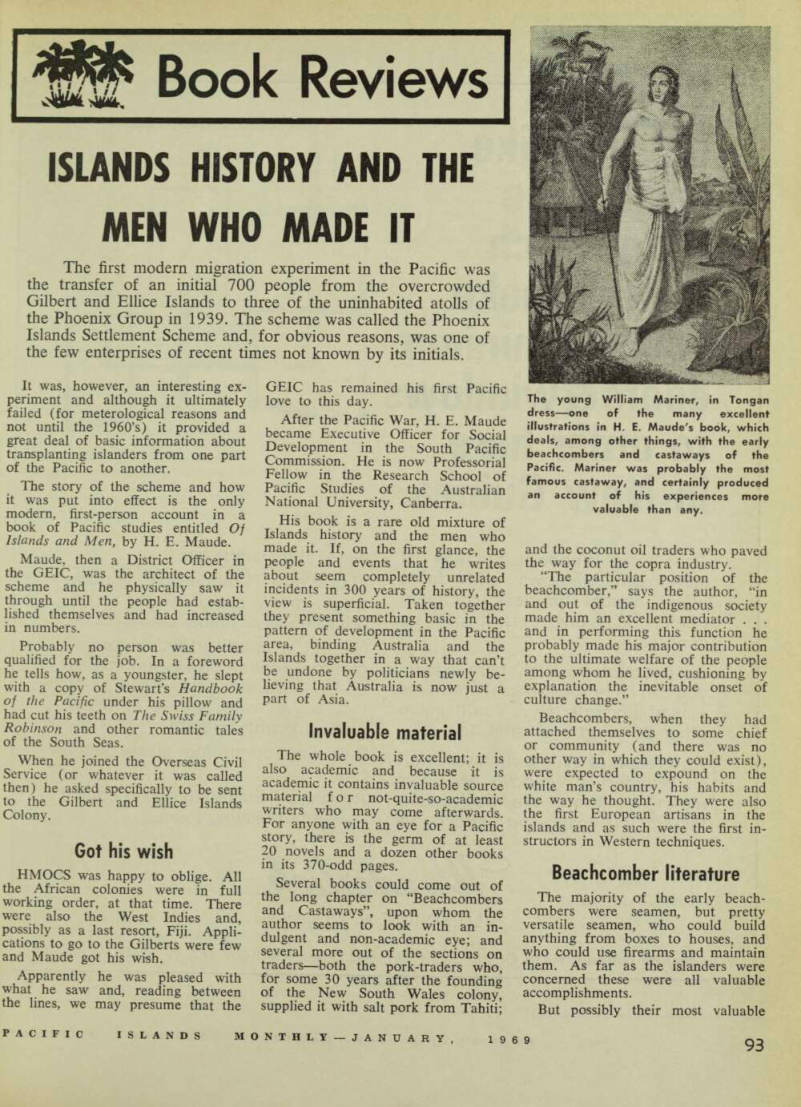
The young William Mariner, in Tongan dress—one of the many excellent illustrations in H. E. Maude's book, which deals, among other things, with the early beachcombers and castaways of the Pacific. Mariner was probably the most famous castaway, and certainly produced an account of his experiences more valuable than any.
But oh the footnotes!
contribution was beachcomber literature which they left behind and which covers the 70 years of the beachcombing era from about 1780-1850.
Maude lists 21 of these works, written either by the beachomber or castaway, or by someone who had access to him. /7 - ■ .
A Ciassic
The best known, of course, is the two-volume work now generally called Mariner’s Tonga. Of it Mr Maude says: “With Mariner producing the facts and Dr. [John] Martin thl editorial expertise, a classic eventuated which include; a history of the islands, a narrative of the political and other events which Occurred during Mariner’s stay, an epitome of Tongan society, including the social structure, material culture, economy and cusiomary observances and a grammar and vocabulary.” 6 Other chapters in Maude's book deal with the Bounty mutineers’ search for a home; the unsuccessful attempt to resettle the Pitcairners on Tahiti in 1831; Spanish and post- Spanish discoveries in the Pacific; and the discovery of Rarotonga by
traders searching for non-existent sandalwood.
The book is illustrated with black and white prints of historical interest and naturally it has a multiplicity of footnotes. One presumes that pub lishers like Oxford University Press would not consider a manuscript that had no footnotes and that academic types for whom they are primarily published are used to their eyes doing a yo-yo dance up and down pages.
This reviewer, however, can tolerate footnotes only when they tell her something extra. For the most part those in this book say merely: “Smith 1844:203-4”; or “Earnshaw 1959:26” and refer to the biblio graphy at the back. If the references had been put at the end of each chapter it might have served the same purpose and at the same time not created a visual distraction.
There is an extensive and valuable bibliography but a curious omission —no index.
A friend of mine who writes travel guide-books refuses to put in an index because, he says, he wants people to read all the book. I’ve read all of Mr. Maude’s book and I know that I’ll want to dip into it for infor mation in the future. But I’d still like
an index to help me to do it.-
JT.
(Of Islands And Men. Oxford Uni
versity Press. $8.75.)
Aborigines, Polynesians in colour
Two new coffee table books by the active New Zealand pub lishers A. H. and A. W. Reed Pty. Ltd., vary in standard but not in price.
The Australian Aboriginal in Colour, with photography by Douglass Baglin and text by Roland Robinson, does more for its subject than Polynesia in Colour, pictures and text by James Siers, does for the South Seas. Both sell for 54.50, and at that price both are good value.
The aboriginal book is simply better value of the two.
Australian Aboriginal gives us a detailed look at aboriginal life, and the superb colour pictures illustrate intelligent, informative text. Both men understand their aborigines, and they have produced a book in which that fact shines through, James Siers has given us a superficial account of life in the Samoas, Tonga, the Cooks, Tahiti, New Caledonia and Fiji. It’s the kind of thing sponsored by the airlines, and quite satisfactory as an introduction to the South Seas.
Most of the colour pictures are excellent in themselves, and yet one sets the impression of unevenness. This may be due to the layout putting colours into conflict.
T7___ t * c u T r tn F ™“ Pf v op ' e *? flsh ; If you want to go rock fishing it would be a
good idea to get hold of Frank Marshall’s Let's Go Rock Fishing (Angus and Robertson, $3.25). This well-illustrated book tells in simple terms which fish to look for and where to look for them, what gear to use, how to tie knots and bait hooks (the drawings make these last two temper-fraying jobs look quite eas V) •• • and > importantly, how to . Prepare the fish for the table, Th * s a b °ok for Australian fishing, but tbe principles are the same, and often the fish (but the names may u- u . r- Tv5 Skl l! 8 ii Ca u 1 e - an § er ’ o^s ’ a nd Ma £shall has included in this .comments f in brackets, a list of do s and don ts tor rock fishermen prepared by the NSW Amateur Fishermen’s Associa tion.