Yesterday
p. 93 · Read in the full issue
The infant South Pacific Commission was getting ready to move from Mosman, Sydney, to its new address in Noumea, New Caledonia, 20 years ago this month. During December, ’4B, and January ’49, members of the Secretariat and the Re search Council of the SPC began to assemble in Sydney from overseas to make ready for the move. Among them were Mr. H.
E. Ward, formerly Resident Commissioner of the GEIC, and then Deputy Secretary General of the SPC; Professor L. G. M.
Baas Becking (Holland), Deputy Chairman of the SPC’s Re search Council; and Major E. Massal (France), Research Council Officer in charge of health. PIM reported that good progress had been made in Noumea to meet the official and residential requirements of the SPC’s staff.
Among other items for January, 1949: In early February, 1949, a work force of 5,000 Javanese was expected to arrive in France’s Melanesian territories —3,000 for New Caledonia and 2,000 for the condominium of the New Hebrides. The Messageries Maritimes Company was arranging transport.
It was reported from Lae that Koranga Gold, which operated sluic ing claims in the upper Bulolo Valley, took £25,000 gold out of a new patch in four days. That was good going —but it hardly compares with the possibilities for the territory if CRA decides to go ahead with mining gold and copper on Bougainville. It could bring Si2o million a year in exports.
PIM was urging the formation of a Pacific Union, run along the lines of the Atlantic Defence Union, to defend the European countries of the Pacific Basin against communist inspired aggression from mainland Asia. An editorial said that Asia held more than half the world’s popula tion, and predicted: “The day is com ing rapidly when the European nations, in and around the Pacific, will have to defend themselves against Asia; and their only sure and certain defence is a sharp sword.”
Tongans were drinking too much, wrote our Nukualofa correspondent; but so, too, were the Europeans in Tonga, he said, and they were sup posed to give an example. Nukualofa’s famous annual club dance had re cently been marred because Tonga’s crack jazz band had arrived “all more or less intoxicated.”
“The announcement, early in De
cember, that the international air authority had recommended the selection of Suva Point, only two miles from the town of Suva, to be the site of Fiji’s great international airport (in preference to Nadi) came as a complete surprise,” announced PIM in January, 1949. Readers to day will be equally surprised. Why didn’t the authorities continue with plans to build an airport within a few minutes of the centre of Suva?
Answer, in a nutshell, is that further
investigations showed that the weather isn’t suitable. Therefore, Nadi, 130 miles from Suva in the dry north-west of Viti Levu, remained the site for Fiji’s international airport.
NG Administration officer Alf Robinson, who survived World War II as a coastwatcher and soldier (he was a survivor of the dreadful Tol massacre), was murdered at Pooaing village, New Britain, in mid-December.
Eight native labourers who were with him were also killed. This was the first incident of the kind in the terri tory for many years.
Due largely to increased expendi ture on public works, the Tongan Government estimates for 1948-1949 showed an increase of over 100 per cent, on the actual expenditure of 1946-47. The Estimates for 1948-49 provided for a small surplus, with revenue calculated at £224,000 and expenditure at £222,242. It was en visaged that Queen Salote and her establishment would receive £5,646 for that current year, the Premier and his establishment, £6,712; the Legislative Assembly, £7,076; and Governors of provinces £1,258.
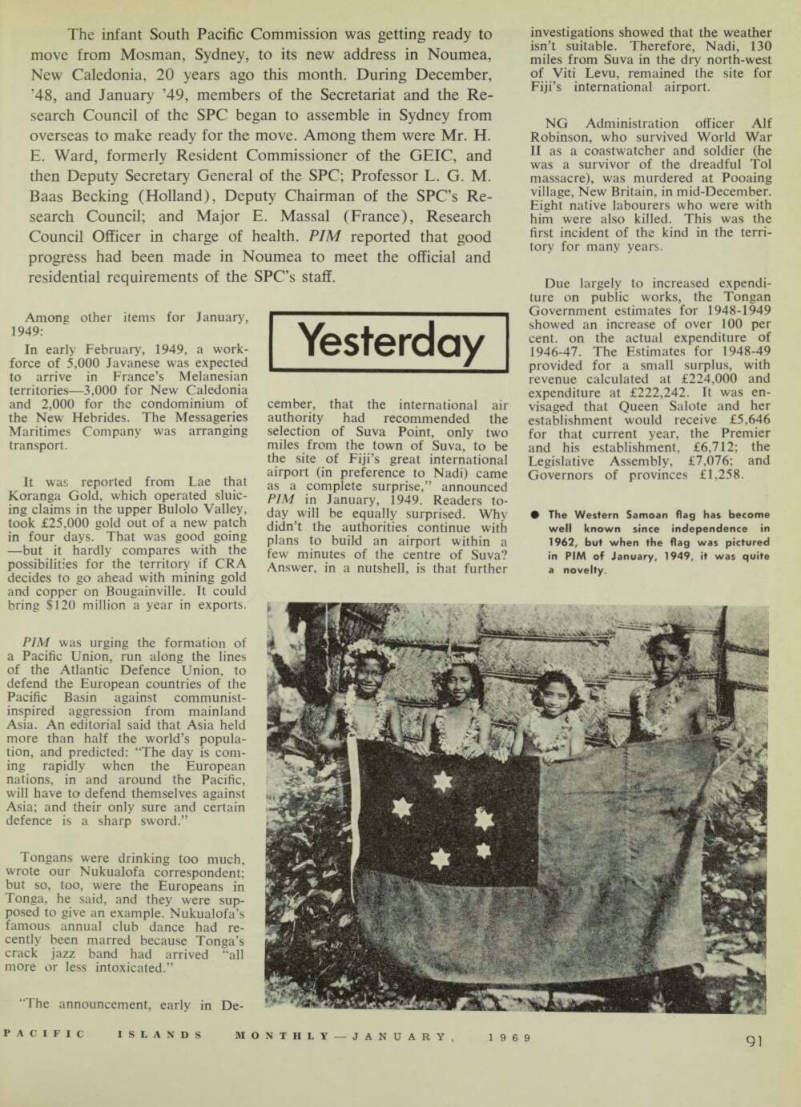
• The Western Samoan flag has become well known since independence in 1962, but when the flag was pictured in PIM of January, 1949, it was quite
a novelty.