Tropicalies
pp. 37-44 · Read in the full issue
Who’d have thought the latest Fiji travel film, called “Fiji . . . Fiji” and previewed in Suva on December 18, would cause Fiji MLC Mr. Wes Barrett so much concern? And who’d have thought that Mr. Barrett’s concern would have resulted in the Legislative Council having the film cut? Not many people— and certainly not Fiji Visitors Bureau’s manager Rory Scott but that’s what appears to have happened after a screening of the film for the Legco on December 19.
“Fiji . . . Fiji” is a good film, a very good film. So it should be —it cost the Fiji Visitors Bureau over $20,000 to commission from Cinesound. It breaks away from the ordinary travelogue image, has no dialogue, no commentary, no free plugs, and no stiffly posed models.
It’s interesting in fact, and should do much to stimulate an ordinary viewing public’s interest in visiting Fiji.
But, according to an affronted Mr.
Barrett, who is also on the board of the Fiji Visitors Bureau, the 30minute film has an “offensive” section.
He was adamant about the fact and he told the Minister for Tourism, Mr. Stinson, what he thought. At the same time Bureau manager, Mr.
Rory Scott was equally adamant about the fact that he didn’t intend to allow “one single frame to be cut”.
Mr. Barrett’s “offensive” section is one which sends up the Europeans in a highly satirical, though not particularly cruel, manner.
We see long-time tourism identity Barry Philp, reclining in boozy splendour in a chaise-longe, while his Indian house-boy pours him another stiff whisky, A local Euro pean businessman scurries down the street, comical in shorts and long socks, umbrella and briefcase.
But Mr. Barrett was most offended by a scene which showed District Officer Don Malcolm riding on horseback, looking fraightfully disdainful, and followed bv a Fijian, also on horseback but juggling an enormous suitcase. In another, Mr.
Malcolm is being punted down the river while a Fijian boy shields him from the sun with a large black umbrella.
And to add to the mad dogs and Englishmen atmosphere is a specially composed background theme to this segment, going something like “We’re
Satirical travel film treads on Fiji toes
aaall guardians of the Empah!”
This part would obviously need some doctoring, Mr. Barrett said.
It showed local people acting as lackeys to Europeans and there was no point in introducing politics into tourism ... it was offensive to local people.
All members of the Legislative Council saw “Fiji . . . Fiji” and they felt that the offending sequence was out of place since Fiji is no longer the sort of colony it depicts.
Someone pointed out that the world outside Fiji was used to being sent up and satire was usually far more biting than that in “Fiji . . .
Fiji”.
“It looks like we’re old hat here,” said Mr. David Ragg, chairman of the FVB—with some justification.
Not what he
bargained for
A lot of conscience money is spent at Nadi airport’s duty free shop. Mostly by businessmen who have promised their wives riches (i.e., a muumuu or two) and have per suaded themselves, as shopping time runs out, “Well, there’s always the duty free shop at Nadi.”
But usually they are in such a hurry at the airport that they don’t get the bargains they bargained for. Far from it.
Take the case of a friend of ours.
He’d bought some dress material, a sulu and a conch shell in Suva, but had failed to buy the straw basket he’d promised his wife. So he de cided to make amends at Nadi before he climbed aboard the Qantas jet.
He queued at the duty free shop— for 20 minutes.
It apparently takes a long time to get served at the duty free shop at 4 a.m.—because there are only two girls serving at that time and they have to handwrite an invoice for every item sold.
When our friend’s turn came to be served, he pointed to a basket on the wall and asked how much.
Three dollars Australian, sir.
He’d take it.
His wife was very pleased with the material and the sulu when she saw them some four hours later, and she nodded at the basket. It was a very small basket and the nicest thing you could do to it was nod, but our friend was pretty hurt about that nod. After all, he’d queued 20 minutes for the thing.
He demanded to know what was wrong with the bag.
Well, nothing really, his wife as sured him. And then she told him.
It was small and full of cobwebs
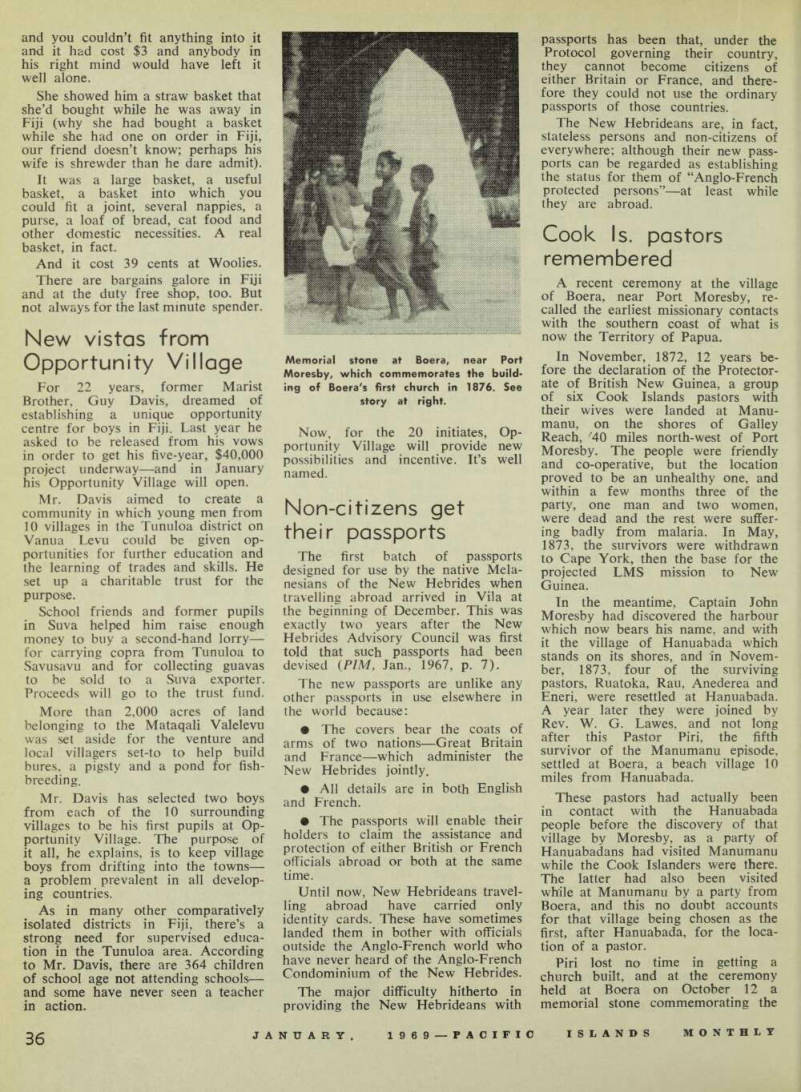
Fiji is no longer THAT sort of colony, say members of the colony's Legco con demning a Fiji travel film which depicts a fraightfully pukka sort of place. Our picture shows the then Governor, Sir Kenneth Maddocks, in colonial, plumed hat, greeting the Queen on her 1963 tour of Fiji. They still wear those hats.
and you couldn’t fit anything into it and it had cost $3 and anybody in his right mind would have left it well alone.
She showed him a straw basket that she’d bought while he was away in Fiji (why she had bought a basket while she had one on order in Fiji, our friend doesn’t know; perhaps his wife is shrewder than he dare admit).
It was a large basket, a useful basket, a basket into which you could fit a joint, several nappies, a purse, a loaf of bread, cat food and other domestic necessities. A real basket, in fact.
And it cost 39 cents at Woolies.
There are bargains galore in Fiji and at the duty free shop, too. But not always for the last minute spender.
New vistas from
Opportunity Village
For 22 years, former Marist Brother, Guy Davis, dreamed of establishing a unique opportunity centre for boys in Fiji. Last year he asked to be released from his vows in order to get his five-year, $40,000 project underway—and in January his Opportunity Village will open.
Mr. Davis aimed to create a community in which young men from 10 villages in the Tunuloa district on Vanua Levu could be given op portunities for further education and the learning of trades and skills. He set up a charitable trust for the purpose.
School friends and former pupils in Suva helped him raise enough money to buy a second-hand lorry— for carrying copra from Tunuloa to Savusavu and for collecting guavas to be sold to a Suva exporter.
Proceeds will go to the trust fund.
More than 2,000 acres of land belonging to the Mataqali Valelevu was set aside for the venture and local villagers set-to to help build bures, a pigsty and a pond for fish breeding.
Mr. Davis has selected two boys from each of the 10 surrounding villages to be his first pupils at Op portunity Village. The purpose of it all, he explains, is to keep village boys from drifting into the towns— a problem prevalent in all develop ing countries.
As in many other comparatively isolated districts in Fiji, there’s a strong need for supervised educa tion in the Tunuloa area. According to Mr. Davis, there are 364 children of school age not attending schools— and some have never seen a teacher in action.
Now, for the 20 initiates, Op portunity Village will provide new possibilities and incentive. It’s well named.
Non-citizens get
their passports
The first batch of passports designed for use by the native Mela nesians of the New Hebrides when travelling abroad arrived in Vila at the beginning of December. This was exactly two years after the New Hebrides Advisory Council was first told that such passports had been devised ( PIM , Jan., 1967, p. 7).
The new passports are unlike any other passports in use elsewhere in the world because: • The covers bear the coats of arms of two nations—Great Britain and France—which administer the New Hebrides jointly, • All details are in both English and French. • The passports will enable their holders to claim the assistance and protection of either British or French officials abroad or both at the same time.
Until now, New Hebrideans travel ling abroad have carried only identity cards. These have sometimes landed them in bother with officials outside the Anglo-French world who have never heard of the Anglo-French Condominium of the New Hebrides.
The major difficulty hitherto in providing the New Hebrideans with
passports has been that, under the Protocol governing their country, they cannot become citizens of either Britain or France, and there fore they could not use the ordinary passports of those countries.
The New Hebrideans are, in fact, stateless persons and non-citizens of everywhere; although their new pass ports can be regarded as establishing the status for them of “Anglo-French protected persons”—at least while they are abroad.
Cook Is. pastors
remembered
A recent ceremony at the village of Boera, near Port Moresby, re called the earliest missionary contacts with the southern coast of what is now the Territory of Papua.
In November, 1872, 12 years be fore the declaration of the Protector ate of British New Guinea, a group of six Cook Islands pastors with their wives were landed at Manu manu, on the shores of Galley Reach, 7 40 miles north-west of Port Moresby. The people were friendly and co-operative, but the location proved to be an unhealthy one, and within a few months three of the party, one man and two women, were dead and the rest were suffer ing badly from malaria. In May, 1873, the survivors were withdrawn to Cape York, then the base for the projected LMS mission to New Guinea.
In the meantime, Captain John Moresby had discovered the harbour which now bears his name, and with it the village of Hanuabada which stands on its shores, and in Novem ber, 1873, four of the surviving pastors, Ruatoka, Rau, Anederea and Eneri, were resettled at Hanuabada, A year later they were joined by Rev. W. G. Lawes, and not long after this Pastor Piri, the fifth survivor of the Manumanu episode, settled at Boera, a beach village 10 miles from Hanuabada.
These pastors had actually been in contact with the Hanuabada people before the discovery of that village by Moresby, as a party of Hanuabadans had visited Manumanu while the Cook Islanders were there.
The latter had also been visited while at Manumanu by a party from Boera, and this no doubt accounts for that village being chosen as the first, after Hanuabada, for the loca tion of a pastor.
Piri lost no time in getting a church built, and at the ceremony held at Boera on October 12 a memorial stone commemorating the
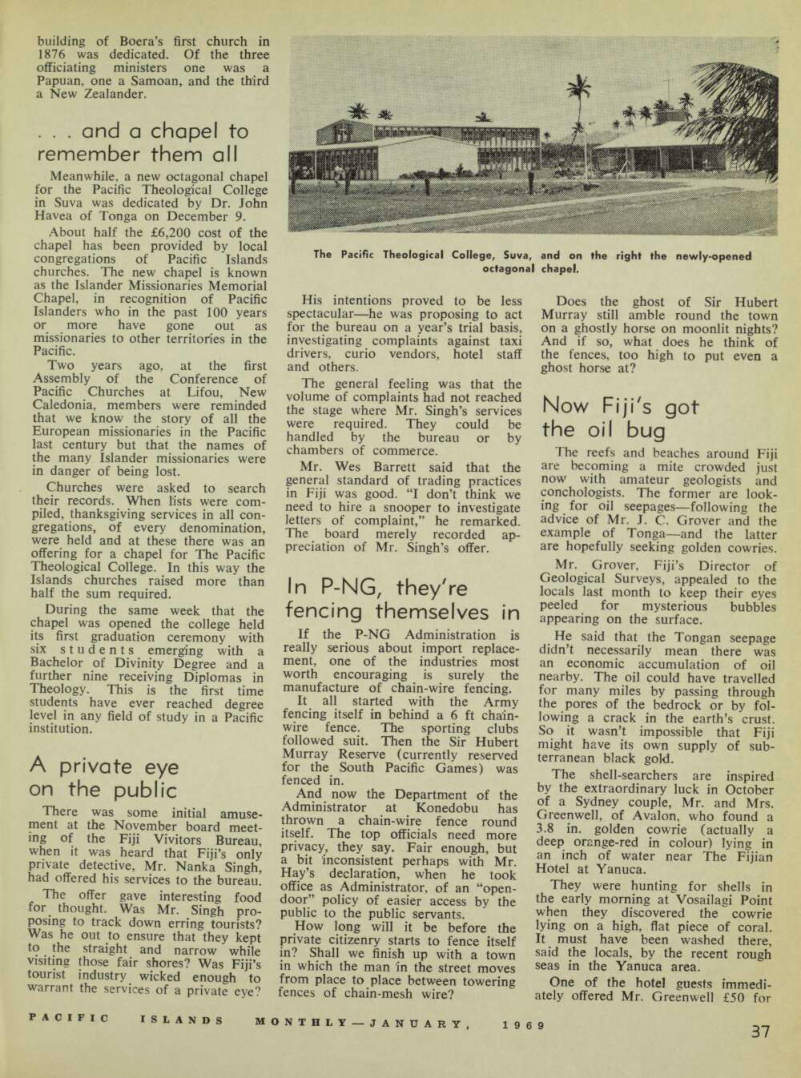
Memorial stone at Boera, near Port Moresby, which commemorates the build ing of Boera's first church in 1876. See story at right.
building of Boera’s first church in 1876 was dedicated. Of the three officiating ministers one was a Papuan, one a Samoan, and the third a New Zealander. . . . and a chapel to
remember them all
Meanwhile, a new octagonal chapel for the Pacific Theological College in Suva was dedicated by Dr. John Havea of Tonga on December 9.
About half the £6,200 cost of the chapel has been provided by local congregations of Pacific Islands churches. The new chapel is known as the Islander Missionaries Memorial Chapel, in recognition of Pacific Islanders who in the past 100 years or more have gone out as missionaries to other territories in the Pacific.
Two years ago, at the first Assembly of the Conference of Pacific Churches at Lifou, New Caledonia, members were reminded that we know the story of all the European missionaries in the Pacific last century but that the names of the many Islander missionaries were in danger of being lost.
Churches were asked to search their records. When lists were com piled, thanksgiving services in all con gregations, of every denomination, were held and at these there was an offering for a chapel for The Pacific Theological College. In this way the Islands churches raised more than half the sum required.
During the same week that the chapel was opened the college held its first graduation ceremony with six students emerging with a Bachelor of Divinity Degree and a further nine receiving Diplomas in Theology. This is the first time students have ever reached degree level in any field of study in a Pacific institution.
A private eye
on the public
There was some initial amuse ment at the November board meet ing of the Fiji Vivitors Bureau, when it was heard that Fiji’s only private detective, Mr. Nanka Singh, had offered his services to the bureau.
The offer gave interesting food for thought. Was Mr. Singh pro posing to track down erring tourists?
Was he out to ensure that they kept to the straight and narrow while visiting those fair shores? Was Fiji’s tourist industry wicked enough to warrant the services of a private eye?
His intentions proved to be less spectacular—he was proposing to act for the bureau on a year’s trial basis, investigating complaints against taxi drivers, curio vendors, hotel staff and others.
The general feeling was that the volume of complaints had not reached the stage where Mr. Singh’s services were required. They could be handled by the bureau or by chambers of commerce.
Mr. Wes Barrett said that the general standard of trading practices in Fiji was good. “I don’t think we need to hire a snooper to investigate letters of complaint,” he remarked.
The board merely recorded ap preciation of Mr. Singh’s offer.
In P-NG, they're
fencing themselves in
If the P-NG Administration is really serious about import replace ment, one of the industries most worth encouraging is surely the manufacture of chain-wire fencing.
It all started with the Army fencing itself in behind a 6 ft chain wire fence. The sporting clubs followed suit. Then the Sir Hubert Murray Reserve (currently reserved for the South Pacific Games) was fenced in.
And now the Department of the Administrator at Konedobu has thrown a chain-wire fence round itself. The top officials need more privacy, they say. Fair enough, but a bit inconsistent perhaps with Mr.
Hay’s declaration, when he took office as Administrator, of an “open door” policy of easier access by the public to the public servants.
How long will it be before the private citizenry starts to fence itself in? Shall we finish up with a town in which the man in the street moves from place to place between towering fences of chain-mesh wire?
Does the ghost of Sir Hubert Murray still amble round the town on a ghostly horse on moonlit nights?
And if so, what does he think of the fences, too high to put even a ghost horse at?
Now Fiji's got
the oil bug
The reefs and beaches around Fiji are becoming a mite crowded just now with amateur geologists and conchologists. The former are look ing for oil seepages—following the advice of Mr. J. C. Grover and the example of Tonga—and the latter are hopefully seeking golden cowries.
Mr. Grover, Fiji’s Director of Geological Surveys, appealed to the locals last month to keep their eyes peeled for mysterious bubbles appearing on the surface.
He said that the Tongan seepage didn’t necessarily mean there was an economic accumulation of oil nearby. The oil could have travelled for many miles by passing through the pores of the bedrock or by fol lowing a crack in the earth’s crust.
So it wasn’t impossible that Fiji might have its own supply of sub terranean black gold.
The shell-searchers are inspired by the extraordinary luck in October of a Sydney couple, Mr. and Mrs.
Greenwell, of Avalon, who found a 3.8 in. golden cowrie (actually a deep orange-red in colour) lying in an inch of water near The Fijian Hotel at Yanuca.
They were hunting for shells in the early morning at Vosailagi Point when they discovered the cowrie lying on a high, flat piece of coral.
It must have been washed there, said the locals, by the recent rough seas in the Yanuca area.
One of the hotel guests immedi ately offered Mr. Greenwell £5O for
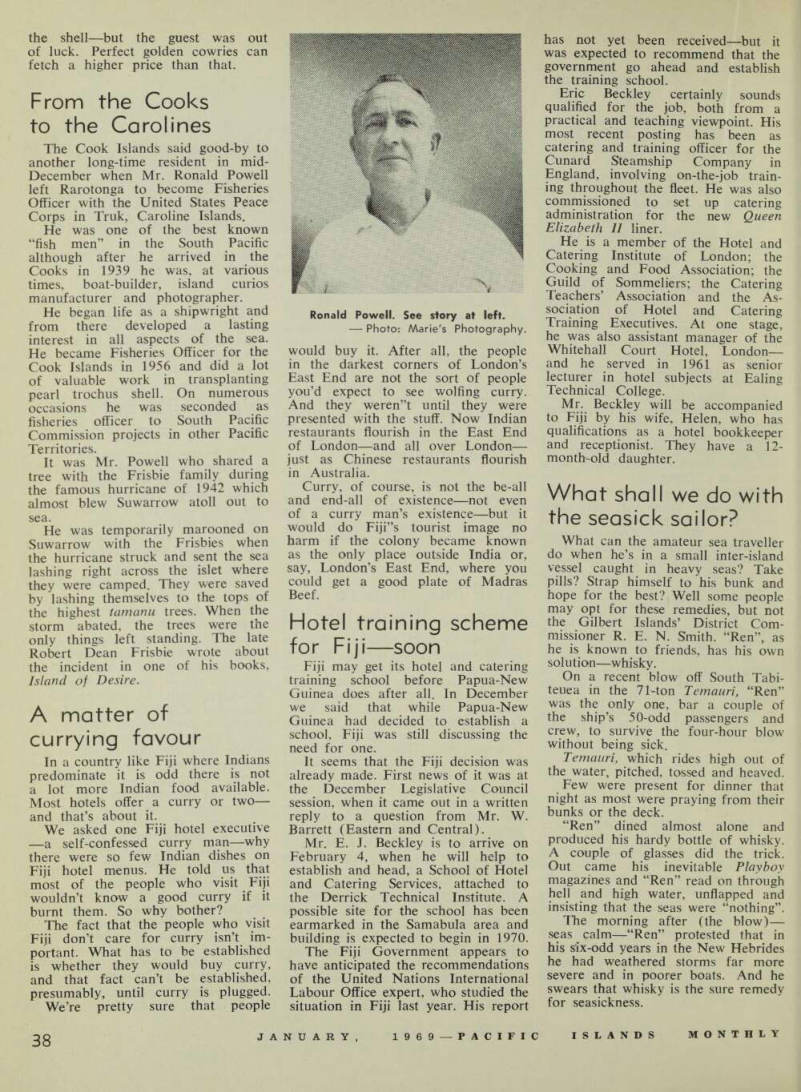
The Pacific Theological College, Suva, and on the right the newly-opened octagonal chapel.
the shell—but the guest was out of luck. Perfect golden cowries can fetch a higher price than that.
From the Cooks
to the Carolines
The Cook Islands said good-by to another long-time resident in mid- December when Mr. Ronald Powell left Rarotonga to become Fisheries Officer with the United States Peace Corps in Truk, Caroline Islands.
He was one of the best known “fish men” in the South Pacific although after he arrived in the Cooks in 1939 he was, at various times, boat-builder, island curios manufacturer and photographer.
He began life as a shipwright and from there developed a lasting interest in all aspects of the sea.
He became Fisheries Officer for the Cook Islands in 1956 and did a lot of valuable work in transplanting pearl trochus shell. On numerous occasions he was seconded as fisheries officer to South Pacific Commission projects in other Pacific Territories.
It was Mr. Powell who shared a tree with the Frisbie family during the famous hurricane of 1942 which almost blew Suwarrow atoll out to sea.
He was temporarily marooned on Suwarrow with the Frisbies when the hurricane struck and sent the sea lashing right across the islet where they were camped. They were saved by lashing themselves to the tops of the highest tamanu trees. When the storm abated, the trees were the only things left standing. The late Robert Dean Frisbie wrote about the incident in one of his books, Island of Desire.
A matter of
currying favour
In a country like Fiji where Indians predominate it is odd there is not a lot more Indian food available.
Most hotels offer a curry or two — and that’s about it.
We asked one Fiji hotel executive —a self-confessed curry man—why there were so few Indian dishes on Fiji hotel menus. He told us that most of the people who visit Fiji wouldn’t know a good curry if it burnt them. So why bother?
The fact that the people who visit Fiji don’t care for curry isn’t im portant. What has to be established is whether they would buy curry, and that fact can’t be established, presumably, until curry is plugged.
We’re pretty sure that people
would buy it. After all, the people in the darkest corners of London’s East End are not the sort of people you’d expect to see wolfing curry.
And they weren”t until they were presented with the stuff. Now Indian restaurants flourish in the East End of London—and all over London— just as Chinese restaurants flourish in Australia.
Curry, of course, is not the be-all and end-all of existence—not even of a curry man’s existence—but it would do Fiji”s tourist image no harm if the colony became known as the only place outside India or, say, London’s East End, where you could get a good plate of Madras Beef.
Hotel training scheme
for Fiji—soon
Fiji may get its hotel and catering training school before Papua-New Guinea does after all. In December we said that while Papua-New Guinea had decided to establish a school, Fiji was still discussing the need for one.
It seems that the Fiji decision was already made. First news of it was at the December Legislative Council session, when it came out in a written reply to a question from Mr, W.
Barrett (Eastern and Central).
Mr. E. J. Beckley is to arrive on February 4, when he will help to establish and head, a School of Hotel and Catering Services, attached to the Derrick Technical Institute. A possible site for the school has been earmarked in the Samabula area and building is expected to begin in 1970.
The Fiji Government appears to have anticipated the recommendations of the United Nations International Labour Office expert, who studied the situation in Fiji last year. His report
has not yet been received—but it was expected to recommend that the government go ahead and establish the training school.
Eric Beckley certainly sounds qualified for the job, both from a practical and teaching viewpoint. His most recent posting has been as catering and training officer for the Cunard Steamship Company in England, involving on-the-job train ing throughout the fleet. He was also commissioned to set up catering administration for the new Queen Elizabeth II liner.
He is a member of the Hotel and Catering Institute of London; the Cooking and Food Association; the Guild of Sommeliers; the Catering Teachers’ Association and the As sociation of Hotel and Catering Training Executives. At one stage, he was also assistant manager of the Whitehall Court Hotel, London— and he served in 1961 as senior lecturer in hotel subjects at Ealing Technical College.
Mr. Beckley will be accompanied to Fiji by his wife, Helen, who has qualifications as a hotel bookkeeper and receptionist. They have a 12month-old daughter.
What shall we do with
the seasick sailor?
What can the amateur sea traveller do when he’s in a small inter-island vessel caught in heavy seas? Take pills? Strap himself to his bunk and hope for the best? Well some people may opt for these remedies, but not the Gilbert Islands’ District Com missioner R. E. N. Smith. “Ren”, as he is known to friends, has his own
solution—whisky.
On a recent blow off South Tabi teuea in the 71-ton Temauri, “Ren” was the only one, bar a couple of the ship’s 50-odd passengers and crew, to survive the four-hour blow without being sick.
Temauri, which rides high out of the water, pitched, tossed and heaved.
Few were present for dinner that night as most were praying from their bunks or the deck.
“Ren” dined almost alone and produced his hardy bottle of whisky.
A couple of glasses did the trick.
Out came his inevitable Playboy magazines and “Ren” read on through hell and high water, unflapped and insisting that the seas were “nothing”.
The morning after (the blow) — seas calm—“Ren” protested that in his six-odd years in the New Hebrides he had weathered storms far more severe and in poorer boats. And he swears that whisky is the sure remedy for seasickness.
Ronald Powell. See story at left.
Photo: Marie's Photography.
Under this banyan tree on Tanna, New Hebrides, hundreds of pigs were slaughtered for the last "toka" celebrations. "Toka"-a time of feasting singing and dancing and a time when traditional Tannese roles are reversed (the women order and the man obey)-is a Tannese version of oneup m anshi p in which one important chief tries to outdo all other local chiefs in the lavishiness of his entertainment. Tanna's "toka"‘ is a tourist attraction , with Air Melanesia running charter flights. But Tanna is only part of the New Hebrides; a different aspect is shown on the next two pages.
Photo: Coral Tours
Modern
Vila
Vila, once one of the untidiest towns in the South Pacific, has been given a face-lift recently, as these pictures of some fine new buildings show. In Vila French, British, New Hebridean and Vietnamese live happily together and as a result Vila is one of the unique places of the South Pacific. Though the closure of the manganese mine at Forrari is now being felt in Vila, especially by the stores and taxi operators, it hasn't stopped the spate of building.
Above, a block of flats and shops that cost $56,000. Right, the new Condominium offices (in the fore ground) and BP store have revolutionised that end of Vila which formerly was given over to unsightly weeds and old tin sheds.
Left, the new French school, on a hill over looking Vila, which was completed in 1968 and which offers full secondary education to French-speaking students. Not to be outdone, the British are now building stage three of their secondary establishment.
Right, a bakery-tearoom which was completed in 1967 at a cost of $36,000.
Above, the new Condominiuoffices, completed at a cost of $260,000, were opened towards the end of last year in true Condominium fashion—the two High Commissioners for the Pacific, French and British, cut a ribbon simultaneously. At the right of the Condominium office is part of the new store of Burns Philp (S.S.) Co. Ltd. The old store and office, which has occupied a quonset type building since the end of the war, is being pulled down. Left, the substantial-looking Vila Club, centre for local social activities.
A fascinating and little visited, part of Papua is Tufi, on the coast of the Northern District. It's famed for its natural fiords like the one above. The guest house is on a point overlooking a fiord (at right). See story opposite page.