1968 A Controversial Year
pp. 36-157 · Read in the full issue
In American Samoa
The year of 1968 was one when the political pot in the increasingly industrialised territory of American Samoa reached boiling point. The fire was lit in June when the American Samoan Democratic Party affiliated with the US mainland party, and it continued to burn as the year drew to an end with the general elections in November. Glen Wright, in a dispatch from Pago Pago, reports:
The village chiefs are alarmed at the deterioration of their traditional powers and privileges; charges and counter charges fly back and forth between conservatives and liberals; the Legislature is at odds with the US Administration; and the people, 85 per cent, of whom voted in favor of US citizenship 10 years ago, are wondering when the enabling act will be passed.
And all this amid a hustle and bustle of auto traffic and commercial activity in a debris-littered, architec turally ugly landscape that would have broken the hearts of Somerset Maugham and his contemporaries who once upon a time knew this isle as one of the loveliest in the Pacific.
“Don’t force citizenship upon us”, plead the Chiefs, and Governor Owen Aspinall replies (blithely ignoring the 1959 plebiscite): “Of course, not—an organic act would be passed by the US Congress only if the majority of the people wanted it”. Big problem of an organic act, he says, is land.
If Samoa becomes part of the US, Americans would be free to buy island real estate, which is now exclusive to native Samoans except in rare instances. And, he points out, if the Samoan were to become an American citizen, he surely would be unfairly exploited, because he has no knowledge of land values.
The political hassle started in June when the Democratic Party of American Samoa affiliated with the US mainland party. In August it hosted a ball featuring Democratic congressman from Hawaii, Spark Matsunaga.
Guiding lights
Eight hundred people were invited —at $lO per head. Two hundred at tended. Trumpeted Pago Pago Democratic leader Ivi Pele to the banqueters: “Government should be guided by public opinion and public opinion should be guided by political parties”.
A couple of weeks later the party conducted a debate over elective
governorship and US citizenship.
Majority of the members favoured both.
While this was going on, Governor Aspinall vetoed bills providing for a constitutional amendment which would give the American Samoa Legislature power over money ap propriations and job appointments.
Incensed, the Legislature protested to US Secretary of Interior Stewart Udall, pointing out that the territory of Hawaii had been permitted to do this in 1910.
Under-Secretary of Interior David Black replied that the Governor had the right to veto the bill because that body should not have made its pro posal in the form of a bill but rather as a “concurrent resolution for a Constitutional Amendment”, about which the Governor has no say.
Surplus plus
However, he said, this was un necessary since the Legislature already has power to appropriate local revenues. But it must keep its hands off US taxpayer grants. (Aspinall argues that the money in question—there was a surplus of some Sl.l million in the 1968 budget —is made up of US grants).
Disregarding the Legislature, the Governor went right ahead and spent $624,000 of that $l.l million surplus and announced plans for disposing of the rest of it—and more.
Budget for 1970 was adopted in late September: $14.1 millions, which is $3.8 millions more than 1969.
Partisan politics were burgeoning apace throughout 1968. In August,
(Continued on p. 153)
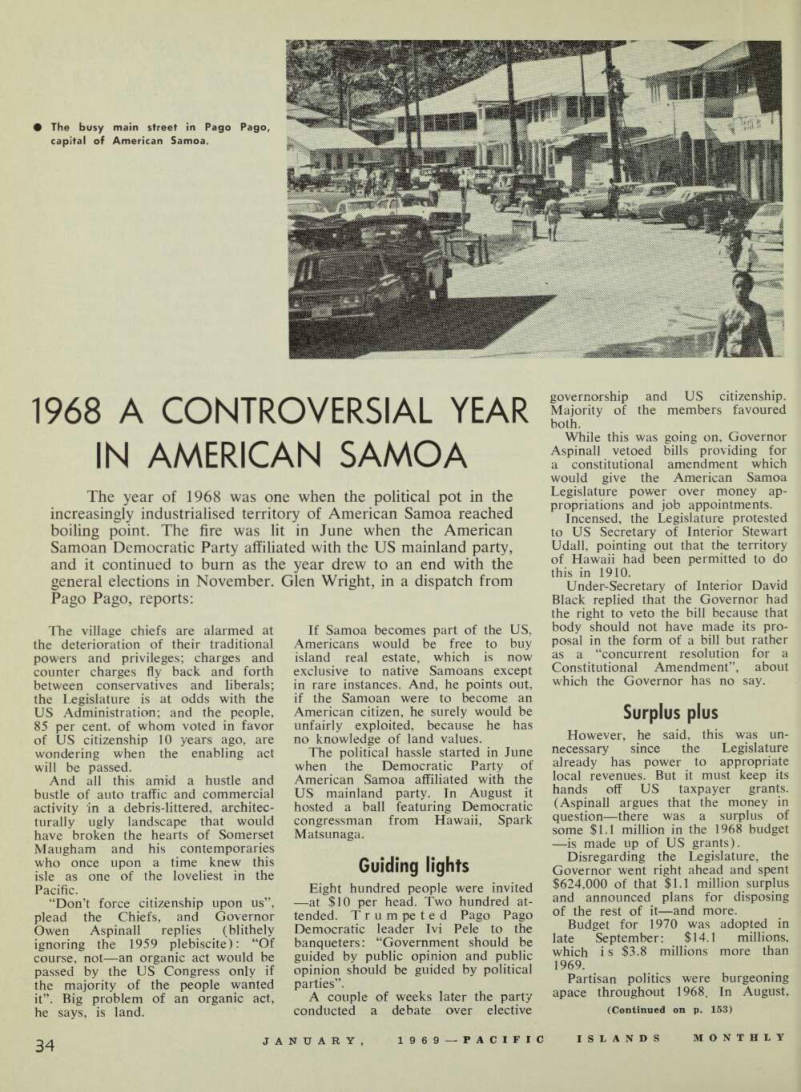
• The busy main street in Pago Pago, capital of American Samoa.
tribal chiefs and orators, concerned that the activities of the Democratic Party would result in loss of Ameri can voice in Washington, formed the American Samoa Party (ASP).
The party’s objectives: ‘To protect the interests and the property of our people from encroachment and ex ploitation by outsiders and modern civilisation”.
One hundred members pledged to promote and protect the chief and communal land ownership systems from “foreign invasion”.
The chiefs, scared out of their lethargy at the prospect of oblivion, are reacting violently at every little thing.
Furious
One of them, President of the Senate, got irked because Governor Aspinall referred to the election of a high chief to the Senate as an “appointment”. They were furious when Speaker of the Assembly urged US citizenship for American Samoans in mid-August.
The Speaker said that the US Congress should pass an organic act in three years, and that the question of statehood could come up later.
Why hadn’t the Legislature acted on the popular mandate of 1959? he wanted to know.
“The Constitution must be revised to permit this once and for all,” he declared. “Each time it has been revised in the past, ‘faults’ have been discovered”. In such a manner, he accused, the chiefs of the Legislature had contravened the wishes of their people for 10 years.
Governor Aspinall poured some oil on the troubled waters by saying that he was prepared to give more authority to the village councils, and that he intended to incorporate chiefs and orators into the govern ment structure. The chiefs countered by advocating that American Samoa become a US protectorate such as Puerto Rico.
As of September, two political parties were going strong. The in evitable then happened. A third group, the Republicans, was organised and became affiliated with its main land counterpart. Prime mover was Pete Sunia.
It declared itself against both enforced US citizenship and the chief system; the people should decide
(ignoring, like the Governor, that the people had already decided). The party also came out against educational television, urging that more classroom teachers be hired.
Changing mood
When the people went to the polls in early November to vote for 20 members of the House of Repre sentatives, only five previous members of the legislature were returned. The other 15 were new—and this, surely, is an indication of the mood of :hange in the territory.
Last reports from American Samoa showed that the House would contain fine Democrats, five Republicans, : our independents and two ASP men. however, various parties were claim ng more supporters. The ASP, for nstance, claimed that it could count )n 13 supporters in the House.
Ng Women's Club For 1969
The first meeting in 1969 of the "Jew Guinea Women’s Club will be eld on Wednesday, February 5, at 0.30 a.m. at the Lyceum Club, th Floor, 77 King Street, Sydney.
The second meeting will take lace at the new address on Wed nesday, February 19, after which le club will meet on the FIRST nd THIRD Wednesday of each lonth. The Feminist Club rooms re not available to the NG Women’s Club in 1969.