Book Reviews
pp. 101-103 · Read in the full issue
Ten thousand years in a lifetime
Two years ago, in my first contribution to PIM, I said, apropos of books on New Guinea, that the book I really wanted to read was one written by a Papuan or New Guinean. I went on to expresss the hope that before too long an indigenous writer would do for New Guinea what Camara Laye, in his African Child had done for old Guinea. And now, long before I really expected it, here it is.
Kiki is the result of a fruitful irtnership between its Papuan author id Ulli Beier, already widely known ►r his encouragement of indigenous frican writing. Maori Kiki talked • Ulli Beier, with a tape recorder his elbow, during a series of eekly meetings with him.
Beier produced the written record om the tapes “exactly in the quence in which he spoke it,” ough he admits to occasional ephrasing and restructing”.
The partnership was a great ccess, and the technique is one lich might well be tried again, since ost Papuans and New Guineans, en in their own language and much 3re so in English, find it easier to k than to write.
The only flaw in the method, and at perhaps a minor one, has been at some proper names have become sspelt in transcription, for example, well-known Port Moresby church m appears as “Archbishop Corpas”. a reprint is called for, as it surely II be, or if this outstanding book neves the distinction of re-publica n as a paperback, these errors in filing should be corrected.
Fascinating
Maori Kiki’s first chapter on his Idhood in his mother’s remote and village is every bit as fascinat and evocative as the early pages Camara Laye’s African Child.
Fhe second chapter, on his fiescence in his father’s village on Papuan coast, is nearly as good, ugh perhaps a little overloaded h tribal legends, not all of equal rary merit. It redeems itself, how r, by the superb story-telling of legend of the origin of the yam. daori next describes his initiation
at a period when tribal rites were on the way out. In fact he never went through the final stage of initiation; by the time he was ready for it the ritual had been discontinued.
But he had witnessed it, and he tells how, when the young men emerged from the final rites, the girls took the initiative in choosing a man by going up to him and saying “I mark my tree”.
“I feel cheated somehow,” he says, “when I remember that I never under went the miro ava akore festival, that I never sat in the hehe eravo, and that no Orokolo girl ever marked me as her tree.”
We now follow Maori’s transmuta tion into Albert: his entry into the white man’s world; his scanty educa tion—as good as could be got in those days; his progress from D.O.’s tea
boy at Kerema to medical student in Fiji; his marriage, back home, to a girl who he had first “met” by correspondence while he was still in Fiji; and his career as pathologist, welfare assistant, patrol officer and finally as full-time secretary of New Guinea’s first viable political party— Pangu Pati.
There is a good deal of bitterness in the telling, but it is shot through by the sardonic humour which is so characteristic of the man.
When Albert and his wife Elizabeth were chosen to represent Papua-New Guinea at Western Samoa’s indepen dence celebrations, they accompanied Mr. Hasluck in a V.I.P. plane, and, as they boarded it, the crew lined up and saluted the minister. To Albert’s surprise the hands did not come down when Paul Hasluck had passed, but remained at the salute while the two Papuans went by.
Albert couldn’t believe it and decided that at the next stop he would put it to the test. So at Auck land he hung back and allowed the minister to get well ahead. But, sure enough, when at last he went down the steps from the plane, the crew were still there, waiting to give the ex-teaboy from Kerema a smart salute.
This is the kind of situation that Albert Maori Kiki enjoys with a quiet chuckle, and without illusions.
Even when he is putting on an act, as he surely was at the airport in Samoa—“l strutted across the tarmac swinging my arms like a white man”
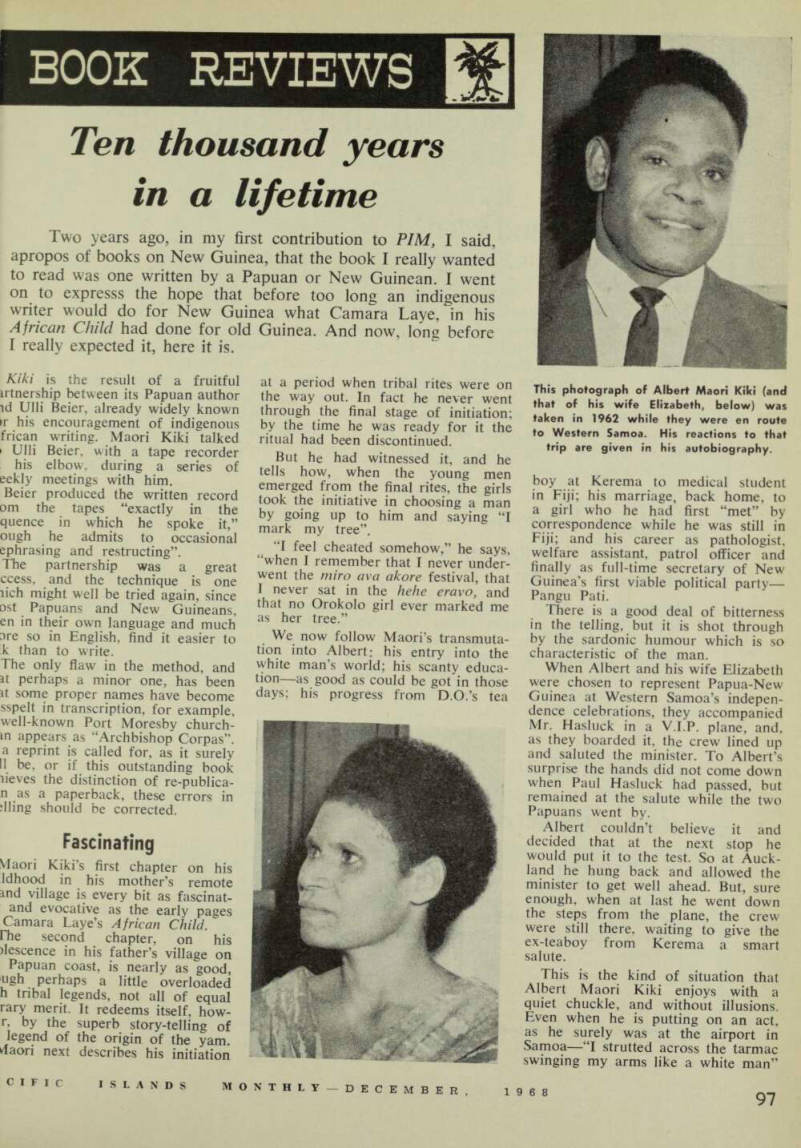
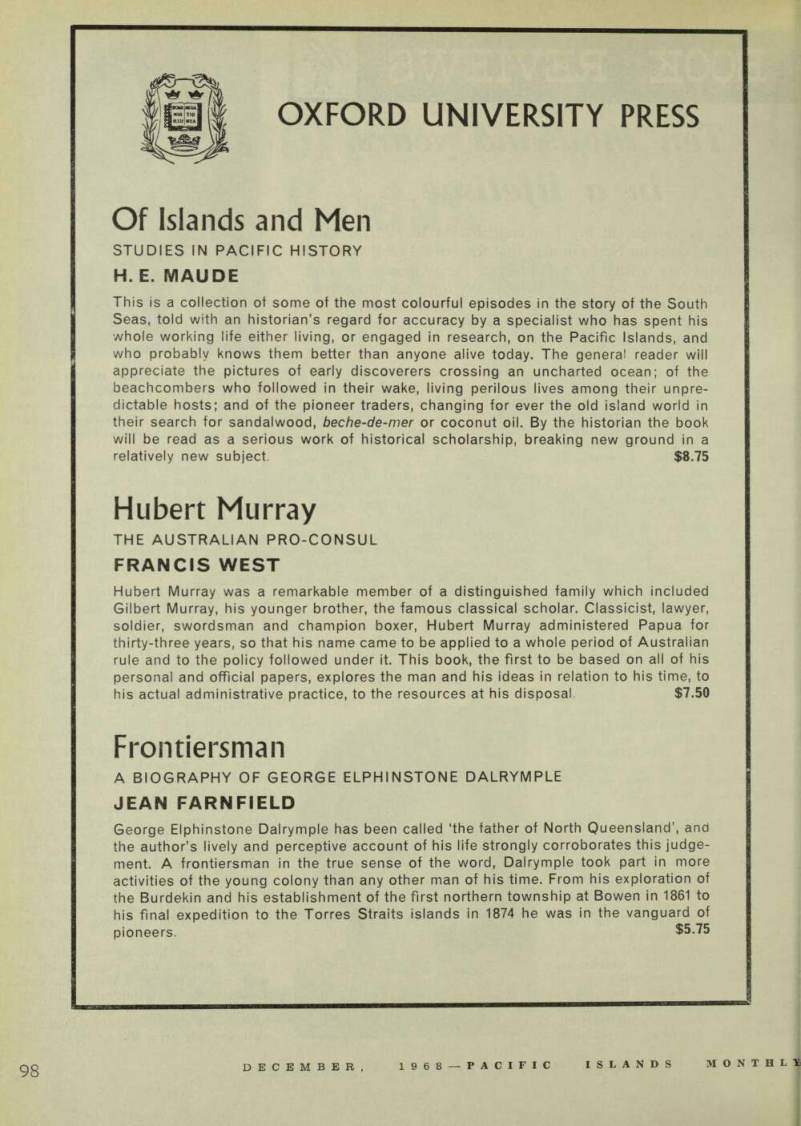
This photograph of Albert Maori Kiki (and that of his wife Elizabeth, below) was taken in 1962 while they were en route to Western Samoa. His reactions to that trip are given in his autobiography.
-he is able to stand apart and laugh himself.
I feel that sometimes he has tended • read back into earlier situations, clings and reactions which really ime to him later. And he sometimes nds to overstate his case.
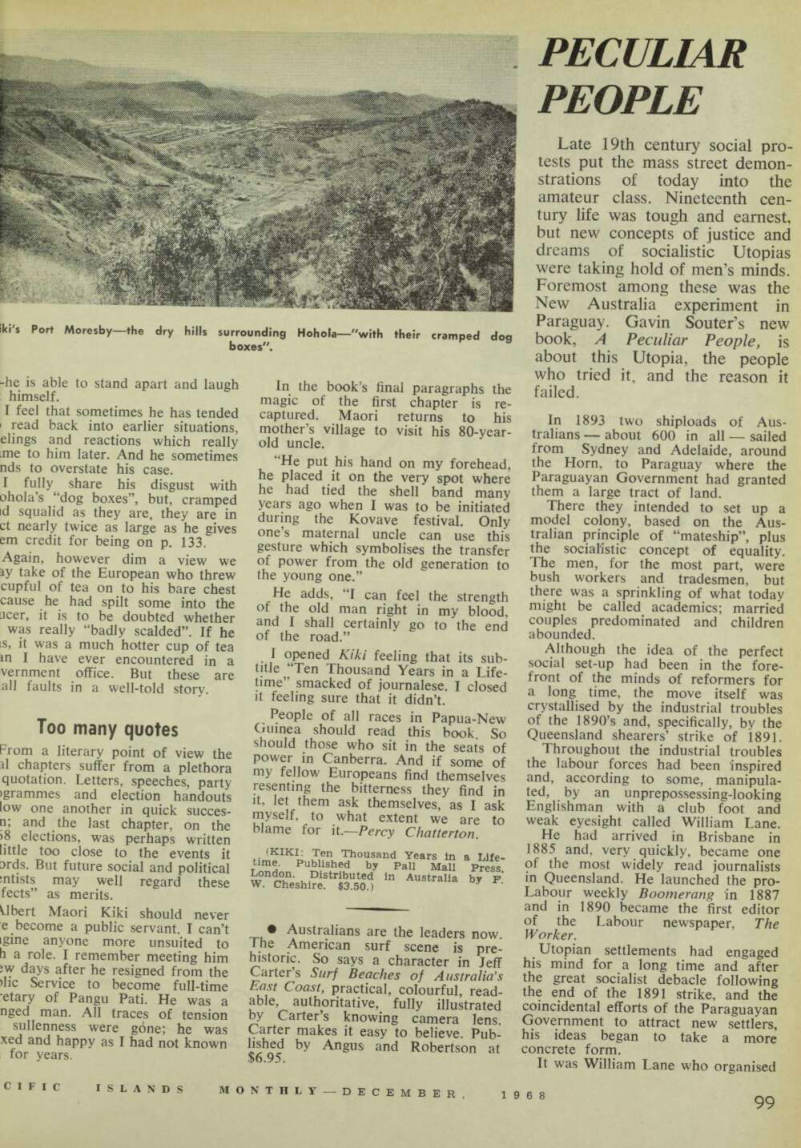
I fully share his disgust with ohola’s “dog boxes”, but, cramped id squalid as they are, they are in ct nearly twice as large as he gives em credit for being on p. 133.
Again, however dim a view we ay take of the European who threw cupful of tea on to his bare chest cause he had spilt some into the Licer, it is to be doubted whether was really “badly scalded”. If he is, it was a much hotter cup of tea m I have ever encountered in a vernment office. But these are all faults in a well-told story.
Too many quotes
From a literary point of view the al chapters suffer from a plethora quotation. Letters, speeches, party »grammes and election handouts low one another in quick succes n; and the last chapter, on the >8 elections, was perhaps written little too close to the events it Drds. But future social and political mtists may well regard these fects” as merits.
Albert Maori Kiki should never e become a public servant, I can’t igine anyone more unsuited to h a role. I remember meeting him jw days after he resigned from the >lic Service to become full-time etary of Pangu Pati. He was a nged man. All traces of tension sullenness were gone; he was xed and happy as I had not known for years.
In the book’s final paragraphs the magic of the first chapter is re captured. Maori returns to his mother’s village to visit his 80-year old uncle.
“He put his hand on my forehead, he placed it on the very spot where he had tied the shell band many years ago when I was to be initiated during the Kovave festival. Only one’s maternal uncle can use this gesture which symbolises the transfer of power from the old generation to the young one.”
He adds, “I can feel the strength of the old man right in my blood, and I shall certainly go to the end of the road.”
I opened Kiki feeling that its sub- Thousand Years in a Life time” smacked of journalese. I closed it feeling sure that it didn’t.
People of all races in Papua-New Guinea should read this book So should those who sit in the seats of power in Canberra. And if some of my fellow Europeans find themselves resenting the bitterness they find in it, let them ask themselves, as I ask myself, to what extent we are to blame for it .—Percy Chatterton. f,i KIKI r; Thousand Years In a Life time. Published by Pall Mall Press.
London. Distributed in Australia by P W. Cheshire. $3.50.) • Australians are the leaders now.
The American surf scene is pre historic. So says a character in Jeff Carter’s Surf Beaches of Australia’s East Coast, practical, colourful, read able, authoritative, fully illustrated by Carter’s knowing camera lens.
Carter makes it easy to believe. Pub lished by Angus and Robertson at 56.95.
ki's Port Moresby—the dry hills surrounding Hohola—"with their cramped dog boxes".