Yesterday
p. 99 · Read in the full issue
A proposal to whack a government tax on copra caused an uproar in the Fiji Legislative Council 20 years ago this month. Fijians, who produced most of the colony’s copra, vigorously opposed the proposal; Indians saw it as a measure to eliminate other revenue-raising funds and Europeans in dicated they would support the Indian moves. Council was hastily adjourned until December 20.
Other news reported by PIM, December, 1948, included: IN a fire said to be the “most spectacular in Port Moresby’s history”, a new Administration copra shed containing 300 tons of copra was mysteriously gutted near the town in November. An official inquiry was to be held to determine the cause of the fire.
IN an agreement welcomed by most producers, the British Ministry of Food was to buy all exportable surpluses of coconut products from Fiji from 1949 to 1957. Prices were to be re negotiated annually. The 1949 price was to be £Stg.4B a ton fob.
RABAUL was lashed by a fierce wind-storm on November 8.
Gusts of up to 70 mph whipped the town, and much damage was done.
A FRENCH steamer left Papeete with 580 Chinese aboard— bound for re-settlement in Hong Kong. A large crowd gathered at Papeete wharf to see the Chinese off.
production was picking up on Bougainville and many well-known planters and their properties were mentioned in a long article. They included: Robin McKay, Aropa; Jimmy Joyes and his family, Iwi and Kekere; Bob Stuart and his wife, Tenekau; “Sandy” Sandford, Numa Numa; Paul Mason and his wife, Inus; A. M. Stewart and his wife, Teo pasino, and Charlie Smith, Tin putz.
PIM said more ships were needed to cope with the extra copra.
NEW ZEALAND was “scouring” the Pacific Islands for aban doned steel of all descriptions because of an acute shortage of steel in the dominion. A light house ship had made quick trips to New Caledonia and the New Hebrides where Quonset huts, roofing iron and old vehicles were loaded.
THE original edition of Eric Feldt’s book, The Coast Watchers, had sold out and there were no plans for a reprint. PIM said it was “absurd” that the publishers thought that there was insufficient demand for a reprint, and forecast that it could have a “steady sale for many years”, if available. (It was in fact many years before a new edition, and then in paperback, was published).
THE Burns Philp steamer Marella was sold for about £BO,OOO to a South American company and was to be renamed Captain Marcos and to sail under the Panamanian flag. Marella operated the old BP Sydney- Singapore run with the Merkur before World War 11, SAMARAI was to have Papua’s second jury trial in December when two Europeans were to come before Mr. Justice Gore and a jury of four. The Europeans were charged with murdering a Papuan at Misima Island in 1942.
Old hands could remember only one other jury trial in Papua. i FTER 116 years, the American consulate in Papeete was to close down—to cut US overseas costs. Queen Pomare IV gave the US a grant of land for a building in Papeete in 1832 and the US built a house there. The last Ame rican consul was Mr. W. H. Scott.
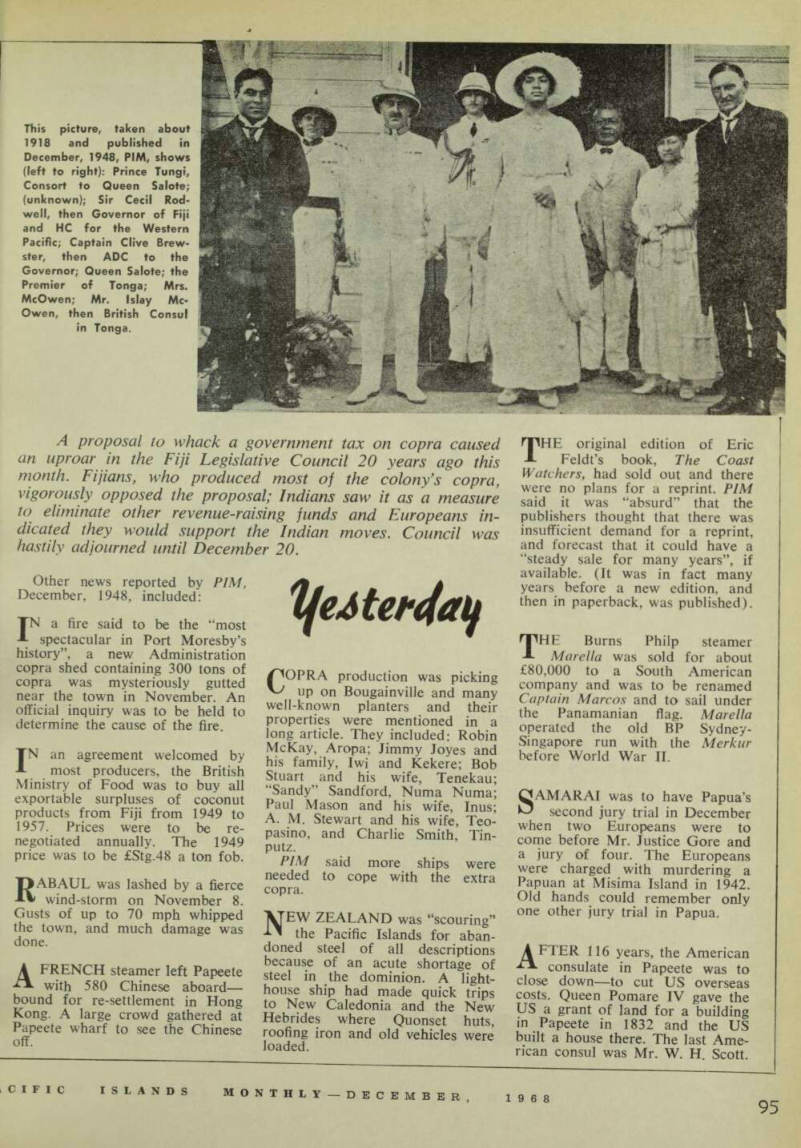
This picture, taken about 1918 and published in December, 1948, PIM, shows (left to right): Prince Tungi, Consort to Queen Salote; (unknown); Sir Cecil Rod well, then Governor of Fiji and HC for the Western Pacific; Captain Clive Brew ster, then ADC to the Governor; Queen Salote; the Premier of Tonga; Mrs.
McOwen; Mr. Islay Mc- Owen, then British Consul in Tonga.