Corps Or The People?
pp. 77-79 · Read in the full issue
Who Gets More-The Peace
SUE WENDT spoke to Stephen Klitzman, a 23-year-old Peace Corps Volunteer In Fiji.
He likes the country, he likes the work and he likes the people. But he asks himself:
Some months ago Dr. Ron Crocombe, of the P-NG Research Unit, wrote an article for PIM on the intensive training under taken by Peace Corps volunteers during their instruction period in Hawaii, before going into the “field”.
He pointed out that even by the end of this year the South Pacific would see 2,000 volunteer workers, representing organisations in five different nations.
And he observed that “there is little doubt that the most pervasive outside influence in the Pacific Islands in the 1970’s will be that of the voluntary worker.”
Dr. Crocombe is probably right, :>ut the extent of their influence will iepend upon how far individual nembers of organisations such as he Peace Corps feel they have a ight to go in instituting change.
Some of them—23-year-old Stephen Clitzman, of Belmar, New Jersey, s one—worry that they might get riore out of the programme than hey are able to give in return.
"Paradise propaganda"
Since January this year Stephen, thoughtful brown-eyed young man r ith a moustache and round-rimmed
aectacles, has been schoolteaching
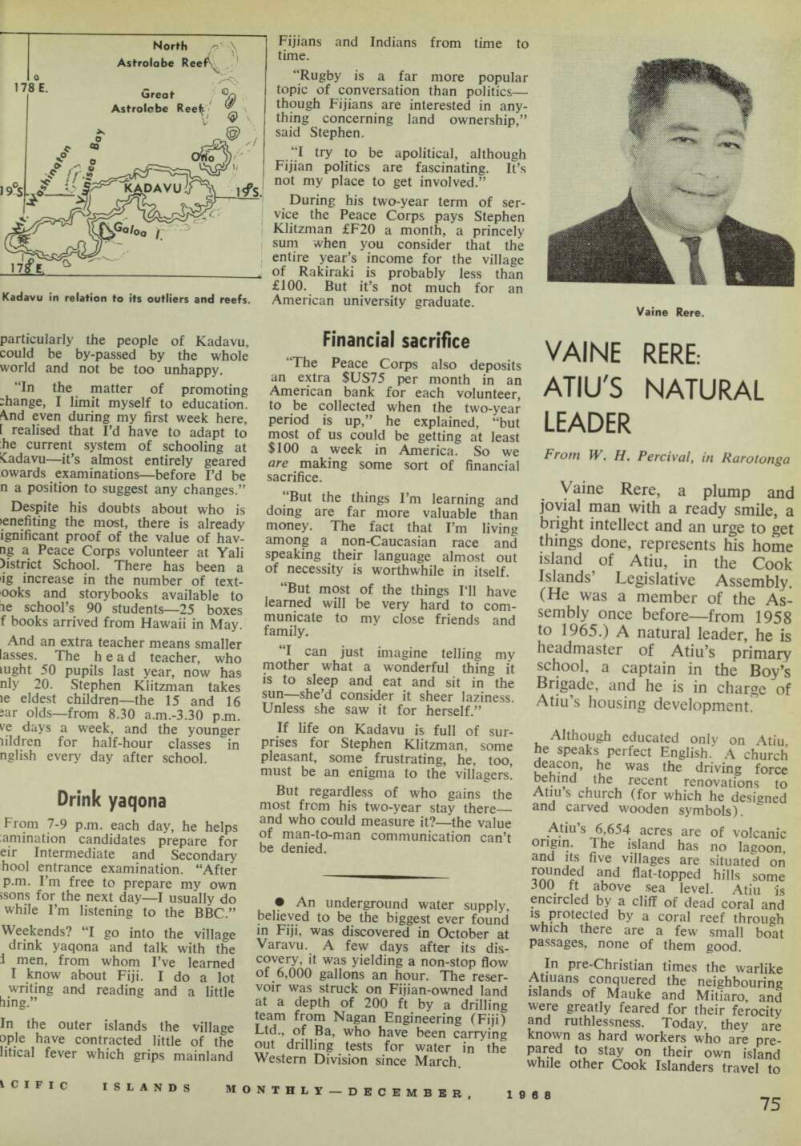
t Rakiraki Village on Kadavu, a Jgged island 50 miles south of Suva.
It is his first teaching job since raduating in 1966 with a BA in olitics from the University of ennsylvania and almost graduating ie’s in the process of completing ie final paper) last year with an [A in journalism from Stanford.
With characteristic honesty, he Imits that the publicity which sur •unded the Peace Corps’ entry into e South Pacific is a major reason •r his being in Fiji. Altruistic otivation had little to do with it. guess I fell for the Peace Corps oes to Paradise propaganda,” he id.
“The South Seas still has the mantic Hollywood-promoted at iction of being a place where a an can be free to live and leam d love as he pleases. I didn’t set
out to prove anything—l set out to experience.
“Admittedly, I wouldn’t have been as ready to apply if the draft hadn’t existed. I sincerely felt that I could make more of a contribution to peace as a Peace Corps volunteer than as a soldier in Vietnam.”
I spoke with Stephen Klitzman in September, when he was in Suva with 35 wide-eyed Kadavu school children, many of whom had never seen the mainland of Viti Levu, and most of whom were overwhelmed by the excitement of “big city” activity.
Although the decision to take the children to Suva rested with the head teacher at the Yali District School, Stephen feels that the trip probably became reality only because he was there to do the letter-writing, make the travel arrangements and en courage the parents to raise money.
The boat trip from Kadavu to Suva and return cost £loo—and the chil dren contributed to this by selling coconuts to the village store.
Stimulating
“The children are having a great time during their six days here—and I personally find Suva just as stimu lating as New York! The real in terest is in the people one sees walk ing along the streets—l don’t miss things like theatres and art galleries,”
Stephen Klitzman said.
For the first few weeks after his arrival at Kadavu in one of the inter-island cargo vessels, the young volunteer experienced what he calls “culture shock”—adjusting to a new way of life, language and even philosophy isn’t easy. “I thought at first—why aren’t they bored, just eating and sleeping and doing little real work,” he explained.
“Then I realised I’d have to take things slowly and adapt. The key shase in the Peace Corps is ‘be flexible’.
“One realises that these islanders,
particularly the people of Kadavu, could be by-passed by the whole world and not be too unhappy.
“In the matter of promoting change, I limit myself to education.
A.nd even during my first week here, [ realised that I’d have to adapt to he current system of schooling at kadavu —it’s almost entirely geared owards examinations—before I’d be n a position to suggest any changes.”
Despite his doubts about who is tenefiting the most, there is already ignificant proof of the value of hav ng a Peace Corps volunteer at Yali )istrict School. There has been a ig increase in the number of text ooks and storybooks available to ic school’s 90 students—2s boxes f books arrived from Hawaii in May.
And an extra teacher means smaller lasses. The head teacher, who mght 50 pupils last year, now has nly 20. Stephen Klitzman takes ic eldest children—the 15 and 16 2ar olds—from 8.30 a.m.-3.30 p.m. ve days a week, and the younger lildren for half-hour classes in nglish every day after school.
Drink yaqona
From 7-9 p.m. each day, he helps amination candidates prepare for eir Intermediate and Secondary hool entrance examination. “After p.m. I’m free to prepare my own jsons for the next day—l usually do while I’m listening to the BBC.”
Weekends? “I go into the village drink yaqona and talk with the 1 men, from whom I’ve learned I know about Fiji. I do a lot writing and reading and a little hing.”
In the outer islands the village ople have contracted little of the htical fever which grips mainland
Fijians and Indians from time to time.
“Rugby is a far more popular topic of conversation than politics— though Fijians are interested in any thing concerning land ownership,” said Stephen.
“I try to be apolitical, although Fijian politics are fascinating. It’s not my place to get involved.”
During his two-year term of ser vice the Peace Corps pays Stephen Klitzman £F2O a month, a princely sum when you consider that the entire year’s income for the village of Rakiraki is probably less than £lOO. But it’s not much for an American university graduate.
Financial sacrifice
“The Peace Corps also deposits an extra SUS7S per month in an American bank for each volunteer, to be collected when the two-year period is up,” he explained, “but most of us could be getting at least SIOO a week in America. So we are making some sort of financial sacrifice.
“But the things I’m learning and doing are far more valuable than money. The fact that I’m living among a non-Caucasian race and speaking their language almost out of necessity is worthwhile in itself.
“But most of the things Til have learned will be very hard to com municate to my close friends and family.
“I can just imagine telling my mother what a wonderful thing it is to sleep and eat and sit in the sun —she’d consider it sheer laziness.
Unless she saw it for herself.”
If life on Kadavu is full of sur prises for Stephen Klitzman, some pleasant, some frustrating, he, too, must be an enigma to the villagers.
But regardless of who gains the most from his two-year stay there— and who could measure it?—the value of man-to-man communication can’t be denied. • An underground water supply, believed to be the biggest ever found in Fiji, was discovered in October at Varavu. A few days after its dis covery, it was yielding a non-stop flow of 6,000 gallons an hour. The reser voir was struck on Fijian-owned land at a depth of 200 ft by a drilling team from Nagan Engineering (Fiji) Ltd., of Ba, who have been carrying out drilling tests for water in the Western Division since March.
Kadavu in relation to its outliers and reefs.