To the Point
pp. 44-46 · Read in the full issue
We Don't Want A Bogus New
Guinea For Visitors!
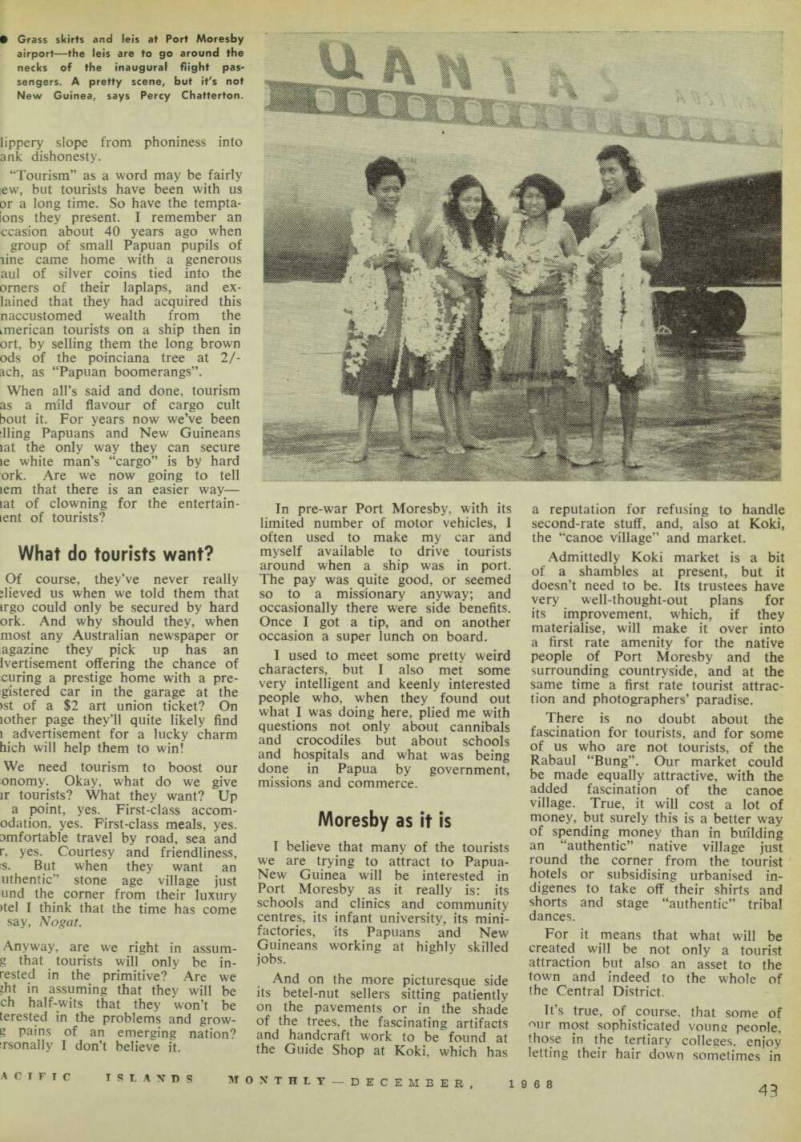
The big plane taxied to a halt at the Port Moresby airport on the inaugural flight of a new service from Australia via Moresby to the Far East. As the passengers walked across the tarmac, they were met by a bevy of grass-skirted Papuan maidens who put leis over their heads. Our local radio thought it newsworthy that one of the grass-skirted maidens went “topless”. Why on earth shouldn’t she? It was the ones who combined grass skirts with “tops” who were im
properly dressed.
A pretty scene. But let’s take a closer look at it. First, those leis.
The making and giving of leis is not a Niuginian custom; it has been introduced from Polynesia. Whether Polynesia invented it or got it from somewhere else I don’t know, nor does it matter. It’s a pleasant custom, far pleasanter than some customs, such as getting drunk on pay night, which have been introduced from Australia.
It’s a pleasant custom when used meaningfully. I have been at a school break-up at which a girl placed a lei over the head of a teacher who was about to leave them, while another girl presented a parting gift and everyone got a bit tearful.
This is meaningful. I have been at a function where an overseas guest at whose presence the company wished to express their pleasure re ceived a lei. This too is meaningful.
But to slap leis on to the necks of people we don’t know from a bar of soap is not meaningful. They may be very nice people indeed.
They may be absconding safe breakers or fraudulent company pro moters. We don’t know. And to use leis like this is to debase their currency and devalue our pleasant little ceremonies.
Grass skirts "rare"
Now take the grass skirts. I have nothing against grass skirts or bare tops. I have lived for most of my life among Papuan communities in which the women and girls wore grass skirts and went topless. But in Port Moresby this no longer happens. The sight of a grass skirt is a rarity. And Papuan women and girls don’t go topless any more, except perhaps in the privacy of their homes for coolness. In today’s Port Moresby grass skirts and bare tops rank as fancy dress.
Fair enough at parties perhaps; but those girls at Jackson’s Airport looked as incongruous as the gentle men in Ruritanian field-marshals’ uniforms who used to stand in the foyers of picture theatres in the
To the Point with Percy Chatterton
palmy days of the cinema. And I have been told by people who were there that they were obviously embarrassed. No wonder, for very few teenage girls in Port Moresby and the neighbouring villages have ever gone topless in public in their lives.
If we must have our visitors met by Papuan maidens, and I for one am all for it, what’s the matter with taking on some of our high school leavers as ground hostesses and receptionists. Some of these girls are really stunning—near-perfect English, poise and charm. Train them, put them in smart clothes incorporating Papuan motifs of the kind which Cecil Abel and others have experi mented with so successfully, and give them appropriate hair-do’s, and they’ll really go over with a bang —a far bigger bang than you’ll ever get out of bogus grass-skirted villagers.
"Be thoroughly bogus"
If we’re going to be bogus, why not be thoroughly bogus? Why strip our frangipanni trees of their loveli ness when plastic flowers look so much like the real thing? They are already being used for leis in some parts of the Pacific, I hear; and anyway, with all the new tricks the surgeons are getting up to these days, we soon won’t be sure how bona fide the necks we put our leis on are.
Plastic grass too would be cleaner and more lasting than real grass for
grass skirts. And if our sophistica ted young misses are squeamish about going topless, it shouldn’t be too difficult to devise a falsie-topless top in brown plastic which would fil neatly over the bust and look almost like the real thing. (One remembers those aborigines in “Corroboree”, but the technology of plastics has moved on since those days).
Why not plastic?
We needn’t stop there, of course If we had an aviary full of plastic birds of paradise in the fore-court ol the Gateway Hotel, tourists wouldn’t have to mount a pilgrimage tc Nondugl.
I have just been reading an article about Cuba. The aboriginal in habitants of Cuba were the Siboney and Taino Indians, who, unlike theii fierce Carib neighbours, were amonj the gentlest and most peaceable ol all the Amerindian tribes. The Spanish conquistadors had no trouble at all in exterminating them. Now 450 years later, modern Cuba ha? re-constructed a Siboney Indiar village, with a life-size statue of £ Siboney woman and her baby.
How phoney can we afford to le 1 tourism get in Papua-New Guinea- My posing of this question is of nc importance at all, but the fact thai many thoughtful Papuans and Nev Guineans are asking it, is important They don’t want to see their fellow countrymen become animals in £ tourist board’s zoo. Nor do they want to see them slide down the
lippery slope from phoniness into ank dishonesty.
“Tourism” as a word may be fairly ew, but tourists have been with us or a long time. So have the tempta ions they present. I remember an ccas'ion about 40 years ago when group of small Papuan pupils of line came home with a generous aul of silver coins tied into the orners of their laplaps, and ex lained that they had acquired this naccustomed wealth from the Linerican tourists on a ship then in ort, by selling them the long brown ods of the poinciana tree at 2/ach, as “Papuan boomerangs”.
When all’s said and done, tourism as a mild flavour of cargo cult bout it. For years now we’ve been :lling Papuans and New Guineans lat the only way they can secure le white man’s “cargo” is by hard ork. Are we now going to tell icm that there is an easier way— lat of clowning for the entertain icnt of tourists?
What do tourists want?
Of course, they’ve never really flieved us when we told them that irgo could only be secured by hard ork. And why should they, when most any Australian newspaper or agazine they pick up has an Ivertisement offering the chance of curing a prestige home with a pre gistered car in the garage at the >st of a $2 art union ticket? On lother page they’ll quite likely find i advertisement for a lucky charm hich will help them to win!
We need tourism to boost our onomy. Okay, what do we give ir tourists? What they want? Up a point, yes. First-class accom odation, yes. First-class meals, yes. amfortable travel by road, sea and r, yes. Courtesy and friendliness, s. But when they want an uthentic” stone age village just und the corner from their luxury )tel I think that the time has come say, Nogat.
Anyway, are we right in assum g that tourists will only be in rested in the primitive? Are we ?ht in assuming that they will be ch half-wits that they won’t be terested in the problems and grow g pains of an emerging nation? srsonally I don’t believe it.
In pre-war Port Moresby, with its limited number of motor vehicles, 1 often used to make my car and myself available to drive tourists around when a ship was in pork The pay was quite good, or seemed so to a missionary anyway; and occasionally there were side benefits.
Once I got a tip, and on another occasion a super lunch on board.
I used to meet some pretty weird characters, but I also met some very intelligent and keenly interested people who, when they found out what I was doing here plied me with anS Stl ?m™s?i , on ,!L a^? ut cannibals and crocodiles but about schools and hospitals and what was being £ overnment ’ missions and commerce.
Moresby as it is
7 I believe that many of the tourists we are trying to attract to Papua- New Guinea will be interested in Port Moresby as it really is: its schools and clinics and community centres, its infant university, its minifactories, its Papuans and New Guineans working at highly skilled J°k s - And on the more picturesque side its betel-nut sellers sitting patiently on the pavements or in the shade tl P es ’ the fascmatin g artifacts and handcraft work to be found at the Guide Shop at Koki, which has
a reputation for refusing to handle second-rate stuff, and, also at Koki, the “canoe village” and market, Admittedly Koki market is a bit of a shambles at prese m, but it doesn . t need to be & trus ; ees have well-thought-out plans for its improvement, which, it they materialise, will make it over into a first rate amenity for the native people of Port Moresby and the surrounding countryside, and at the same time a first rate tourist attrac tion and photographers’ paradise, xhere is no doubt about the fascination for tourists, and for some of us who are not t ' ourist of the Rabau| “ Bu ng”. Our market could be made equally attractive, with the added (ascination of tbe canoe village. True, it will cost a lot of money, but surely this is a better way of spending money than in building an “authentic” native village just round the corner from the tourist hotels or subsidising urbanised in digenes to take off their shirts and shorts and stage “authentic” tribal dances.
For it means that what will be created will be not only a tourist attraction but also an asset to the town and indeed to the whole of Central District, It’s true, of course, that some of nur most sophisticated voune peoole those in the tertiary colleges, enjoy letting their hair down sometimes in
Grass skirts and leis at Port Moresby airport—the leis are to go around the necks of the inaugural flight pas sengers. A pretty scene, but it's not New Guinea, says Percy Chatterton.
a sing-sing. Coming from many different parts of the territory they take delight in learning one another’s songs and dances, and in putting them on, either just for fun or to raise funds for college amenities or good causes. However, I think that they would soon get tired of turning them on to order at the behest of the P-NG Tourist Board.
No doubt some of our tourists will yearn for the primitive. And they can have it. There’s plenty of primitiveness still to be found, the genuine article, within easy flying time from the padded comfort of the Gateway and the Melanesian hotels.
We may not be able to offer them luxury accommodation in the places where it is to be found, but we could give them reasonable over night comfort in chalet type motels, or, if they are very demanding, we could fly them there and back in the same day.
For the more adventurous, ready to rough it a bit, there’s a bumpy trip to Rouna Falls and the Sirinumu Dam, over that dusty gravel road the Administration is so reluctant to bitumenise, a safari up the Highlands Highway, or a houseboat trip up the Sepik R 1 er.
Finally, for those with strong nerves and not much time to spare, there is the trip in to that never-never airstrip at Tapini, little more than half-an-hour’s flying time from Port Moresby over the incredible Goilala landscape.
Old hand that I am, I never get tired of squinting down through the plane window at the tiny hamlets perched on narrow ridges with the ground falling away steeply into deep ravines and occasionally a little church looking as if it had been transplanted straight from Switzer land; and finally the flight up the Airara gorge with the mountains towering on either side of the plane, and the landing on that tiny ledge on the mountainside which is Tapini.
My first trip to Tapini was made in an Anson. I sat up in front in the seat beside the pilot, with a little notice right in front of me telling the pilot what to do if one engine cut out. As we dropped down towards the strip it was quite obvious to me that we were going to hit the cliff about 10 feet below the edge of the shelf.
Of course we didn’t. I doubt if
anywhere in the world there is z cheaper or more exhilerating way o] spending a morning than by doinf the round trip from Moresby tc Tapini and Woitape and back tc Moresby.
Yes, we’ve got everything. Wc don’t need to be bogus. Let’s refuse to be.
A last word: while waiting foi the travel agents to do their stufl and for the package tourists to arrive en masse, can’t we do a bit more for the casuals travelling on the regular passenger and cargo ship! calling at Port Moresby?
I often see them wandering through the streets looking hot, tirec and bored. The unluckiest, of course, are those who arrive on Sunday and wander through a silent, deserted town, without even a picturesque policeman on point duty to photo graph. I even saw a couple the othei day gazing apathetically at the pictures displayed in the windows of the (closed) Tourist Board office, Most of these people probably go back to wherever they’ve come from and say to their friends, “Don’t gc there whatever you do: awful place”.