Tropicalities
pp. 42-43 · Read in the full issue
Unless something extraordinary happens, the GEIC will not enter a team in the Third South Pacific Games in Port Moresby next August. The GEIC’s Amateur Sports Association has decided not to send a team to Moresby for two reasons: one, because the money could be better spent on improving sports facilities in the colony and, two, because the colony’s chances of putting on a good show are poor.
Although the ASA is the big noise in Gilbertese sports, its decisions are not binding on the people of the colony. In announcing that it would not send a team to Moresby, the association declared, in a truly democratic spirit, “If the public at large feels that this is a mistake, then the ASA is prepared to call an extraordinary general meeting, where its decision can be challenged”.
The ASA says the colony got very little in return for sending a team to the 1966 Games in Noumea.
There had been no increase in interest in sport to speak of (although a soccer league was organised this year) and the only sports facility resulting from the Games is the Bairiki running track.
To add to this, says the ASA, the standard of sport in the South Pacific is getting dangerously high. An official of the ASA said; “Unless would-be competitors have been in constant training throughout the last three years, they would not get through to the qualifying rounds, let alone the finals.”
The ASA would like to see its Games money spent on local sports facilities —such as running tracks and soccer pitches, equipment for indoor sports, and the creation of sporting organisations.
Ken McGregor, our man on Tarawa, says that there is a slender hope that Ocean Island, with BPC money, may send two entrants to the Games, and that GEIC tennis champion, Wiram Tarawa, the colony’s only medal hope, may also go.
McGregor says that the ASA’s decision is considered sensible—and inevitable —in view of the massive cost of sending a team to Moresby, and that it is likely that the GEIC will opt out of the Tahiti Games in 1972. He says there is little over all dismay about it locally.
Air fares to Port Moresby would be about $9OO alone.
However, the decision is a dis-
GIEC says it won't go to games
appointment to Stanley Putnam, president of the ASA, and Peter Baker, manager of the Otintai Hotel, who worked so hard as GEIC team manager at the Noumea Games.
At Moresby the GEIC had nominated to take part in soccer, athletics, basketball, lawn tennis, table tennis and volley ball, and was to send a team of 20. If the colony does in fact pull out it will bring to four those territories eligible to compete but who won’t be there.
The others are Niue, the US Trust Territory of Micronesia and the Tokelaus.
Viliame's good news
Fiji’s javelin thrower, Viliame Liga, may not have brought back any medals from the Olympic Games in Mexico'—but he brought good news for Fiji’s budding champions.
Viliame, Fiji’s only representative at the Olympics, found at least three overseas coaches who showed interest in visiting Fiji to give local athletes a tip or two.
They were the Australian track and field coach, John Chepper, and American coaches Lee Roy Walker and Joe Yancey.
Fiji hopes they’ll
kiss it better
Film-going Fiji Indians, ardent supporters of India’s heroes and heroines of the screen, are watching with great interest an official battle going on in Bombay about whether kissing on the screen should be allowed.
Indian films, mostly Hindustani language, are screened regularly at Nadi, Suva and Lautoka. Although
local advertising does its best promote them in Fiji with a measui of good old-fashioned sex-appei the Indian Board of Censors ensur that Bombay’s increasingly frustrate film-makers adhere to the cleai living syndrome.
Nothing so sexual as an embrai is permitted; such fleshly vulgari as a kiss is out of the question.
At the moment, advertising f Indian films shown in Fiji titillat its public with such persuasi phraseology as “The story of stranger, a stone and an un fire.. or, “A story of three I nocents caught in the cross-fire Destiny, .and even, “A bold ai dynamic look at Family Life ..
Imagine what heights of seducti advertising could be reached Bombay producers and directc succeed in persuading the censors change their concept of obscenit What delight to have the job dreaming up promotion for “T First Indian Film to Contain Kiss!”
It just might happen. The whe question of kissing is being examin by an official committee of inquii headed by the retired Chief Justi of the Punjab High Court, Mr. D. < Khosla. He’ll deliver his verdict March.
At the same time, Bombay actc producer I. S. Johar is reported be making an 11-minute documenta on different styles of kissing throug out the world.
In New Caledonia
it never rains, but..
NEW CALEDONIA in rece months has been going throu one of its regular droughty perio< with dying cattle, menacing bus fires and dwindling water suppl: providing ever-recurring topics conversation for the locals.
On November 3, however, seemed to the people in the sor of the main island that they woi never have to think in terms drought again.
For seven hours, from 10 in t morning to five in the afternoon, t skies opened up and poured r« down by the proverbial bucket o\ an area extending from Dumb to Yate.
In Noumea, which had fc inches, the street gutters becai raging torrents, houses and otl buildings were inundated, stre< became rivers, and some of t town’s squares were converted ir lakes.
The movement of motor trafl became virtually impossible and fl
)cal plane services of Air Caledonia ad to be abandoned for the day.
The rain made an appreciable ifference to the water level at the r ate reservoir, which supplies loumea. However, the authorities ill adjudged it to be insufficient to :e Noumea over dry summer months lat lie ahead, without careful usage ad restrictions.
Tore Christian
ogetherness
N New Guinea, Anglicans and Catholics are to operate a new hool jointly. It’s to be a registered imary school near Gasmata, New ritain, and it’s opening soon.
And at Geruahi, near Samarai, the nglican and United churches will : co-operating with a school being lilt by the Maramatama Local overnment Council.
In New Britain there are at present i Anglican school at Menpa and Roman Catholic one at Akam, but >th these will be closed when the w Gasmata school opens. The acher in charge will be an iglican, Mrs. Mary Jamison. But e Roman Catholics will help to iff the school and some of their ildren, from outlying villages, will ard at the Anglican mission station.
At Geruahi the Anglicans will be sponsible for running the school— ;y are moving their educational d medical organisations there from arby Awaiama—but there will be lited Church children at the school d that church will therefore help staff it.
Meanwhile, as another step in *etherness, the next two intakes of iglican student teachers in Papua !W Guinea will be trained at Balob itheran college in Lae.
Lutheran authorities have agreed an Anglican request for this angement —at present Anglican lurch leaders feel that their St. dan’s college at Dogura, in the Ine Bay District, has not got the dlities to provide an adequate ining.
Lhe first intake of about 25 iglican students, will start at Balob st year.
arry Philp out
f resort scheme
|NE-TIME doyen of Fiji hoteliers, Mr. Barry Philp, an intending ireholder in the South Pacific velopment Corporation which ms to turn Toberua Island into resort ( PIM , Aug., p. 22), has hdrawn.
Mr. Philp said that as a result of “changed circumstances” he would not become an investor in the Dela ware-registered corporation, or its subsidiary Toberua Island Ltd., which is Fiji registered.
During a three-week visit to Fiji in October-November he was taken ill and he spent a week as a patient at the Emberson Clinic in Suva. Before returning to Sydney in mid-November he said he had no immediate plans for other investment in Fiji’s tourist industry.
A director of the South Pacific Development Corporation, Mr. Tom Hill (a former American Vice- Consul in Suva) announced that the corporation had agreed to buy the majority of shares in Toberua Island Ltd., which was started by Toberua’s owner, Mr. Joe McHugh.
As well as Mr. McHugh, who is principal of a Sydney law firm, Mr.
Hill’s fellow directors are New York lawyers Barclay Wagner and Joel Pensley. The three Americans were in Fiji in November, pursuing other investment opportunities for the cor poration.
Development of Toberua to the stage where it can attract high paying American tourists will probably run over the SUS2OO,OOO mark. The corporation hopes to open the resort next March.
Selling the
best-seller
THE British and Foreign Bible Society in Papua and New Guinea can claim to be well out ahead of the field in advancing locals into positions of responsibility.
For the last 10 years, Rev. Leo Buckman has been territory secretary of the society, and he is one of those who take the view that their job in Papua-New Guinea is to work themselves out of a job.
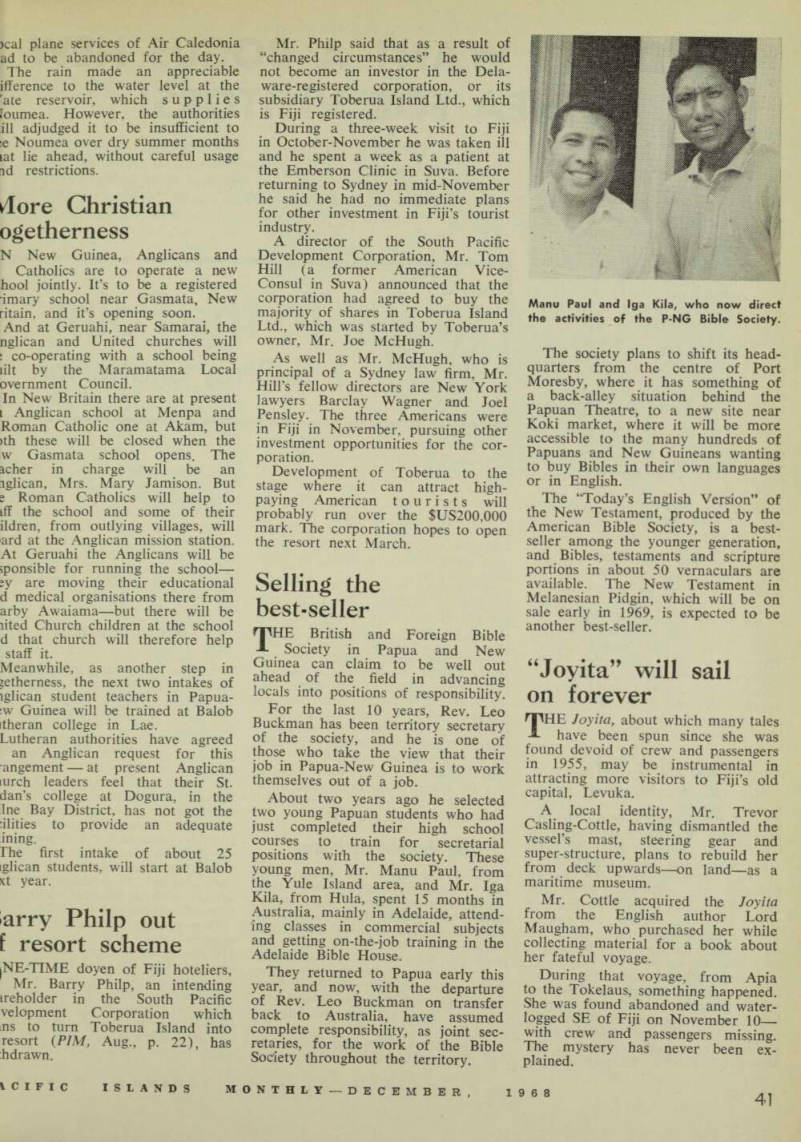
About two years ago he selected two young Papuan students who had just completed their high school courses to train for secretarial positions with the society. These young men, Mr. Manu Paul, from the Yule Island area, and Mr. Iga Kila, from Hula, spent 15 months in Australia, mainly in Adelaide, attend ing classes in commercial subjects and getting on-the-job training in the Adelaide Bible House.
They returned to Papua early this year, and now, with the departure of Rev. Leo Buckman on transfer back to Australia, have assumed complete responsibility, as joint sec retaries, for the work of the Bible Society throughout the territory.
The society plans to shift its head quarters from the centre of Port Moresby, where it has something of a back-alley situation behind the Papuan Theatre, to a new site near Koki market, where it will be more accessible to the many hundreds of Papuans and New Guineans wanting to buy Bibles in their own languages or in English.
The “Today’s English Version” of the New Testament, produced by the American Bible Society, is a best seller among the younger generation, and Bibles, testaments and scripture portions in about 50 vernaculars are available. The New Testament in Melanesian Pidgin, which will be on sale early in 1969, is expected to be another best-seller.
“Joyita” will sail
on forever
THE Joyita, about which many tales have been spun since she was found devoid of crew and passengers in 1955, may be instrumental in attracting more visitors to Fiji’s old capital, Levuka.
A local identity, Mr. Trevor Casling-Cottle, having dismantled the vessel’s mast, steering gear and super-structure, plans to rebuild her from deck upwards—on land—as a maritime museum.
Mr. Cottle acquired the Joyita from the English author Lord Maugham, who purchased her while collecting material for a book about her fateful voyage.
During that voyage, from Apia to the Tokelaus, something happened.
She was found abandoned and water logged SE of Fiji on November 10— with crew and passengers missing.
The mystery has never been ex plained.
Manu Paul and Iga Kila, who now direct the activities of the P-NG Bible Society.