The 'Top People'
pp. 36-37 · Read in the full issue
Didn't Help Rabi,
After All
Bitterly disappointed by the British Govern ment’s rejection of their claims for a fairer phos phate deal, the Banaban people are planning to petition the Queen.
Not a practical move perhaps, but Tebuke Rotan, who is manager of the Rabi Island Council, considers hope is all-important to morale, and until the Queen herself (“we think she is a very good lady”) rejects their claims, the Banabans can still hope.
“At least there is that much merit in such a move,” said a somewhat chastened Tebuke in Suva in Nov ember. “We have been badly treated by the British in this matter for 60 years—we must keep hoping.”
The 2,000 Banabans are the owners of Ocean Island, which is part of the Gilbert and Ellice Islands Colony, and which has been worked for phosphate by the BPC, together with neighbouring Nauru. Since 1945 the Banabans have been living on Rabi, in the Fiji Group, and for most of that time they have been attempt ing to get a fairer share of the royalties from the phosphate.
Earlier this year, they approached the UN committee of 24, asking for independence for Ocean Island (and got only sympathy), and in October they put their case to Lord Shepherd, Minister of State at the Common wealth and Foreign Office. It was the rejection of their case which has touched off their present anger.
GEIC was there
Two delegations went to London in October—one lead by Tebuke Rotan, and including Rab i ’ s economic advisers—members of the Sydney firm of Philip Shrapnel and Co. Pty. Ltd.; the second from the GEIC, headed by Resident Commis sioner V. J. Andersen and including the Chief Elected Member of the GEIC, Reuben Uatioa.
The UK Government wanted joint talks between the GEIC and Banaban delegations, with the UK acting as umpire, but the Banabans insisted that their argument was with Britain not with the GEIC, and were granted separate talks. They asked for: • Immediate independence for Ocean Island so that the Banabans
would be in a better position to retain their separate identity and secure financial justice. • A reduction in the extraction rate of prosphate from the present 600,000 tons a year to 450,000 tons, so that Ocean Island’s life can be extended until 1981 instead of 1977 —the longer time to allow the Banabans to better prepare for the future. • Restoration of the surface of Ocean Island to its original con dition (at a cost, the Banabans estimate, of SABO million), the three phosphate partner governments to contribute this amount. • Britain to make 'an ex-gratia payment for the development of Rabi Island without any strings attached (Britain last year offered to pay £StgBo,ooo for Rabi development, provided the Banabans accepted this as full compensation for the effects of phosphate mining on Ocean Island). • The Banaban people to receive full economic benefit from their phosphate. At present the GEIC Government taxes 17/Id in the £ of all Ocean Island phosphate pro ceeds, or 84.9 per cent., and the Banabans asked for a more equitable return.
In making these submissions the Banabans pointed out that with the current level of taxation the Banabans were providing 50 per cent, of the total revenue of the GEIC.
They said had they remained on Ocean Island at the end of the war they could have been a substantial part of the BPC work force and
received a wage income, as well the benefits of medical, educatioi and other services at present ps for on Ocean Island by the BP And they would also have th royalties.
In London, the Banabans c( tinually compared their lot with 1 Nauruans, “who had the go fortune of being placed under 1 protection of the UN and been si cessful in obtaining both th political and economic indep< dence”.
They said that they had be unable to set aside any money ] their own future on Rabi becai their royalties had been absorl in a struggle for survival on Rat
Independence issue
“We were deposited on an isla with no prospects of earning adequate income for many ye because we lacked the capital a know-how to develop it. The Brit Government did nothing to medy this lack of knowledge to how to develop this island.
Lord Shepherd dispensed with Banaban arguments in a fairly sh report.
He rejected the independei demand because he said there v a cardinal principle to wh Britain had adhered to in deal with her dependent territories— ti the wishes of the people as a whc within the existing boundary of territory, must be the main guide action.
Whatever motives may hi
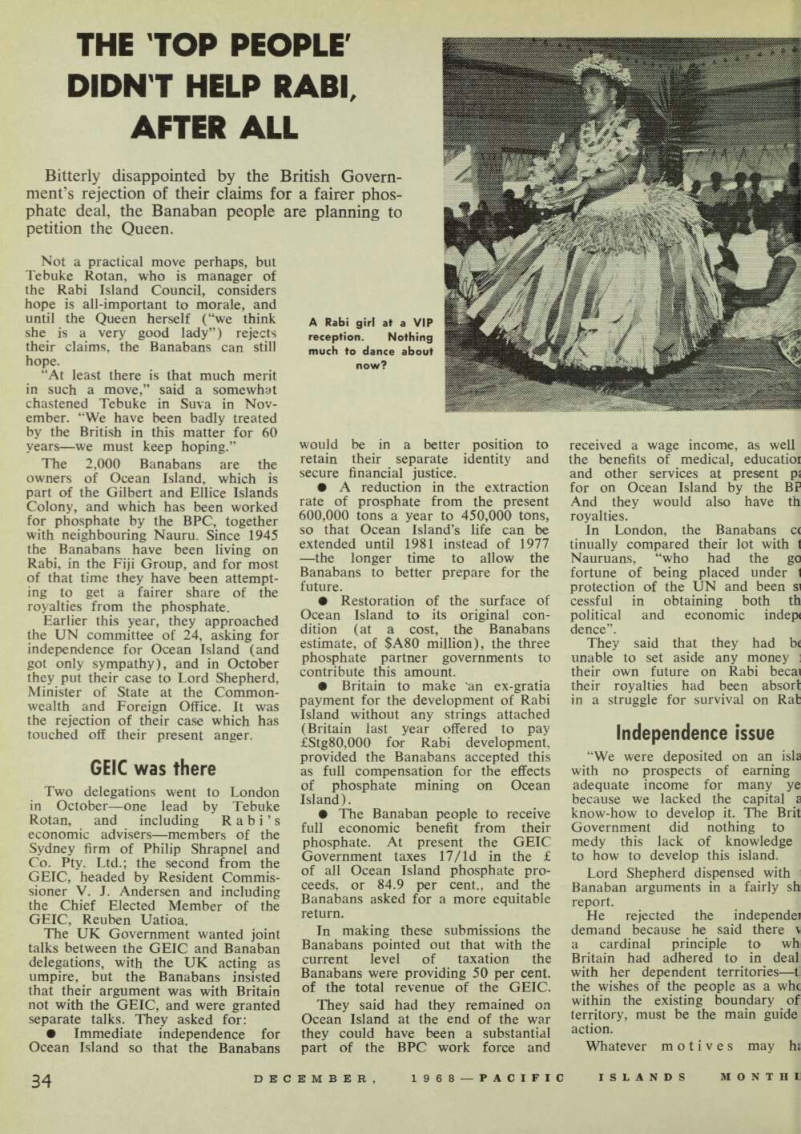
A Rabi girl at a VIP
reception. Nothing
much to dance about now?
/most a riot
[uenced the determination of the iIC boundaries in the past, Ocean md was now part of the GEIC, i the majority of people of the ffC were against its exclusion.
Dn the question of rehabilitation Ocean Island, Lord Shepherd n’t bother to coat the pill. He i that Britain was under no igation, and even if Britain was in position to find her £Stg.l7 mil i share of the cost she would dly be likely to allot it “for the pose of a risky undertaking to ore a thin layer of soil on Ocean nd”. )n the Banaban claim for a bigger re of the phosphate money, Lord pherd said it was exceptionally icult to concede they had made a convincing case of need in trast to the case presented by the IC. Except for the Nauruans, the labans were better off than most ific islanders. The £150,000 from sphate constituted a greater an
nual income per head or per family than anything to which the GEIC people could aspire.
Lord Shepherd said that if the proposal of the Banabans was carried to its logical conclusion it would mean that half the revenue of the government of the 50,000 people of the GEIC would be diverted in order that the 2,000 people constituting the Banaban community might have more.
Arrangements would therefore continue to be made for taxation of the phosphates by the GEIC government to absorb for the time being 84.88 per cent, of the overall phosphate benefits, the Banabans to receive the remaining 15.12 per cent.
Lord Shepherd said the current extraction rate should also be con tinued, because expert advice was that the best method of maximising profits on present phosphate prices was to aim at an annual extraction rate of 600,000 tons. However, the Wellington agreement of 1967 did allow for a review of various aspects of the agreement, and the British Government would now consider this review—and the matter of the extrac tion rate could no doubt come up.
Unhappy reception
Lord Shepherd added that the British Government was prepared to renew the offer of a grant of £Stg.Bo,ooo it had made last year conditional only on its controlled application to the development of Rabi.
When interviewed in Suva in the appropriately run-down Banaban Transit House shortly after his abortive trip to London, Tebuke denied that the people of Rabi enjoyed individual wealth. The need for money was pretty urgent at this moment he said, as his reception had not been a happy one on Rabi.
“The people looked at us as if we were liars—we’d told them we were sure the British Government would see reason when the case was pro perly presented to them. We were not asking for the British Govern ment’s money—we were asking for our own money,” he said.
“When we returned to Rabi with out the concessions, there was much bitterness especially when we had to put off 200 workers. We found we couldn’t afford to pay the wages of everybody until December—at the moment, only about 100 have jobs.
“There was almost a riot—the Banabans are very bitter, very dis appointed with the British officials.
Now I’m in Suva seeking a bank
overdraft of £F6,000, so that we can re-employ those workers.”
There is no doubt the Banabans have been devastated by the London decision. For years they have told themselves that all they needed to do to get justice was to break through to the top people in London. Finally they broke through, only to receive what they describe as “lollies for children”. And they are not even certain they will get that £BO,OOO anyway.
They’ll presumably await the result of their petition to the Queen.