Back to the bloody battle
p. 35 · Read in the full issue
of Tarawa —25 years later
From KEN McGREGOR, on Tarawa It was the GEIC’s biggest day in more than 20 years.
Thousands of colourful, excited and, in many cases, bewildered islanders crowded Betio’s artificial harbour entrance on Novem ber 23 to see British, NZ, Australian and US forces lay wreaths below an 18-ft memorial light and plaque to commemorate the 25th anniversary of the Battle of Tarawa.
fwo hours before the wreath ing—in what was surely a sign of changing mood in the South :ific —the Japanese Daiwa Line ghter Fiji Maru steamed in to io to inaugurate its new shipping dee to Tarawa, The captain and first mate were invited to the imony.
Tie Japanese, who told me after ds that they knew the wreath ng ceremony was to take place, e accepted by veterans and nders alike. Although this was a :mony for Allied dead, there e no recriminations. d Tarawa for the ceremony were US escort destroyer USS Morris, aUS Cl3o cargo plane n Hawaii and one NZ Bristol ghter aircraft. lews media present, besides PIM, uded Time, The New York es, Life, UPI, AAP and Chicago spapers. There were also three i-makers doing a Tarawa umentary for the Westinghouse poration.
• On November 20, 1943, US Marines landed at low tide at Tarawa in the GEIC, and, under merciless Japanese fire, they waded or swam ashore.
Once on the beach they were pinned down by enemy fire, but somehow they managed to establish beach heads. By November 25, the Marines had taken Tarawa, but at a high price: more than 1,000 dead and 2,500 wounded.
At the ceremony, men stood in full military dress under a burning sun, and one US sailor and one Gilbertese trainee seaman fainted.
The celebrations which followed the wreath-laying were celebrations as only the Islanders know them— despite a food shortage due to the delay in the arrival of the Moana raoi from Sydney. There were dances, feasts, dinners, boat trips, parties and receptions.
Of more significance to the locals, though, was the laying of a stone at
Betio for the proposed Betio-Bairiki Friendship Causeway to link the com mercial and administrative islands of Tarawa.
The Foundation for the Peoples of the South Pacific will spend about SA 100,000 on a dredge to get this going. The causeway may cost as much as $A500,000, though where the rest of the money is coming from no one seems to know. It is hoped that, once the causeway is built, it will be possible to reclaim land on Tarawa with the dredge.
Among the big names at the Tarawa ceremony were: General D. M. Shoup, USMC, colonel in command of the land forces during the battle; Rear Admiral E. M.
Rosemberg, USN; Sir Alexander Waddell, on behalf of the UK; R. M.
Birch, Australian Commissioner in Fiji; Peter Maher, US Vice-Consul in Suva, who read a message from President Johnson; GEIC Resident Commissioner V. Andersen and Chief Elected Member in the GEIC, Reuben K. Uatioa.
Recalled to duty
Shoup, 63, was recalled to active duty (for eight days) to attend the Tarawa ceremony. He left the corps five years ago.
And what of the Japanese? Weren’t they hit hard on Tarawa? The figures tell a tragic story. Only 146 survived out of a garrison of 4,836 men. It was fitting, then, that the Japanese ship should arrive. Perhaps one day the Japanese may be invited to take an official part in such ceremonies.
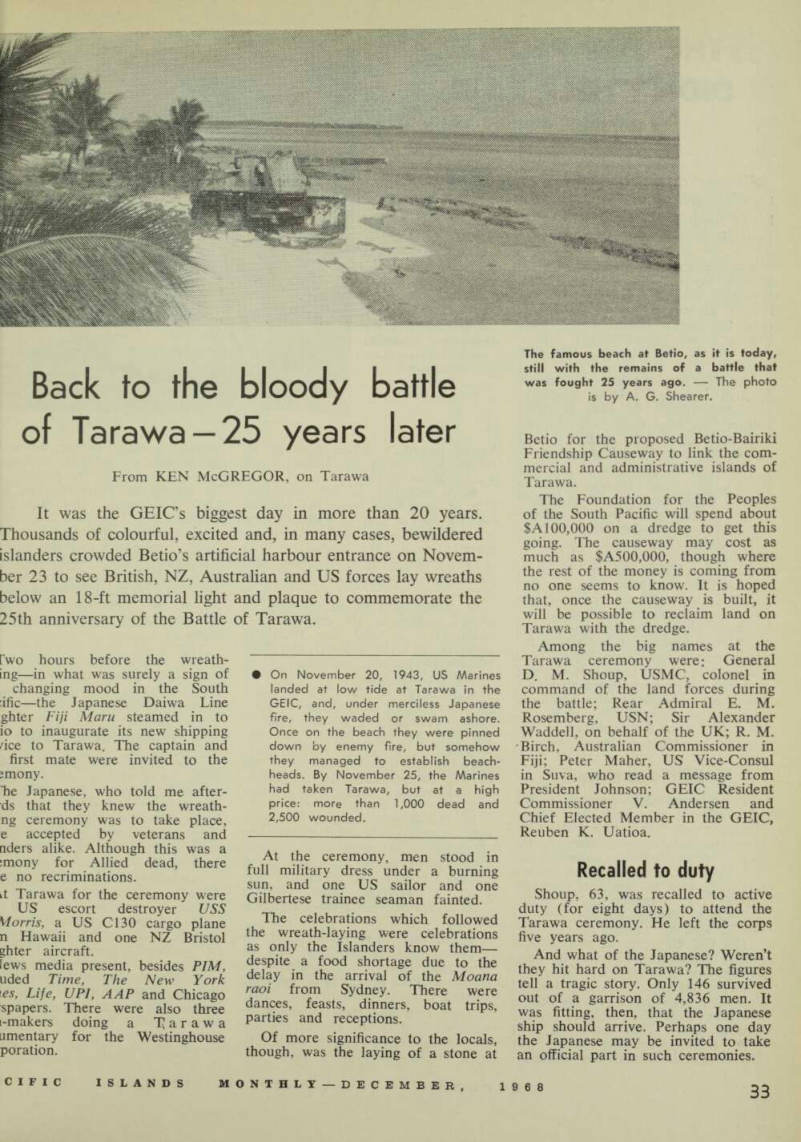
The famous beach at Betio, as it is today, still with the remains of a battle that was fought 25 years ago. The photo is by A. G. Shearer.