eccentric aeroplanes
pp. 97-99 · Read in the full issue
Book Reviews
Parer: The bloke with the eccentric aeroplanes
Most pre-World War II residents of New Guinea knew Ray Parer as the bloke with the claim next door; as a drinking mate; or the owner of sometimes eccentric aeroplanes. Most knew, too, something of his pre-New Guinea days and his famous flight, with John Mclntosh, from England to Australia in 1920.
A new book, Battling Parer, by Englishman John Godwin, gives the full story of the Parer-Mclntosh flight to win the £10,000 offered by Australian Government for a flight from England to Australia; while the later Parer-Hemsworth attempt in the Melbourne Centenary Race, of 1934.
In neither race was Parer and partner successful but in both, some kind of record was put up for improvisation and endurance.
Off-the-beam
A small part of the book deals with Parer’s life in New Guinea— which lasted from the late 1920’s until he left there in 1961 for good but this section is mainly superand occasionally off-the-beam An example, the wrecked Bristol freighter was not at the bottom of Wau airstrip while Ray Parer was
flying. Bristol freighters did not come into use until after the war and this one was wrecked a few years after. It was being flown around the world for its makers during a sales campaign and, in Wau, parked on the sloping airstrip and without anyone in attendance, rolled downhill to crash in a coffee plantation.
But everyone who knew Ray personally, and a great many who are simply interested in aviation, will find the account of the two UK-Australia “races” in which he took part of absorbing interest.
In both cases his plane was out of the race almost before it started, but he carried on against what seemed like impossible odds because he seemed incapable of quitting.
When he decided to take part in the 1920 race, neither he nor John Mclntosh, who was not an airman
but a Lieutenant in the AIF, had been discharged from the services, and the first part of their incredible journey included some cloak-and dagger stuff when they imagined that they had to keep out of the sight of the Army and Air Force authorities.
But this typical Parer antic was only part of their troubles. To begin with, they had no money to buy a plane. This was eventually overcome, with the help of Peter Dawson, a whisky millionaire who “liked Australians”, and they purchased a war-disposals DH9, which had originally been built as a day bomber. Its greatest asset was a range of 500 miles—a range that was necessary if they were to cross the last hurdle of the 12,000-mile journey—the Timor Sea between Timor and Darwin.
Hazards
But except on that one vital occasion, the DK9 rarely flew for more than a fraction of 500 miles without experiencing engine or radiator trouble; or being forced to land because of weather or other hazards.
Their first hop, after leaving Hounslow at 10.30 am on January 8, 1920, was typical. They had scarcely crossed the French coast when they were enveloped in cloud and were finally forced to land in a ploughed field.
A tyre blew out, a wheel was twisted beyond repair and Parer ended by borrowing a horse and dray from a farmer, drove 15 miles to the nearest railway station, took
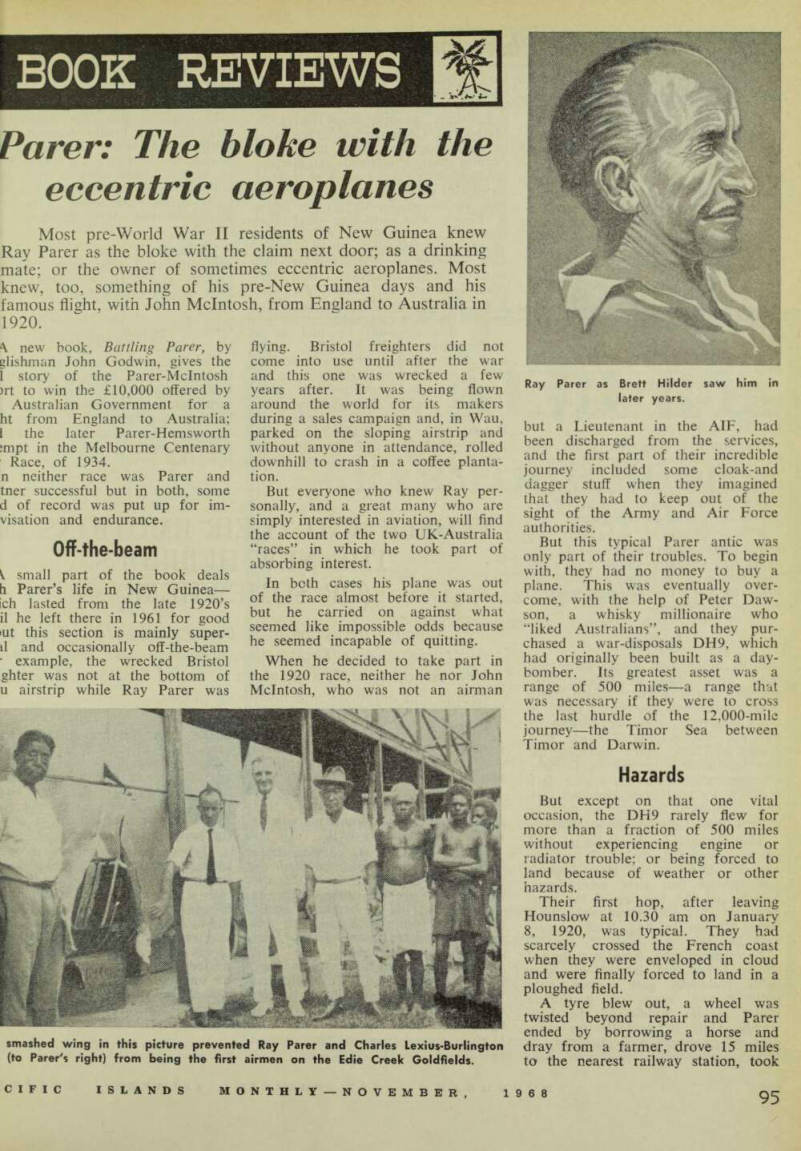
smashed wing in this picture prevented Ray Parer and Charles Lexius-Burlington (to Parer's right) from being the first airmen on the Edie Creek Goldfields.
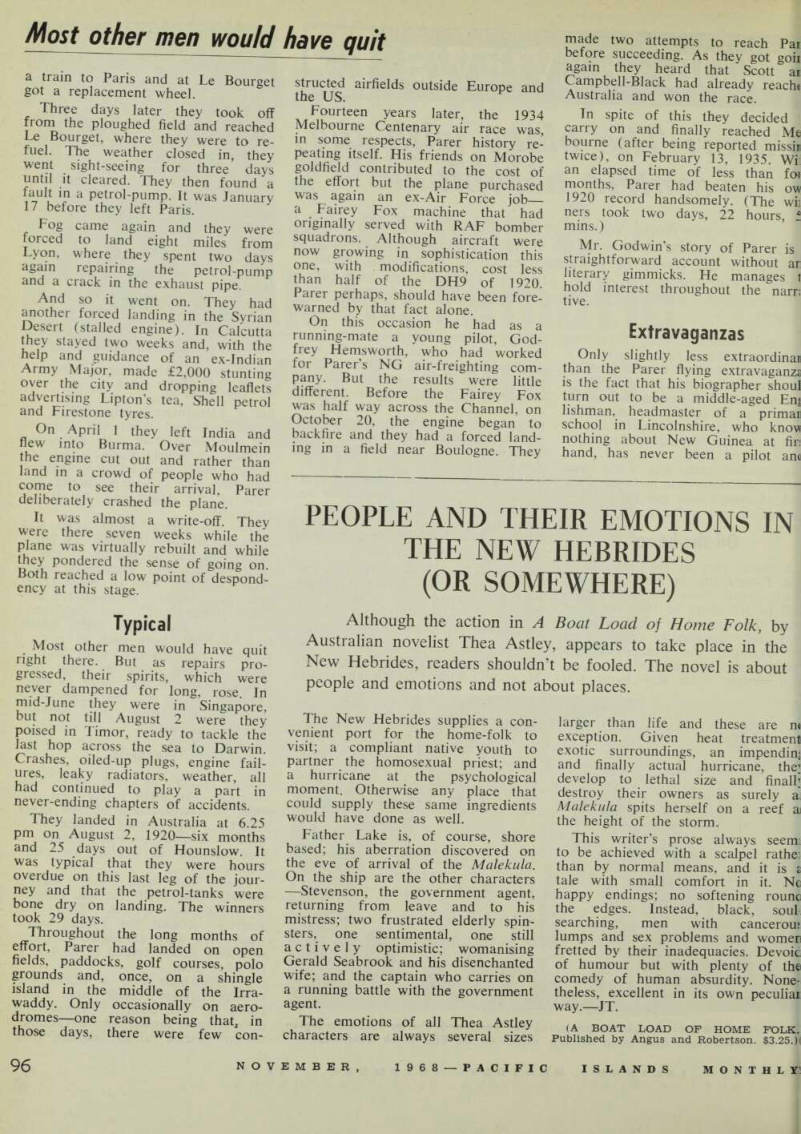
Ray Parer as Brett Milder saw him in later years.
Most other men would have quit
a train to Paris and at Le Bourget got a replacement wheel.
Three days later they took off from the ploughed field and reached Le Bourget, where they were to re fuel. The weather closed in, they went sight-seeing for three days until it cleared. They then found a fault in a petrol-pump. It was January 17 before they left Paris.
Fog came again and they were forced to land eight miles from Lyon, where they spent two days again repairing the petrol-pump and a crack in the exhaust pipe.
And so it went on. They had another forced landing in the Syrian Desert (stalled engine). In Calcutta they stayed two weeks and, with the help and guidance of an ex-Indian Army Major, made £2,000 stunting over the city and dropping leaflets advertising Lipton’s tea, Shell petrol and Firestone tyres.
On April 1 they left India and flew into Burma. Over Moulmein the engine cut out and rather than land in a crowd of people who had come to see their arrival, Parer deliberately crashed the plane.
It was almost a write-off. They were there seven weeks while the plane was virtually rebuilt and while they pondered the sense of going on.
Both reached a low point of despond ency at this stage.
Typical
Most other men would have quit right there. But as repairs pro gressed, their spirits, which were never dampened for long, rose. In mid-June they were in Singapore, but not till August 2 were they poised in Timor, ready to tackle the last hop across the sea to Darwin.
Crashes, oiled-up plugs, engine fail ures, leaky radiators, weather, all had continued to play a part in never-ending chapters of accidents.
They landed in Australia at 6.25 pm on August 2, 1920—six months and 25 days out of Hounslow. It was typical that they were hours overdue on this last leg of the jour ney and that the petrol-tanks were bone dry on landing. The winners took 29 days.
Throughout the long months of effort, Parer had landed on open fields, paddocks, golf courses, polo grounds and, once, on a shingle island in the middle of the Irra waddy. Only occasionally on aero dromes—one reason being that, in those days, there were few con
structed airfields outside Europe and the US.
Fourteen years later, the 1934 Melbourne Centenary air race was, in some respects, Parer history re peating itself. His friends on Morobe goldfield contributed to the cost of the effort but the plane purchased was again an ex-Air Force job a Fairey Fox machine that had originally served with RAF bomber squadrons. Although aircraft were now growing in sophistication this one, with modifications, cost less than half of the DH9 of 1920.
Parer perhaps, should have been fore warned by that fact alone.
On this occasion he had as a running-mate a young pilot, God frey Hemsworth, who had worked for Parer’s NG air-freighting com pany. But the results were little different. Before the Fairey Fox was half way across the Channel, on October 20, the engine began to backfire and they had a forced land ing in a field near Boulogne. They
made two attempts to reach Par before succeeding. As they got goii again they heard that Scott ai Campbell-Black had already reach* Australia and won the race.
In spite of this they decided carry on and finally reached Me bourne (after being reported missiu twice), on February 13, 1935. Wi an elapsed time of less than foi months, Parer had beaten his ow 1920 record handsomely. (The wii ners took two days, 22 hours, * mins.) Mr. Godwin’s story of Parer is straightforward account without ar literary gimmicks. He manages t hold interest throughout the narr; live.
Extravaganzas
Only slightly less extraordinai than the Parer flying extravaganzs is the fact that his biographer shoul turn out to be a middle-aged En| lishman, headmaster of a primal school in Lincolnshire, who know nothing about New Guinea at first hand, has never been a pilot and
parently, never met his subject. In :ent years Australian writers have t about done New Guinea to ith; none thought it worthwhile write a book about Ray Parer. ; are indebted to someone 12,000 les away for doing just that.
Fhe book does, however, deserve >etter title than it’s got. A battler, the Australian context, usually ijures up a vision of a man h 17 kids, who had gone through Depression and been evicted ee times from his farm, ending broken in spirit, in an Old Men’s me, very sorry for himself.
Whatever Ray Parer was, he was r er sorry for himself. He made a at deal of money at times and he lost it again, it was not be se of Depressions but because never cared enough about busi s. le was the greatest of all impre ss in the days when planes were ;k together with string and wing-gum. Some of his most 'aordinary exploits resulted from own shortcomings, such as hav left his tool-kit in the hangar, f he had not had to spend so :h of his time and determination ing out of his own scrapes, then probably would have ended up president of an international air . But if he had, then he wouldn’t e been New Guinea’s Ray Parer.
Territorian tru. —J.T.
BATTLING PARER. Published by iy Ltd. $3.75.) DNEY publishers Angus and Robertson deserve thanks for ing now recognised the real value Gavin Souter’s descriptions of tiey which they interleaved with /ishy-washy collection of photo )hs in 1965 and released under title of Sydney. They have re lished the prose in its own right, )rated with a number of George nar’s sketches, in a more compact lat, retitled Sydney Observed 75). This, now, is a book for ing as well as for giving; a book comes off the coffee table and to the bedside table, where it be better appreciated for what is—a brilliant mosaic of the ;h Pacific’s largest city. For the Sydney, from the pen of a real leysider, you need go no further.