yesterday
p. 95 · Read in the full issue
Norfolk Island was well up in the news 20 years ago.
Prosperity for the “Little Island” could be on the way, PIM said. The Australian Government had undertaken to build a £120,000 hotel near the south-western section of the airport (it never did) and also start a regular cargo service with the “Dongarra” (2,500 tons), then under construction in Australia.
Burns Philp had, of course, been running ships to Norfolk for many years, but in 1948 only the old steamer “Morinda” was making regular calls at Norfolk —and then only once every three months.
OTHER items in PIM foi Nov ember, 1948. included.
THE newly-formed South Pacific Commission held its second session in Sydney in October.
Secretary General was Mr. W. D.
Forsyth, now an Australian Ambassador in the Middle East, and his deputy was Mr. H. E.
Maude, now with the School of Pacific History, Australian National University, Canberra.
PAPUA’S fruitless oil search was in full swing and the Australasian Petroleum Company was busily sinking a well at Oroi, 60 miles northwest of Port Moresby. Nearly 400 Europeans and 2,500 Papuan labourers were involved.
NATIONS were debating Aus tralian and New Zealand trusteeship control of New Guinea and Western Samoa in the United Nations. New Zealand was being praised for its administration of Samoa, but Australia was being blasted, by Russia, for its opera tions in New Guinea. The Rus sians said that Australians in NG were stealing native lands and depriving NG of adequate health services.
THE New Zealand vessel Matai was a most welcome sight in Luganville, Santo, New Hebrides, in mid-October when she arrived with her holds filled with NZ beer. The island had a shortage of beer “adding up to years,”
PIM reported.
THE old Island trader was a thing of the past in the Gilbert and Ellice Islands, said a visitor to Tarawa, administrative centre of the islands. All business
was being handled by native co operatives. Lovers of the old South Seas viewed this news with regret because in the 1800’s and earlv 1900’s the GEIC boasted many of the South Pacific’s most bizarre and colorful trading characters.
LONDON-BORN Frederick
Cuthbert, who made a fortune of over £lOO,OOO in the 1930’s through his big share holdings in New Misima Gold Mines Ltd., and Cuthberts Misima Goldmine Ltd., died in Brisbane, aged 92. A bachelor, “Freddie” made and lost two mining fortunes in Queensland before he started mining Misima Island, Papua, in 1929 —while in his seventies. In the early 1930’s on extraordinarily rich extractions of gold, his New Misima company was paying dividends of 120 per cent. When he died (as a result of a fall) he was worth at least £250,000.
HAROLD CATTY, pioneer Pacific aviator and chairman of South Seas Marine Products Ltd., announced plans to set up a tuna industry which would be based at Suva with all catches to be sent to Pago Pago, Ameri can Samoa, for canning before they were exported to the US.
SSMP was to be a Suva-registered company with British and Ameri can shareholders, Mr. Catty said. (The firm was not a success).
THE Free Church of Tonga had acquired a sleek, 80 ft schooner, Caroline, for maintain ing operations among the numerous mission stations in the Tongan Islands. She was built originally for the British Admiralty and sold to the church for £6,500.
Mr. E. J. Maelstrom (Now
Sir Edward), Sydney philan thropist and manufacturer of refrigerators, gave £20,000 to the Australian Government to set up a sheep-breeding industry at Nondugl, in the Highlands of NG.
Mr. Hallstrom had 500 Romney Marsh sheep flown to Nondugl from Australia.
THERE was a backlog of 100 passengers in Apia waiting for berths to New Zealand because the Union Steam Ship Company vessel Matua, withdrawn to NZ in August for her annual survey, was not expected to be back on her normal run until mid-Nov ember due to delays in Auckland dockyards. The delays meant more headaches for the USSC and “further exasperation” for the already frustrated Islands travel ler, PIM said.
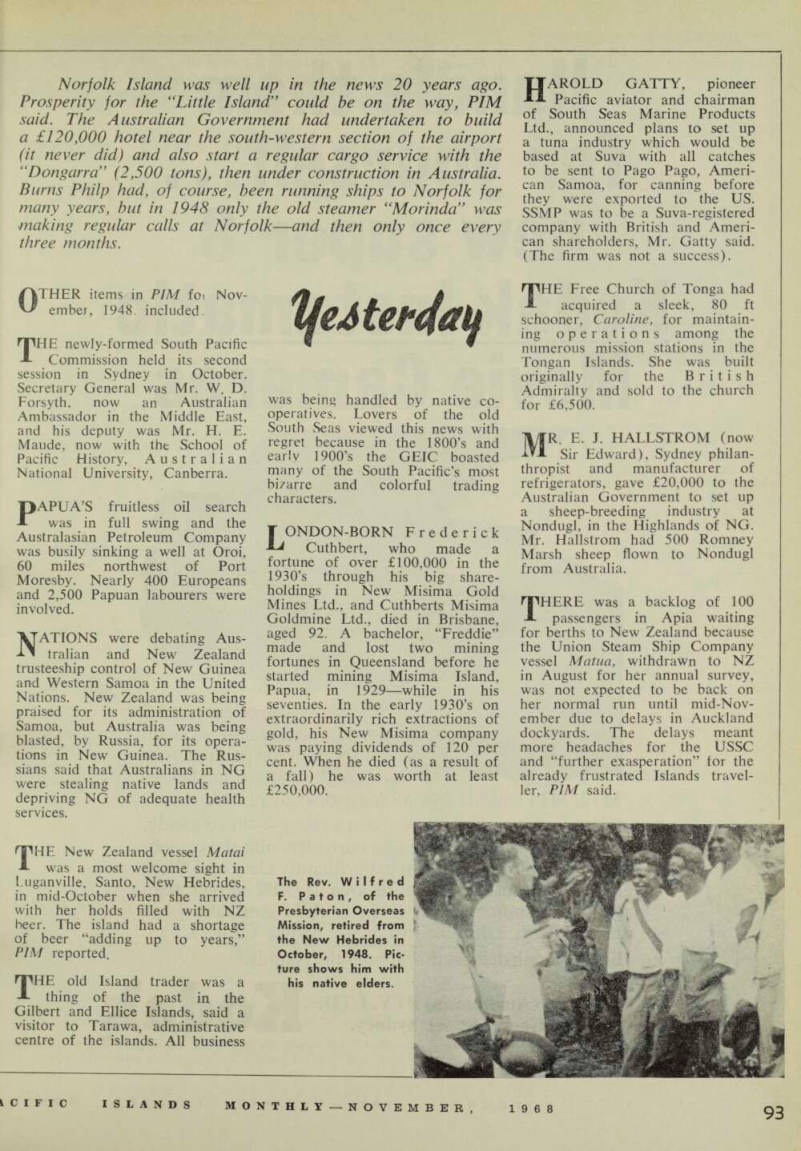
The Rev. Wilfred F. Paton, of the Presbyterian Overseas Mission, retired from the New Hebrides in October, 1948. Pic ture shows him with his native elders.