At Penrhyn, Pearls Are
pp. 90-91 · Read in the full issue
Where You Find Them
• Dr. David Lewis, a New Zealand medical practitioner and yachts man, has recently taken up a research fellowship at the Australian National University, Canberra, to study the star navigation techniques of the Pacific Islanders in the context of Pacific history. He was sailing around the world with his family when he learned of his appointment, and he made a hurried trip from England in his 39 ft gaff ketch "Isbjorn" to take the appointment up. En route, the Lewises—Dr. David, his wife Fiona, 19-year-old son Barry, and daughters Vicky, 6, and Susie, s—called at isolated Penrhyn Island in the Cook Group. Here (which the natives call Tongareva) they found that . . .
By David Lewis
We reached Tongareva after a leisurely voyage of 1,100 miles from Nukuhiva, Marquesas Islands.
At 9 a.m. one day in August, the tops of coconut palms came abruptly over the horizon 10 miles ahead.
Eagerness to enter Tongareva’s lagoon was tempered by prudence.
The passage through the reef being to windward, we laboriously dis mantled the steadying canvas and hoisted staysail and gaff mainsail to forestall any such untoward event as engine failure.
But all went well.
Our 30-year-old Kelvin diesel drove us steadily through Taruia Pass, stemming the swirling outflow.
Isolated coral patches that studded the lagoon were easily picked out from the ratlines and avoided.
Twelve and a half days out from Nukuhiva the anchor went down in eight fathoms off the village of Omoka.
Jostling
“Kiaorana!” came the familiar greeting, as Resident Agent and the doctor (both Cook Islanders) came on board, while the yacht was surrounded by a jostling throng of outrigger canoes.
The Resident Agent proved to be Dane Rasmussen, a son of the famous Danish Islands skipper, Captain Viggo Rasmussen, who married a Tongareva girl and spent his last years on that island.
A fair proportion of the atoll’s 600 people were children, and it seemed that most of them were accompany ing us whenever we went ashore.
Our Pied Piper progress up the village street was repeatedly inter
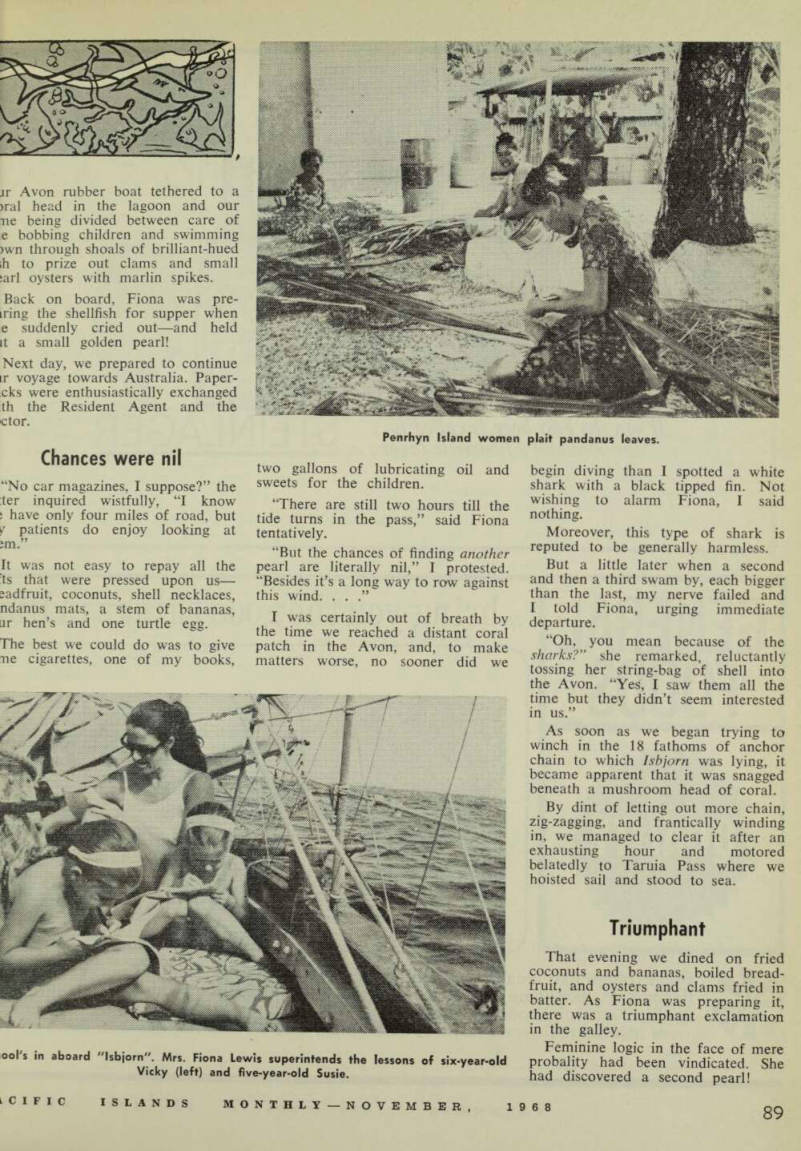
rupted by greetings, questions and invitations to visit. Gauguinesque groups of women sitting back on their heels were usually to be seen paring pandanus leaves with knives made out of a crashed wartime B-24 (It also provided material for combs and aluminium watch straps).
Whipped white
The men would be drying copra or working on their semi-open cutters or the lateen rigged asymetric out rigger canoes whose design had been adopted from the Gilberts years before.
A famous schooner skipper, Philip Woonton, whose mother came from Manihiki, the next island (185 miles
away), had retired to Tongarev where he had been born.
The day he visited us the lagoo< was being whipped white by a strom south-easter and Isbjorn was tossini so widly that I feared lest his 8 years might preclude his comim aboard.
I might have saved myself th worry. He strode up to the landing hefting a sack heavy with drinkin nuts and sugar cane.
With a hearty “Good day captair here’s some kai for your wahine' galley!”, he tossed it to me on handed—and I collapsed under th weight.
He went up the yacht’s side witl more agility than I could muster, ani after an interested inspection of ou rig, went below for refreshments.
“Pearls? Yes,” he told us, “th men still dive for them in the lagooi whenever the price of copra is down Most shell is in 20 fathoms.
“No, their only gear is a pair o goggles and a stone to carry then down.
Pearls in their oysters
“But there are often pearls in th( smaller shallow water pipi oysters.' The rest of his talk was full o fine sailing ships; his memories wen clear, though sometimes hard t< follow over so great a time span his escape from capture by Felix Voi Luckner in World War I. being inter larded with reminisences of th< Islands in the Second.
When I returned from rowing hin ashore, I noticed a dreamy look ii Fiona’s eyes.
“Don’t be silly, you would have to dive for weeks before finding i single pearl,” I asserted, correctl) interpreting her thoughts.
Nevertheless, that afternoon founc
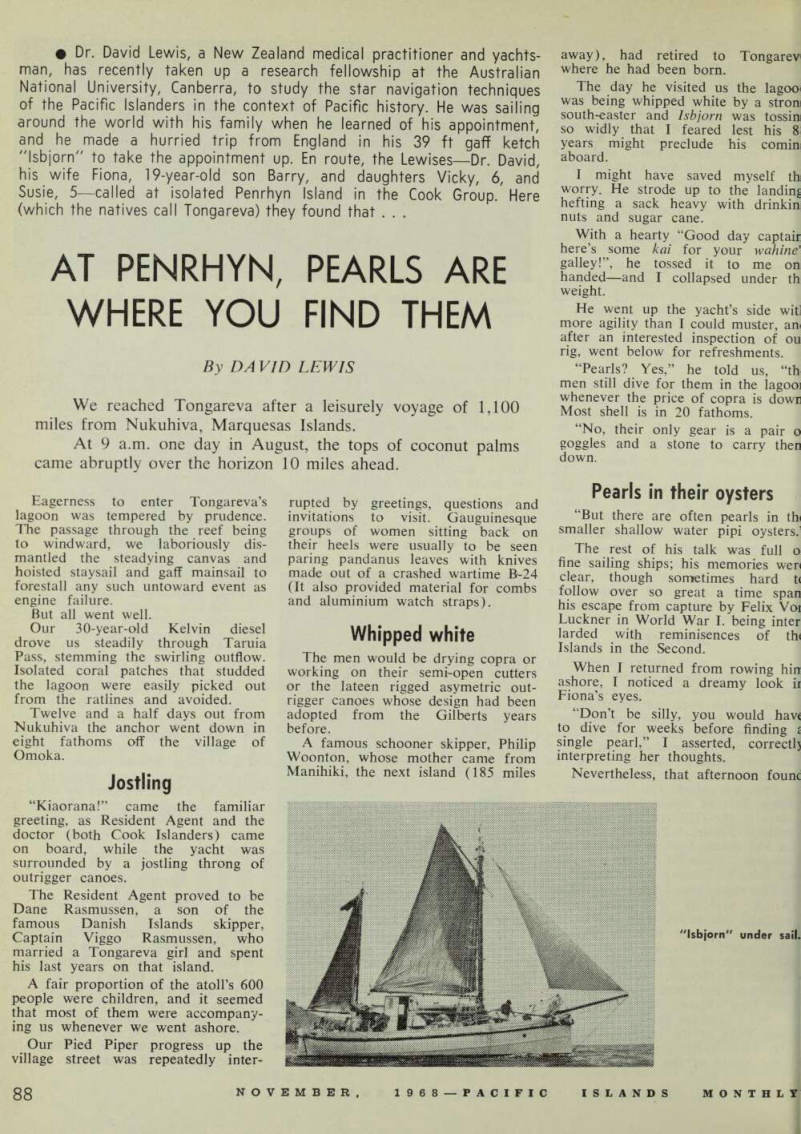
"Isbjorn" under sail.
jr Avon rubber boat tethered to a >ral head in the lagoon and our Tie being divided between care of e bobbing children and swimming )wn through shoals of brilliant-hued ;h to prize out clams and small :arl oysters with marlin spikes.
Back on board, Fiona was pre iring the shellfish for supper when e suddenly cried out—and held it a small golden pearl!
Next day, we prepared to continue ir voyage towards Australia. Paper cks were enthusiastically exchanged th the Resident Agent and the ctor.
Chances were nil
“No car magazines, I suppose?” the ter inquired wistfully, “I know 5 have only four miles of road, but y patients do enjoy looking at ;m.”
It was not easy to repay all the ; ts that were pressed upon us— sadfruit, coconuts, shell necklaces, ndanus mats, a stem of bananas, ar hen’s and one turtle egg.
The best we could do was to give Be cigarettes, one of my books,
two gallons of lubricating oil and sweets for the children.
“There are still two hours till the tide turns in the pass,” said Fiona tentatively.
“But the chances of finding another pearl are literally nil,” I protested.
“Besides it’s a long way to row against this wind. . . .”
I was certainly out of breath by the time we reached a distant coral patch in the Avon, and, to make matters worse, no sooner did we
begin diving than I spotted a white shark with a black tipped fin. Not wishing to alarm Fiona, I said nothing.
Moreover, this type of shark is reputed to be generally harmless.
But a little later when a second and then a third swam by, each bigger than the last, my nerve failed and I told Fiona, urging immediate departure.
“Oh, you mean because of the sharks?” she remarked, reluctantly tossing her string-bag of shell into the Avon. “Yes, I saw them all the time but they didn’t seem interested in us.”
As soon as we began trying to winch in the 18 fathoms of anchor chain to which Isbjorn was lying, it became apparent that it was snagged beneath a mushroom head of coral.
By dint of letting out more chain, zig-zagging, and frantically winding in, we managed to clear it after an exhausting hour and motored belatedly to Taruia Pass where we hoisted sail and stood to sea.
Triumphant
That evening we dined on fried coconuts and bananas, boiled bread fruit, and oysters and clams fried in batter. As Fiona was preparing it, there was a triumphant exclamation in the galley.
Feminine logic in the face of mere probality had been vindicated. She had discovered a second pearl!
[?]ool's in aboard "Isbjorn". Mrs. Fiona Lewis superintends the lessons of six-year-old Vicky (left) and five-year-old Susie.
Penrhyn Island women plait pandanus leaves.