Magazine Section
pp. 87-89 · Read in the full issue
Pacific Islands Monthly
Apia trader wrote his "wonderful" Islands tales at the urging of R.L.S.
• Former PIM assistant editor Robert Langdon is these days with the Australian itional University, Canberra, where he has established the Pacific Manuscripts Bureau the Research School of Pacific Studies. The main purpose of the bureau is to ck down unpublished documents of value concerning the Pacific Islands and to tain copies of them on microfilm for four world libraries specialising in Pacific learch. The four libraries are the National Libraries of Australia and New Zealand; > Mitchell Library, Sydney; and the Library of the University of Hawaii, Honolulu, me of the documents that come into the bureau's hands have strange and romantic tories to them. Here is the story of how an. . . .
By Robert Langdon
Two evocative and exciting novels about the South Sea slands, which were written at the suggestion of the celebrated tovelist Robert Louis Stevenson, are among a number of un mblished literary items that have been lent to the Pacific Manuscripts Bureau recently for copying.
Fhe two novels are the work of late Harry J. Moors, an Ameri i, of Apia, Western Samoa, doors died in Samoa in March, 16, after more than 40 years in Islands. He was the author of a dy book of reminiscences entitled th Stevenson in Samoa (Boston, 0). doors’ book describes how Steven urged him to write down some the “wonderful stories” about his ly career that he had related to venson. fhe book also tells how, shortly ore Stevenson’s death in 1894, ors and Stevenson had planned to to uninhabited Nassau Island, ich Moors owned, so they could h do some serious writing, un urbed.
Leading businessman
doors was one of the leading inessmen and planters in Apia ;n Stevenson first arrived there in member, 1889. He was closely as ated with the novelist throughout five-year sojourn in Samoa, iorn in Detroit in 1854, Moors ; went to Samoa in 1875, probably i supercargo of a ship trading out San Francisco.
After a second visit to Samoa in 1878, he entered the service of the Government of Hawaii (then an independent kingdom) and worked as an agent for the Board of Im migration. In that capacity, he made several voyages to the Marshall and Gilbert Islands to recruit labourers for Hawaii’s sugar plantations.
The Marshalls and Gilberts in those days were raw, lawless places, where fierce islanders frequently fought each other, and picturesque and ruffianly European beachcombers were commonplace.
Moors had a number of adventures
in these islands. Then, in 1883, he went to Samoa again, married a part- Samoan girl, and settled down.
In 1884, he established a whole sale and retail business in Apia with one E. A. Grevsmuhl; and two years later, he set up in business on his own account. By the time Stevenson arrived in Apia, Moors was a prosperous man and a leading figure in the local business and planting world.
Having been forewarned of the famous novelist’s arrival in Samoa, Moors made a point of meeting him and his entourage—partly, no doubt, with an eye to business—as soon as Stevenson’s chartered schooner Equator dropped anchor in Apia harbour.
“At that time,” Moors recalled in With Stevenson in Samoa, “there was but one hotel in Apia, and as it badly needed to be ‘under new management.’ I invited the party . . . to stay at my house. This was the beginning of a long acquaintance.”
Moors said that after the Steven sons had stayed with him for some time, they rented a small cottage nearby; but even then the novelist still spent a large part of his time at his house.
“Often during the fine evenings,”
Moors wrote, “he would sit on my balcony facing the moonlit sea; and he would relate in his most engaging way some of his experiences and adventures to eastward in the Marquesas and Tahiti groups, and then carry me with him in a disserta tion on the wildly savage Gilberts.
I was familiar with all the different islands, and having visited them much earlier than he had, I was able to point out how conditions had been
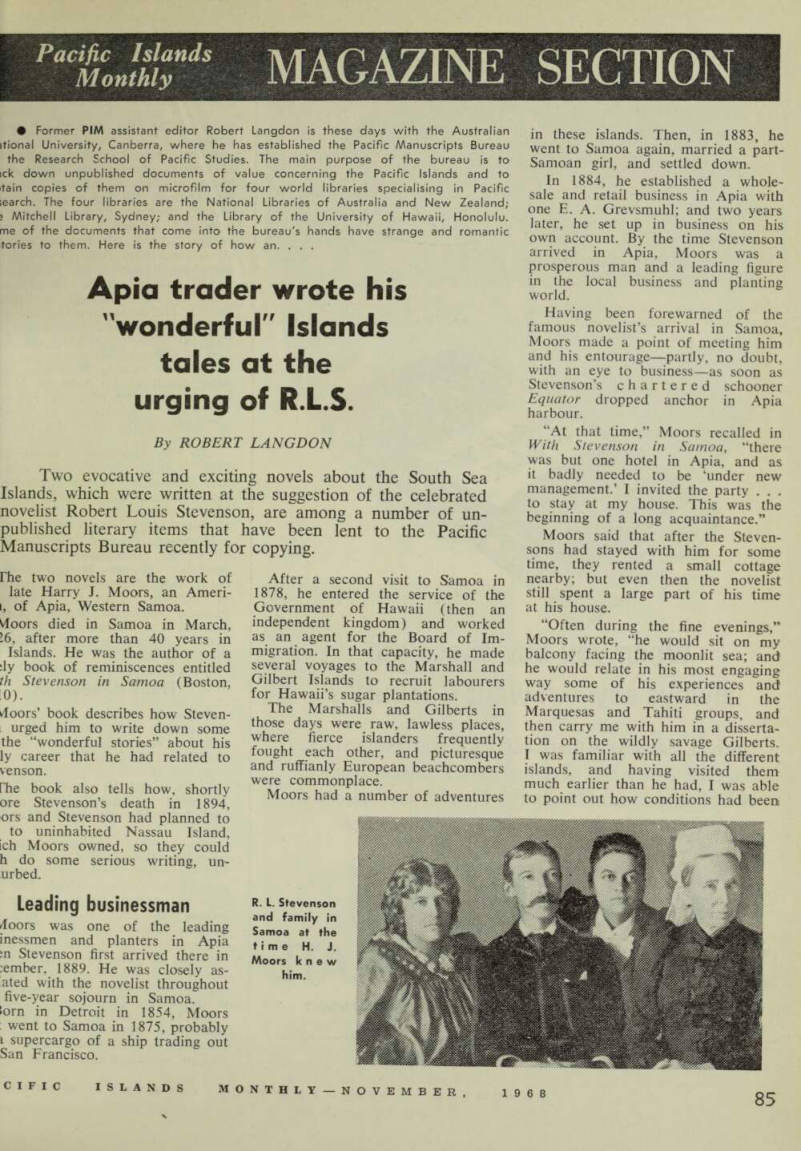
R. L. Stevenson and family in Samoa at the time H. J.
Moors knew him.
They talked to one another—man to man
modified by the arrival of whit! settlers . .
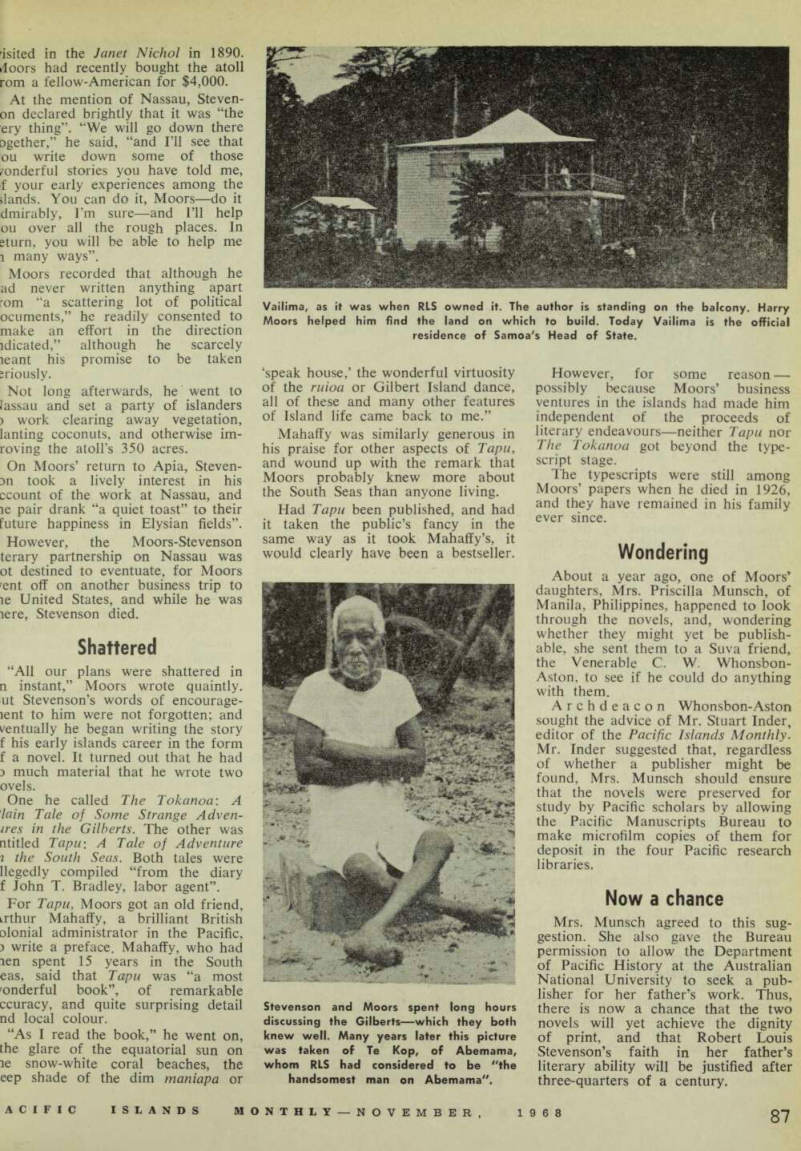
Moors recorded that when th Stevensons decided to make the] home in Samoa, RLS approache; him to look out for a suitable prc perty. Moors arranged for th novelist to inspect a number of prc perties, among which was Vailiim an estate behind Apia of 400 acre: Stevenson bought it for $4,000.
The novelist and his family the went off on a voyage to Sydney leaving Moors to supervise the cor struction of a temporary house fc them at Vailima, pending the erec tion of a permanent one.
On their return, Stevenson agai spent much of his time in Moor: house, where he wrote A Footnot to History, an account of Samoa political troubles over the previou eight years.
One of Stevenson’s biographer: Elsie Noble Caldwell, has recorde that Stevenson became less friendl with Moors as time went on becaus Moors overcharged him “in nearl all his dealings”.
However, Moors’ own accour gives the impression that gres cordiality always reigned betwee them; that Moors had the privileg of reading most of Stevenson' Samoan works in manuscript; an that he and Stevenson spent man hours discussing the novelist’ literary projects.
Frank discussions
On such occasions, Moors wrote “all reserve was thrown aside; w talked to each other as man to mac and friend to friend”.
It was in one of these frank dis cussions, about the end of 1893, tha Stevenson suggested that Moor should try his own hand at author ship.
Moors, who had recently returne* from the World’s Fair in Chicago had severely criticised Stevensoi over The Wrecker, which had jus appeared, and which the novelist has written in collaboration with hi stepson, Lloyd Osbourne.
Stevenson took Moors’ plain speaking in good part, and declares that if he could only get away some where and work undisturbed, h( might accomplish something better. ’
Moors suggested that Stevenson should try Nassau Island, an uni inhabited atoll several hundred miler east of Samoa, which Stevenson has
Tsited in the Janet Nichol in 1890. doors had recently bought the atoll rom a fellow-American for $4,000.
At the mention of Nassau, Steven on declared brightly that it was “the ery thing”. “We will go down there agether,” he said, “and I’ll see that ou write down some of those wonderful stories you have told me, f your early experiences among the >lands. You can do it, Moors—do it dmirably, I’m sure —and I’ll help ou over all the rough places. In eturn, you will be able to help me i many ways”.
Moors recorded that although he ad never written anything apart rom “a scattering lot of political ocuments,” he readily consented to make an effort in the direction idicated,” although he scarcely leant his promise to be taken jriously.
Not long afterwards, he went to lassau and set a party of islanders ) work clearing away vegetation, lanting coconuts, and otherwise im roving the atoll’s 350 acres.
On Moors’ return to Apia, Steven an took a lively interest in his ccount of the work at Nassau, and le pair drank “a quiet toast” to their future happiness in Elysian fields”.
However, the Moors-Stevenson terary partnership on Nassau was ot destined to eventuate, for Moors 'ent off on another business trip to le United States, and while he was icre, Stevenson died.
Shattered
“All our plans were shattered in n instant,” Moors wrote quaintly, ut Stevenson’s words of encourage lent to him were not forgotten; and yentually he began writing the story f his early islands career in the form f a novel. It turned out that he had a much material that he wrote two ovels.
One he called The Tokanoa: A lain Tale of Some Strange Adven ires in the Gilberts. The other was ntitled Tapu: A Tale of Adventure i the South Seas. Both tales were llegedly compiled “from the diary f John T. Bradley, labor agent”.
For Tapu, Moors got an old friend, Arthur Mahaffy, a brilliant British olonial administrator in the Pacific, a write a preface. Mahaffy, who had len spent 15 years in the South eas, said that Tapu was “a most wonderful book”, of remarkable ccuracy, and quite surprising detail nd local colour.
“As I read the book,” he went on, the glare of the equatorial sun on le snow-white coral beaches, the eep shade of the dim maniapa or
‘speak house,’ the wonderful virtuosity of the ruioa or Gilbert Island dance, all of these and many other features of Island life came back to me.”
Mahaffy was similarly generous in his praise for other aspects of Tapu, and wound up with the remark that Moors probably knew more about the South Seas than anyone living.
Had Tapu been published, and had it taken the public’s fancy in the same way as it took Mahaffy’s, it would clearly have been a bestseller.
However, for some reason possibly because Moors’ business ventures in the islands had made him independent of the proceeds of literary endeavours—neither Tapu nor The Tokanoa got beyond the type script stage.
The typescripts were still among Moors’ papers when he died in 1926, and they have remained in his family ever since.
Wondering
About a year ago, one of Moors* daughters, Mrs. Priscilla Munsch, of Manila, Philippines, happened to look through the novels, and, wondering whether they might yet be publish able, she sent them to a Suva friend, the Venerable C. W. Whonsbon- Aston, to see if he could do anything with them.
Archdeacon Whonsbon-Aston sought the advice of Mr. Stuart Inder, editor of the Pacific Islands Monthly.
Mr. Inder suggested that, regardless of whether a publisher might be found, Mrs. Munsch should ensure that the novels were preserved for study by Pacific scholars by allowing the Pacific Manuscripts Bureau to make microfilm copies of them for deposit in the four Pacific research libraries.
Now a chance
Mrs. Munsch agreed to this sug gestion. She also gave the Bureau permission to allow the Department of Pacific History at the Australian National University to seek a pub lisher for her father’s work. Thus, there is now a chance that the two novels will yet achieve the dignity of print, and that Robert Louis Stevenson’s faith in her father’s literary ability will be justified after three-quarters of a century.
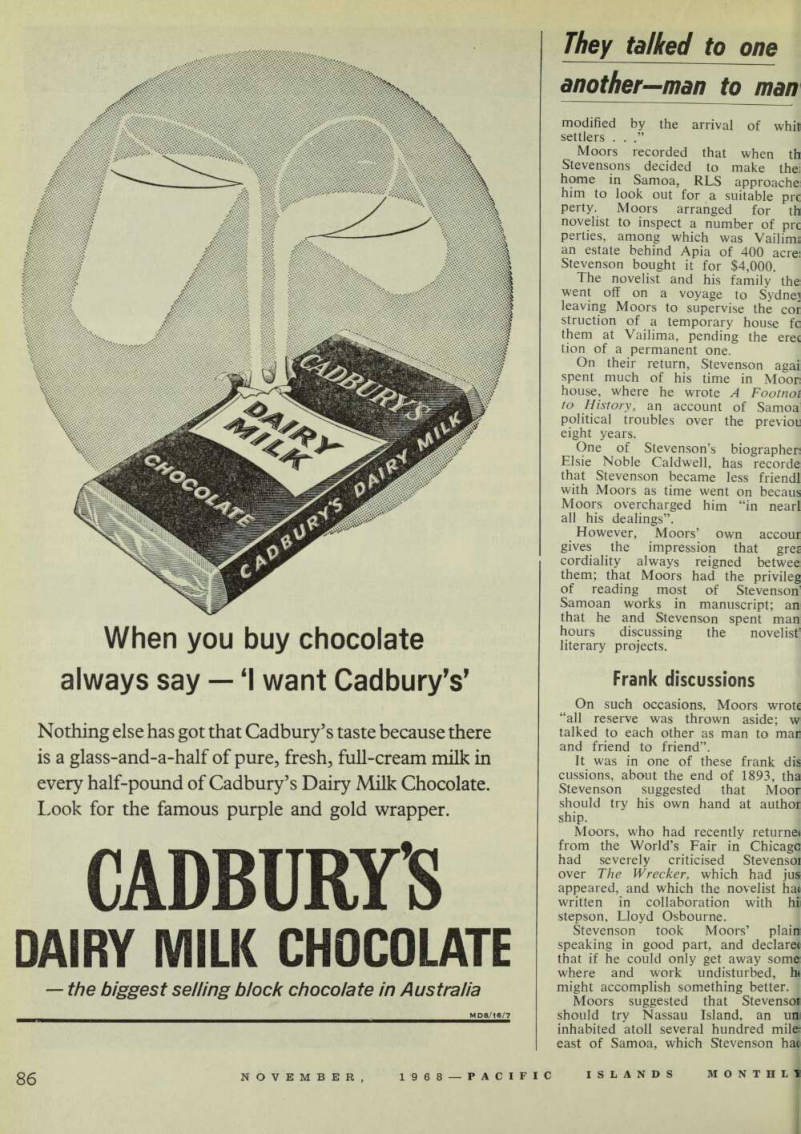
Stevenson and Moors spent long hours discussing the Gilberts —which they both knew well. Many years later this picture was taken of Te Kop, of Abemama, whom RLS had considered to be "the handsomest man on Abemama".
Vailima, as it was when RLS owned it. The author is standing on the balcony. Harry Moors helped him find the land on which to build. Today Vailima is the official residence of Samoa's Head of State.