West Irian: Agonised casuality
pp. 70-78 · Read in the full issue


of the Indonesian crisis
The time is fast approaching when the West Irianese will be given an opportunity to decide whether to remain within the Indonesian Republic. In this article, PETER HASTINGS discusses the possible method of determining the people’s wishes, and is validity, and reports on the present state of West Irian at first hand. A more detailed account, from which this article has been distilled, is to be found in the latest issue of New Guinea Quarterly, which Peter Hastings edits.
The agreement signed in New York by Holland and Indonesia in 1962 transferred sovereignty to Indo nesia with the obligation that Dja karta would hold an “act of self determination” before the end of 1969 to allow the West Irianese to decide “(a) whether they wish to remain with Indonesia; or (b) whether they wish to sever their ties with Indonesia”.
Awkward questions have already arisen as to what method of ascer tainment Indonesia will use and which West Irianese should be ascer tained. Of West Irian’s 800,000 at least 300,000 are primitive High lands people who can neither read nor write and most of whom have little if any political sophistication.
The people who count in West Irian politically are the urban elites and the coastal Papuans who have had some 80 years or so of more or less continuous Christian missionary contact—Protestant in the north, Catholic in the south.
An Indonesian “electoral team” has been in West Irian for some time trying to determine a “formula” for ascertainment. So far they have not produced one, although a “one man, one vote” ascertainment has been rejected. West Irian’s terrain con tains some of the worst country in the world and the costs and logistic requirements of a universal referen dum are too enormous for Indonesia to afford.
Not one man one vote Djakarta also rejects the notion of “one man one vote” on the not unreasonable grounds that half the population wouldn’t have the faint est idea of what it was supposed to be voting for or against.
It is likely that the method of ascertainment will be through consul tation between the Indonesian Gov ernment and elected and appointed
“tribal” leaders—a difficult and scarcely convincing act of self-deter mination in a country which has neither tribal organisation nor tribal leaders in the African sense and where there are more than 300 sep arate languages, Coastal Papuans who' are the important voters are already angry and resentful over a series of resolu tions, voicing solidarity with Indo nesia and requesting cancellation of the act of self-determination, passed by the regional councils of Biak, Sukarnapura and Manokwari.
These are successors to the re gional councils set up by the Dutch, which used to consist of appointed and elected members. Today they consist only of members appointed by the Indonesian Administration.
They are widely condemned as stooge bodies, and West Papuans fear that the outside world will re gard them as genuine voices of
Papuan feeling. The chances ar that the UN representative an( his assistants may be obliged t take Papuan reservations of thi sort into account at the time o ascertainment.
Indonesia’s dream of sovereignt in West Irian was more excitin than the reality.
Indonesian civil servants, troop! political agitators and black marke operators poured into West Iria after the takeover in 1962, but nc thing had prepared them for th reality of the area; its gaunt, forbic ding, strangely beautiful landscape: its primitive people (“they are s black”, an Indonesian civil servai remarked to me with refreshin candor) or for the immense admir istrative effort that would be require of Indonesia to maintain its new pr( vince.
Indonesia’s administration of We: New Guinea in the last five yeai has been nothing short of calamitou;
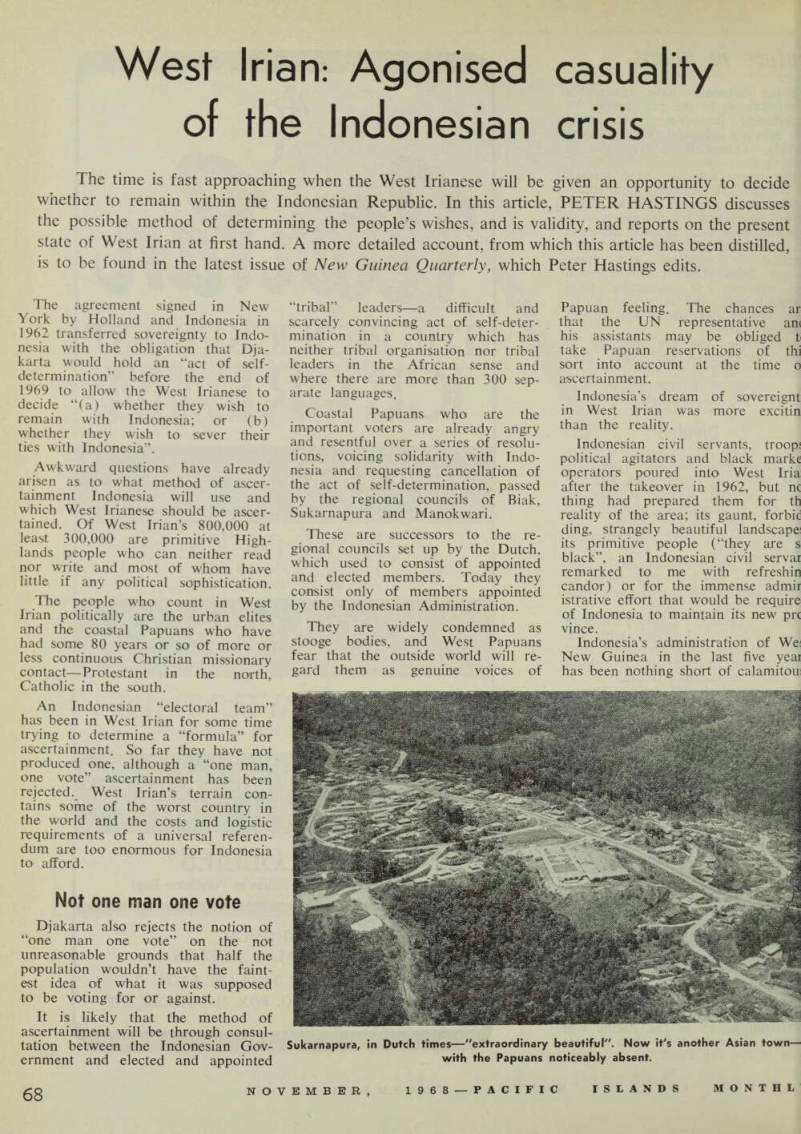
Sukarnapura, in Dutch times—"extraordinary beautiful". Now it's another Asian town with the Papuans noticeably absent.
[hile many members of the West ianese elite were prepared to try id work with the Indonesian Jministration nothing prepared em for what was to follow. Indo sia quickly abandoned all pretence maintaining either a proper iministration or the economic velopment projects started by the itch.
Indifference in Djakarta, the com- Isions of confrontation and sheer pstical incapacity led to rapid ministrative breakdown in an area ►re than ordinarily dependent upon ;h grade administrative skills and art and upon good communica ns.
Beatings, shootings
fhe Indonesian Army carried out nerous beatings, shootings and lings in order to ensure a passive •ulation. In 1965 the situation so deteriorated that the pro :e was virtually closed to all signers and to all but carefully cted members of the Indonesian icstic Press. ollowing the 1965 coup in Indo a, West Irian once again became issue of Indonesian political con nce and attempts were made to irbish the Administration and to ct new life into the practically met West Irianese economy. he problem in providing a new for West Irian was the dire lomic straits in which Indonesia id itself. It had practically no ping, no aircraft and very little to spare for what was yet her part of the Republic clamor
ing for assistance even though the Province’s political pacification was obviously a top priority matter, not ordy * n v * ew °f the coming act of self-determination but because of *h e problems posed Indonesia’s rnorale and national self-respect by 2,000 or more refugees who had crossed into Papua-New Guinea seeking asylum or permissive resi dence. The vast majority of the refu g ees were the economically dis- ? f Sukarnapura and J ° bS 3nd con ! um f r “ d tEXST* ’
Nevertheless about 300 West Irian ese > including families, who had suffered or might suffer hardship under the Indonesians have been ? ranted “permissive residence” in Australian New Guinea on the strict understanding that tbpv n/iu undertake anv nnlitiVall - t ? ot
Many have sfmnlv clisobLed S fn*
junction thp 1R f
suffering to feXgs
of pan-Papuanism already loosely established among some of the elites by Dutch-Australian actions in the years P rior to 1963.
F ° r those familiar wit h the frag mePted nature of Papuan society, and its terrain, the ability of Welt
Papuans to organise politically has been nothing less than amazing. At least three organisations exist in West New Guinea devoted to the notion of West New Guinea inde pendence.
They are the Odganisasi Papua Merdeka (OPM) or Free Papua Organisation, the Gerakan Papua Merdeka (GPM) or Free Papuan Movement and the Gerakan Nasional Papua (GNP) or National Papua Movement. They represent different degrees of anti-Indonesian feeling and all have loose links, but the OPM is the better organised and is financed by private Dutch, Japan ese, US and, allegedly in Djakarta, Australian money. Some officials in Djakarta insist that the money isn’t entirely private—that foreign govern ment funds play a role.
Political rebellion
There is also some evidence that Chinese Communist funds find their way into West New Guinea on the logical grounds that Peking can only profit from anything that embar rasses the present Djakarta regime.
Despite sporadic denials from Djakarta the OPM has been un doubtedly at the back of the continu ing rebellion of the Arfak tribes people in the mountains at the back of Manokwari.
In 1965-66 there were 4,000 dis affected Arfak people, a problem tribe in Dutch times, with nothing more at their disposal than primitive weapons and rusty World War II Japanese, US and Australian arms.
The situation they created was
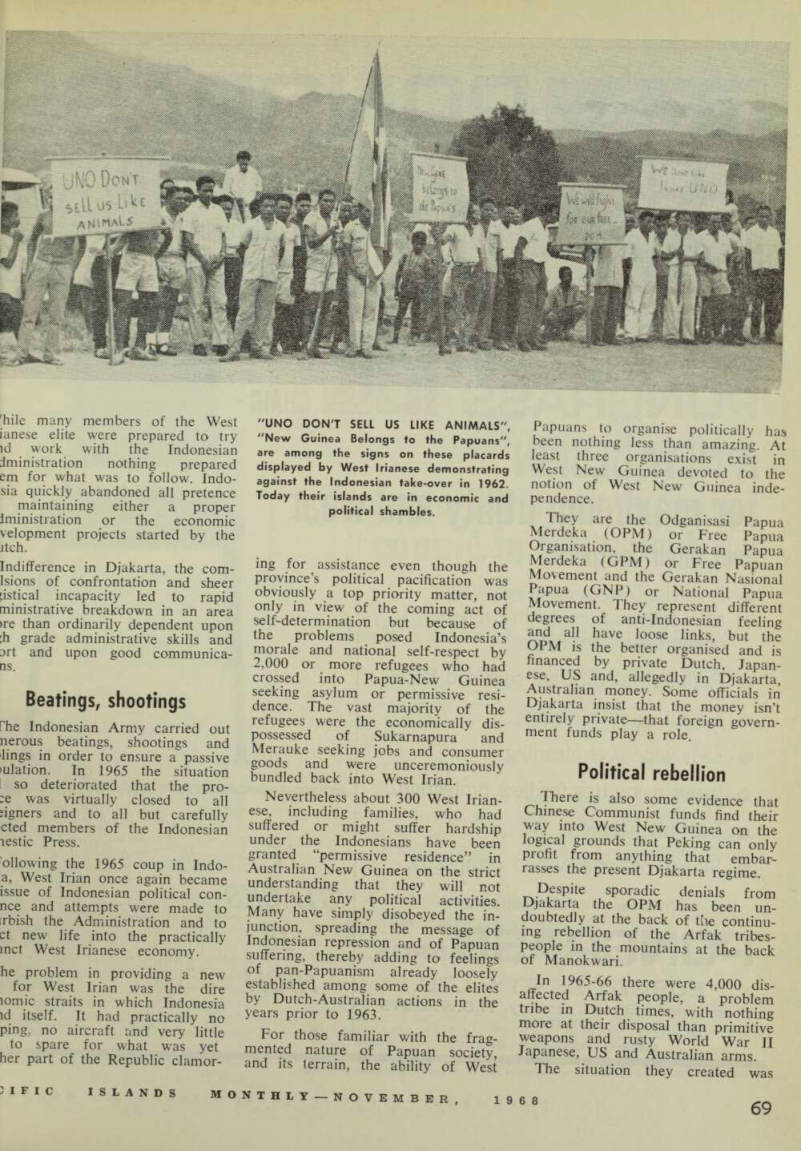
"Uno Don't Sell Us Like Animals",
"New Guinea Belongs to the Papuans", are among the signs on these placards displayed by West Irianese demonstrating against the Indonesian take-over in 1962.
Today their islands are in economic and
political shambles.
West Irian today
various enough to warrant a number 3f Indonesian air force bombing raids and armed patrols accounting For 1,200 dead. The situation is low more or less under control ilthough the province, coastally at all jvents, seethes with discontent.
My own return to West Irian after i five years’ absence proved some hing of an anti-climax. I was the irst foreign journalist permitted an maccompanied visit since 1964 and \dam Malik moved heaven and larth to obtain the reluctant permis ion of a suspicious Home Affairs Ministry to obtain approval.
At first glance Sukarnapura hadn’t hanged much since Dutch days ilthough this was more a tribute to he solidarity of the Dutch infra tructure than to maintenance and levelopment since the takeover.
The bitumen roads that serve the own and airport had stood up well, tie docks and installations put in y US forces in 1944 looked much lie same, the comfortable villas uilt high on the steep hillsides sur ounding the stunning, glittering anorama of Humboldt Bay looked 00l and inviting as ever. But there changes.
Sentani Airport was in bad shape nd there had been hardly any new uilding in the intervening years part from a new Christian church, le completion of the West New ruinea Regional Council chambers darted by the Dutch) and next to , the somewhat flashy, sinister new jgional police headquarters.
Troops everywhere
In Dutch days Hollandia, like lanokwari, had been an extra rdinarily beautiful, somewhat eepy Dutch tropical outpost with a lint East Indies flavour. Sukarna ura is now another Asian town, an lusion created is not so much by the bundance of Indonesian flags and mguage signs but by the Indonesian uality of life.
Indonesian troops and police in ingle greens throng the town, lakassarese huddle over stalls in le central market.
The most noticeable characteristic F Sukarnapura today is the absence F the Papuan whom one sees in the ack roads of Sukarnapura tending is gardens, driving trucks or carry ig huge loads. The schools, the Iministrative offices, the shops are lied with Indonesians who also in abit the high, pleasant, hillside
illas and drive the jeeps, Holdens, ords, Volvos, Volkswagens and iats that pound up and down the ;eep roads with aimless fury.
The hotel was indescribably dirty fid uncomfortable even by Indone an standards. The stench of un ushed lavatories suffused the area )r a radius of 100 yards. Prices were dronomical. Two rounds of micro :opic chicken satay came to $A7.50. tin of Heineken’s was $1 and a ack of Benson and Hedges the ime.
My companion and I became rapid aware that we were being followed /erywhere. Hotel receptionists were armed and hostile when we in sted on visiting the markets and nphatically demanded that we lould be accompanied.
We soon found out why. In the :ntre of the market was an enclosed ea which was the Papuan market odelled on the style of the tradi anal New Guinea hung. Prices ere extremely high. At the official te of 10 Irbar (Irian Barat) rupiah the US dollar three tiny tomatoes >st 50c and half a smoked fish $2.
Being watched
The reason for our being watched eca m e apparent immediately, ipuans approached us and talked us in Pidgin which neither the :avily armed police, stray soldiers )r our anxious hotel guide could iderstand. The Pidgin speaking ipuans had all at one time or [Other worked in Australian New uinea.
Their stories weren’t pretty though all were similar. There aren’t enough jobs and wages were w. The Indonesians had taken er all the principal administrative bs and the only ones available for
’apuans were given to Indonesian tooges.
Hundreds of Papuans were in aol, beatings were common and lany had been shot out of hand. In lanokwari, in Merauke and further in Sorong many Papuans had een shot in the market place as a earning. There had even been public xecutions in Sukaraapura itself.
Those who had been civil servants nder the Dutch had been kicked ut of their houses and dispossessed.
Wiat about the well-stocked shops, 'e asked?
These were very recent, the Pap ans answered, and besides very few adonesians could afford the prices, ;t alone Papuans.
A Papuan standing by asked the levitable question—“ What can Aus *alia which promised us so much i the old days do to help us now?”
I wanted to go to Manokwari nd Sorong and Merauke as I had een promised, and I asked the right fficial about this. He shook his ead sorrowfully. Very well then ould I see the political prisoners?
“Which political prisoners?” he sked blandly.
“Specifically the 31 held at Ifar icluding the former Irianese Gov rnor, Bonay, and some young stu ents,” I replied.
“Oh, those political prisoners,” he nswered, “I’m afraid you cannot, hat is an internal Indonesian latter. Incidentally, who told you bout them?”
Two other sources of information jmained to be tapped—the mission ries and the Fund for the United lations Development of West Irian
Indonesia is trying to make amends
(FUNDWI) organisation which had just set up its headquarters to over see administration of the SUS2S million grant—originally $3O mil lion—made by Holland at the time of the takeover.
The missionaries were uniformly gloomy. The Administration was old order, they said, inefficient, cor rupt and xenophobic. Missionary Aviation Fellowship Cessnas were providing nearly 80 per cent, of all Administrative contact with outlying bush strips in the Highlands and in the southern part of the territory.
At a guess there were between 6,000 and 10,000 Indonesian soldiers in West Irian, a large proportion at Manokwari. They had a reputation for brutality and corruption although they were expecting better things from the new Panglima (Command ing General) Sarwo Edhie, a tough uncompromising paratroop general with a reputation for personal hon esty and sincerity.
The situation of the missionaries throughout the island, comprising some 200 to 300 families, was un comfortable. In the Highlands, mis sionaries were almost entirely respon sible for civilising contact and even for such small economic develop ment as there was. Indonesian field staff was well-trained and resented missionary activities.
Church conflicts
There is a growing conflict be tween Christian and Islamic interests.
Djakarta might have saved a great deal of friction and hostility if it had taken care to see that Indonesian administrative field staff and senior Administrative officers in West New Guinea had been recruited from among Christian Indonesians.
Although this would have run counter to the Republic’s policy of recruiting its civil service regardless of regional or religious affiliations it would have been politically wise.
Islamic interests are now militantly interested in West New Guinea and the almost certain result will be a further alienation of the indigenous population.
The economic development of the island is practically at a stand still. The Dutch commenced various projects, rice growing near Merauke, a large and very efficient native timber and saw mill co-operative at
Manokwari, market gardening at Sentani and various projects on Biak —the island to the north of New Guinea which was also the site of the KLM Boeing jet strip.
At the time of their departure they had a large number of economic development projects on the books, mainly of a co-operative nature but these have all been abandoned.
FUNDWI was set up to administer a $3O million gift from Holland to which Indonesia was supposed to contribute a similar sum. When Indonesia left the United Nations the fund was frozen.
It now stands at $25 million—ss million having gone on administra tive expenses, into an emergency fund and into paying salaries and expenses of the special UN economic survey teams that have visited the island since Indonesia rejoined the UN.
Half the fund is being devoted to rehabilitation of utilities such as water purification plants in the main centres and to communications.
Indonesia’s capacity to maintain air services in the island the only means of communication with the Highlands—has long since been ex hausted.
At present, apart from Missionary Aviation Fellowship resources, it has three twin Otters currently grounded for lack of spare parts, a Piaggio, a Dakota which is unserviceble and a few other small craft. The Indo nesian Air Force is also almost with out transport facilities.
Coastal shipping is practically non existent. A senior Army officer, an old friend of mine, told me that officers and men in Manokwari had
been without home leave for three years owing to lack of transport.
The other half of the special fund will go on long term economic pro jects, mainly in food growing and timber development. Some of this amount is earmarked for investment loans in small local industries such as importing leather for shoes and flour for urban bread consumption.
The total grant, equal to one year’s Netherland’s subsidy before the takeover, will be spent by 1970.
It is a pitifully small amount of money and there is no more in sight.
There have been some investigative activities by several Japanese com panies into timber and fisheries development and Freeport Sulphur has been examining the feasibility of copper extraction on the far west coast. Access is difficult and costs are high and there are rumours that Freeport Sulphur may pull out or examine the possibilities of nickel in the island of Waigeo to the north.
One way and another West Irian is a sorry mess but not the sort of mess that can be easily swept under somebody’s carpet and quietly for gotten. The chances of West Irian registering a severance vote next year are slim and the thought of the explosive chain reaction in Indo nesia if it did—horrifying.
Winds of change
West Irian is an unfortunate casualty of Indonesia’s continuing economic crisis. Currently Djakarta is making what amends it can. The majority of the political prisoners are being released and those still detained at least accorded more humane treatment.
The Army’s switch of command ers, the sudden spurt of Djakarta interest in the province’s economic problems and the attempt to clean up the Administration are straws in the wind of change.
The question is whether the same wind will continue to blow at the end of next year. Probably not, despite the coming problem of the two New Guineas and their nascent inclinations towards a free, Melane sian state in the future.
It is an ironic comment on the age of decolonisation that relatively huge sums of money, almost $ll a head for every Australian, are being spent in East New Guinea to prepare it for independence only to make it the envy and despair of its captive neighbour and the target of Indonesian resentment.
Former Governor Bonay, installed by the Indonesians, but who quickly lost favour.
Now he's in gaol, and said to be ill.