American Samoa: In Many Ways
pp. 62-69 · Read in the full issue

You've Got To Be Impressed
Staff writer KEN McGREGOR recently spent a week in Pago Pago, American Samoa, where he spoke to just about everyone—from Governor Owen Aspinall downwards. Here are his impressions.
The young American Samoan looked at the rain bouncing on the roof of Pago Pago’s new shipping terminal—one of the more garish signs of change in the territory—and told me, with measured optimism;
“Every new car that is landed, every jet that comes in, and every new visitor who comes to our shores —they all change us and we can never be the same again. But it’s no use crying out that change should never have started. We must accept changes and prepare ourselves for the future.
“Here in American Samoa it may be that we are the only Islanders who are properly equipped to cope with change.”
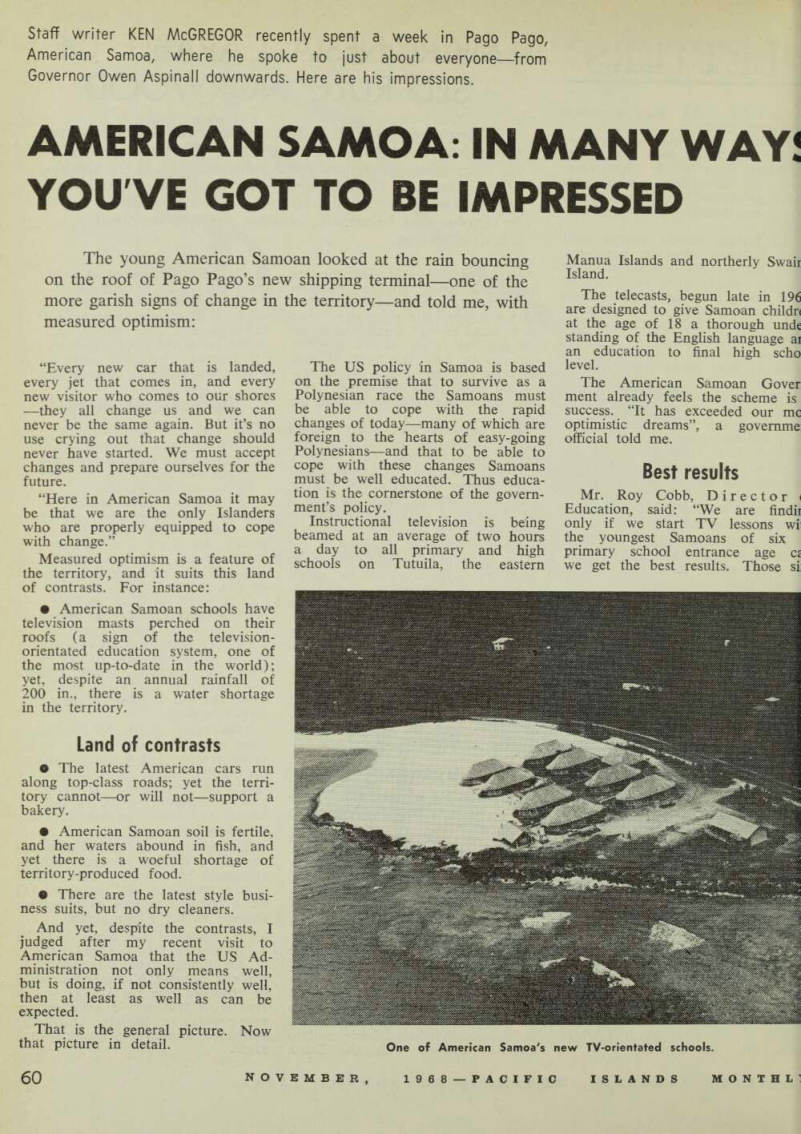
Measured optimism is a feature of the territory, and it suits this land of contrasts. For instance: • American Samoan schools have television masts perched on their roofs (a sign of the television orientated education system, one of the most up-to-date in the world); yet, despite an annual rainfall of 200 in., there is a water shortage in the territory.
Land of contrasts
e The latest American cars run along top-class roads; yet the terri tory cannot—or will not —support a bakery. • American Samoan soil is fertile, and her waters abound in fish, and yet there is a woeful shortage of territory-produced food. • There are the latest style busi ness suits, but no dry cleaners.
And yet, despite the contrasts, I judged after my recent visit to American Samoa that the US Ad ministration not only means well, but is doing, if not consistently well, then at least as well as can be expected.
That is the general picture. Now that picture in detail.
The US policy in Samoa is based on the premise that to survive as a Polynesian race the Samoans must be able to cope with the rapid changes of today—many of which are foreign to the hearts of easy-going Polynesians—and that to be able to cope with these changes Samoans must be well educated. Thus educa tion is the cornerstone of the govern ment’s policy.
Instructional television is being beamed at an average of two hours a day to all primary and high schools on Tutuila, the eastern
Manua Islands and northerly Swaii Island.
The telecasts, begun late in 196 are designed to give Samoan childn at the age of 18 a thorough unde standing of the English language ai an education to final high scho level.
The American Samoan Cover ment already feels the scheme is success. “It has exceeded our me optimistic dreams”, a govemme official told me.
Best results
Mr. Roy Cobb, Director « Education, said: “We are findii only if we start TV lessons wi the youngest Samoans of six primary school entrance age c* we get the best results. Those si
One of American Samoa's new TV-orientated schools.
r ear-olds who started off with us in 964 and are now 10 are under tanding English far better than lamoans of high school age who ame in at an older age. When these 0-year-olds finish the television ourse, in 1976, they will be able to old their own with any other of 18 in the world”.
He pointed out that there are Iready more American Samoans liv ig in the US than living in Samoa -and working in second class jobs, his showed, he said, that an in snsive education system was called >r, “If you remember that because f American Samoa’s small size it ill never be able to support a Dpulat'ion bigger than 50,000 there ill continue to be a steady flow I Samoans to job opportunities over :as,” Mr. Cobb said.
And educated Samoans, of course, ill have better job opportunities, an ill-educated Samoans.
Mr. Bill Dale, the Assistant irector of Education, told me that levision programmes were con lually being prepared and the lildren were never shown the same ow twice. His department pre ires new films and tapes every year -no tapes are kept.
“All schools are in talkie-radio ntact with other schools and if achers don’t feel that a certain >son was successful or did not get ross to the children the next pro ved lesson does not go on.
“We remake the film, rewrite the struction books and repeat the un ccessful lesson in another fashion itil we feel the Samoans have iderstood what they are being Jght. If they don’t take in the ;son the second time, the whole ocess is repeated, in a third fashion.
Criticism
“When the children understand, d only then, do we proceed with j following lessons.”
On the face of it American moa’s education system is an im essive one—it certainly impressed j and it certainly impresses many moans—but there is criticism of 5 system in the territory.
One Samoan put it this way: “To grade Samoa, we must be healthy st. It took us seven years to get modern medical centre—the LBJ opical Medical Centre—and even •w the centre is still not well uipped. Other priorities should
have been considered before huge sums were allocated for education.
“We have a huge rainfall of 200 in. a year and yet we don’t have any good water systems.” (There was a water shortage while I was in American Samoa, although it rained heavily every day of my stay).
A Samoan from Se’etaga Village said that he thought that many children were satisfactorily repeating sentences learned on television with out knowing anything of the struc ture of sentences.
Outside education, American Samoans can expect a watering down in major public works, intensified efforts in agriculture and a steady growth in tourism.
Governor Aspinall (one year a Governor and six years in the terri tory), who works long hours, favours white suits in public appearances and is less interested in publicity than his predecessor (H. Rex Lee), has yet to show he has Governor Lee’s capacity to extract extra US funds for American Samoan projects.
And with the US tightening its purse strings it seems likely that it will reduce its grants to the territory.
Reduce grants
Probably no one in American Samoa is watching this month’s US elections more closely than Governor Aspinall. His job is a political “plum” awarded by pressure in the US Con gress.
During his years in Samoa, Gov ernor Aspinall has built up a good working knowledge of Samoa. He has just completed his first year of Governorship and has not yet had time to put into action any ideas he may have as opposed to the policies of Governor Lee.
There is plenty of scope, for in stance, for him to put the territory back on a solid food production basis.
Government to blame
After all, American Samoan agri culture is a shambles. The territory cannot produce even half of each of the two staple foods for its people —taro and bananas.
Most food is imported, whether it’s taro from Western Samoa, or tinned food from the US. With no bakery, all bread is flown in by jet from Hawaii. Households must order weeks ahead or stockpile huge
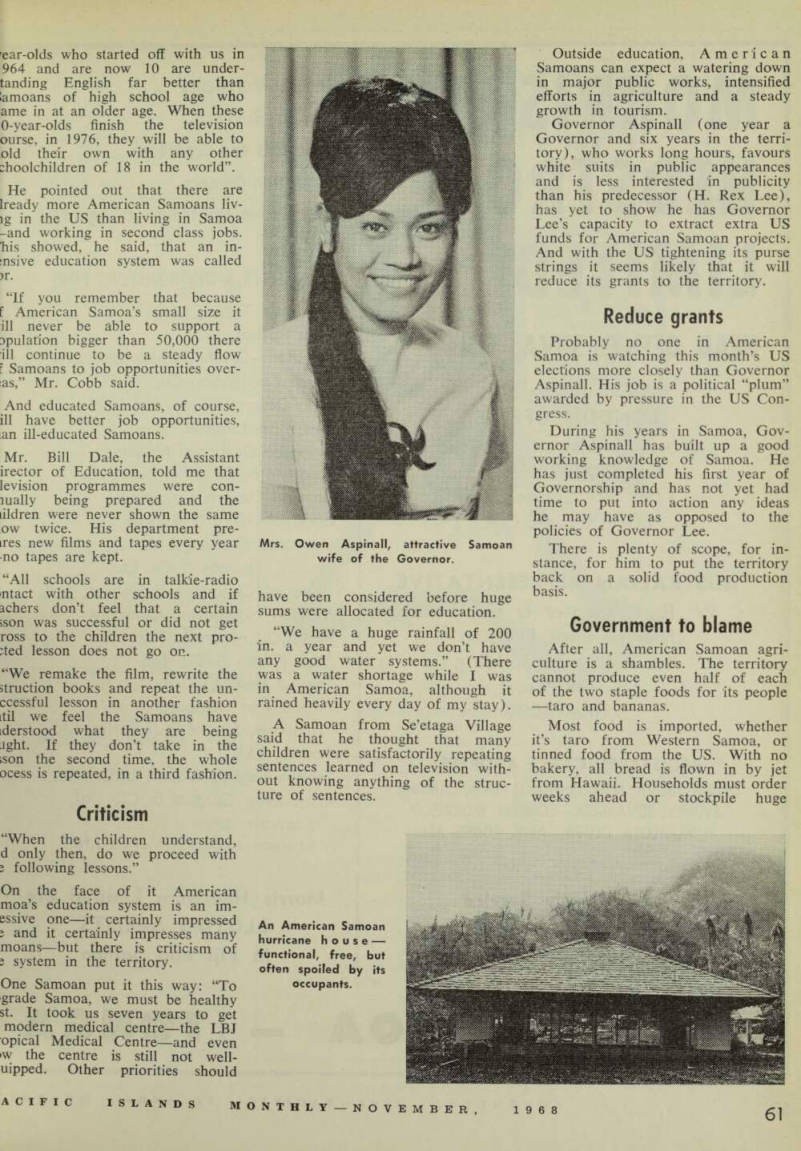
Mrs. Owen Aspinall, attractive Samoan wife of the Governor.
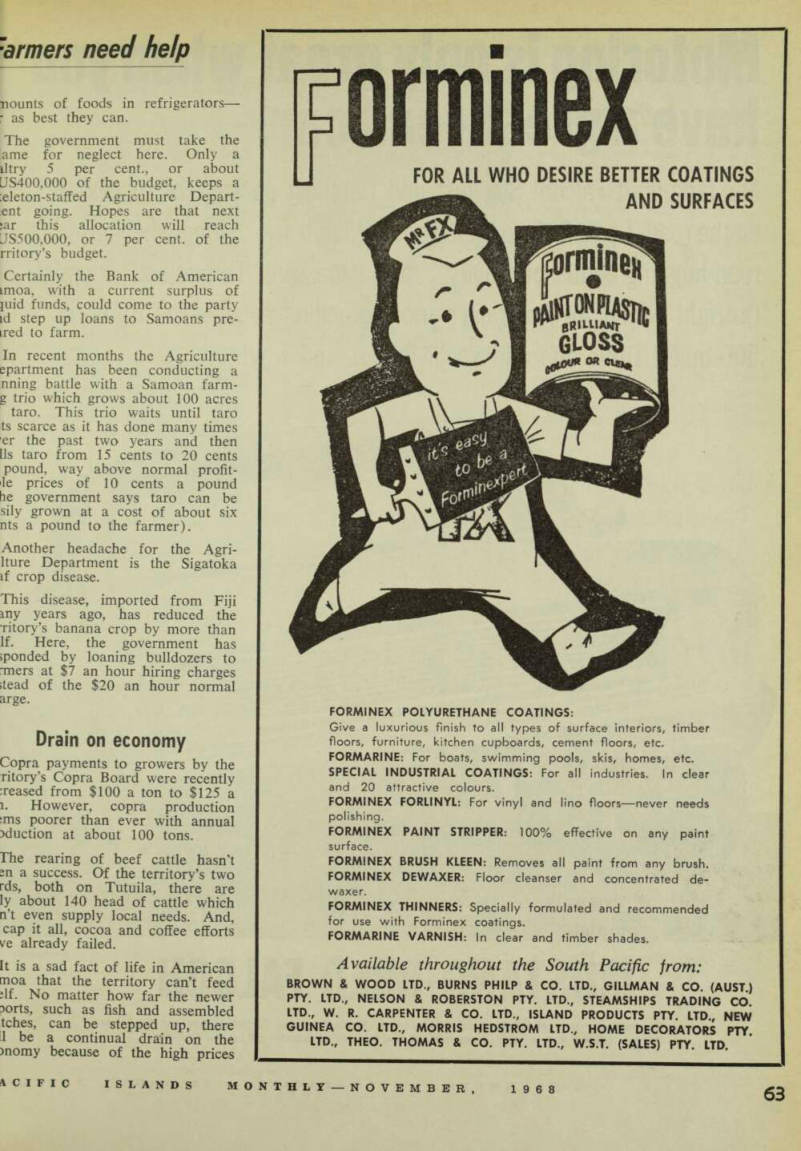
An American Samoan hurricane house functional, free, but often spoiled by its occupants.
'•amen need help
nounts of foods in refrigerators— : as best they can.
The government must take the !ame for neglect here. Only a iltry 5 per cent., or about J 5400,000 of the budget, keeps a :eleton-staffed Agriculture Depart ent going. Hopes are that next ;ar this allocation will reach J 5500,000, or 7 per cent, of the rritory’s budget.
Certainly the Bank of American imoa, with a current surplus of luid funds, could come to the party id step up loans to Samoans pre ired to farm.
In recent months the Agriculture epartment has been conducting a nning battle with a Samoan farm g trio which grows about 100 acres taro. This trio waits until taro ts scarce as it has done many times er the past two years and then Us taro from 15 cents to 20 cents pound, way above normal profit ie prices of 10 cents a pound he government says taro can be sily grown at a cost of about six nts a pound to the farmer).
Another headache for the Agri- Iture Department is the Sigatoka if crop disease.
This disease, imported from Fiji my years ago, has reduced the ritory’s banana crop by more than If. Here, the government has sponded by loaning bulldozers to *mers at $7 an hour hiring charges stead of the $2O an hour normal arge.
Drain on economy
Copra payments to growers by the ritory’s Copra Board were recently sreased from $lOO a ton to $125 a i. However, copra production ;ms poorer than ever with annual xluction at about 100 tons.
The rearing of beef cattle hasn’t m a success. Of the territory’s two rds, both on Tutuila, there are ly about 140 head of cattle which n’t even supply local needs. And, cap it all, cocoa and coffee efforts ve already failed.
It is a sad fact of life in American tnoa that the territory can’t feed df. No matter how far the newer sorts, such as fish and assembled tches, can be stepped up, there I be a continual drain on the )nomy because of the high prices
living standards up
o be paid for most of the people’s oods.
With this in mind, what is being one to help the economy of Samoa 0 enable Samoans to look after hemselves—at home?
So dependent is the territory on he whims of Washington that it light have faced a minor recession 1 the past two years because of iccessive reduced budget allocations, ad it not been for SUS 4 million in ery welcome tourist dollars received ver this period.
But for all the territory’s apparent lortcomings, one must be impressed y much recent progress in American amoa. Dozens of the latest-model merican cars run on smooth bitu len roads which curl within a few ards from some of the prettiest ;aches. PanAm jets maintain almost lily services to the US, Hawaii, Aus alia and NZ, and is widely publicis g the territory’s charms.
A spectacular chairlift (built for JS 150,000) crosses massive Pago ago Bay between equally-spectacular [circling mountains shrouded in 'er-changing clouds. Tastefully tofed schools, complete with dozens : television receivers, nestle near :aches.
Great strides have been made in urist facilities, including a busy t airstrip, a luxury resort hotel, e unique chairlift and improved cilities for handling huge liners in igo Pago Bay. Living standards ive risen, medical services are odern and good, almost no money s been spared to build up the ex asive education system and news sdia have been vastly improved th a radio station and limited State le television programmes.
Wholeheartedly
In any country in the world, it very easy to criticise the govern ;nt in power. This is probably m more so in American Samoa cause Americans seem to always things more wholeheartedly than dr British or French counterparts.
Take the hundreds of free bund le houses built by the Government American Samoa on Tutuila for those Samoans who lost their mes during 1966. They are solid, >dem style buildings, designed to nd up to the strongest winds. In :m I saw the best and the worst ults of genuine American efforts overcome the problem of the rricane. (Over)
■uture in doubt
Some Samoans have made big iprovements to the new houses by troducing furnishings, tapa mats id planting colourful flower gardens itside. Others have even put in jds to sleep on.
But many Samoans have refused improve the houses, and some nes four or five families have oved into sleep on the floors with gs and dogs, etc. Strips of corruga d iron and old tins are often mmed in windows and many sitors from Western Samoa, with e memory of attractive little atched huts, find American hurri ne homes just about the ugliest fht anywhere.
Meanwhile, the big question in nerican Samoa is: What does nerica intend to do with her terri fy? And, as I reported in Sep nber (p. 25), nobody seems to ow.
Divided
The Samoans themselves are dded on this question. There are ee prevailing views: one, that the untry should seek independence; o, that it should seek assimilation th the US; three, it should seek litical union with independent astern Samoa.
A fourth group of Samoans cannot ike up its mind whether American tnoa should go for independence assimilation.
One Samoan, a well-educated in, holding a key job with the nerican Samoan Government, had ne strong feelings on the subject American Samoa’s future.
He stressed that American Samoa not equipped for independence— . But, he said, “Let us run our n country internally for a few irs and then let the Samoans :ide by a national vote what they uld like to do”.
He said that the US Department the Interior cannot continue to a negative policy on American noa. [n my view, American success in territory will depend ultimately her revolutionary educational tern. Of course, it’s too soon tell whether the system Will work not. The first real results won’t felt for another eight years.
However, if ambition and money anything to go by (and the lericans have plenty of both: the icational programme is costing m a hearty SUS 2 million a year), n it is likely that the present lerican policy in the Pacific will >ve to be a lot more than a mere >p in the Big Pond.