Tropicalities
pp. 39-41 · Read in the full issue
The beginnings of trade unionism in Papua-New Guinea took the form of the establishment of “Workers’
Associations” catering for workers in all occupations. Such associations were formed in several of the main towns, and in one or two cases on a district basis, and have functioned with varying measures of success.
)utstanding has been the Rabaul ociation, which, under its able and rgetic president, Thomas Toßun , has successfully negotiated with Employers’ Federation a whole es of awards for various groups workers, including awards for lifted tradesmen. Rather less suc ful has been the Port Moresby rkers’ Association, which, once hie lead, seems to have drifted into doldrums. .11 along it has been recognised these all-inclusive Workers’ As ations could only be regarded as age on the way to craft unions, during the last few years moves i been made in several parts of territory in this direction, notably ;he timber industry and among hers. :>rt Moresby Workers’ Associa s president, Oala Oala-Rarua, on other hand, has advocated a ral association with specialist ps within its structure. His at >ts to get this concept off the nd have not, however, met with iSS.
Overtones
Port Moresby the issue has now i on political and personal over ;. It began when Gavera Rea, one he four co-chairmen of Pangu made it known that he was help- Port Moresby’s wharfies to lise themselves into a union of own the Central District rside Workers’ Association. ;ly after, it transpired that Pangu ; secertary, Albert Maori Kiki, helping workers in the building try to form and secure registra for a “Central District Building :ers’ Union”. ese moves were clearly a threat le Port Moresby Workers’ As tion’s already crumbling founda and president Oala Oala-Rarua sd vigorously, claiming that the
There's a trade union war in Port Moresby
formation of these unions was a Pangu Pati move to get the workers on-side politically.
To get the full flavour of this dis pute it is necessary to remember that Oala Oala-Rarua was one of the founders of Pangu Pati, and sub sequently resigned from it (or was tossed out of it—we never quite learned which) after a disagreement over some rather brash statements he had made on independence during a visit to Sydney.
Messrs. Kiki and Rea denied that they were grinding a political axe, claimed that they had been asked by the workers concerned to help them form unions, and asserted that the Port Moresby Workers’ Association was no longer effective, if indeed it could be said to exist.
Mr. Oala-Rarua retorted that the Workers’ Association had more than 400 members and was campaigning for more.
“It’s a pity to see the Port Moresby Workers’ Association going down the drain,” riposted Albert Maori Kiki smoothly.
Messrs. Kiki and Rea went on to challenge Mr, Oala-Rarua to lodge an objection, under the Industrial Organisations Ordinance, to the registration of the Building Workers’
Union, a move which would expose him to cross-examination on the real state of his Workers’ Association.
There the matter stands at present.
Perhaps the day of the general “Workers’ Association” is nearly over.
One can feel sympathy for Oala Oala- Rarua, who has pioneered Papua- New Guinea trade unionism; but it does look as if his star as a trade
union leader may be setting. Maybe he won’t mind all that much; as As sistant Ministerial Member for Treasury he has plenty of new interests and opportunities.
Just to what extent there may be political motives behind the two Pangu men’s incursion into trade unionism is anybody’s guess. But, as a South Pacific Post editorial has pointed out, even if Pangu Pati has ideas for using unions to increase its mass support, this is a perfectly legitimate political tactic which it is entitled to employ.
Tahiti’s political
monument
ALTHOUGH Tahiti already has more historical monuments than most of the other South Pacific islands put together, it seems that these days, with about 25,000 tourists visiting the island annually, and look ing for things to see, it can never have quite enough.
The monuments put up in the past year or two to Samuel Wallis, Tahiti’s first European visitor, and to Bougain ville, the French explorer, have been valuable additions to such tourist sights as the Gauguin museum, and the Cook and Duff memorials at Point Venus.
Now there is a proposal to put up a statue to Tahiti’s last king, King Pomare V, who ceded Tahiti and its dependencies to France in 1880.
However, when the question of the Pomare V memorial was considered in October by one of the committees of French Polynesia’s Territorial Assembly, the member charged with supplying facts about the project
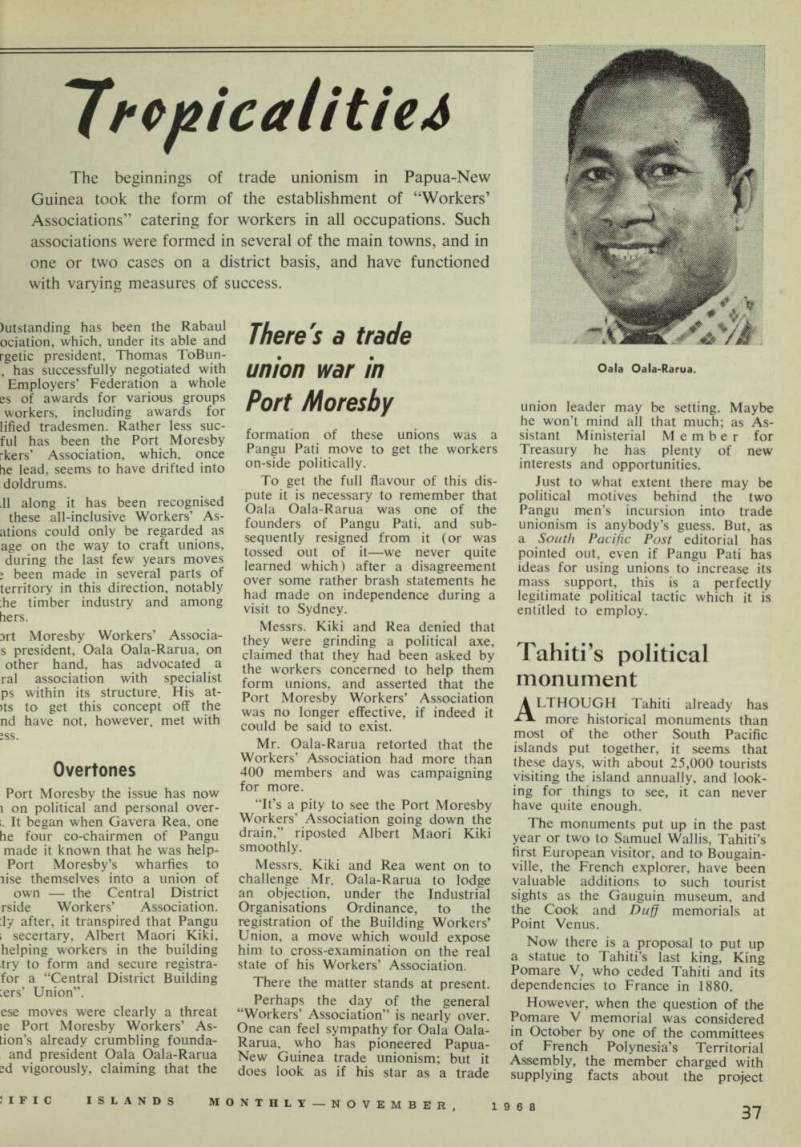
Oala Oala-Rarua.
was not enthusiastic—apparently for political reasons.
“If a monument is to be erected to King Pomare V,” he said, “then the French Government should entirely foot the bill.
“However, if Tahiti wants to put up a monument to one of its sovereigns, then it should choose Queen Pomare IV, who reigned for nearly half a century and who presided over the destiny of the country in particularly grave circum stances . . .”
We gather from these remarks that Tahiti’s pro self-government politicians see nothing to be proud about in Pomare V, the “giveaway king”.
On the other hand, they would be pleased to honour the king’s mother, Pomare IV, who reigned from 1827 to 1877, and who refused to submit to French authority for nearly three years after France declared her country a protectorate in the early 1840’s.
Is the passing of
the bure far off?
PICTURE FIJI: Sunny islands and atolls, slender palms and gentle seas . . . and instead of the traditional thatched bures, hundreds of little boxes. Maybe thousands.
Fiji’s landscape might be ditted with flat-roofed, box-like dwellings, prototypes of a £2OO house designed by the Medical Department as a sug gested substitute for bures and for housing farmers on development schemes.
The low-cost house, with an area of 320 square feet and containing a living area, kitchen and washroom (with shower and water-seal latrine), can be put up on a do-it-yourself basis. A Medical Department spokes-
man estimated that it would take about a fortnight for one man to build it.
Sad as the passing of the pic turesque bure might seem to anyone who doesn’t have to live in one, the introduction of a practical, hygienic, inexpensive substitute became neces sary in Fiji with the rising costs of 6wre-building. A few years ago, you could have a decent bure built for around £5O-£6O. Now, certainly in areas close to towns, it will cost £l5O or more—if you can get the materials.
As the Medical Department fellow said: “The substitute mightn’t look very
beautiful—but it’s more sensible 1 the working Fijian. Even if he bi a bure for £l5O, it would need repa ing after three years. And the 1 expectation of a bure is only abx 10 years all told.
“The low-cost house would last family man at least until his childi were grown up and able to affc homes of their own.”
The day when the village-st; bure, atmospheric but not really co fortable, is little more than a musei piece, may be fast approaching.
Run for your life!
ANY pretence of low-gear livii far from the hectic pace madding crowds and such, has 1 Suva forever. On the roads, anyw; With the introduction in Octol of the city’s new traffic seller Suva’s drivers, possessed of a suich disregard for life, have achieved n heights of enthusiastic recklessness, The scheme introduces a new tral flow along Stinson Parade and 1 new bridge across Nubukalou Cre and a system of one-way stre< Those one-way streets do it! Drive intent upon reaching some obsci destination in the fastest time thr caution to the winds. Pedestrians j invisible, or they’re regarded prime targets in the game of hum skittles . . .
Confusion reigned during the fi few days of the new scheme’s inti duction. Cars were parked in i
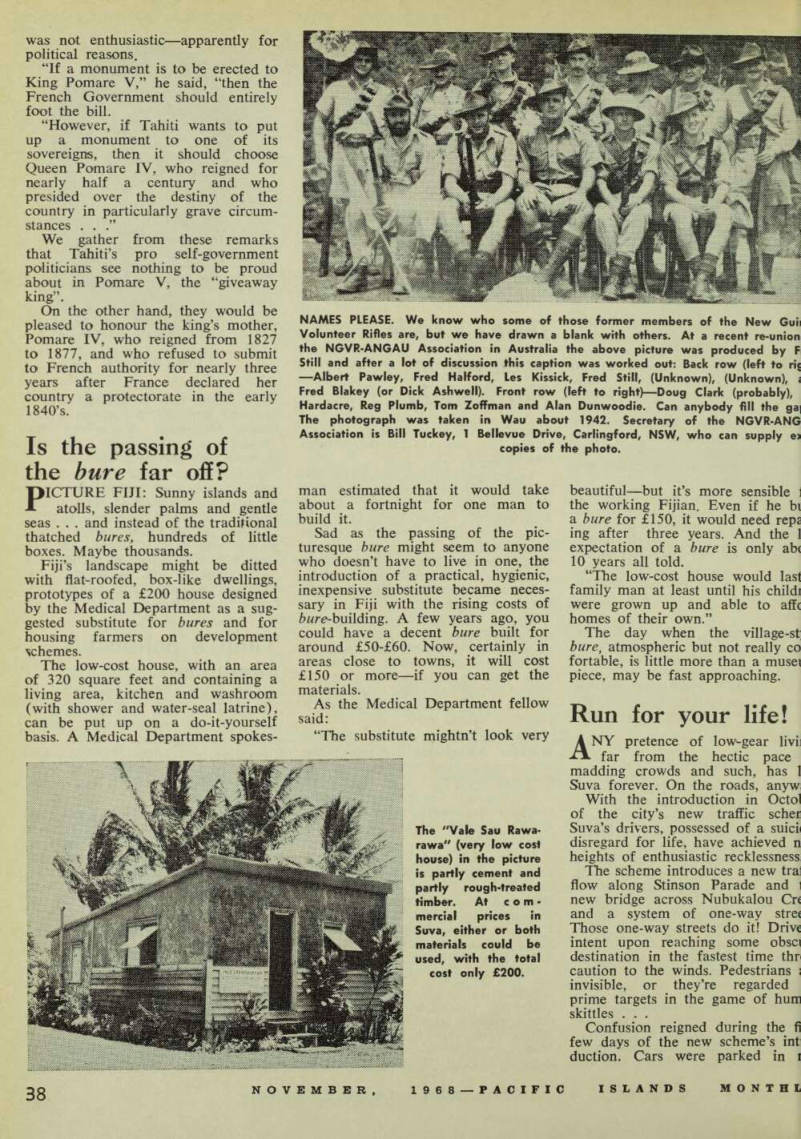
NAMES PLEASE. We know who some of those former members of the New Guinea Volunteer Rifles are, but we have drawn a blank with others. At a recent re-union the NGVR-ANGAU Association in Australia the above picture was produced by F[?] Still and after a lot of discussion this caption was worked out: Back row (left to rig[?] —Albert Pawley, Fred Halford, Les Kissick, Fred Still, (Unknown), (Unknown), [?] Fred Blakey (or Dick Ashwell). Front row (left to right)—Doug Clark (probably), Hardacre, Reg Plumb, Tom Zoffman and Alan Dunwoodie. Can anybody fill the ga[?] The photograph was taken in Wau about 1942. Secretary of the NGVR-ANG Association is Bill Tuckey, 1 Bellevue Drive, Carlingford, NSW, who can supply e[?]
copies of the photo.
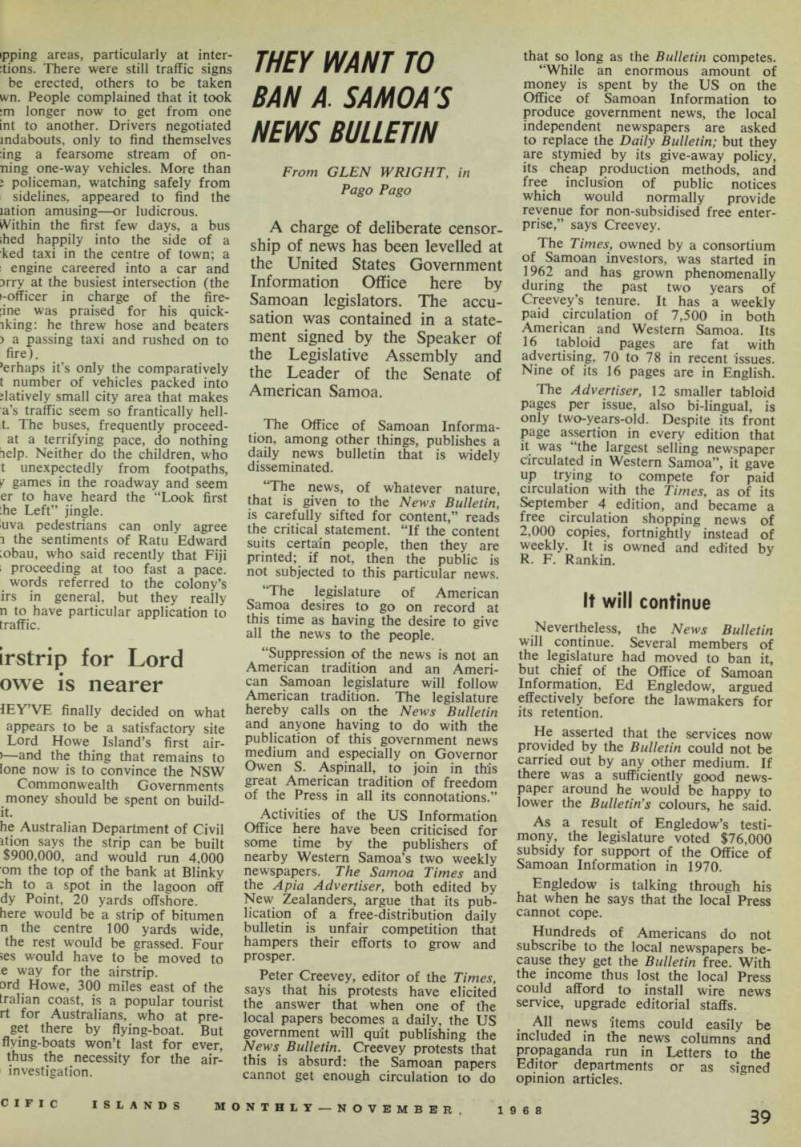
The "Vale Sau Rawa rawa" (very low cost house) in the picture is partly cement and
partly rough-treated
timber. At com mercial prices in Suva, either or both materials could be used, with the total cost only £200.
ipping areas, particularly at inter com. There were still traffic signs be erected, others to be taken wn. People complained that it took ;m longer now to get from one int to another. Drivers negotiated indabouts, only to find themselves :ing a fearsome stream of on ning one-way vehicles. More than j policeman, watching safely from sidelines, appeared to find the lation amusing—or ludicrous.
Within the first few days, a bus ;hed happily into the side of a ked taxi in the centre of town; a engine careered into a car and Drry at the busiest intersection (the (-officer in charge of the fire ;ine was praised for his quick iking: he threw hose and beaters ) a passing taxi and rushed on to fire). *erhaps it’s only the comparatively t number of vehicles packed into datively small city area that makes a’s traffic seem so frantically hell t. The buses, frequently proceed at a terrifying pace, do nothing help. Neither do the children, who t unexpectedly from footpaths, y games in the roadway and seem er to have heard the “Look first :he Left” jingle. fiva pedestrians can only agree i the sentiments of Ratu Edward :obau, who said recently that Fiji ■ proceeding at too fast a pace. words referred to the colony’s irs in general, but they really n to have particular application to traffic.
irstrip for Lord
owe is nearer IEY’VE finally decided on what appears to be a satisfactory site Lord Howe Island’s first air- ) —and the thing that remains to lone now is to convince the NSW Commonwealth Governments money should be spent on build it. he Australian Department of Civil ition says the strip can be built $900,000, and would run 4,000 om the top of the bank at Blinky :h to a spot in the lagoon off dy Point, 20 yards offshore, here would be a strip of bitumen n the centre 100 yards wide, the rest would be grassed. Four >es would have to be moved to e way for the airstrip, ord Howe, 300 miles east of the tralian coast, is a popular tourist rt for Australians, who at pre get there by flying-boat. But flying-boats won’t last for ever, thus the necessity for the air investigation.