In Niugini, as elsewhere, people
pp. 36-38 · Read in the full issue
don't always matter very much
When following news of events in various parts of the world one finds oneself asking, “Dc people matter any more?” Even in our little world of Papua-New Guinea the question sometimes obtrudes itself.
PORT MORESBY is overlooked by two BPs—Burns Philp and Burns Peak. The former calls for no explanation. The latter is an 800 ft hill which looks down on its shoreward side on Konedobu, Gov ernment House and Hanuabada Village. On the inland side it looks down on what I can remember as a quiet, grassy valley to which, when I lived at Hanuabada in those far off days before the war, we used sometimes to repair—climbing over a saddle in the hills—for picnics, scout and guide outings and such like.
Now that once grassy valley is crossed by a bitumen highway, and is full of the little concrete-brick boxes which comprise the low covenant suburb of Hohola. A sub stantial proportion of the hundreds of Papuan and New Guinean public servants who work in the Admini stration’s headquarters at Konedobu live there.
Years of talk
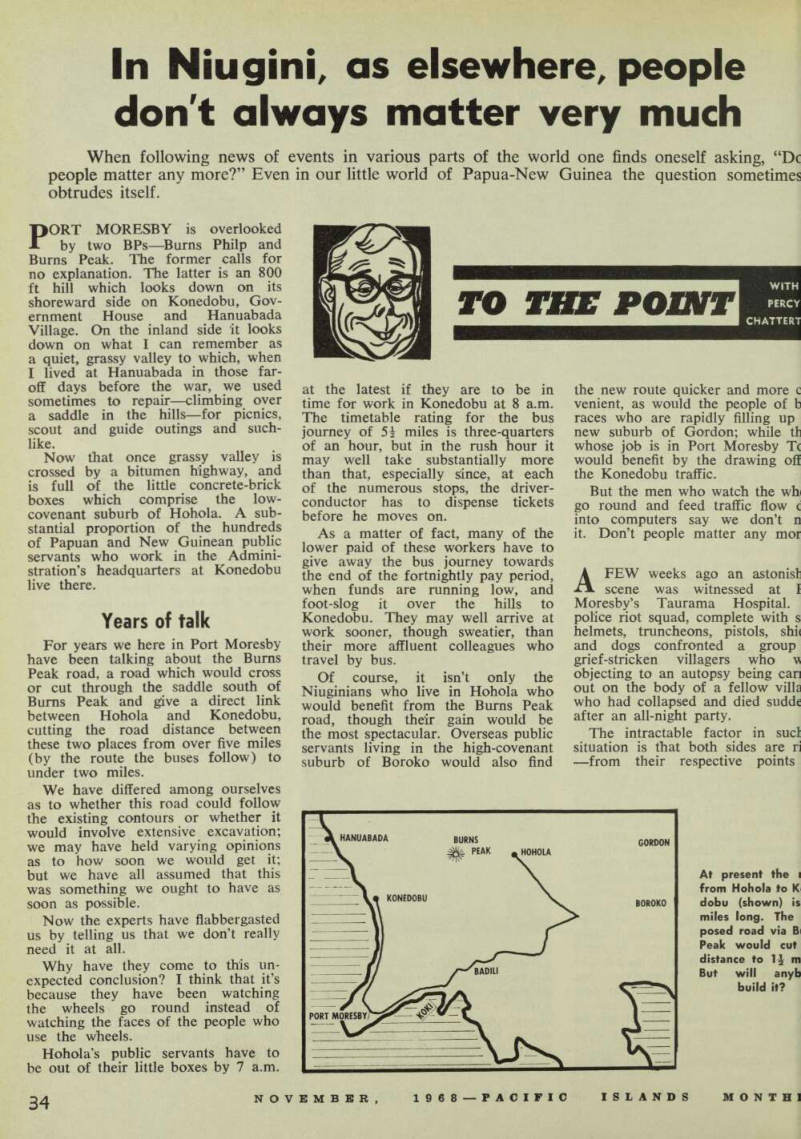
For years we here in Port Moresby have been talking about the Bums Peak road, a road which would cross or cut through the saddle south of Bums Peak and give a direct link between Hohola and Konedobu, cutting the road distance between these two places from over five miles (by the route the buses follow) to under two miles.
We have differed among ourselves as to whether this road could follow the existing contours or whether it would involve extensive excavation; we may have held varying opinions as to how soon we would get it; but we have all assumed that this was something we ought to have as soon as possible.
Now the experts have flabbergasted us by telling us that we don’t really need it at all.
Why have they come to this un expected conclusion? I think that it’s because they have been watching the wheels go round instead of watching the faces of the people who use the wheels.
Hoholas public servants have to be out of their little boxes by 7 a.m.
To The Point
With
Percy
Chattert
at the latest if they are to be in time for work in Konedobu at 8 a.m.
The timetable rating for the bus journey of 51 miles is three-quarters of an hour, but in the rush hour it may well take substantially more than that, especially since, at each of the numerous stops, the driver conductor has to dispense tickets before he moves on.
As a matter of fact, many of the lower paid of these workers have to give away the bus journey towards the end of the fortnightly pay period, when funds are running low, and foot-slog it over the hills to Konedobu. They may well arrive at work sooner, though sweatier, than their more affluent colleagues who travel by bus.
Of course, it isn’t only the Niuginians who live in Hohola who would benefit from the Burns Peak road, though their gain would be the most spectacular. Overseas public servants living in the high-covenant suburb of Boroko would also find
the new route quicker and more c venient, as would the people of b races who are rapidly filling up new suburb of Gordon; while th whose job is in Port Moresby Tc would benefit by the drawing off the Konedobu traffic.
But the men who watch the wh( go round and feed traffic flow c into computers say we don’t n it. Don’t people matter any mor A FEW weeks ago an astonish scene was witnessed at I Moresby’s Taurama Hospital, police riot squad, complete with s helmets, truncheons, pistols, shi< and dogs confronted a group grief-stricken villagers who v objecting to an autopsy being can out on the body of a fellow villa who had collapsed and died sudde after an all-night party.
The intractable factor in sue! situation is that both sides are ri —from their respective points
At present the [?] from Hohola to K[?] dobu (shown) is miles long. The posed road via B[?] Peak would cut distance to 1½ m[?] But will anyb[?] build it?
w. The villagers (they come from ullage which expanding urbanisa i is threatening to swallow up but ich is essentially still a bush age) said, “This is our flesh and od; we claim the right to mourn bury him according to our own toms”. The doctors and the aner said, “We don’t know why man died and it is our duty to out”.
Barrier of truncheons
ut there were people available ► could have found a less drastic tion than the riot squad if they been given the chance. Ministers the United Church, of which t of the villagers are adherents, ht have helped if they had been sd in. hen there was the District linistration man from District -e who, following a deputation villagers to the Administrator, called in 48 hours after the ition first developed! He □aded the deputation to accept autopsy and accompanied them ; to the hospital, only to find the autopsy had already taken 3 willy-nilly behind a barrier of zheons, pistols, shields and dogs, as this confrontation necessary what did it achieve? »me of the dead man’s relatives, iding his widow, came to talk ae after it was all over. They known me since they were and talked freely. They had , and indeed still were, stirred nd resentful. ley may well have appeared le and dangerous to timid or in rienced Europeans. But I didn’t the impression that they had usly contemplated violence. They hoped to persuade, perhaps to urise, the doctors to forgo the isy. I doubt whether they had asly contemplated breaking into norgue and snatching the body, t even if they had! Moresby’s ral Police Station at Boroko is than a mile from the hospital, e event of the situation becom igly, a single police officer on spot with a walkie-talkie radio have brought a riot squad on -by to the scene in two minutes, hy the histrionics? ;11, the doctors got their own Presumably they found out why nan died. Possibly they made small addition to the sum total cientific knowledge. Certainly added yet another group of e to those (for this kind of mt has occurred before, though o dramatically) who have made ieir minds never to allow them-
selves to be taken to hospital, howeV r J? ay be .‘ When I talked with them, I found that what stuck in their throats most wa fi e „ d°g s * * Are we pigs ° r wallabies , they asked, “that they have to bring out their dogs to us?”
Surely the proper use of police dogs is to track down suspected criminals or escapees. Their value in confront ing mob violence is dubious; i understand that even those tough characters, the American police, are coming round to this view. And anyway, this was not a violent mob.
Not in fact, nor probably in intern 10 n nn . t . nnn°t thp,w P r matter .. a " y ™ ore , ?
Dont their feelings matter? Doesnt their grief matter?
St a vnr' \ i n tt UDA KOGA is 10. He comes from the Goilala, a mountainous stretch of country less than 100 miles from Port Moresby, but still very primitive.
Recently police in Moresby rounded up a number of vagrants.
Without visible means of suonort they were living with and on relatives employed about the town. As usual, some of them were from Goilala, and of these a dozen or so were .^ ough *° be d ealt with by the Childrens Court rather than the ...
Suda was the youngest. Eileen
Tom, middle-aged welfare assistant from Hula, on the Papuan coast. was there as a sort of prisoners’ friend. The magistrate told them that they would have to go back home and if they hadn’t the price of an air fare they would have to walk back.
What else could he tell them?
Glummer and qlummer
3 they’re going to walk. I’m g° in g to walk with them,” said Eileen Tom - And she did.
I saw them off. Suda was a merry Httle chap, but he got glummer and glummer as the time drew nearer for him to board the truck which was to take theip to the Toad .^ the Vanapa River, some 20 miles out of Moresby, from where they would start their long trek into the hills. What is he going back to? n , ... lfle Goilala sub-district has a stee Ply mountainous terrain and a s f arse population (as compared with those in . tbe Highlands proper) scatter cd in small hamlets over a large area - The first contacts its people had with the outside world were when they were visited by missionaries of the Order of the Sacred Heart over half a centur y aRO. and no" °ong after they made their first acquaint-
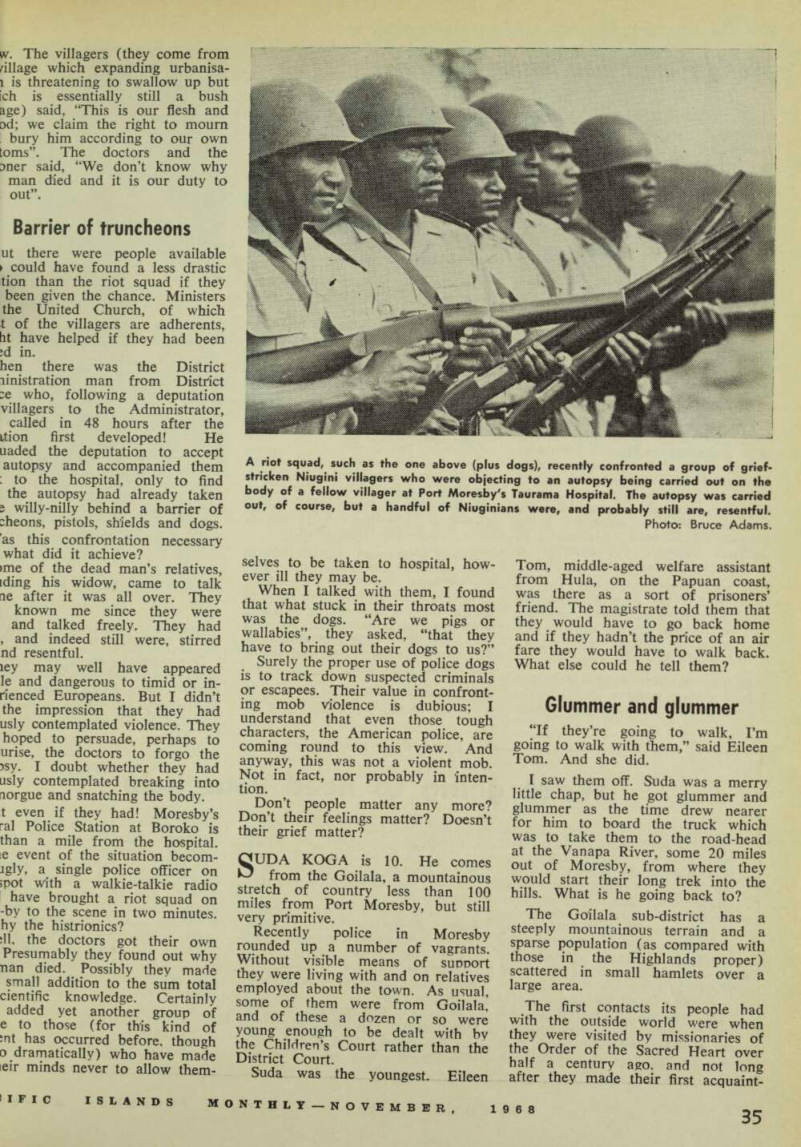
A riot squad, such as the one above (plus dogs), recently confronted a group of grief stricken Niugini villagers who were objecting to an autopsy being carried out on the body of a fellow villager at Port Moresby's Taurama Hospital. The autopsy was carried out, of course, but a handful of Niuginians were, and probably still are, resentful.
Photo: Bruce Adams.
World's most hair-raising airstrip
ance with government officers.
They did not receive either with enthusiasm, and they have not been given much cause to become enthusiastic since. Goilala became and has remained Papua’s Cinderella.
Goilala has no road link with the coast, and of its two airstrips one, Tapini, is probably one of the world’s most hair-raising strips—a sloping shelf on the edge of a gorge, on which planes land uphill, and from which they take off again by rushing off the end of the strip and becom ing air-borne over the gorge.
English potatoes and other cool climate vegetables grow well on these mountains, but transporting them to Port Moresby and marketing them at a competitive price is the problem.
Papuan Air Transport’s new “Skyvan” planes, when they arrive, may make the problem a bit easier to solve, but the only real solution is a road link to meet the Brown River road, which now reaches from Moresby past the Brown to the Vanapa River, currently being bridged. This road is planned to continue through flat country to Bereina, in the fertile Mekeo plain.
A road from the Goilala moun tains to link up with it would be quite a project, and the experts say that as compared with similar pro jects in other parts of the territory it isn’t worth it.
In the meantime there is only one Administration primary school in the whole of the Goilala (population
30,000). There are a number of mission primary schools, but, accord ing to Louis Mona, Goilala’s MHA, only one of them covers the full primary curriculum. So of course there is no high school in Goilala, and so far appeals for a vocational school have fallen on deaf ears. Even these schools, apparently, only cater for a primary-top intake, so for Goilala they are out.
Goilala men, harried by their local government councils to pay tax, flock into Moresby to take jobs as un skilled labourers, and quite often get involved in crime; while small boys head for town in the forlorn hope of being able to wriggle their way into an urban school and so get their feet on to an educational ladder which will go somewhere and not turn out to be a variant of the Indian rope trick.
No wonder young Suda Koga looked glum as he headed for home.
What’s in it for him? Frustration and boredom in his village? A job on one of Moresby’s garbage trucks?
Or a cell in Boumana Gaol?
A few weeks ago a small boy in New Guinea, just about the same age as Suda, was bitten by a death adder. A radio and aviation network swung into action in an attempt, unfortunately unsuccessful, to save the lad’s life. The economics of the exercise were not considered.
And quite right too.
But does a 10-year-old have to be bitten by a death adder before he
is treated as a human being i not as a potential unit of manpow Don’t people matter if they ] in an area of low economic potent; Doesn’t Suda Koga matter? Eil Tom thinks he does.
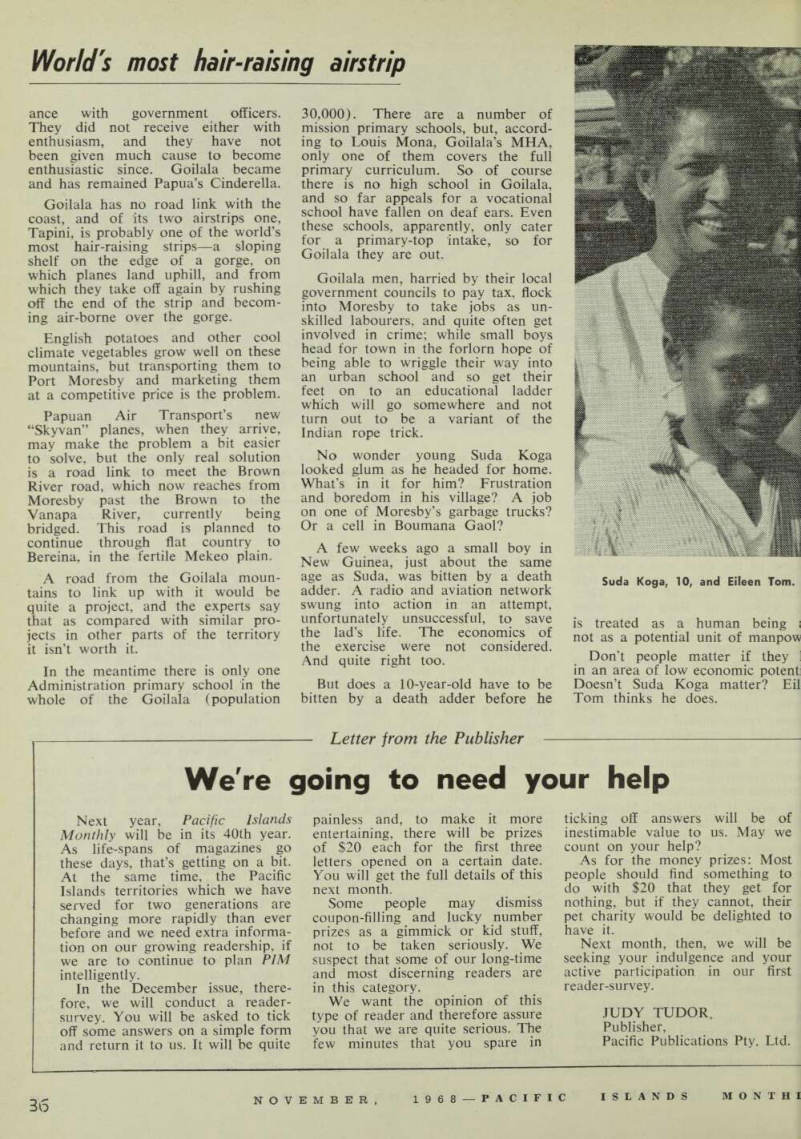
Suda Koga, 10, and Eileen Tom.