Beekeeping prospects
pp. 149-155 · Read in the full issue
in the Islands
By R. S. WALSH, Apicultural Advisory Officer, NZ Department of Agriculture.
Honey bees arrived in the Pacific many years ago. In all the Islands I have visited, with the exception of Niue, the German strain of black bee is firmly established. However, in countries where beekeeping is carried out on a large scale, a programme to eradicate the German bee, and replace it with the Italian or some other strain, has been vigorously undertaken.
These strains are considered to be quieter and generally more prolific. Nonetheless, I have found the pure German bees in the Islands are good workers and not unduly difficult to handle.
By using the local (i.e., German) bees and housing them in hives made from local timbers, a comparatively inexpensive industry could be started in most Islands. But there are problems, and the biggest is a lack of knowledge of beekeeping. Another problem is that many Islanders have little or no English. For a European to teach beekeeping to these people, it would be necessary to train one or two English speaking natives from the various groups and then leave it to them to teach others who are interested.
Good quality honey is at present in demand overseas—and in the Islands—and beeswax was recently fetching the highest price ever.
Although the honey market
fluctuates, it is unlikely that a serious glut in honey could occur, because crop failures, or near failures, hit some part of the honey producing world almost annually.
Boost incomes
Although I consider beekeeping in a small way by individuals or groups supplying a central packing plant would help boost incomes, it does appear that large commercial opera tors will soon start beekeeping in the Islands. Niue Island is already in this category (see story p. 143), although the Islanders themselves have some interest in the venture.
A New Zealander proposes to establish 300 hives in Fiji, and in Tonga the nucleus of what could
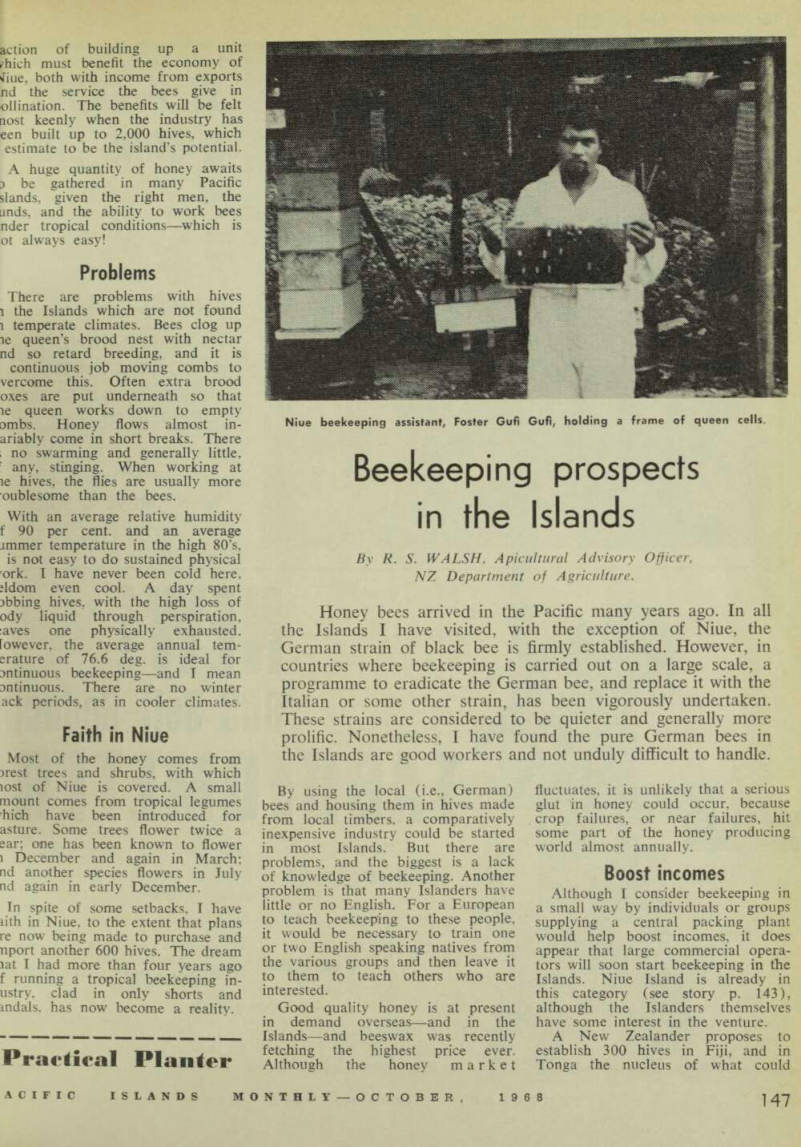
Niue beekeeping assistant, Foster Gufi Gufi, holding a frame of queen cells.
;come a large commercial concern is been formed.
Most of the Islands-produced )ney I have sampled is of good lality. There is some that is rather irk, such as the honey from the iconut palm, but generally speaking ivours are good, with colours »vering a fairly wide range between hite and dark brown. If the flavour good, light honeys will always ing a better price than dark meys. but there will always be a •od sale—at a good price—for dark mey to health conscious people, id this trade is increasing.
I have studied the results of itanical surveys covering various oups of islands, and, from a know dge of honey sources gained in iue and elsewhere. I have been able trace honey plants, common to ost Islands, that produce good lality honey.
Excess water
The humidity in some islands is :ely to increase the water content honey to a point where its keeping lalities would be endangered and market value seriously jeopardised, lis can occur, even when every ecaution for its prevention is taken.
Equipment is available for the re oval of excess water from honey).
NIUE ISLAND: The first indica ms that Niue could produce a fine lality honey came a few years ago icn Mr. Percy Walsh (no relation).
Ministry of Works employee and lateur beekeeper, sent samples of s Niue honey to New Zealand for praisal.
Subsequently at the request of the iue Island Administration I was ked to visit the island and assess e possibilities of commercial honey oduction there. I found the island be a beekeepers’ paradise. There is an almost continuous honey flow lich kept the bees contented and, cause of this, beekeepers could ndle the hives without protective Mhing. (The bees on Niue were e gentle Italian strain, obtained a w years previously from an Auck id beekeeper).
In most beekeeping countries, 'arming is one of the beekeepers’ igbears but on Niue it appeared be a rarity.
There are disadvantages as well as vantages to these Utopian con tions. Honey comes in so fast that e bees fill the comb cells in which e queen should be laying her eggs
r the production of worker bees, tie result is a much smaller work g force than one would like to see.
Nevertheless, each hive was pro icing about 200 lb of honey per ;ar.
Beekeepers have to make pro sion to replace queen bees at regu r intervals and also breed them for e purpose of increasing the number hives. This I found difficult on iue. It may have been the time of e year, but should queen breeding i a large scale be possible, it >ens up tremendous possibilities for e island’s beekeeping, particularly hen the airstrip is completed. It Duld mean the raising of thousands queen bees for sale overseas at a ne when breeding in other •untries is very difficult.
No diseases
There are no bee diseases in Niue, irds and rodents do not disturb e hives, and there are no wasps, ch as the vespula Germanica •ec'ies, to plague the hives as in ew Zealand.
FIJI: The islands of Fiji should ove excellent country for bee ;eping. There are numbers of fine )ney producing plants similar to ose in Niue—and many as yet un sted. Some areas will undoubtedly 5 better for honey production than hers and these will be found as fiaries are spread out over the lands.
Beekeeping on a medium scale as carried out in the dry south istern part of Viti Levu for many ;ars, and the honey examined New Zealand was found to be good quality though rather thin )died.
Earlier this year a New Zealand ;ekeeper loaded 300 hives on a ship nmd for the coconut plantations on anua Levu. However, the bees died i route, and shipments from Aus alia are now being made to replace em.
Whether the serious brood disease lown as BL exists in the colony is icertain.
TONGA: The islands of Tonga ive great possibilities for honey •eduction. The similarity of the jgetation of Vavau to that in Niue quite striking. Wild hives estab ?hed in trees and buildings were •und to have ample supplies of mey in a variety of colours and avours, and the bees showed no gn of disease.
Eua is a well-forested island that
ives promise of supporting many flonies of bees. One particularly ne honey tree that is found in Niue r as noticed in abundance.
Good progress
The main island of Tongatapu oes not have as much forest area s other islands in the group but does ossess a wide variety of honey roducing plants. A number of hives ere sent to Tongatapu earlier this ear and were found to be making aod progress. However, since it as winter and relatively cool, there as not the spectacular flow of oney experienced in Niue—little lore than was necessary to support le colonies was being gathered by le bees. The honey was light in flour and a number of flavours ere detected, all of them extremely leasant. The Tongatapu hives were lipped to the island on the deck of le Mania and were watered as re wired. The success of this shipment f bees has shown that hives can be iccessfully sent to the Islands as sck cargo during the winter months.
WESTERN SAMOA: Earlier this ;ar, Western Samoa planned to nport 300 hives from NZ, with the Itimate aim of setting up 200 flonies. The staff of Alafua Agri iltural College—where one hive is ;pt—are interested in bees, and at ne time beekeeping was taught icre. A boy who had assisted me hen I was at Niue, had been trained Alafua College.
The New Zealand High Com lission in Western Samoa has shown terest in the suggestion that bee >eping could be the means of earn g overseas funds, and has inquired lout the possibilities of finding some jrson qualified to teach beekeeping.
Much of the flora and timber mnd in Western Samoa is similar i that on Niue. The climate, apart om the high humidity, is ideal for iney production, and, apparently, 3 serious bee diseases exist.
Bees are not useful only as honey oducers; they are useful also as 3llinating agents. In most honey oducing countries, beekeepers are lid to locate their colonies in the cinity of crops for which pollina -3n is essential. The coconut palm ill produce more nuts if ample 3llinating agents are available. i Planters—for information on
workboats, please turn to
p. 155.