The Practical Planter
pp. 145-149 · Read in the full issue
The (Beekeeping)
Dream That
Became
A Reality
"A huge quantity of honey awaits to be gathered in many Pacific Islands, given the right men, the funds and the ability to work bees under tropical conditions—which is not always easy!" So writes J. B. MACKISACK who in this story describes how he set up a beekeeping business on Niue.
About four years ago in New Zealand 1 read an article about a part-time beekeeper on a Pacific Island who worked sees in shorts, in almost perpetual summer, and received few if any bee stings. Since I was down in the dumps (it was cold and vet and my bees were stinging), I thought what a great sort of ife this would be. But at that time it was just a happy thought, lothing more.
rhe following autumn I happened mention the article to a staff mber of the NZ Honey Marketing thority in Auckland. He told me t the authority was receiving small aments of honey from a few hives t on a place called Niue.
V year later the subject came up in during a conversation that I I with Mr. Colin Rope, Govern nt Honey Grader at the Honey rketing Depot. He gave me a iple of Niue honey and worked the amount of Niue honey sent Auckland over past years. Those ires renewed my interest in bee ping on Niue.
Ihortly after my conversation with . Rope, I heard that Mr. R. S.
Ish, Apicultural Advisory Officer the Department of Agriculture, I been asked to go to Niue to
make a survey of the possibilities of commercial beekeeping following re ports received from Mr. Colin Goose, manager of the NZ Honey Marketing Authority.
I rang Mr. Walsh and told him of my interest in beekeeping in the Islands. I asked him to let me have a report on Niue’s beekeeping possibilities on his return from the island.
Trial run
While Mr. Walsh was away, I asked the Department of Island Territories’ Auckland Office for all available information on Niue. Soon afterwards I met Mr. A. J. Neil, Economic Development Officer for Niue, who had just returned from the island, and who was later to become a great help in making the
necessary business arrangements.
On the return of Mr. Walsh, from whom I received a detailed and favourable report, I wrote to the Resident Commissioner of Niue, Mr.
L. A. Shanks, putting up a tentative proposal for a beekeeping business.
Things now began to move rapidly, and it was agreed that we should undertake a trial run with 55 hives of bees. The purpose of this was to test how the hives would travel in the ship’s cooler, how they would stand being unloaded in lighters at Niue, and whether they would establish themselves after their journey. He also discussed what form the business would take and how much assistance we would need from the Administration of Niue.
The result of these discussions was the formation of the Niue Island Honey Co. Ltd., in which the Niue Development Board became a share holder. The purpose of the company was to purchase 650 hives of bees and ship them from New Zealand to Niue, together with a light truck
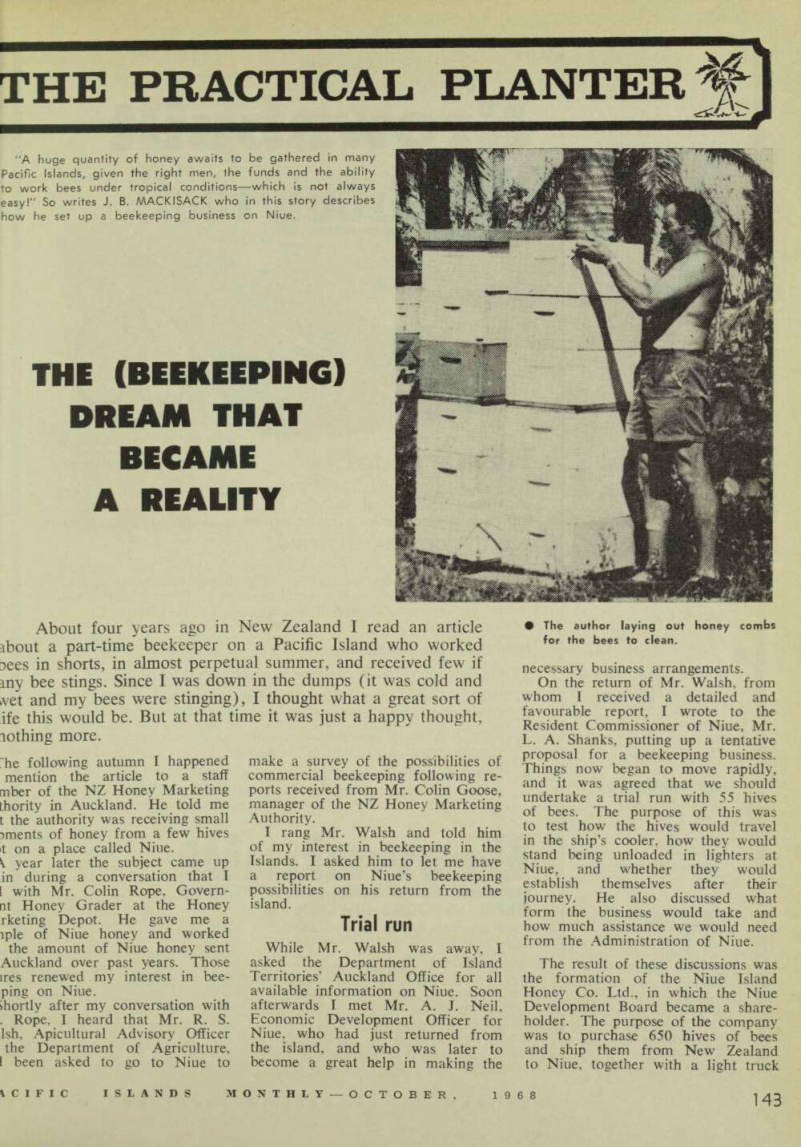
The author laying out honey combs for the bees to clean.
id trailer, and all the necessary ant and equipment to set up a >ney processing factory on the and.
Work on the factory began soon ter the formation of the company.
The trial run with 55 hives took ace in March, 1967. Strong hives ere selected, which were loaded to the cooler space in the Union ompany’s vessel Tofua, and kept at temperature of approximately 55 :g. in the dark.
Anxiety
The bees were watered daily rough screens in the top of each ve. By the time the ship had ;en at sea for seven days many ;es were impatient to get out, and e bees rushed to the screens as soon i any light was shown. During this •st voyage there was considerable ixiety. If the crew and passengers : the Tofua had been terrorised by yarms of bees on this trip, there ould have been little hope of future ips on the same ship.
On arrival at Niue the unloading ent smoothly enough, although »me of the Niuean cargo workers ere not very happy when they iw a few bees escaping. The sudden se of temperature from 55 deg. in ic hold to approximately 85 deg. itside gave us some anxiety. The 'ves were loaded into containers in ie hold for their trip ashore in In spite of being “lightered” hore, loaded onto trucks, and ansported two miles to an unload g area, no hives were lost—as "tits. However, some hives lost lany bees by being partly smothered ith the high temperature during the me taken to complete their unload ig and release.
It was estimated that approxi mately one-third of the hives lost alf strength of bees, the balance aving fewer losses. As a result of lis trial shipment, 300 hives were ansported in the following July id another 300 in August without ie loss of a single hive.
For the main shipments, the hives ere trucked to a central checking id packing area in the Waikato, len trucked 90 miles to Auckland. >aded into the ship’s cooler and arried more than 2,000 miles over ie normal route of the Tofua, irough Suva, Pago Pago and Apia ) the port of Alofi, Niue. After nloading. less than one per cent, of ie queen bees were found to be
lost—no more than is often lost in a major trucking operation in New Zealand.
I will say that I lost a lot of weight after each unloading. The worry and anxiety took more out of me than the actual physical work and the heat, both of which were considerable.
Relief
A huge sigh of relief went up when the first 300 hives were set out in one big field as a staging area.
The hives were checked for release, the screens were removed and the lids put on. The screens were then packed and sent back on the same ship for use with the next lot of hives. It was a big day.
The next big job—in settling those first 300 hives—was to clear 300-odd apiary sites in the bush, and fit up a workshop and extracting plant in the new factory building. My son Murray, who had come to assist at this stage, and our worthy Niuean assistant, Foster Ikimau, had plenty to do, as extra hive equipment had to be made up in addition to all the other work.
The weather during the first two months or so was not favourable to the build-up of hive strength, and the hives didn’t reach full working strength until November. They were at their best shortly before Christmas.
Honey was taken and extracted from August onwards in increasing amounts, until a peak in January which held until a most unwelcome hurricane in February cut off pro duction completely.
During this period we extracted and shipped to New Zealand approxi mately 40 tons of honey. Although production for the period was not as high as had been hoped for, we feel sure that we would have reached
10 tons per 100 hives if it had not been for the hurricane. Until that wretched hurricane things were booming.
A preliminary warning of the hurricane came during Thursday, February 8, 1968. After the “final” warning, early the following morn ing, hives that were not already “strapped” had to be attended to by several very frantic and anxious men with a strapping machine. The work went on during the Friday right until the wind became too strong, and conditions became too dangerous.
It was a very unpleasant ex perience. The winds reached 100 miles per hour, first from one direc tion and then from the opposite direction, and almost all the trees and shrubs were stripped bare of leaves.
Narrow escapes
No hives were lost, although many had narrow escapes from falling trees and branches. Some hives could scarcely be seen for the debris and rubbish strewn over them, but they were all right underneath, although the bees were very bad-tempered.
Seldom in 30 years of beekeeping have I seen bees so cross as during and immediately after the hurricane.
And that, briefly, is how the bee keeping industry started on Niue.
We came, of course, to produce honey. We also came to help the island’s economy, and to train Niueans to take over the business eventually. The shares held by the Niue Development Board, and probably my own shares, will be available to any Niueans who can prove themselves capable and willing to carry on this work.
For myself there has been the challenge of setting up a new in dustry from scratch, and the satis
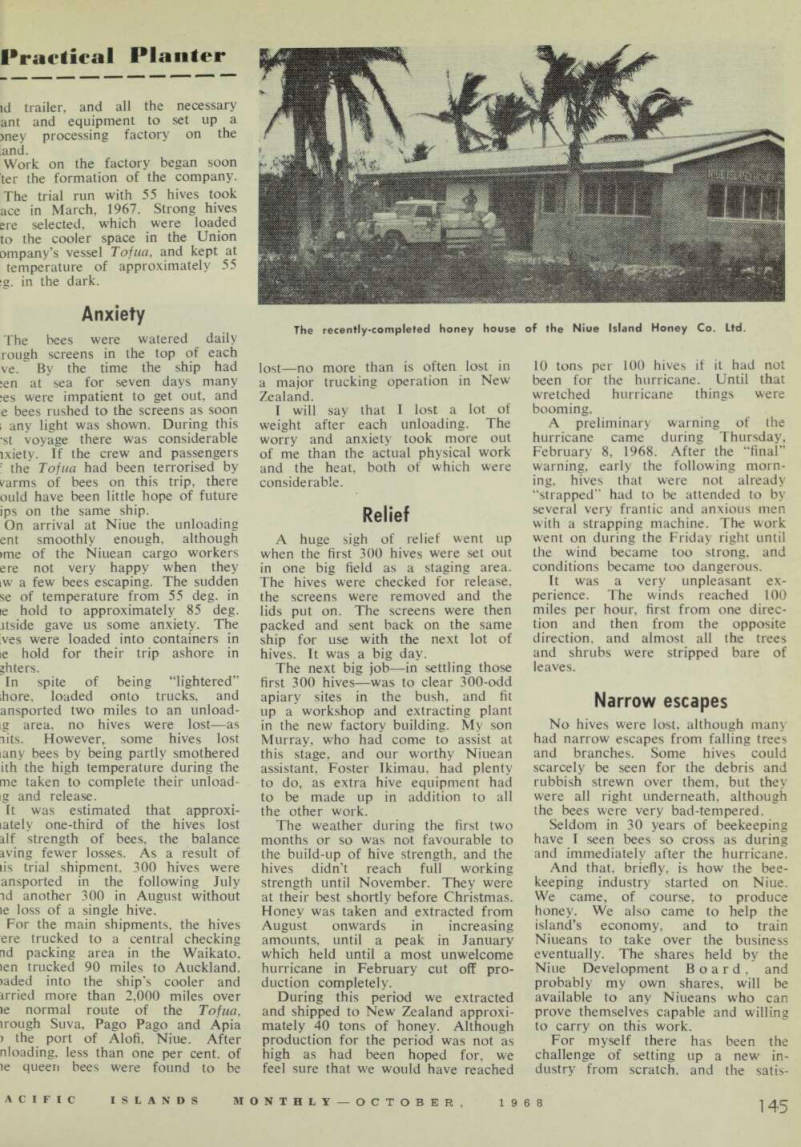
The recently-completed honey house of the Niue Island Honey Co. Ltd
action of building up a unit /hich must benefit the economy of fiue, both with income from exports nd the service the bees give in ollination. The benefits will be felt nost keenly when the industry has een built up to 2,000 hives, which estimate to be the island’s potential.
A huge quantity of honey awaits 3 be gathered in many Pacific slands, given the right men, the ands, and the ability to work bees nder tropical conditions—which is ot always easy!
Problems
There are problems with hives i the Islands which are not found i temperate climates. Bees clog up le queen’s brood nest with nectar nd so retard breeding, and it is continuous job moving combs to vercome this. Often extra brood oxes are put underneath so that le queen works down to empty □mbs. Honey flows almost in ariably come in short breaks. There . no swarming and generally little, ' any, stinging. When working at le hives, the flies are usually more oublesome than the bees.
With an average relative humidity f 90 per cent, and an average immer temperature in the high 80’s, is not easy to do sustained physical ork. I have never been cold here, fldom even cool. A day spent ebbing hives, with the high loss of ody liquid through perspiration, ;aves one physically exhausted, [owever, the average annual tem erature of 76.6 deg. is ideal for zmtinuous beekeeping—and I mean □ntinuous. There are no winter ack periods, as in cooler climates.
Faith in Niue
Most of the honey comes from )rest trees and shrubs, with which lost of Niue is covered. A small mount comes from tropical legumes hich have been introduced for asture. Some trees flower twice a ear; one has been known to flower i December and again in March; nd another species flowers in July nd again in early December.
In spite of some setbacks, I have nth in Niue, to the extent that plans re now being made to purchase and nport another 600 hives. The dream rat I had more than four years ago f running a tropical beekeeping in ustry, clad in only shorts and mdals, has now become a reality.