Of Fiji
pp. 41-43 · Read in the full issue
Awesome,
Incredible
Firewalkers
Of Fiji
From SUE WENDT, in Suva
The drums begin several days before the actual ceremony, beating out an insistent, hypnotic pre lude to one of the most mysterious religious rites in Fiji. It is the annual self-purification and fire walking ceremony of the devotees of Maha Devi, the Divine Mother, an awesome practice still followed wherever Southern Indians of the Hindu religion have settled in Fiji.
Phis year’s ceremony, watched by Governor and his family as well hundreds of Maha Devi followers, ious Fijians and incredulous Euro m tourists, was held in September the grounds of the Suva Sangam ?h School. It was the culmination 10 days of total abstinence, rship and meditation for two -en or so devotees selected to Ik on fire in the name of the ►ther. ncompatible though it may seem h palm trees and other mani tations of the South Seas, Indian walking remains an integral part the life in the colony, signifying tenacity with which the Indian ►pie have clung to their traditions I culture. n keeping with the times, it has ome a tourist showpiece. But for se who undergo the ordeal of , whipping and self-inflicted
piercing with skewers and needles, it is a spiritually-elevating form of penance.
At 2 p.m. on a hot, hazy Sunday the participants, some of them quite small boys, walked several miles from the Maha Devi Temple at Samabula to the black sand flats at Laucala Bay, separated from spectators by a circle of rope and accompanied by the indefatigable drumming.
They wore garlands of marigolds and yellow robes, representing the robes of the Mother (as well as the Maha Devi, she is known as the Goddess Kaali or Maari) and their faces were smeared with Vermillion dye and yellow tumeric powder, con sidered by sect members to be a
symbol of prosperity and of power to destroy disease.
They carried tridents, the three prongs of which are said to destroy the three demons of lust, greed and anger, and they were followed by the heavy, cloying fumes of incense. To the unbelievers—the onlookers—it was a strangely eerie spectacle.
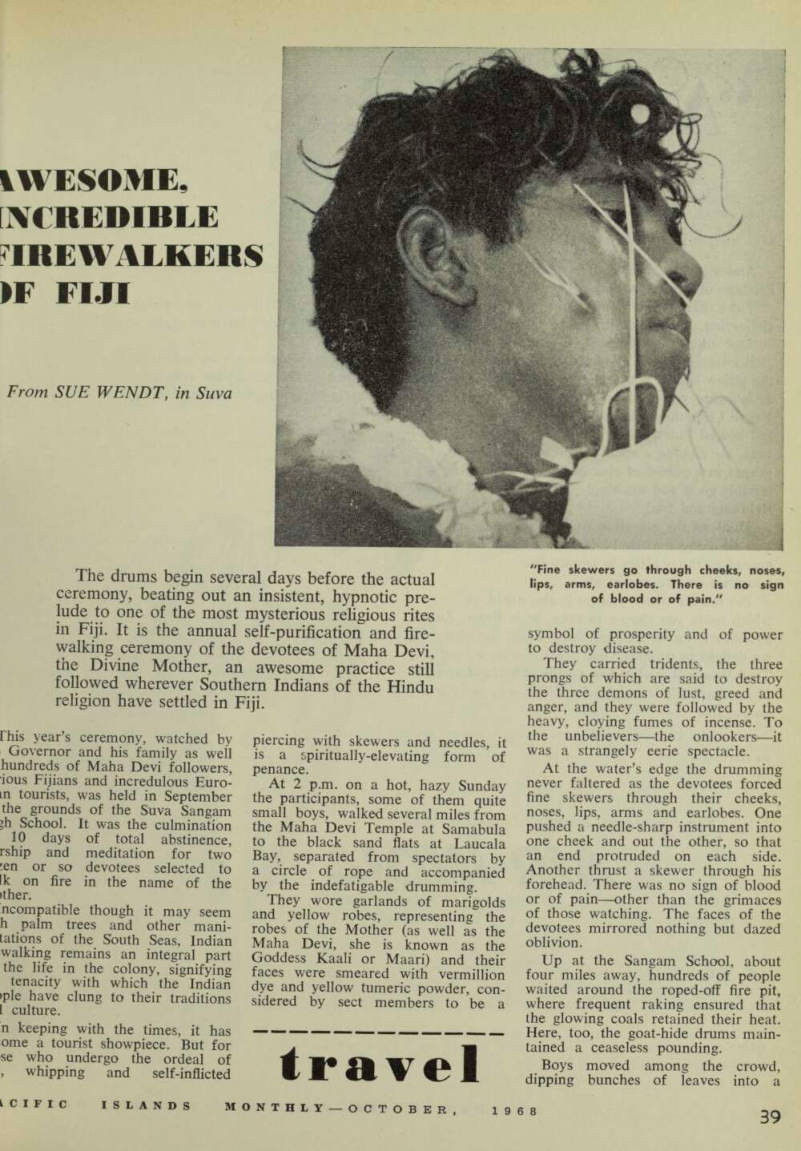
At the water’s edge the drumming never faltered as the devotees forced fine skewers through their cheeks, noses, lips, arms and earlobes. One pushed a needle-sharp instrument into one cheek and out the other, so that an end protruded on each side.
Another thrust a skewer through his forehead. There was no sign of blood or of pain—other than the grimaces of those watching. The faces of the devotees mirrored nothing but dazed oblivion.
Up at the Sangam School, about four miles away, hundreds of people waited around the roped-off fire pit, where frequent raking ensured that the glowing coals retained their heat.
Here, too, the goat-hide drums main tained a ceaseless pounding.
Boys moved among the crowd, dipping bunches of leaves into a
"Fine skewers go through cheeks, noses, lips, arms, earlobes. There is no sign of blood or of pain."
cet of yellow-coloured liquid and hing it into the air. The same done around the edge of the fire until the ground was quite damp. still the drums continued, arely can so many colours have i seen together. The Indian com ity has a propensity for bright ling and the scene at the fire dng—with Maha Devi followers ivid yellow, the priest in scarlet, women and girls in shimmeringly escent lime greens, luminous pinks purples—was one of unrivalled iance.
Tension high
msion was high by the time devotees, having completed the ication rites at the water’s edge walked the four miles to Sama , danced and leapt with ecstatic into the fire-pit area, jsponding to the increased tempo le drums, they cavorted silently re a much-decorated image of joddess. The eyes of some rolled ly. Others, their faces like pin ions, were without expression, nlike Fijian firewalking—inspired ;gend rather than religious belief lndian performance is fairly hy, with the devotees leaping i and again across the white-hot
coals. During the ceremony I wit nessed, one man apparently felt the heat. He staggered drunkenly and missed a turn. He was whipped with a length of rope—but seemed to feel no pain.
A girl, perhaps 12 or 13, was led to the edge of the pit, a stunned,
bewildered expression on her face.
The drums quickened, but she backed away from the heat and prostrated herself before the Goddess instead.
Overhead a lone paper kite flew and outside an ice-cream van was doing good business.
Finally the roped-off area was filled with Maha Devi worshipers, the fire walkers still energetically cavorting, the others following the praying to the Divine Mother. Several times around the ring they went. And still the drumming.
Then they were gone and a loud speaker announced the end of the ceremony. The silence was almost uncomfortable as people moved off to avoid the mundane reality of traffic congestion.
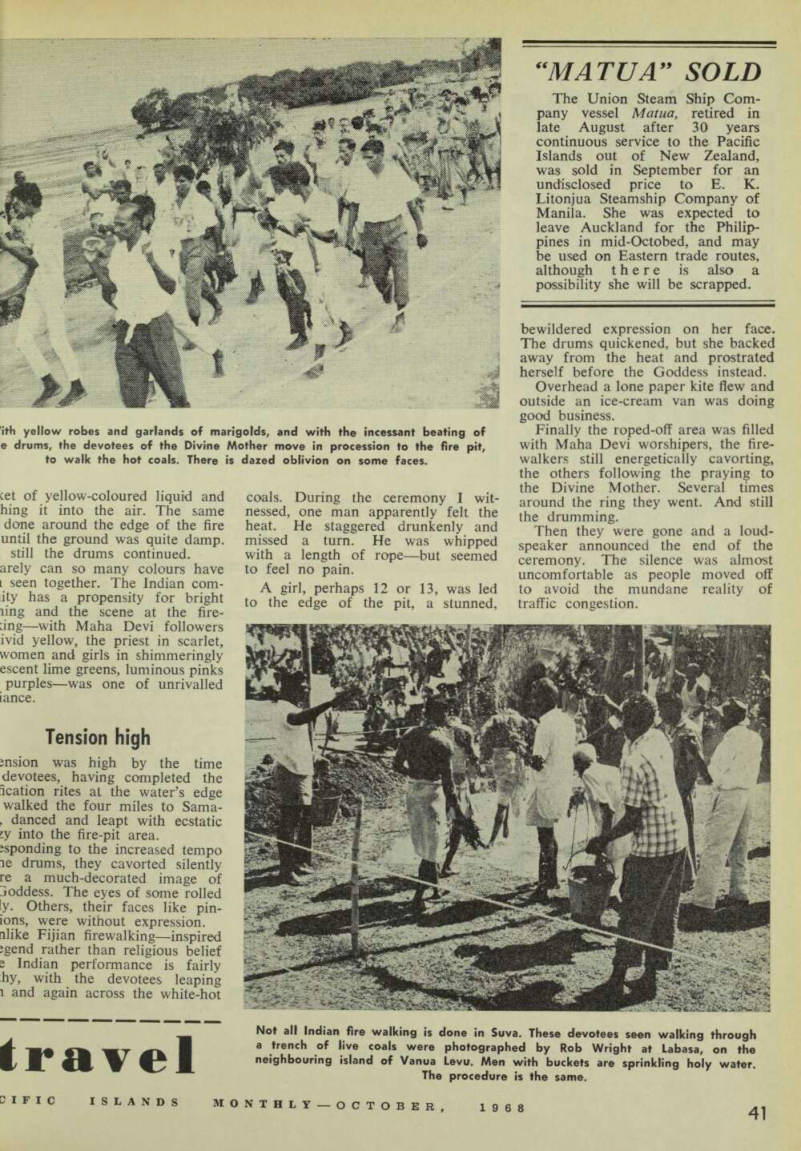
[?]ith yellow robes and garlands of marigolds, and with the incessant beating of [?]e drums, the devotees of the Divine Mother move in procession to the fire pit, to walk the hot coals. There is dazed oblivion on some faces.
Not all Indian fire walking is done in Suva. These devotees seen walking through a trench of live coals were photographed by Rob Wright at Labasa, on the neighbouring island of Vanua Levu. Men with buckets are sprinkling holy water.
The procedure is the same.