Samoan privy is (somewhat
pp. 34-35 · Read in the full issue
hesitantly) on the way out
From GLEN WRIGHT, in Apia The ugly, incongruous lagoon privy that has marred the tropically picturesque shoreline of Western Samoa for so long may soon be a thing of the past. Its replacement is the water sealed toilet, a simple and cheap device being energetically in troduced by the Peace Corps.
Some 400 of these toilets have been installed in the past few months, accompanied by a noticeable reduction in the number of beach outhouses. Acceptance increases as the price reduces. Cost per unit is now down to SWSI.4O.
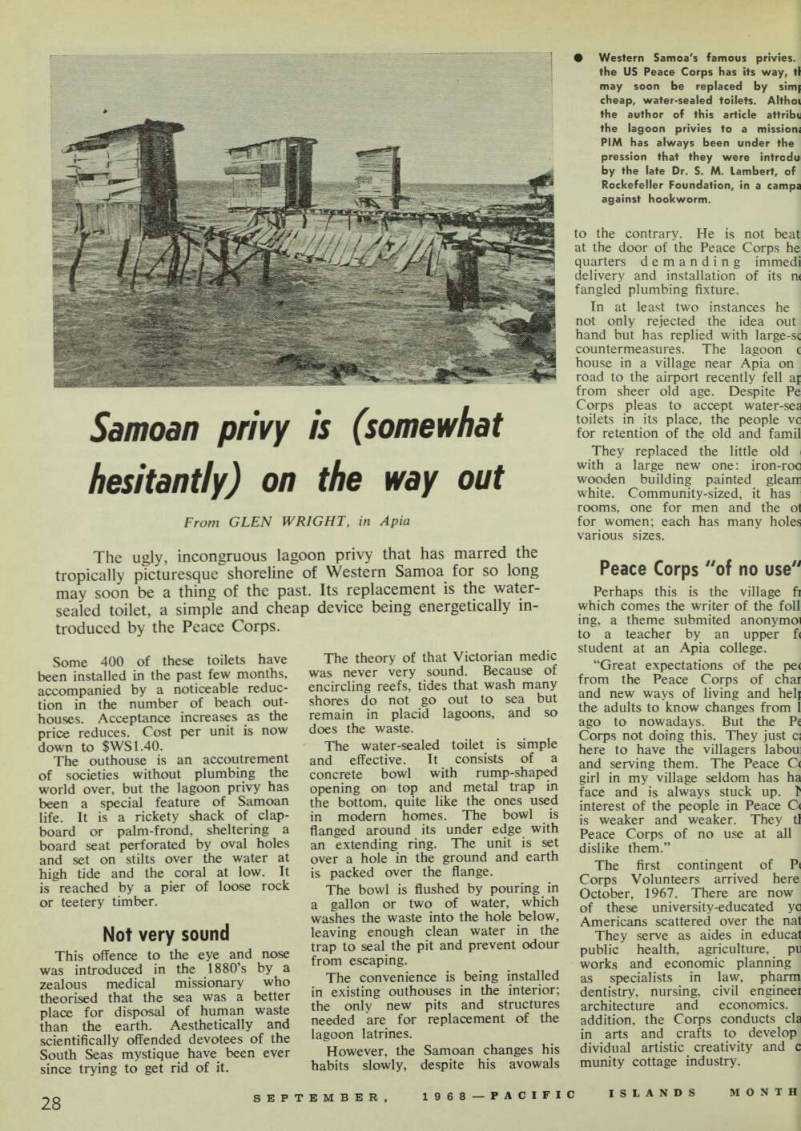
The outhouse is an accoutrement of societies without plumbing the world over, but the lagoon privy has been a special feature of Samoan life. It is a rickety shack of clapboard or palm-frond, sheltering a board seat perforated by oval holes and set on stilts over the water at high tide and the coral at low. It is reached by a pier of loose rock or teetery timber.
Not Very sound
™. T
sursj" xiSS,
theorised that the sea was a better place for disposal of human waste than the earth. Aesthetically and scientifically offended devotees of the South Seas mystique have been ever since trying to get rid of it.
The theory of that Victorian medic was never very sound. Because of encircling reefs, tides that wash many shores do not go out to sea but remain in placid lagoons, and so does the waste.
The water-sealed toilet is simple and effective. It consists of a concrete bowl with rump-shaped opening on top and metal trap in the bottom, quite like the ones used in modem homes. The bowl is flanged around its under edge with an extending ring. The unit is set over a hole in the ground and earth is packed over the flange, -phe bowl is flushed by pouring in a gallon or two of water, which washes the waste into the hole below, leaving enough clean water in the
sr-stt
, Th, j Mjg g
m existing outhouses m the interior, the only new P lts 3X1(1 structures needed are for replacement of the lagoon latrines.
However, the Samoan changes his habits slowly, despite his avowals
to the contrary. He is not beat at the door of the Peace Corps he quarters demanding immedi delivery and installation of its n< fangled plumbing fixture.
In at least two instances he not only rejected the idea out hand but has replied with large-sc countermeasures. The lagoon c house in a village near Apia on road to the airport recently fell ap from sheer old age. Despite Pe Corps pleas to accept water-sea toilets in its place, the people vc for retention of the old and famil They replaced the little old with a large new one; iron-roc wooden building painted glean: white. Community-sized, it has rooms, one for men and the ol for women; each has many holes various sizes.
Peace Corps "of no use"
Perhaps this is the village fi which comes the writer of the foil ing, a theme submited anonymoi to a teacher by an upper fi student at an Apia college.
“Great expectations of the pe< from the Peace Corps of chai and new ways of living and hell the adults to know changes from 1 ago to nowadays. But the P« Corps not doing this. They just c< here to have the villagers labou: and serving them. The Peace C< girl in my village seldom has ha face and is always stuck up. T* interest of the people in Peace Q is weaker and weaker. They tl Peace Corps of no use at all dislike them.”
The first contingent of P< Corps Volunteers arrived here October, 1967. There are now of these university-educated yc Americans scattered over the nat They serve as aides in educal public health, agriculture, pr works and economic planning as specialists in law, pharm dentistry, nursing, civil engineei architecture and economics, addition, the Corps conducts cla in arts and crafts to develop dividual artistic creativity and c munity cottage industry.
• Western Samoa's famous privies, the US Peace Corps has its way, tl[?] may soon be replaced by simf[?] cheap, water-sealed toilets. Althou[?] the author of this article attribute the lagoon privies to a mission!
PIM has always been under the pression that they were introdu[?] by the late Dr. S. M. Lambert, of Rockefeller Foundation, in a campa[?] against hookworm.
“We are helping a newly indepen nt nation become self-sufficient,” ys young, personable, Corps direc r David Ziegenhagen.
In so doing, he says, the volunteers idergo the unique experience of coming assimilated into the moan communal social system, ley literally become members of family units which make up each lage and district. They work on 5 farms, help fill the family larder, ntribute to the common purse, and ide by the rules as established by j Matais, or chiefs.
They have 24-hour-a-day jobs and 2 dominated by the strong-willed moans, who are very selective in cepting what the volunteers offer.
Go native
As a result the volunteers tend “go native” at first. But, says jgenhagen, they recover soon and gin to express their individualities.
However, Samoans do not take idly to undertaking assignments for yone except their chiefs. Inevit ly friction develops because the ace Corpsmen are trying to teach ;m to do things.
Consequently, as in the student’s ade, the Corps is often criticised the Samoans, who either do not derstand that what they complain out stems from their overlording the volunteers, or don’t, upon ex igence, like the changes they have ced for.
Nonetheless, director Ziegen gen says that the longer the Corps 5 here, the less criticism it re ves. By and large, the govern mt is enthusiastic about the pro imme.