Thorough The
p. 33 · Read in the full issue
Apartheid
Spanners Out
From Leo Morgan,
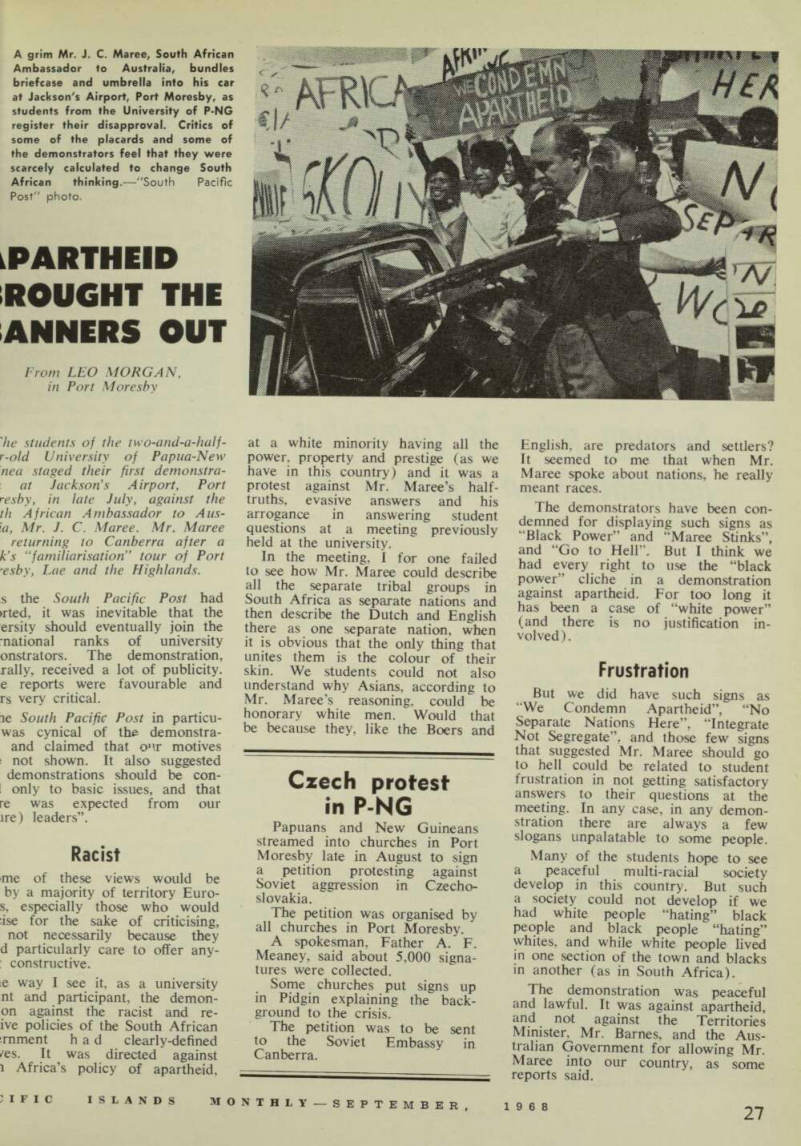
in Port Moresby 'he students of the two-and-a-half r-old University of Papua-New hea staged their first demonstra at Jackson’s Airport, Port resby, in late July , against the th African Ambassador to Aus la, Mr. J. C. Maree. Mr. Maree returning to Canberra after a k’s “familiarisation” tour of Port *esby, Lae and the Highlands. s the South Pacific Post had ►rted, it was inevitable that the ersity should eventually join the •national ranks of university onstrators. The demonstration, rally, received a lot of publicity, e reports were favourable and rs very critical. le South Pacific Post in particu was cynical of the demonstra and claimed that our motives : not shown. It also suggested demonstrations should be con -1 only to basic issues, and that re was expected from our ire) leaders”.
Racist
me of these views would be by a majority of territory Euro s, especially those who would -ise for the sake of criticising, not necessarily because they d particularly care to offer any : constructive. e way I see it, as a university nt and participant, the demon on against the racist and re ive policies of the South African :rnment had clearly-defined /es. It was directed against i Africa’s policy of apartheid,
at a white minority having all the power, property and prestige (as we have in this country) and it was a protest against Mr. Maree’s half truths, evasive answers and his arrogance in answering student questions at a meeting previously held at the university.
In the meeting, I for one failed to see how Mr. Maree could describe all the separate tribal groups in South Africa as separate nations and then describe the Dutch and English there as one separate nation, when it is obvious that the only thing that unites them is the colour of their skin. We students could not also understand why Asians, according to Mr. Maree’s reasoning, could be honorary white men. Would that be because they, like the Boers and
English, are predators and settlers?
It seemed to me that when Mr.
Maree spoke about nations, he really meant races.
The demonstrators have been con demned for displaying such signs as “Black Power” and “Maree Stinks”, and “Go to Hell”. But I think we had every right to use the “black power” cliche in a demonstration against apartheid. For too long it has been a case of “white power” (and there is no justification in volved).
Frustration
But we did have such signs as “We Condemn Apartheid”, “No Separate Nations Here”, “Integrate Not Segregate”, and those few signs that suggested Mr. Maree should go to hell could be related to student frustration in not getting satisfactory answers to their questions at the meeting. In any case, in any demon stration there are always a few slogans unpalatable to some people.
Many of the students hope to see a peaceful multi-racial society develop in this country. But such a society could not develop if we had white people “hating” black people and black people “hating” whites, and while white people lived in one section of the town and blacks in another (as in South Africa).
The demonstration was peaceful and lawful. It was against apartheid, and not against the Territories Minister, Mr. Barnes, and the Aus tralian Government for allowing Mr.
Maree into our country, as some reports said.
A grim Mr. J. C. Maree, South African Ambassador to Australia, bundles briefcase and umbrella into his car at Jackson's Airport, Port Moresby, as students from the University of P-NG register their disapproval. Critics of some of the placards and some of the demonstrators feel that they were scarcely calculated to change South African thinking.— " South Pacific Post" photo.