Commercial notes
pp. 121-122 · Read in the full issue
Bright future seen for Burns Philp
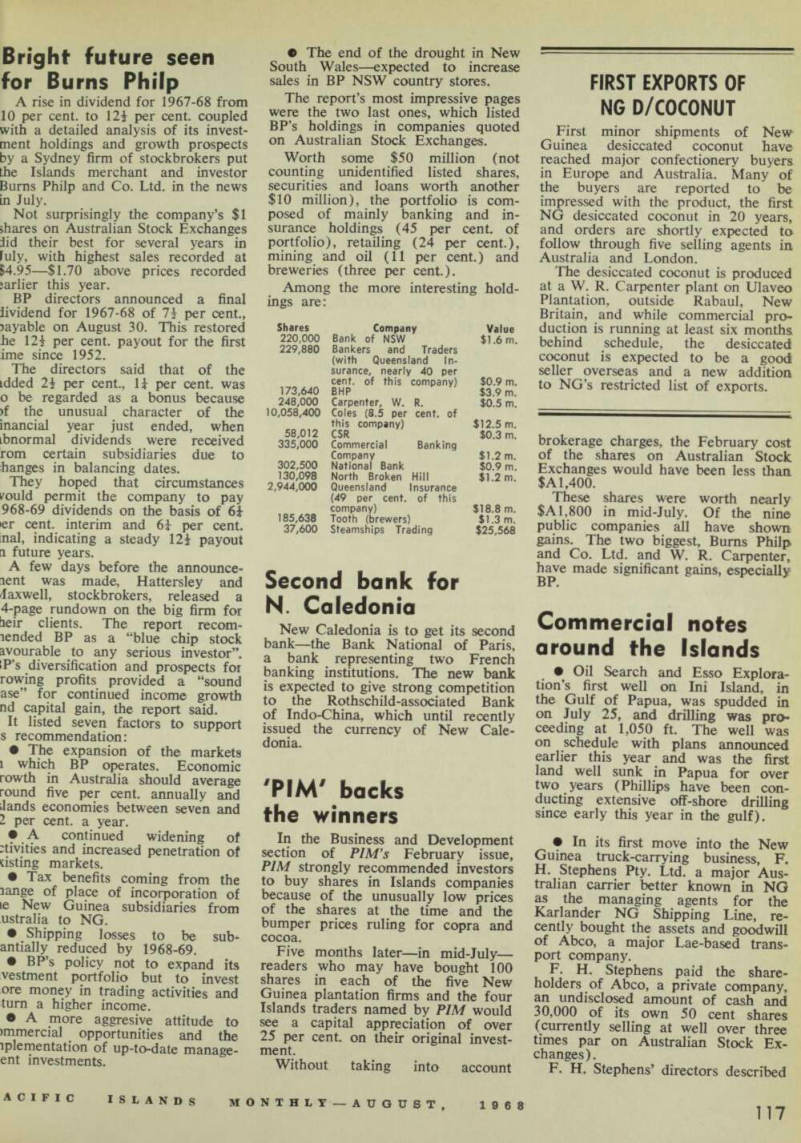
A rise in dividend for 1967-68 from 10 per cent, to 12J per cent, coupled with a detailed analysis of its invest ment holdings and growth prospects by a Sydney firm of stockbrokers put the Islands merchant and investor Burns Philp and Co. Ltd. in the news in July.
Not surprisingly the company’s $1 shares on Australian Stock Exchanges did their best for several years in luly, with highest sales recorded at 54.95—51.70 above prices recorded earlier this year.
BP directors announced a final lividend for 1967-68 of 7i per cent., sayable on August 30. This restored he 12i per cent, payout for the first ime since 1952.
The directors said that of the idded 2i per cent., li per cent, was 0 be regarded as a bonus because >f the unusual character of the inancial year just ended, when ibnormal dividends were received rom certain subsidiaries due to hanges in balancing dates.
They hoped that circumstances yould permit the company to pay 968-69 dividends on the basis of 6i •er cent, interim and 6i per cent, inal, indicating a steady 12i payout a future years.
A few days before the announce ment was made, Hattersley and iaxwell, stockbrokers, released a 4-page rundown on the big firm for ieir clients. The report recom mended BP as a “blue chip stock avourable to any serious investor”. •P’s diversification and prospects for rowing profits provided a “sound ase” for continued income growth nd capital gain, the report said.
It listed seven factors to support s recommendation: • The expansion of the markets 1 which BP operates. Economic rowth in Australia should average round five per cent, annually and •lands economies between seven and I per cent, a year. • A continued widening of :tivities and increased penetration of listing markets. • Tax benefits coming from the lange of place of incorporation of le New Guinea subsidiaries from ustralia to NG. • Shipping losses to be sub antially reduced by 1968-69. • BP’s policy not to expand its vestment portfolio but to invest ore money in trading activities and turn a higher income. • A more aggresive attitude to wnmercial opportunities and the iplementation of up-to-date manage ent investments.
® The end of the drought in New South Wales—expected to increase sales in BP NSW country stores.
The report’s most impressive pages were the two last ones, which listed BP’s holdings in companies quoted on Australian Stock Exchanges.
Worth some $5O million (not counting unidentified listed shares, securities and loans worth another $lO million), the portfolio is com posed of mainly banking and in surance holdings (45 per cent, of portfolio), retailing (24 per cent.), mining and oil (11 per cent.) and breweries (three per cent.).
Among the more interesting hold ings are:
Second bank for
N. Caledonia
New Caledonia is to get its second bank—the Bank National of Paris, a bank representing two French banking institutions. The new bank is expected to give strong competition to the Rothschild-associated Bank of Indo-China, which until recently issued the currency of New Cale donia.
'PIM' backs
the winners
In the Business and Development section of PlM’s February issue, PIM strongly recommended investors to buy shares in Islands companies because of the unusually low prices of the shares at the time and the bumper prices ruling for copra and cocoa.
Five months later—in mid-July— readers who may have bought 100 shares in each of the five New Guinea plantation firms and the four Islands traders named by PIM would see a capital appreciation of over 25 per cent, on their original invest ment.
Without taking into account
brokerage charges, the February cost of the shares on Australian Stock Exchanges would have been less than $ A 1,400.
These shares were worth nearly $ A 1,800 in mid-July. Of the nine public companies all have shown gains. The two biggest. Bums Philp and Co. Ltd. and W. R. Carpenter, have made significant gains, especially BP.
Commercial notes
around the Islands
• Oil Search and Esso Explora tion’s first well on Ini Island, in the Gulf of Papua, was spudded in on July 25, and drilling was pro ceeding at 1,050 ft. The well was on schedule with plans announced earlier this year and was the first land well sunk in Papua for over two years (Phillips have been con ducting extensive off-shore drilling since early this year in the gulf). • In its first move into the New Guinea truck-carrying business, F.
H. Stephens Pty. Ltd. a major Aus tralian carrier better known in NG as the managing agents for the Karlander NG Shipping Line, re cently bought the assets and goodwill of Abco, a major Lae-based trans port company.
F. H. Stephens paid the share holders of Abco, a private company, an undisclosed amount of cash and 30,000 of its own 50 cent shares (currently selling at well over three times par on Australian Stock Ex changes).
F. H. Stephens’ directors described
Shares Company Value 220,000 Bank of NSW $1.6 m. 229,880 Bankers and Traders (with Queensland Insurance, nearly 40 per 173,640 cent, of this company) $0.9 m.
Bhp
$3.9 m. 248,000 Carpenter, W. R. $0.5 m. 10,058,400 Coles (8.5 per cent, of this company) $12.5 m. 58,012
Csr
$0.3 m. 335,000 Commercial Banking Company $1.2 m. 302,500 National Bank $0.9 m. 130,098 North Broken Hill $1.2 m. 2,944,000 Queensland Insurance (49 per cent, of this 185,638 company) $18.8 m.
Tooth (brewers) $1.3 m. 37,600 Steamships Trading $25,568
Lae as “the most rapidly developing NG centre”.
O A “principal anomolous zone of copper extending over one square mile” has been discovered north of the Cultus Pacific NL—Pacific Island Mines Ltd. gold workings at Mt. Sisa on Misima Island, Papua.
Cultus reported this in July and said the first stage of a programme of geological mapping and sampling of stream sediments on a 22-square mile lease on the island had been completed. The second stage, which includes shallow rotary drilling, was to start in late July. • Two Australian mineral and oil prospecting companies—Exoil NL and Transoil NL —have applied for a 800-square mile prospecting area over the Manus District of New Guinea to search for bauxite, copper, iron, gold and silver.
Exoil will have a 70 per cent, interest in the venture, if approved, and Transoil 30 per cent. Surveys several years ago showed slight in dications of bauxite in the area. • Concrete Industries (NG) Ltd., a subsidiary of the Australian firm of the same name, is now manu facturing three new products in New Guinea —concrete agricultural pipes, fibreglass septic tanks and fibreglass well liners.
The company has been operating in NG for 10 years and is making the new products at its Lae and Port Moresby factories.
Copra market
'extremely sensitive'
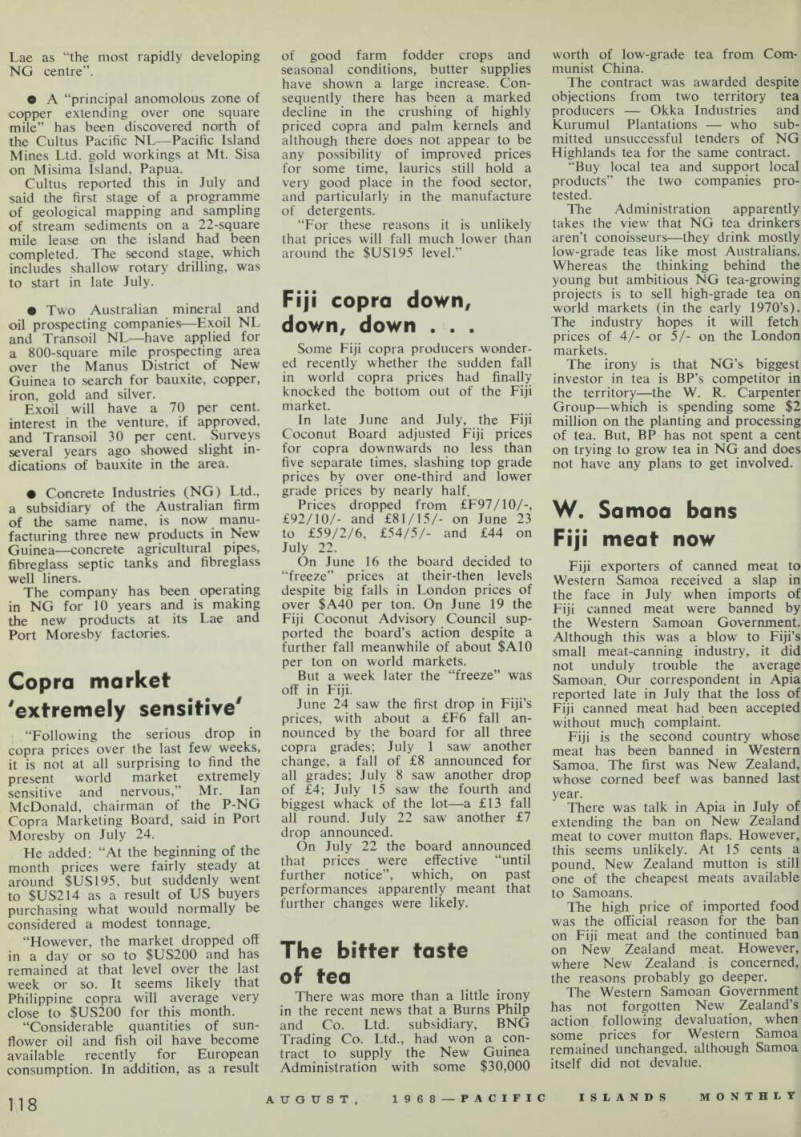
“Following the serious drop in copra prices over the last few weeks, it is not at all surprising to find the present world market extremely sensitive and nervous,” Mr. lan McDonald, chairman of the P-NG Copra Marketing Board, said in Port Moresby on July 24, He added: “At the beginning of the month prices were fairly steady at around SUSI9S, but suddenly went to SUS2I4 as a result of US buyers purchasing what would normally be considered a modest tonnage.
“However, the market dropped off in a day or so to SUS2OO and has remained at that level over the last week or so. It seems likely that Philippine copra will average very close to SUS2OO for this month.
“Considerable quantities of sun flower oil and fish oil have become available recently for European consumption. In addition, as a result
of good farm fodder crops and seasonal conditions, butter supplies have shown a large increase. Con sequently there has been a marked decline in the crushing of highly priced copra and palm kernels and although there does not appear to be any possibility of improved prices for some time, laurics still hold a very good place in the food sector, and particularly in the manufacture of detergents.
“For these reasons it is unlikely that prices will fall much lower than around the SUSI9S level.”
Fiji copra down,
down, down . . .
Some Fiji copra producers wonder ed recently whether the sudden fall in world copra prices had finally knocked the bottom out of the Fiji market.
In late June and July, the Fiji Coconut Board adjusted Fiji prices for copra downwards no less than five separate times, slashing top grade prices by over one-third and lower grade prices by nearly half.
Prices dropped from £F97/10/-, £92/10/- and £Bl/15/- on June 23 to £59/2/6, £54/5/- and £44 on July 22.
On June 16 the board decided to “freeze” prices at their-then levels despite big falls in London prices of over SA4O per ton. On June 19 the Fiji Coconut Advisory Council sup ported the board’s action despite a further fall meanwhile of about SAIO per ton on world markets.
But a week later the “freeze” was off in Fiji.
June 24 saw the first drop in Fiji’s prices, with about a £F6 fall an nounced by the board for all three copra grades; July 1 saw another change, a fall of £8 announced for all grades; July 8 saw another drop of £4; July 15 saw the fourth and biggest whack of the lot—a £l3 fall all round, July 22 saw another £7 drop announced.
On July 22 the board announced that prices were effective “until further notice”, which, on past performances apparently meant that further changes were likely.
The bitter taste
of tea
There was more than a little iropy in the recent news that a Burns Philp and Co. Ltd. subsidiary, BNG Trading Co. Ltd., had won a con tract to supply the New Guinea Administration with some $30,000
worth of low-grade tea from Com munist China.
The contract was awarded despite objections from two territory tea producers Okka Industries and Kurumul Plantations who sub mitted unsuccessful tenders of NG Highlands tea for the same contract.
“Buy local tea and support local products” the two companies pro tested.
The Administration apparently takes the view that NG tea drinkers aren’t conoisseurs—they drink mostly low-grade teas like most Australians.
Whereas the thinking behind the young but ambitious NG tea-growing projects is to sell high-grade tea on world markets (in the early 1970’5).
The industry hopes it will fetch prices of 4/- or 5/- on the London markets.
The irony is that NG’s biggest investor in tea is BP’s competitor in the territory—the W. R. Carpenter Group—which is spending some $2 million on the planting and processing of tea. But, BP has not spent a cent on trying to grow tea in NG and does not have any plans to get involved.
W. Samoa bans
Fiji meat now
Fiji exporters of canned meat to Western Samoa received a slap in the face in July when imports of Fiji canned meat were banned by the Western Samoan Government.
Although this was a blow to Fiji’s small meat-canning industry, it did not unduly trouble the average Samoan. Our correspondent in Apia reported late in July that the loss of Fiji canned meat had been accepted without much complaint.
Fiji is the second country whose meat has been banned in Western Samoa. The first was New Zealand, whose corned beef was banned last year.
There was talk in Apia in July of extending the ban on New Zealand meat to cover mutton flaps. However, this seems unlikely. At 15 cents a pound, New Zealand mutton is still one of the cheapest meats available to Samoans.
The high price of imported food was the official reason for the ban on Fiji meat and the continued ban on New Zealand meat. However, where New Zealand is concerned, the reasons probably go deeper.
The Western Samoan Government has not forgotten New Zealand’s action following devaluation, when some prices for Western Samoa remained unchanged, although Samoa itself did not devalue.