Business and Development
pp. 119-150 · Read in the full issue
What Does
The Future
Hold For The
Fly River?
What hope is there for the people who live by the Papua- West Irian border on the muddy, mosquito-ridden banks of the Fly River? The UN World Bank Economic Mission to P-NG in 1963 virtually wiped off the Western District as a worthwhile cash cropping area.
Coffee or cattle at one time looked ike being possibilities, but Austra lia’s quarantine regulations now srevent the growing of coffee or the raising of cattle within 20 miles >f the West Irian border.
P-NG’s senior agricultural officers lad a nerve-wracking experience vith coffee rust near Port Moresby ;wo years ago, and they don’t want mother outbreak entering through West Irian.
And if stock diseases crossed the P-NG/West Irian border there would 3e a risk of the diseases being trans lated to Australia’s 80 million :attle.
New Guineans along the border ippear to be left with rubber as the >nly reasonable cash crop at this stage.
By European living standards, •übber is barely worth growing. It wrings only 15 or 16 Australian cents i pound delivered to Australia, even vith the subsidy. Production costs sractically negate the effort of grow ng it.
But in P-NG the Administration relieves rubber at 15 or 16 cents a >ound is still worthwhile for village
people who can keep their produc tion costs down by communal effort.
District Agricultural Officer for Western Papua, Mr. lan Pendergast, says rubber seems the only pos sibility now to raise the standard of living of the local people.
First rubber
The first rubber in Western Papua was planted at Madiri Plantation in the lower reaches of the Fly River about 1909, but it wasn’t until two years ago that the Administration began “pushing” rubber among village people.
The Western District now has 500 acres under rubber in village projects, and it may reach 1,200 acres by early next year.
New plantations are being opened up alongside the waterway linking the Fly River with Suki Lagoon, at Kawok Village south-west of Kiunga, and at other villages north of Kiunga.
Papua’s Regional Agricultural Officer Mr. Fred Kleckham, says some of the rubber trees near Kiunga have grown more rapidly than any other trees in Papua.
But it’s a battle convincing village Papuans that they should get on with the job of planting rubber. In the Kiunga area, they’ve had only 31 years of European contact, and life hasn't changed much in that time— except that today there is more law and order.
The villagers live largely by sub sistence gardening, and any govern ment scheme without very rapid and substantial profit leaves them fairly cold.
“They may not like being told what to do now, but their children may, in a few years,” he says.
There are plenty of irksome psychological problems, too, in trying to get rubber planted on a big scale.
One of the latest is a report filtering across to Kiunga from Mindiptanah in West Irian that the villagers at Mindiptanah are going to get much more money per pound for their rubber than villagers in Papua, The Dutch planted rubber at Mindiptanah after the war, and it seems the Indonesian authorities are trying to rejuvenate the scheme.
Somebody from Mindiptanah
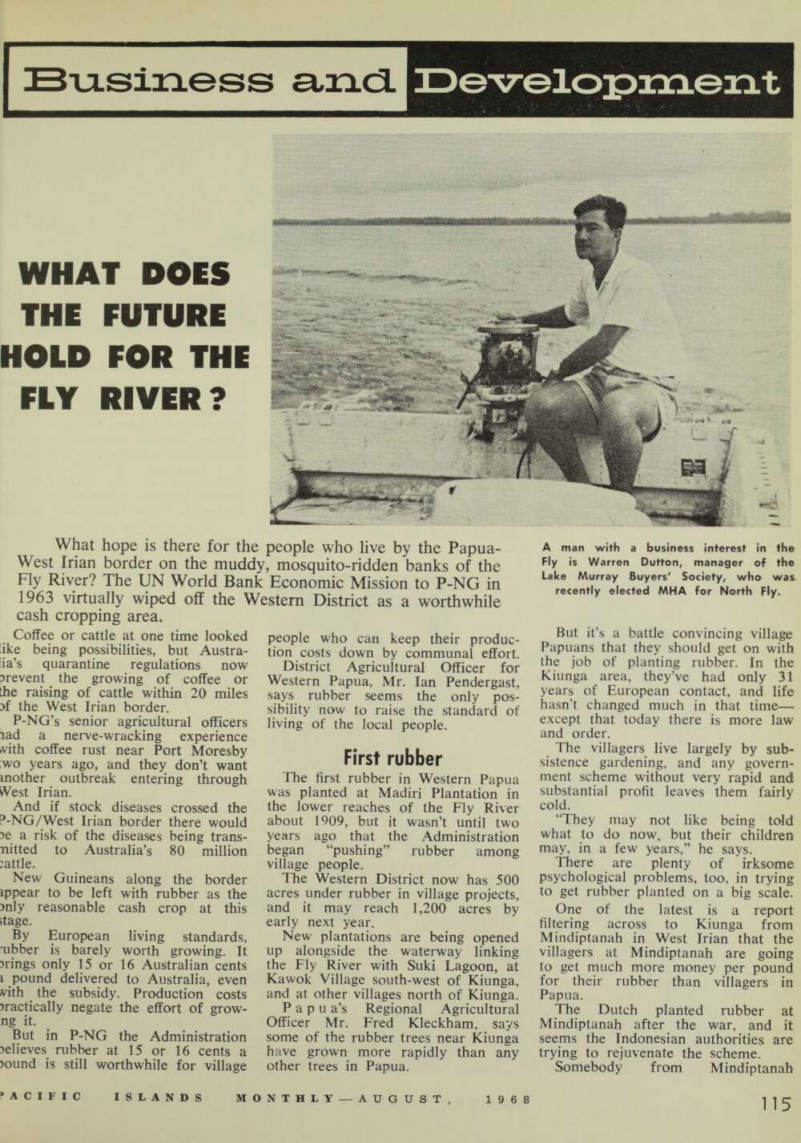
A man with a business interest in the Fly is Warren Dutton, manager of the Lake Murray Buyers' Society, who was recently elected MHA for North Fly.
wandered into Papua, telling the Kiunga people they’d never make much money out of rubber on the money the Australians would be paying for it.
The upshot now is something of a government anti-propaganda cam paign around Kiunga to make sure Papuans go on growing rubber despite their doubts about the price they’ll get.
There are 60,000 Papuans in 40,000 square miles in the Western District.
The World Bank Mission virtally recommended that the Administration give the district up as a bad job, because of nature’s utter economic depression of the area.
The soil is leeched continually by rainfall up to 250 in. a year in some areas.
The Western District must be the most inhospitable 40,000 square miles of land anywhere in P-NG but Australia cannot ignore the districts 60,000 people.
Crocodile Industry
1 The Lake Murray crocodile industry makes the 3,500 Lake Murray villagers the richest m the district, with an estimated $300,000
going into their pockets this year.
But the Australian Administration cannot prevent the wholesale slaughter of young crocodiles The industry at Lake Murray is be oo^l^mint U f! I sLmOn<^!n d wifh rubber
Is I backstop
a?™™,? 1 jeu Ulirrciv Manager of the Lake ® o 7 e \he S °North “V” Mr tor the North Ply M r. warre
(Continued on p. 146)
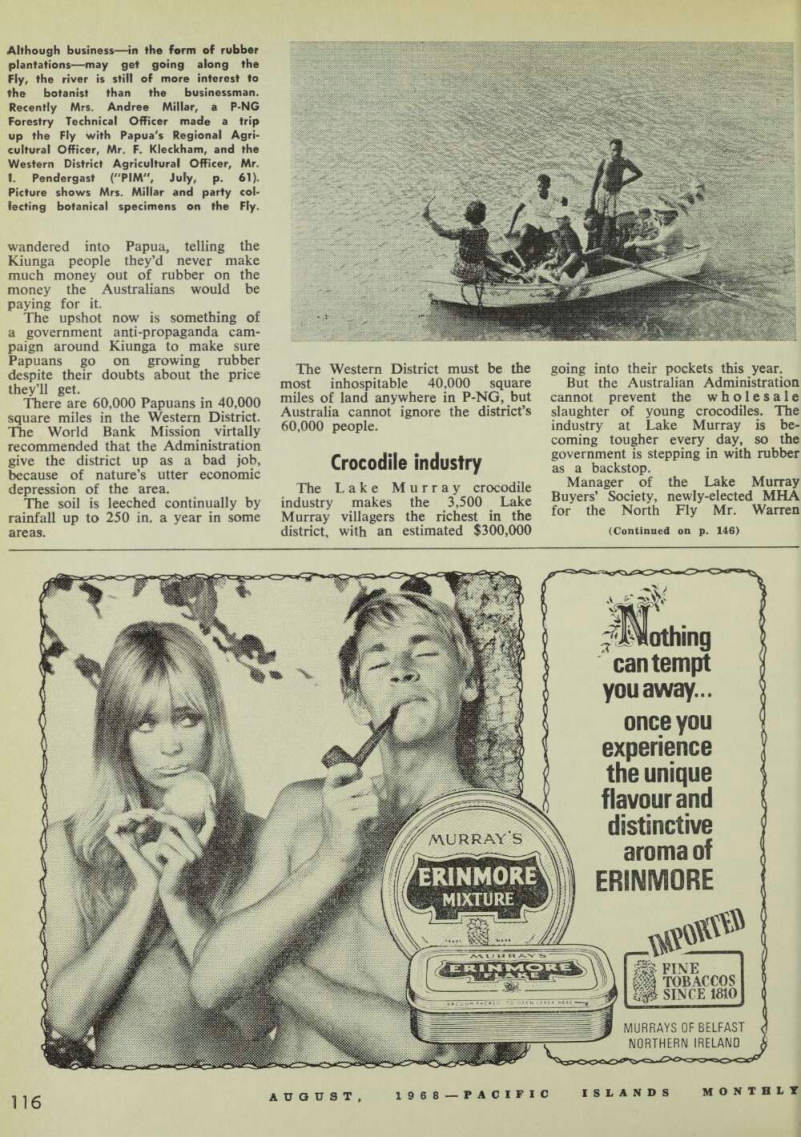
Although business—in the form of rubber plantations—may get going along the Fly, the river is still of more interest to the botanist than the businessman.
Recently Mrs. Andree Millar, a P-NG Forestry Technical Officer made a trip up the Fly with Papua's Regional Agri cultural Officer, Mr. F. Kleckham, and the Western District Agricultural Officer, Mr, I. Pendergast ("PIM", July, p. 61).
Picture shows Mrs. Millar and party col lecting botanical specimens on the Fly.
Dutton, says the crocodile indust: is on the way out.
As a precaution against collaps the society has just bought 45,(X rubber seedlings, many of them fro Malaysia.
Australia is fighting an uph battle in Western Papua. The 60,(X village people in the district w probably always be farmers, but District Agricultural Officer Ii Pendergast puts it, “you’ve got have a stout heart to be a farmer this area”.
No promises
In Port Moresby, one of 1 superiors summed up: “Looking the whole thing dispassionately, t Western District has little or i future. We cannot promise t people anything really worthwhile . and I suspect that quite a few them know just how tough their liv are going to be, when the rest the territory is on a good ca: income.
“And I think, too, that a lot the Western District village peop realise that we, the Europeans, a trying to force them into a ca economic system that we, the Eur peans, spend most of our time tryii to get out of. A pretty cynical sui mary, but pretty close to the truth For 15,000 or 16,000 of tl Papuans in the Western Distrii there’s very little immediate chan of any cash income—those aroui Ningerum on the Western Irii border, the estimated 5,000 aroui Olsobip in the foothills of t Hindenburg Range and the St Mountains, and the estimated 5,(> Biami, Supei, Kubor and Komil people in the Nomad Subdistrict.
Unless there are dramatic develo ments over the next few years, t Ningerum, Olsobip and Nom people are going to continue livii much as they do now—almost they were living 1,000 years ago.
Nomad might have a slight a vantage—on the surface. The stati< has a house of permanent materh for an agricultural officer, but Pc Moresby says it knows nothing abo the house, and has never planned send an agricultural officer Nomad.
Director of Agriculture Mr. W. I Conroy, says that Nomad has h: only a preliminary agricultui survey—“and the area is impossible “There’s no plan for anything Nomad. We may be able to he them with their subsistence fo< crops—nothing else I’m afraid.”