Cruising Yachts
pp. 99-107 · Read in the full issue
Pacific Shipping And Cruising Yachts
Four new cargo runs highlight changes in Islands shipping
Four carriers will start four new cargo runs in the South Pacific in July and August. Our shipping correspondent says that this is a clear indication of the extensive changes going on among inter-territory shipping operations in the Islands.
Fhree of the new runs will be ;ed out of Australia and New dand. They will be operated by althy European and Asian shipping porations, already well-established the Pacific Islands.
Fhese are the German-financed 1 New York-based Columbus Line; French-government subsidised :ssageries Maritimes Line and the tish and Hong Kong-controlled ina Navigation Company, fhe fourth new run will be opera by the only major government itrolled company in the GEIC, Wholesale Society, fhe new runs will be: • Messageries Maritimes. A 50j service from August out of ckland to Melbourne, Sydney, umea, Vila, Santo, Suva and Deete, and return. • Columbus Lines. A 28-day vice from late August out of ckland to Noumea, Port Moresby, i and Rabaul, and return. i China Navigation. A 21-day vice from August 3 out of Sydney
to Brisbane, Lae, Madang and Rabaul, and return. • GEIC Wholesale Society. A 49-day service from July 29 out of Tarawa to Sydney, and return.
Delayed
Messageries Maritimes will use an 18-year-old, 4,000-ton cargo vessel Imerina on its new run. Imerina will be taken off the company’s Madagascar run, where it has been working for several years.
In late June, a company spokes man told PIM that Imerina’s first sailing date out of Auckland could be delayed up to mid-September. He said strikes in France had delayed refurbishings to the vessel. Some late changes could also be made to the vessel’s Pacific Islands itinerary.
The company hoped to include passenger room for up to 12 people.
Columbus Line will operate its New Zealand to Melanesia run through two NZ associate companies, NZ Export Line and Maritime Services Ltd.
Two 884-tons gross ships, Caroline Horn and Harald Horn, will be used and the first one to leave Auck land on the run will be renamed New Zealand Exporter.
These ships will be registered initially in NZ, and carry NZ crews.
Both are eight years old.
They will carry refrigerated and general cargo and are expected to lead to a much greater NZ export attack on the huge SAI3O million NG and New Caledonian markets.
When the announcement of this
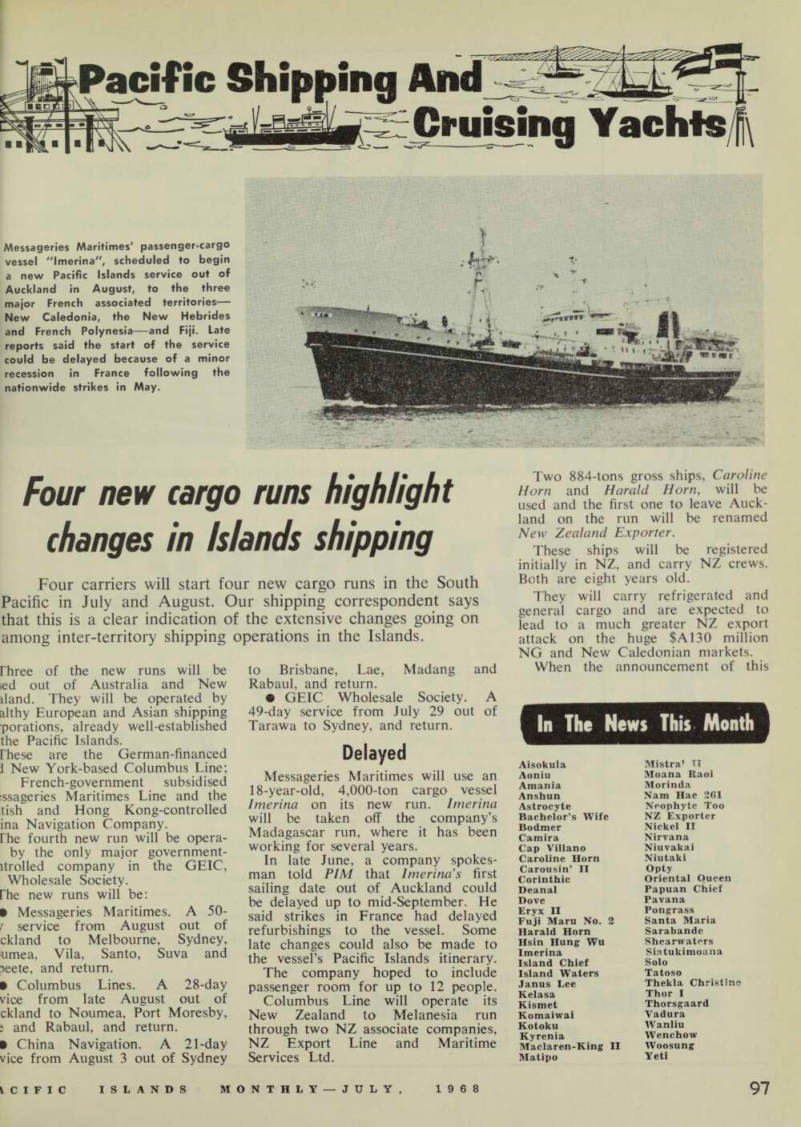
Messageries Maritimes' passenger-cargo vessel "Imerina", scheduled to begin a new Pacific Islands service out of Auckland in August, to the three major French associated territories — New Caledonia, the New Hebrides and French Polynesia—and Fiji. Late reports said the start of the service could be delayed because of a minor recession in France following the nationwide strikes in May.
n was made in NZ in early June, received harsh criticism from iptain J. F. Holm, managing rector of Holm Shipping Company, lich maintains regular cargo rvices out of NZ to New Cale •nia, the New Hebrides, Norfolk and, the Cooks and Tahiti.
The Holm Company had re ested a SNZISO,OOO subsidy from i NZ government to extend its rvices to NG and the Solomons any months before the Columbus ne had begun negotiating for the rvice in January this year at the quest of the South Pacific Export ;tion Committee.
Captain Holm claimed Columbus sight rates would be 40 per cent, ove his company’s proposed rates NG.
“It appears that a NZ company hting for its life has been sold wn the drain by a government un epared to arrive at a decision and parently willing to encourage a reign-owned concern,” he said.
"Sour grapes"
Mr. H. W. Rilk, Australian man er for Columbus Lines, later told M that Captain Holm’s protests sre “sour grapes”. Mr. Rilk said len he had been in NZ early this ar he had asked Captain Holm help run the services jointly with )lumbus Lines. Captain Holm had fused, Mr. Rilk said.
“Sour grapes” or not the fact mains that Holm Line has had its ibitious shipping plans set back r a bigger rival. If Holm Line does er go ahead with a Melanesian ute it is almost certain that it ill have to do so without a NZ overnment subsidy.
A NZ Government Minister has >inted out that it’s a 100 to one lance a subsidy for a service will ! granted now that a non-subsidised rvice is about to begin.
Sideport loading
China Navigation will use a 6,400ns deadweight freighter Island hief, on its NG return run. Island hief will be almost fully unitised, ith sideport loading. Vehicles and frigerated and preslung cargo will so be carried.
Island Chief, which the company’s Mney representatives are already bbing “Big Chief’, will travel up • speeds of 17 knots and complement e work of her sister ship, Papuan hief, which restricts her NG calls • Port Moresby.
Steamships Trading Company Ltd., ill act as agents for the Island hief in NG.
The new ship will completely re-
place China Navigation’s three “W” ships Woosung, Wenchow and Wanliu —which have been running a Sydney-NG-Far East run. The “W’s” will make their last NG calls in mid-July.
Introduction of the new unit loader coincides with the end of 25 years’ service to NG ports by China Navigation. One of the company’s first vessels, the Anshun, was sunk in the Milne Bay area in 1942-43.
Long-awaited
When the Wholesale Society’s vessel Moana Raoi leaves Tarawa for Sydney on July 29, it will be the start of the long-awaited GEIC direct link, with the colony’s own ship, to Australia.
Overnight, the GEIC will become the second Pacific Islands territory with its own overseas shipping con nections (Tonga was the first).
It is expected that Moana Raoi will carry about 400 tons of copra for Australia on each southbound trip and return with general goods, most of which are imported from Australia anyway (by Columbus Lines).
It is hoped that over 2,000 tons of copra can be exported to Australia each year—at the expense, in cidentally, of NG producers—on this route.
Two other benefits of the new service are the saving of foreign currency by carrying a large pro portion of the GEIC’s cargo in its own vessel and continued job oppor tunities for Gilbertese and Ellice seaman aboard the Moana Raoi.
She will be replaced on inter island and Suva runs by the Aisokula and Komaiwai, both chartered from Fiji.
While the Wholesale Society’s shipping operations are doing quite well, thank you (especially in its
transhipment business to the US Trust Territory), trading and retail ing remain still its big money earner.
Big Changes In
Tongan Shipping?
Big changes in Tongan shipping operations could be the result of a four-week study tour of the king dom’s shipping operations in May and June by Mr. D. Koludrovic, a regional advisor for the UN’s Eco nomic Commission for Asia and the Far East.
Mr. Koludrovic arrived in Tonga in mid-May. He studied all activities of the Tonga Shipping Agency and examined the chances of the king dom’s two traders, Aoniu and Niuvakai, expanding their overseas services to include new ports of call.
He also looked at internal shipping services among the Vavau, Haapai and Tongatapu Groups and suggested the types of ships Tonga may need for her future requirements.
"Oriental Queen" Becomes
Floating University
The 12,000-ton cruise liner Oriental Queen will be used as a floating Pacific University, travelling from Japan to Hawaii and the US West Coast.
Oriental Queen left the South Pacific early last year after making many cruises through the Pacific Islands, visiting Tonga, Fiji and New Caledonia ( PIM, Feb., 1967, p. 105).
Toyo Yusen Line, of Japan, put her in dry-dock in January, 1967.
Early this year she was reported in service around Indonesia.
Now, a team of Japanese scholars and industrialists has organised educational cruises for the ship. The first cruise was to leave Japan on June 30 on a five-week trip to Los Angeles and Honolulu.
Each cruise will take 400 tertiary
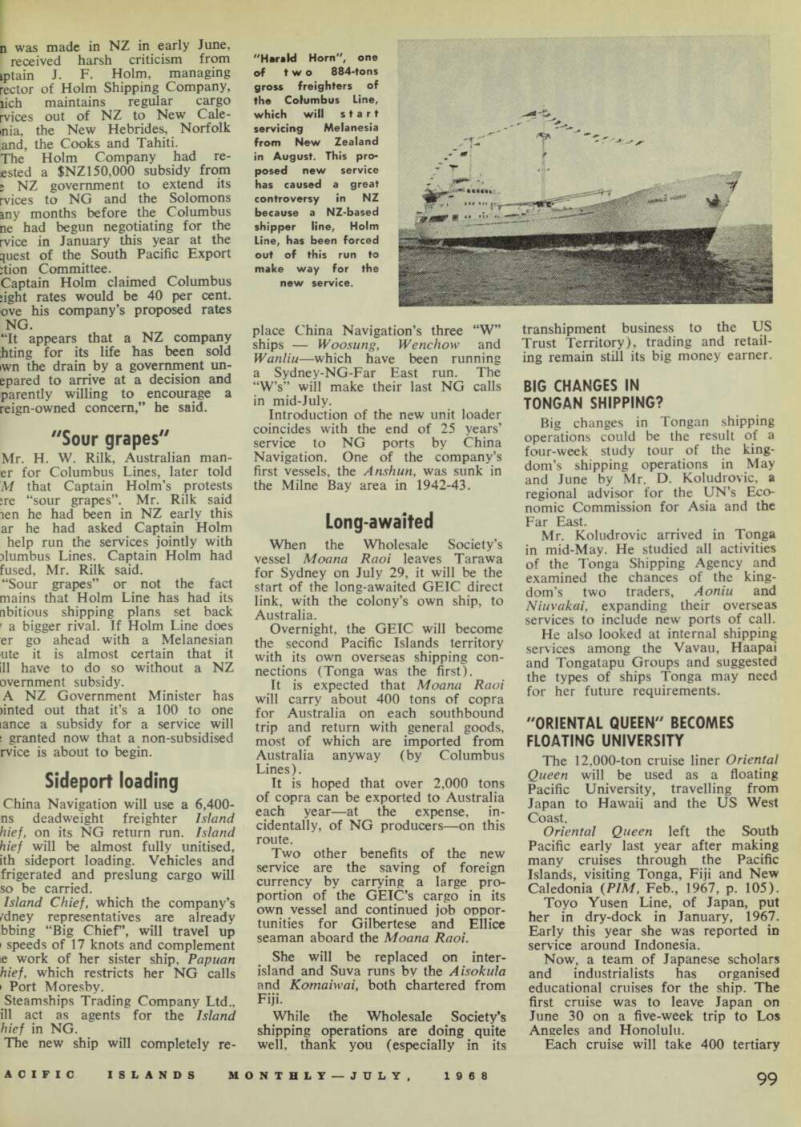
"Harald Horn", one of two 884-tons gross freighters of the Columbus Line, which will start servicing Melanesia from New Zealand in August. This pro posed new service has caused a great controversy in NZ because a NZ-based shipper line, Holm Line, has been forced out of this run to make way for the new service.
\ secondary students from Japan, ath Korea, Thailand, India and ylon.
Ickel Ii" Grounded On
Ef Near Noumea
Lhe 15,000-ton nickel ore carrier ckel II spent four days grounded a reef near Anse Vata Beach, iumea, in late May. She was floated the reef after nearly 1,000 tons nickel ore were offloaded into rges.
French navy divers inspected the 11 of the carrier and found little mage.
No reason for the grounding of i Societe le Nickel vessel has been en. She hit the reef at 9 p.m. in m weather on May 27.
The strangest things happen to i Societe le Nickel vessels,” PlM’s ►umea correspondent said. “A few irs ago one of them tried to climb : Cook pines on Porcupine Island ar where Nickel II hit the reef. ‘Noumea’s daily newspaper, which owned by the Societe le Nickel, d this time that Nickel II ap rently ‘deviated slightly’ from its urse. That surely must be the derstatement of the year.”
Ingan Seaman
St Overboard
Akuila Latu, 23, a seaman from tapai, Tonga, was lost overboard in avy seas 500 miles north-east of dney off the Tongan Government ssel Niuvakai on May 28.
Niuvakai was steaming from dney to Lautoka when the accident curred. Latu was securing drums deck when two huge waves swept n overboard.
Crew members saw him surface mediately, but he was unable to ach lifebelts thrown to within 20 rds of him.
Niuvakai’s master, Captain C. H. finer, turned the vessel around and ent four hours searching for Latu.
!Ment Co. Builds
)Ncrete Tug
Fiji Industries Ltd., cement manu cturers, have built a concrete tug, e Nuitaki (Trusted), which cost >out £B,OOO.
The tug was built at the mpany’s cement works at Lami, id taken by trailer to the sea.
Advantages of a concrete tug are w maintenance costs, particularly tropical waters, and relatively low eight.
About 10 tons of concrete were >ed to build the Nuitaki.
According to the company the way ► build a concrete ship is to first
construct a framework of steel pipe frames.
The framework is reinforced with high tensile steel rods, and covered with many layers of wire mesh.
The framework is then plastered with concrete, smoothed off with trowels and then steam cured.
The Nuitaki has been fitted with a variable pitch propeller, which will enable her to go forward or reverse.
The Nuitaki will be used to tow raw material such as coral sand and silica to the cement works.
Her specifications are: 19 tons, 38 ft long, and 12 ft 2 in. beam.
"Thorsgaard" Starts
Ng Run In August
The Pacific Islands Transport Line, which announced plans recently to extend its Pacific Islands calls to Lae and Rabaul, NG, with its 7,850-ton deadweight freighter Thor I, will put a second ship, the 8,000-ton Thors gaard, into NG in August.
Thorsgaard is scheduled to reach Rabaul on August 13-15 and Lae on August 16-17. She will pick up big consignments of coffee and cocoa which have been ordered by US importers.
A spokesman for the company’s
ydney agents told PIM that the [lips would make regular calls at JG during the coffee season. He aid that the NG service was a faster ink with the big US markets ecause it eliminated trans-shipment tirough Hong Kong and Japan ports PIM, June, p. 99).
Mergency Call At
Ucairn By "Corinthic"
The Shaw Savill vessel Corinthic nade an emeregncy call at Pitcairn sland on May 13 to give urgent icdical attention to Mr. Albert foung, aged 68.
Corinthic steamed 250 miles off ier path to help Mr. Young, who had alien from a visiting ship. Cap 'illano, a few days before. Corinthic’s loctor, Dr. Gwenda Hutchison, went ishore and made Mr. Young as omfortable as possible, giving nstructions to Pitcairn’s resident lurse on how to look after him.
It was judged impracticable to ake Mr. Young to Panama. :rayfish galore
N "Bodmer's" Freezer
Inter-island trader, the 278-ton 3odmer recently arrived in Raro onga with quite a load of Islands )roduce from the northern Cooks. In ;ix weeks Bodmer visited Manihiki, Rakahanga, Penrhyn, Palmerston, Nassau and Pukapuka.
Bodmer, skippered by Captain Lumbers, collected 170 tons of copra, a freezer full of fish and crayfish and 65 deck and cabin passengers.
The day after her arrival in Raro tonga crowds rushed to the ship to buy up the quarter-ton of crayfish of all shapes and sizes, caught at Palmerston.
By 10.30 a.m. most of the crays were sold to people “who seemed to materialise from nowhere”, as a
local report put it. Captain Lumbers had his hands full weighing the crays in buckets and passing them out to eager customers.
The four-ton catch of frozen fish took a couple of days to sell.
Record Number Of
Visits To Rotuma
The isolated island of Rotuma, about 240 miles north of the main Fiji group, which normally sees only two Fiji government vessels a year, will have received a record number of visits by 1969.
From June to December this year four government vessels are scheduled
to make nine trips to Rotuma.
They will take cattle and building materials, a medical team for a special survey, and government personnel who will do preparatory work connected with Fiji’s change over to decimal currency in 1969.
Ini Island Should Have
New Harbour Soon
Ini Island, in Deception Bay, Gulf of Papua, should have a new harbour by September. Dredging work was to start in late June and take about two months.
One of the reasons for building a new harbour is that a well will be
ink on the island by Esso Explora an-Oil Search Ltd. in late July or j\y August. Esso is currently piling structure on the island for their g to drill on, because very high les sometimes submerge the small land.
, Samoa's Tug To
I Called "Tatoso"
American Samoa’s 85 ft seagoing g ( PIM, June, p. 105) will be tiled Tatoso —a name made up of e first letters of the territory’s five apulated islands —Tutuila, Aunuu, au, Ofu, Swains and Olosega. itoso will reach Pago Pago from ew Orleans in August.
Drfolk Stamp
Dnours "Morinda"
The popular old Burns Philp earner Morinda was featured on a ;w $1 stamp issued by Norfolk land on June 18. This stamp will mind many oldtimers in NG, the ew Hebrides, the Solomons and orfolk and Lord Howe Islands of 'orindas long and varied service.
Morinda first headed for Papua late 1913, but hit a rock near aoktown, Queensland, and had to turn to Sydney for repairs.
She plied the Sydney-NG routes itil 1931, after which she spent ght years on the Sydney-Lord owe-Norfolk Island-New Hebrides in.
From 1939 to 1941 her run was :tended to the Solomons, and this in was continued after World War . In 1952 she was laid up—after !1 completed voyages.
Drean Fishing Ship
Its Suva Reef
A Korean fishing ship, the Nam ae 261, went on the reef at the ft of the main passage to Suva arbour on June 2.
She was pulled off at high tide ;xt morning by a Japanese fishing >at, the Fuji Maru No. 2.
The tow rope snapped while she as being pulled off, and wrapped telf round the Nam Hae’s propeller.
The Nam Hae was towed to King’s harf, where divers freed the opeller and examined the hull for image.
)Rmosan Ship Drifts
I The Koro Sea
The Hsin Hung Wu, a Formosan thing ship, based at Pago Pago, nped into Levuka late in May after iving drifted in the Koro Sea hen the engine broke down.
During her drift the Hsin Hung
Wu went close to Makogai, but the crew managed to make temporary repairs to the engine, and she was able to sail to Levuka.
After repairs at Levuka the Hsin Hung Wu was to go to Pago Pago.
"Deanel" Sinks On
Second Major Voyage
Deanel, a 120-ton, 94 ft coastal trader, capsized and sank off Lae Wharf, NG, in late May.
Loading operations were under way when Deanel slowly went down, set tling in 30 ft of water. No one was reported injured.
Owned and skippered by Madang businessman, Mr. John Licciadro,
Deanel was built in Japan and was on her second major voyage.
Soon after the sinking, the P-NG Harbours Board tabbed the ship a “wreck”.
Marine Complex Planned
For Moresby Harbour
A $250,000 marine and accom modation complex, including a 400 ft jetty, may be built off Konedobu, Port Moresby, by Kone Boat Ser vices Pty. Ltd.
If a decision is made to go ahead, the complex should be completed in time for the South Pacific Games, to be held in Port Moresby in August, 1969.