Coffee-Table Size
pp. 96-97 · Read in the full issue
New Guinea Asmat Is
Whether you regard it as a memorial to young Michael Rockefeller; a memorial to an ancient culture; or an example of what modem publishers can do on an unlimited budget, The Asmat of New Guinea is a fantastic book.
It comes in coffee-table size, weighs about 10 pounds and, like the price, is big in all directions.
About half the volume is devoted to a pictorial record of the first of Rockefeller’s two visits to the Asmat people of West New Guinea (the photographs taken during the second and longer expedition were lost with him). Most of the rest of the book is a pictorial catalogue of the carv ings and ceremonial objects which he collected during the two visits and which now make up the Michael C.
Rockefeller Collection of Asmat Art in the Museum of Primitive Art in New York.
Both sections are magnificiently produced and of intense interest to the layman and, I should imagine, great importance to the academic.
The book has been edited by Professor Adrian A. Gerbrands, of the University of Leiden, who spent about a year among the Asmat studying the methods and meanings of their art and who was Michael Rockefeller’s mentor during his first visit to this area.
Professor Gerbrands also supplies an introduction to the book, which is as valuable as, and complements, the pictorial sections. In this he gives a first-class account of the Asmat, their background, their culture and the 10,000 square miles of mud, sluggish rivers, swamps and man groves that make up most of their country.
The Asmat occupy a rough triangle on the mid-southern coast of West New Guinea and, about the time the Dutch left, it was estimated that there were just over 30,000 of these people occupying about 75 villages of various sizes.
'Mud is everywhere'
Their land, records Dr. Gerbrands, is little but a gigantic mud plain, covered by a tropical rain forest that has adapted to the brackish conditions.
Countless rivers and streams cut through the plain but apart from a couple of patches of firm sand, “mud is everywhere . . . even the rivers are grey with it. . . . This part of New Guinea is without distinct coastline.
At low tide, miles of muddy shore appear, though it is always uncertain where the sea turns into mud. Only at high tide, when the trees mark the high water line, do the muddy margins disappear so that the land really becomes land. But even then the distinction is not clear, for the sea-water seeps between the roots of the mangroves and the other trees native to these tropical, alluvial shores.”
The Asmat were thus protected by the sea and by their swamps, on one hand, and by the high, snow-capped Central Range on the other. They lived in jungle villages, in houses raised high above the mud. In each village there was at least one ceremonial house around which the whole cultural life of the people revolved.
Their land was devoid of stone of any sort and such stone-axes as there were had been traded down mysterious trade-routes from the interior; there was no clay suitable for pottery and no land suitable for gardens. Their basic foods were sago, made from the palms that grow in the brackish swamps; and fish.
Headhunting
Nonetheless, in spite of this poverty in their environment, or perhaps because of it, the Asmat developed a fairly complicated cultural life in which symbolism played a large part.
Symbolism included headhunting, as a form of fertility rite, and the
carving of ceremonial object:;! shields, drums, paddles, spears, cas prows, ancestor figures and pa bowls, etc.
Some of these objects had a pi tical use as well; some, such as ancestor poles, or bis, after ce; monial use were frequently thro away to decay in the forest so t their supernatural power might p mote the growth of the sago palm It is through their carvings 1 the Asmat are best know to the t side world. Although most of 1 carving—for example, on shields bowls—is in low relief, the op work designs seen on drums, particularly on the ancestor-poc or bis, are better known and are garded as characteristic.
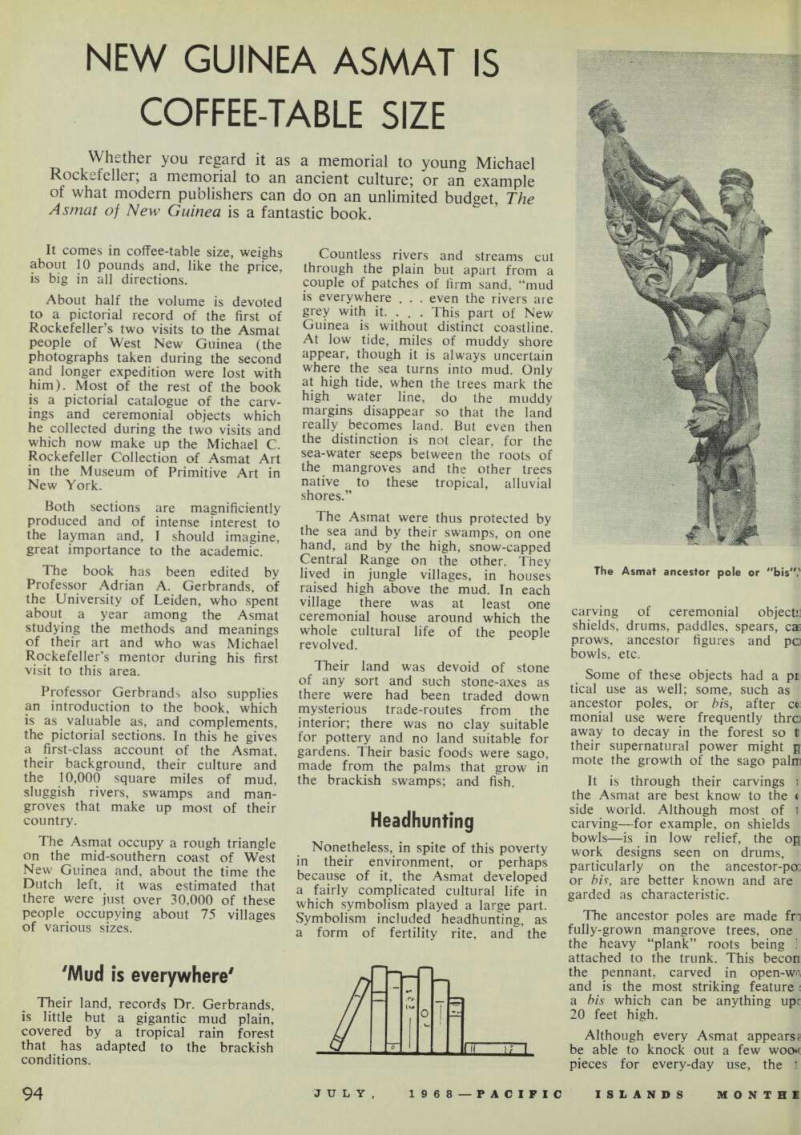
The ancestor poles are made fn fully-grown mangrove trees, one the heavy “plank” roots being ] attached to the trunk. This becon the pennant, carved in open-wi\ and is the most striking feature: a bis which can be anything upc 20 feet high.
Although every Asmat appears? be able to knock out a few wook pieces for every-day use, the 1
The Asmat ancestor pole or "bis"
rvings of the ceremonial objects ; the work of experts. These ex rts exercise a certain amount of iginality but Asmat carvings are vays based on a set form of mbols.
The Asmat themselves, remarks ■. Gerbrands, have no trouble erpreting the symbols because they ve become signs, with fixed mean 's. “The forms are more than just saningless and ornamental decora ns,” he goes on, “we might very ill call them ideograms, and one ts the impression that they are . . . the verge of becoming a written iguage. . . . Their meaning is the ne all over the Asmat territory.”
Real interest
Although a few carvings had found fir way into Dutch museums fore the Pacific war, real interest these artifacts and of the Asmat mmed from about 1954 when the itch re-established a patrol-post it had been set up for a brief time fore the war.
In March, 1961, when he was less m a year out of university, ichael Rockefeller went to West sw Guinea as photographer and jnd-technician with the Harvard abody Expedition which was study ' a group of people in the Hintainous Baliem Valley.
In June and July, 1961, he took Pew weeks off with a college friend make a private expedition to the ast with the intention of buying rvings from the Asmat people. It this trip that is covered by his otographs, the narrative that ac mpanies these coming from notes at he made at the time and from ivate letters to friends and family.
After the Harvard-Peabody Ex dition had gone back to the US, )ckefeller, in September 1961, turned to the Asmat country and th Rene S. Wassing, a Dutch thropologist, spent two months ing from village to village along s seacoast and rivers, collecting aterial for the Museum of Primitive •t, of which he was a trustee.
On November 18, while crossing e mouth of the Eilanden River, sir catamaran overturned. Wassing lyed with the craft and was
eventually rescued. Rockefeller ap parently attempted to swim ashore and was never seen again.
During his short life, Michael Rockefeller appears to have been an unassuming and quiet young man who chose to spend his time, in considerable discomfort, thousands of miles away from what we call civilisation, finding out how other men lived, and recording it—with the results we see in this book.
Chartered jet
However, his death was another matter. His father, Governor Nelson Rockefeller of New York, chartered a 707 Boeing jet which landed him at Biak; from there a smaller plane took Rockefeller Sr., and Michael’s twin sister, to Merauke, which was still 250 miles from where the young man disappeared.
In their wake went newspapermen, TV crews and radio commentators until 50 of them overflowed the small town and jammed the local radio station with their messages to the world.
The Dutch turned on everything they had in search equipment; Aus tralia sent a RAAF Hercules, two Army helicopters, 26 men and -a Dakota plus a TAA Catalina from Port Moresby; the US offered an aircraft-carrier from the Seventh Fleet.
While it lasted the Asmat. and Agats, the village from which Michael Rockefeller set out on his last journey, got more publicity than they are likely to get again. Less than a year later, the Dutch got out of New Guinea and left it to the Indonesians;
what has happened to the Asmat since is anyone’s guess, But thanks to Michael Rockefeller, the photographs he took and the art objects he collected; and thanks also to the people who compiled this book, the Asmat and their culture, as they were in 1961, have been preserved, The Asmat Q f New Guinea is pub lished by the New Y ork Graphic Society. Apart from the valuable text , there are 90 photographs in colour, 510 in black-and-white—all magnificient—and a fold-out map.—
JT.
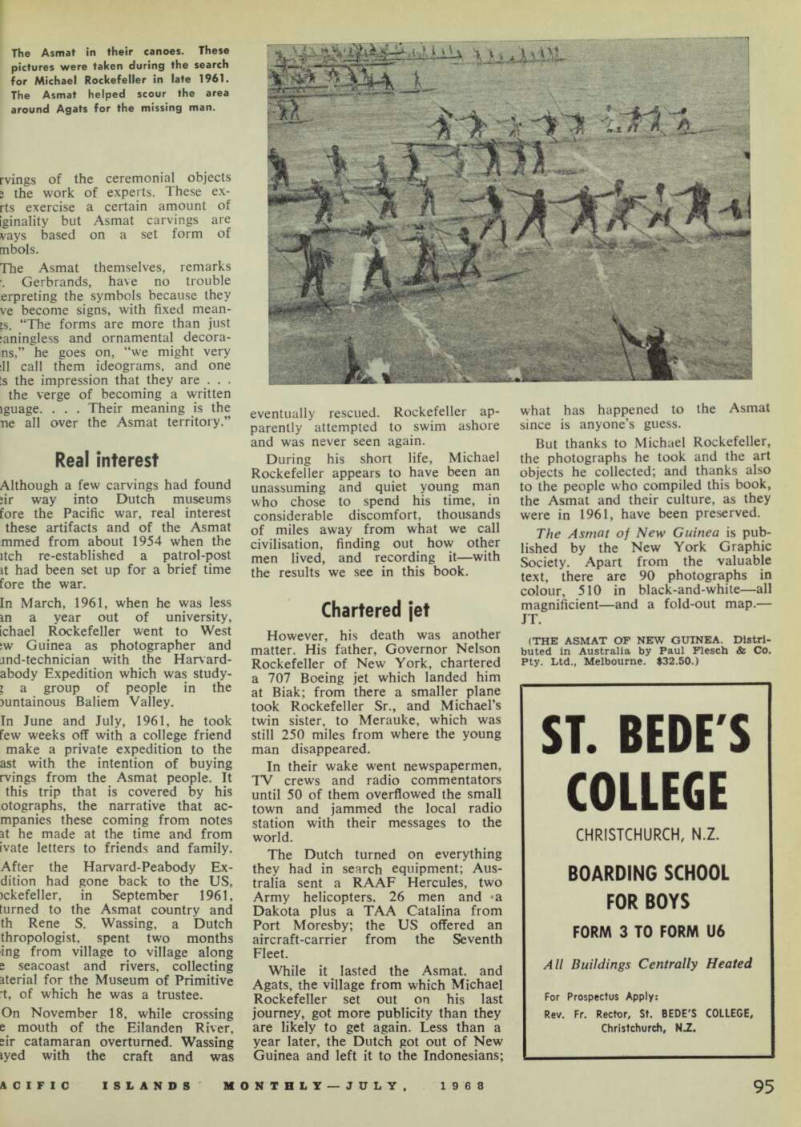
The Asmat in their canoes. These pictures were taken during the search for Michael Rockefeller in late 1961.
The Asmat helped scour the area around Agats for the missing man.