Tropicalities
pp. 35-37 · Read in the full issue
With half of the population of the Cook Islands inder the age of 15, there was a likelihood of a copulation explosion in the territory.
This was part of an unpretty pic ure the Director of Health in the ?ooks, Dr. A. Guinea, painted in i paper called “Health and the Com tiunity” which he presented to a eminar on the “Social and Economic )evelopment in the Cooks” in Raro anga in late May.
Dr. Guinea said the birth rate in he Cooks was about 42 per 1,000 f population, with one in every five mmen in the reproductive age roups pregnant.
Currently there were indications hat more young people were remain ig in the Cooks instead of moving > NZ. Dr. Guinea said that until jcently the territory’s population ad been limited by emigration to \Z.
Dr. Guinea said the Cooks’ coming Mirism boom would aggravate the opulation problem, encouraging lore Cook Islanders to stay rather lan move to NZ.
Social stress was being caused by besity, consumption of alcohol, at tudes to work and increasing thefts.
Dr. Guinea made the following rggestions to counter some of the urrent problems in the Cooks. • Re-assess the housing policy jgarding loans. • Set up work incentives and put ages on a more equitable basis with ore prices. • Introduce family planning and ;duce or ban imports of tinned >od.
ihe’s his right
land man
VHEN vivacious Christine Stewart, 23, of Sydney, and intense nthony Constantine Voutas, 25, of ew Guinea (no fixed abode) decided • marry, they were faced with an un cpected problem—how to go about . At the time of Toni Voutas’ pro )sal the pair were two days’ walk Jt of Sialum, on New Guinea’s uon Peninsula, with a couple of eeks of intensive patrolling ahead f them and no copy of the P-NG [arriage Ordinance in the next dozen
Population problem in the Cooks
valleys. What were the legal require ments for marriage in P-NG?
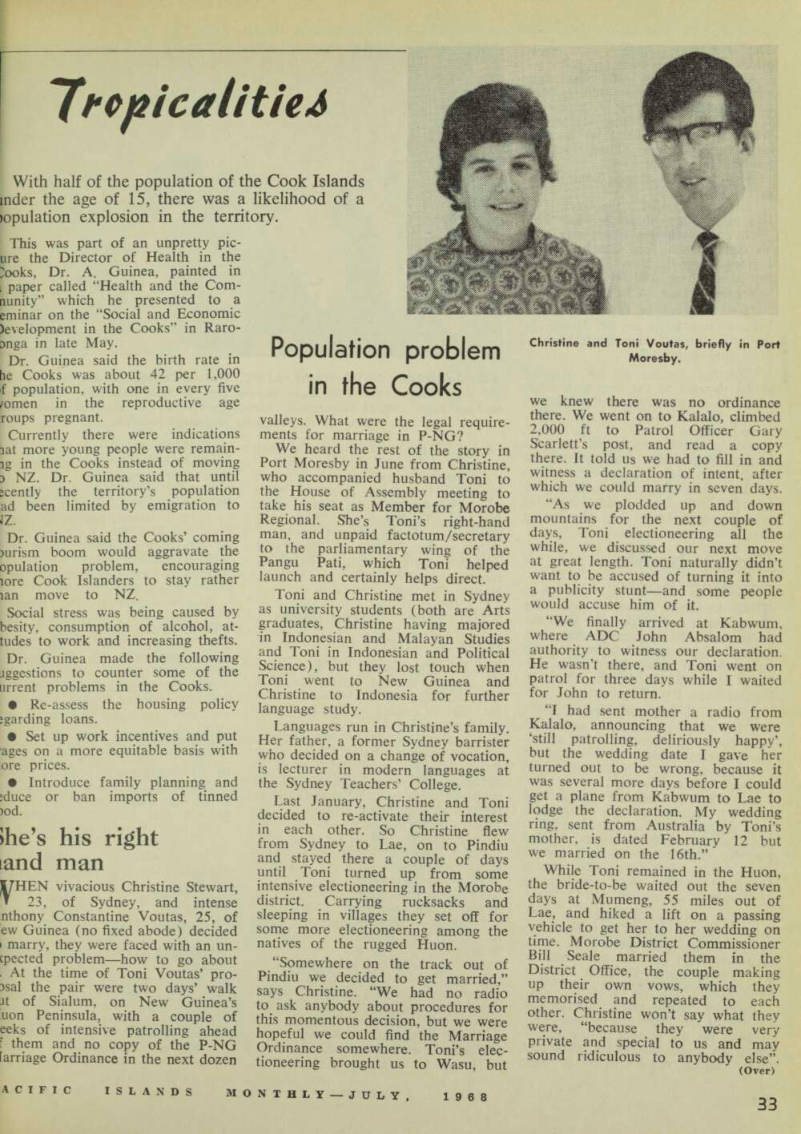
We heard the rest of the story in Port Moresby in June from Christine, who accompanied husband Toni to the House of Assembly meeting to take his seat as Member for Morobe Regional. She’s Toni’s right-hand man, and unpaid factotum/secretary to the parliamentary wing of the Pangu Pati, which Toni helped launch and certainly helps direct.
Toni and Christine met in Sydney as university students (both are Arts graduates, Christine having majored in Indonesian and Malayan Studies and Toni in Indonesian and Political Science), but they lost touch when Toni went to New Guinea and Christine to Indonesia for further language study.
Languages run in Christine’s family.
Her father, a former Sydney barrister who decided on a change of vocation, is lecturer in modern languages at the Sydney Teachers’ College.
Last January, Christine and Toni decided to re-activate their interest in each other. So Christine flew from Sydney to Lae, on to Pindiu and stayed there a couple of days until Toni turned up from some intensive electioneering in the Morobe district. Carrying rucksacks and sleeping in villages they set off for some more electioneering among the natives of the rugged Huon.
“Somewhere on the track out of Pindiu we decided to get married,” says Christine. “We had no radio to ask anybody about procedures for this momentous decision, but we were hopeful we could find the Marriage Ordinance somewhere. Toni’s elec tioneering brought us to Wasu, but
we knew there was no ordinance there. We went on to Kalalo, climbed 2,000 ft to Patrol Officer Gary Scarlett’s post, and read a copy there. It told us we had to fill in and witness a declaration of intent, after which we could marry in seven days.
“As we plodded up and down mountains for the next couple of days, Toni electioneering all the while, we discussed our next move at great length. Toni naturally didn’t want to be accused of turning it into a publicity stunt—and some people would accuse him of it.
“We finally arrived at Kabwum, where ADC John Absalom had authority to witness our declaration.
He wasn’t there, and Toni went on patrol for three days while I waited for John to return.
“I had sent mother a radio from Kalalo, announcing that we were ‘still patrolling, deliriously happy’, but the wedding date I gave her turned out to be wrong, because it was several more days before I could get a plane from Kabwum to Lae to lodge the declaration. My wedding ring, sent from Australia by Toni’s mother, is dated February 12 but we married on the 16th.”
While Toni remained in the Huon, the bride-to-be waited out the seven days at Mumeng, 55 miles out of Lae, and hiked a lift on a passing vehicle to get her to her wedding on time. Morobe District Commissioner Bill Seale married them in the District Office, the couple making up their own vows, which they memorised and repeated to each other. Christine won’t say what they were, “because they were very private and special to us and may sound ridiculous to anybody else”. (Over)
Christine and Toni Voutas, briefly in Port Moresby.
The ordinance merely lays down minimum requirements for vows.
Eight magnums of champagne were a feature of the wedding feast, celebrated with a small group of friends in Lae, and the honeymoon was a whole weekend at a grass house at Mumeng. Then back to patrolling for Toni.
What sort of a man is Toni Voutas to his wife?
“He’s an idealist,” she says. “We live in a grass house because Toni doesn’t want to live any better than his constituents. Toni sees himself as a stopgap politician—the people will run their own political affairs, and he’s merely here to help.
“Toni believes in the Pangu Pati because last term in the House he saw for himself the frustration of individual politics.”
Christine Voutas is not alarmed at the thought of the next four years of constant patrolling with Toni in his big New Guinea electorate. They intend always to be on the move, spending eight months of the year in the villages (and much of the rest of the time in the Assembly meetings in Port Moresby). The intelligent, friendly bride from Sydney has had an early introduction to the roving life.
Bigger bomb,
smaller boom
THE hydrogen bomb that France plans to explode at Mururoa Atoll during the current nuclear test ing season is reported to be umpteen times bigger than the Hiroshima bomb and all the bombs that the French have let off before.
But the shopkeepers, restaurateurs and bar owners of Tahiti could well remember it as a bomb with a con siderably smaller boom than any of its predecessors exploded in the French Pacific.
The fact is that the sailors and assorted bomb-watching personnel who arrived in Tahiti on May 18 in the French task force Alpha, headed by the 22,000-ton aircraft carrier Clemenceau, left far less wealth behind them than their counterparts of previous years.
It was not that the men of 1968 were stingier. They just had less to spend—possibly because they had emptied their pockets of much of their money during a call at Noumea early in May (P/M, May, p. 19).
Papeete businessmen interviewed by one of the local newspapers early in June on the impact of the Alpha force on their businesses estimated that turnover had increased by only
10 to 15 per cent, compared with as much as 50 per cent, in 1966.
However, some of them were optimistic that things might be better when the Alpha force (which sailed for the Tuamotus on June 11) returned to Tahiti about October.
“Only then,” one of them said, “will we really be able to judge the force’s economic impact on the terri tory.”
Old Bev Varradel
had a farm
VERY few people could claim a greater run of misfortune than Unevangelised Fields Mission farmer Mr. Bev Varradel, at Lake Murray in Western Papua.
A year ago, the P-NG Admin istration granted him 600 acres on Baboa Island in Lake Murray, so he could try to set up an agricultural training school for Papuans drop ping out of primary schools.
Mr. Varradel brought in two billy goats from Brisbane and half a-dozen nanny goats, a bull and a cow from various parts of Papua.
Then—disaster!
The cow died of snakebite.
This made the bull a bit edgy.
He became more aggressive and damaged various items around the farmyard, Mr. Varradel decided to cool him off with a short spell on a nearby island, so he set off to swim the bull to the island, alongside a dugout canoe with an outboard.
The bull got in thick reeds near the island. And drowned.
The two billy goats had been
brought up in the backyard of Brisbane home, and seemed to pre: their own company.
So Mr. Varradel sent the t billy goats and selected nanny got to a small island, hoping to increi their numbers. One billy goat died he was trapped upside down in i fork of a fallen tree.
Then disease killed several of nanny goats.
At latest report the remaim billy goat was not showing mi] interest in the nanny goats.
To put the seal on his fantas run of bad luck, Mr. Varradel tB found that most of the young m who’d been interested in the ag cultural training school a year s are now married, and have otl interests.
Unlike the billy goats.
Mr. Varradel, from Brisbane, mains undeterred.
“I’ll bring in more stock as sc as I can raise the money. At moment I’m catching barramundi Lake Murray, and flying them ii the Highlands.
“It may take some time, but I going to keep it up—l’ve got to ra the money somehow, and this is that’s offering.”
To the top of the
ladder in Hong Kor
r’S just 3O years ago tl Paul Tsui, a young scho teacher from Hong Kong left N Guinea to return home after period of teaching for the Catho Mission at Rabaul.
Today the former schoolteac:
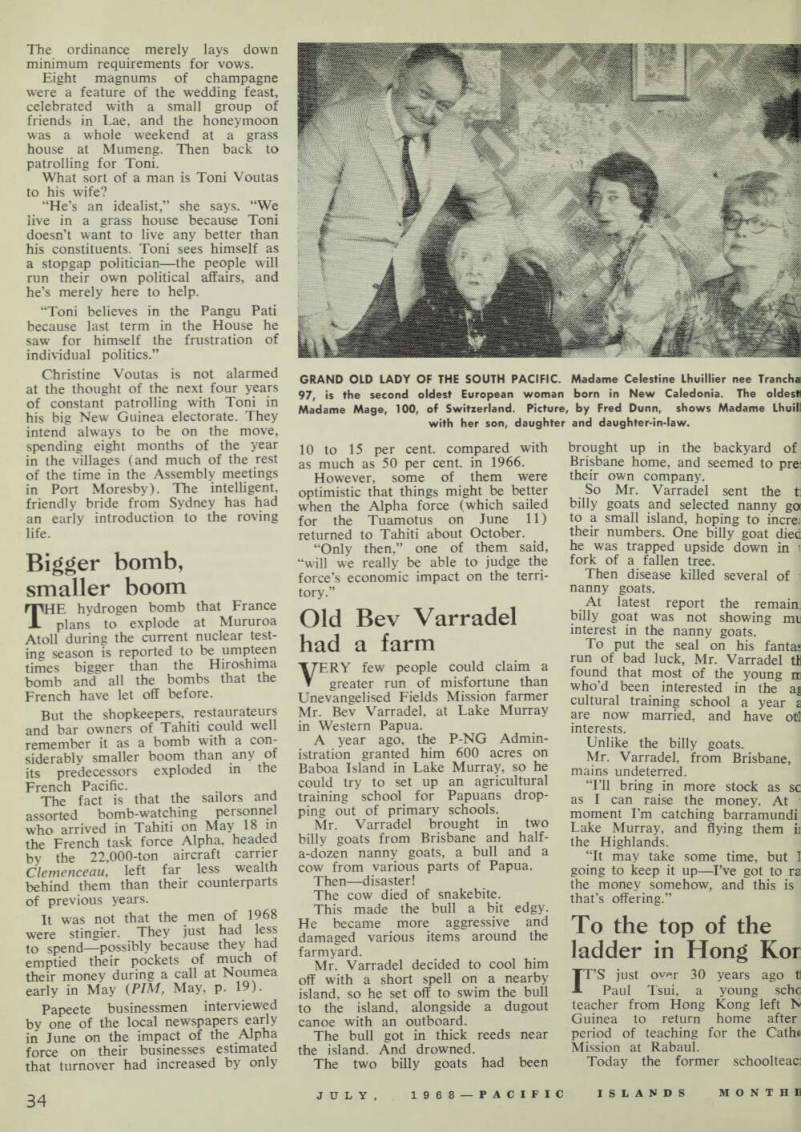
GRAND OLD LADY OF THE SOUTH PACIFIC. Madame Celestine Lhuillier nee Trancha[?] 97, is the second oldest European woman born in New Caledonia. The oldest Madame Mage, 100, of Switzerland. Picture, by Fred Dunn, shows Madame Lhuillier with her son, daughter and daughter-in-law.
I the Hon, Paul K. C. Tsui, OBE, j>, one of the top men in the Hong ong Administration.
A distinguished career in wartime id in civil administration has filled e years since Mr. Tsui left Rabaul, it he still keeps a circle of pjaintances in New Guinea and Iks over old times with New uinea friends visiting Hong Kong.
Mr. Tsui is Acting Secretary for hinese Affairs in Hong Kong, a isition soon to be redesignated ome Secretary.
He is an ex officio member of the ong Kong Executive Council and : the Legislative Council.
He was invested with the OBE this ar for his services to Hong Kong.
Mr. Tsui went to Rabaul in the irties after completing his teacher lining, and to make a contribution missionary teaching in Chinese immunities.
He left Rabaul in 1937 soon after e big eruptions, and spent the next w years at university studies in igland. He then served with the itish Army in the Far East.
His career with the Hong Kong ril service began immediately after e war.
Mr. Tsui has eleven children, one whom is studying at a university Canada.
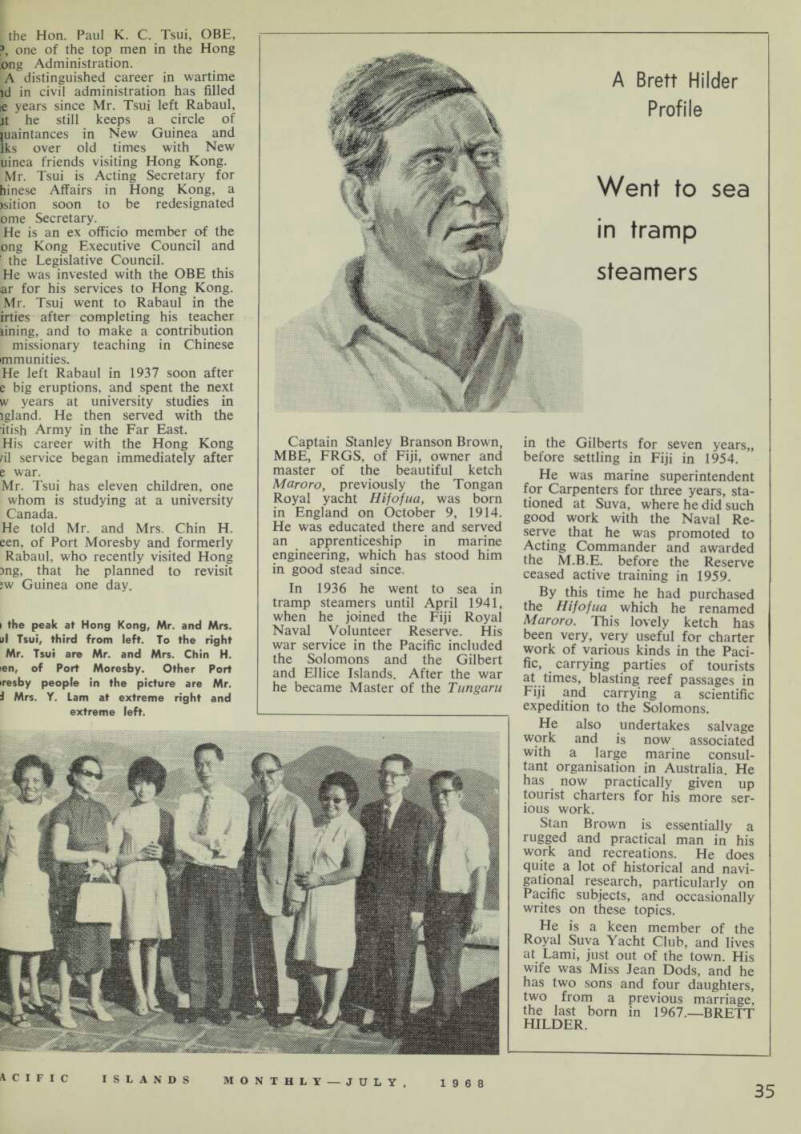
He told Mr. and Mrs. Chin H. een, of Port Moresby and formerly Rabaul, who recently visited Hong mg, that he planned to revisit ;w Guinea one day.
[?]i the peak at Hong Kong, Mr. and Mrs. [?]l Tsui, third from left. To the right Mr. Tsui are Mr. and Mrs. Chin H. [?]en, of Port Moresby. Other Port [?]resby people in the picture are Mr. [?]d Mrs. Y. Lam at extreme right and extreme left.