Fiji, 1968: Confrontation Of
pp. 28-134 · Read in the full issue
Past And Future
By Judy Tudor
What has been happening along the 10 miles sweep around the foreshores of Suva Harbour, from Bay of Islands to Suva Point, has changed the seaward face of Fiji’s capital city. Similar spec tacular development has taken place around Nadi Airport and in the 25 miles of Viti Levu coast from Yanuca to Korolevu. All of it is a significant indication of the faith both local and overseas investors have in the future of Fiji. How far is this justified?
Fiji has not had a favourable visible balance of trade since 1963—and hadn’t had one for some time before that. In 1964 the deficit was over £1,500,000 and it has risen steadily ever since—£7,800,000 in 1965, £5,835,000 in 1966 and the tentative figures for 1967 show a deficit of nearly £7,500,000. The pattern has continued into 1968.
The gap is filled by overseas in vestment, loan money, overseas grants and, increasingly, by the tourist industry. According to the Fiji Visitors Bureau, tourism was worth £5,400,000 to Fiji in 1967. It is going to have to do even better in the future if it is to fill the gap. Some of Fiji’s traditional industries now appear moribund. Or, anyway, static.
Since 1960, Fiji has increased the tonnage of sugar exported from 217,833 tons (valued at £8,706,000) to 318,142 tons in 1967 (valued at £11,356,000). This increase has been made possible by the suspension of world quotas when Cuba withdrew in 1961 and also by the development of a modest market in the United States. Sugar, however, is an over produced world commodity.
Of other primary exports, Fiji pro duced 17,985 tons of coconut oil in 1960; 14,160 tons last year; 2,499 tons of copra in 1960; 1,756 tons last year. Production of bananas in 1960 was 13,512,000 lb; last year 3,478,000 lb.
In the late 1950’s and early 1960’5, when trade deficits seemed to be getting out of hand, there was almost panic insistence that Fiji should pro duce more at home to get her trade into better balance.
Since then, Fiji has attracted at least a score of local industries that did not exist a decade ago—cement manufacture, a brewery, new paint factories, a plastics works, two cig arette factories, two factories for corrugating steel sheets, two canners of fruit juice and pulp, factories for locally made nails and building com ponents —to name just a few of them.
Tourism is "cure-all 7
In addition, there has been a big increase in the production of local eggs and poultry and an increased production of local meat, in the fresh state and also in the form of small goods and, more recently, preserved in cans.
Nonetheless, the deficit has not got less —to the contrary. One reason for this is that the population has grown also; another that the tourist industry has boosted imports.
But where is that panic of yester day? Sunk in the present and grow ing expectation that tourism, that universal cure-all for under-developed countries, will continue to take care of most of it. The view once was that this industry could supply the jam; now there are a great many people who believe that, in the long term, tourism is capable of supplying Fiji’s bread and butter as well.
In theory, the money brought into Fiji by tourists seeps down through the whole community. In practice it seeps a great deal more freely through some quarters than others.
A better standard of living, a grow ing sophistication and awareness of the good things of life, are apparent around Suva and, to a lesser extent, around the Nadi-Lautoka area. The further you travel from these places the less change is apparent and, in purely Fijian areas, it looks to be absent altogether.
Along the Yanuca-Korotogo tourist coast, the Fijian villages have not changed, except to become more tumble-down, probably because the power of the chiefs who once organ ised these things, has been curtailed.
The village on the Suva side of Sigatoka has, in the last couple of years, built a barn-like church but still has its acre of dwarf-sized, individual privies on the other side of the road, each sitting up on top of a mound, presumably because the ground is too stony or the villagers too tired to dig deep holes.
Sigatoka, the only town in the area, changes slowly and certainly not for the tourist. The small shops cater for the local trade; the Big Stores stock the same tried-and-true merch andise, last year, this year, and seem ingly, forever.
Labour problems
The market, which shows real animation on Saturday, when it seethes with people selling black shell-fish and taro to each other, for the rest of the working week sinks into apathy, offering a dribble of over-ripe bananas, soft tomatoes and tired looking beans to a few local customers.
The rich produce of the Sigatoka Valley is packed into large trucks and taken off to Suva.
A few of the local people work in the hotels but this can be a mixed blessing for the hotels. Come a big local occasion, like a fish-drive, the local staff will not turn up for work; family weddings and funerals also call them away. It becomes common sense therefore to employ Indians, or Fijians from far away places.
Where a village has cane-lands rented out and controlled by the Native Land Trust Board, it is assured of some income but cane-land is patchy along this coast and does not exist at all east of Korotogo.
The men get some seasonal work during the cane-crushing season; they do a little road work; they sell dry coconuts to the local Indian or Chinese store; they do some work in their gardens. The women stand half the day, up to their waists in the lagoon, fishing; the teenagers gather shell-fish from the reef.
As long as they have enough to eat, enough yaqona to drink, three bob for the football match on Satur day and the price of a pint or two after it, their immediate needs are satisfied.
But around the grog bowl at night they talk, and some of the things they have been talking about are party-politics and the magical busi ness of voting. Having voted-in their very own candidate to the Legislative Council in 1966—t0 say nothing of three other candidates from the cross voting electorates—they had expected more results.
Electors unhappy
Now they are browned-off, accord ing to my spy in one of these villages.
They are fed up with seeing the chiefs and cabinet miniiisters still with government jobs and parlia mentary salaries, “driving around in cars” and obviously enjoying life “while the villagers have got noth ing.”
Next time, goes the talk, they will probably vote for the Opposition.
I am horrified and say: “But what about the Chief Min ister, Ratu Mara? Surely they think he’s doing a good job?”
After some hesitation: “Ratu Mara is a little bit good. But he is a Lauan; what he does is for Lau not for Nadroga-Navosa.”
So, although it is over 90 years since Cession, Fijians are still not Fijians—but Lauans, or Bauans, or Rewas or Seruas or Nadrogans or a dozen other varieties!
(Continued on p. 28)
[lt is interesting to note, in this connection, that the latest Trusteeship mission to New Guinea took the Australian Government to task for not doing more to inspire nationalism among the New Guineans. It suggested that, towards this end, a national flag, a national anthem and a corporate name for the two terri tories be invented.
Papua-New Guinea is about 26 times larger in area than Fiji, its population is four times greater and it has about 700 language groups, not a dozen.
The Fijians have a flag and they all can sing Isa Lei which, while it might not be an anthem, must be a step in that direction. It seems, then, that P-NG has quite a way to go towards national togetherness although the newly elected Speaker of the House of Assembly, John Guise, did his best in the way of universal symbolism by making his first appearance in a Westminster wig, and a tapa cloak decorated with a corsage of bird-of-paradise plumes.
A polished pearl-shell hung round his neck. What he did must have pleased the pundits of the Trustee ship Council although some observers were cruel enough to think it made him look like a witch-doctor.]
Progress, but no benefits
It is not likely that when the next Fiji election comes around the Nadroga people will vote for the Federation; nor can they be re garded as typical of Fijians in gen eral —they have a reputation for be ing “difficult people.”
Nonetheless, it is interesting to see how some people think when they have the trappings of progress and none of the benefits.
The one new industry that could revolutionise their lives —tourism— has so far had little effect. These people could, if they wished, get into some kind of tourist business of their own, as some Fijians have around Suva. But they apparently have not the imagination, the initiative nor the drive.
In many ways, anyway, mass tourism is a Mother Monster that eats its own young. In its worst forms it is something that you wouldn’t wish on your worst enemies, much less on unsuspecting Fijians.
Recently I spent a few days in Nassau, New Providence Island, Bahamas, which is the most ghastly tourist trap I’ve ever had the mis fortune to visit. I spent most of my time there asking myself, in
(Continued on p. 132)
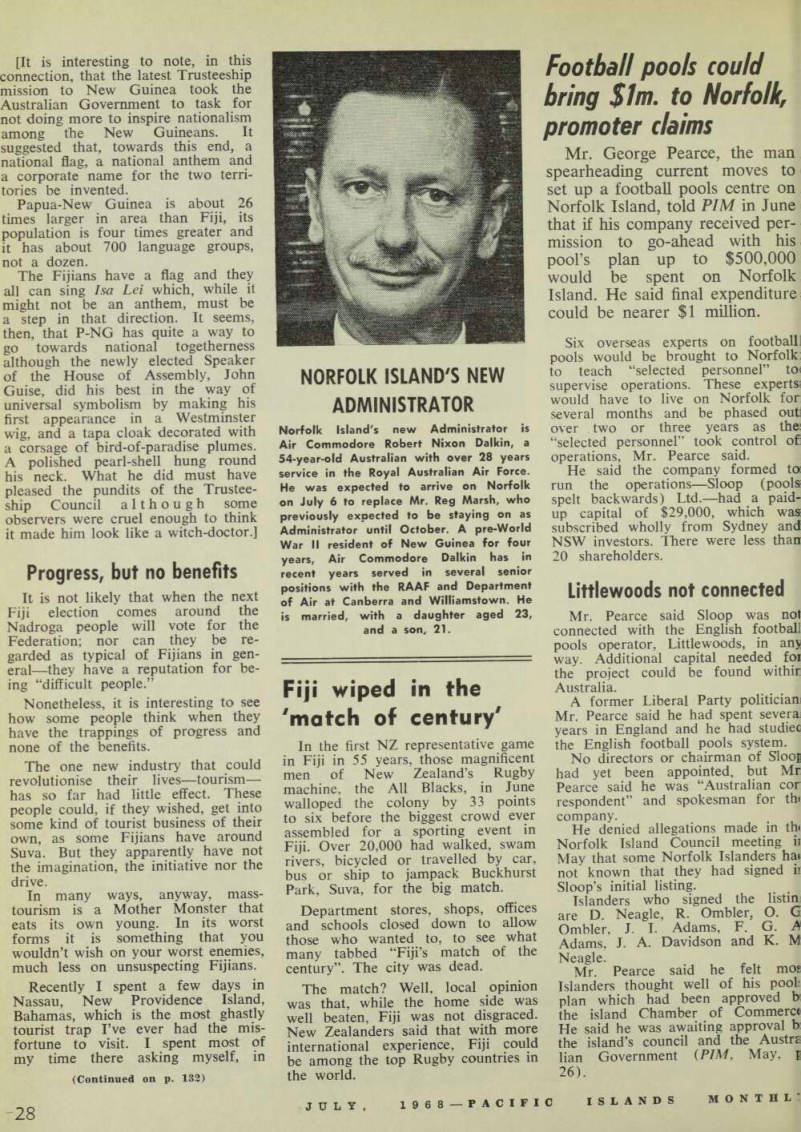
Norfolk Island's New
Administrator
Norfolk Island's new Administrator is Air Commodore Robert Nixon Dalkin, a 54-year-old Australian with over 28 years service in the Royal Australian Air Force.
He was expected to arrive on Norfolk on July 6 to replace Mr. Reg Marsh, who previously expected to be staying on as Administrator until October. A pre-World War II resident of New Guinea for four years, Air Commodore Dalkin has in recent years served in several senior positions with the RAAF and Department of Air at Canberra and Williamstown. He is married, with a daughter aged 23, and a son. 21.
anguish, could this ever happen to
Fiji? .
This tiny, flat, scrub-covered island has no natural beauty, except the sea that surrounds it and a few stretches of sandy beach. Its only natural assets are a warm winter climate when the North American continent is freezing or snow-bound; and proximity to the United States— about 20-30 minutes by jet from Miami.
Between 80,000-90,000 people, about half the population of the whole Bahamas group, live in New Providence. There is a small Euro pean community but most of the people are descendants of African slayes. The economy is now almost entirely artificial—the Bahamans live by selling chunks of real estate to expatriates; by providing income-tax free subsidiaries for British and American corporations; and, most of all, by catering for one million tourists a year.
For the most part these are accom modated in huge hotels, each about the dimensions, and with the same
amount of noisy activity, as the new San Francisco air-terminal. To feed them > vast quantities of food and other necessities are imported, mostly from the United States, Customs tariff on these imports providing most of the government’s revenue. Water is pumped from bores or distilled from sea-water.
Because of all these high-cost consumer commodities and activities, the cost of living is astronomical on South Pacific standards and the local people, it seems to me, are rolled out flat and completely demoralised by the vastness of the flood of visitors.
Although their bread-and-butter comes from it, they consequently are the surliest, rudest most uncooperative people who have ever had anything to do with a tourist industry.
M INOT anOlnGr INaSSaU The Bahamas are still nominally British, although it is hard to see signs of it. The Queen’s head still appears on coins and postage stamps; and vehicles still keep to the lefthand side of the road. [Cars, nonetheless, all have the steering-wheel on the left-hand side and if you ask why, you’ll be told
that it’s because Americans wouldn’t know what to do with their right hands if confronted with a right hand-drive car. I don’t know why Americans should be regarded as dumber than the rest of us who usually manage to be ambidextrous in this matter], I suppose there is good economic reasoning behind artificial excresences like Nassau and, no doubt, the per manent residents are what is generally described as “enjoying a higher standard of living” because of it.
Nonetheless, I find it hard not to see it as a prime example of mid-20th century madness, A tourist industry has its uses; in a large, developed country it takes its rightful place and is unnoticed; in a small, underdeveloped country it can be overwhelming, Perhaps Fiji is too large to be overwhelmed; too fertile. Perhaps tourism will never be more than number-two among money-earning industries. But one Nassau and I’m inclined to agree, for once, with Albert Henry of the Cook Islands and the Western Samoans who used to say (they don’t say it any longer) that tourism is all right—in small doses.